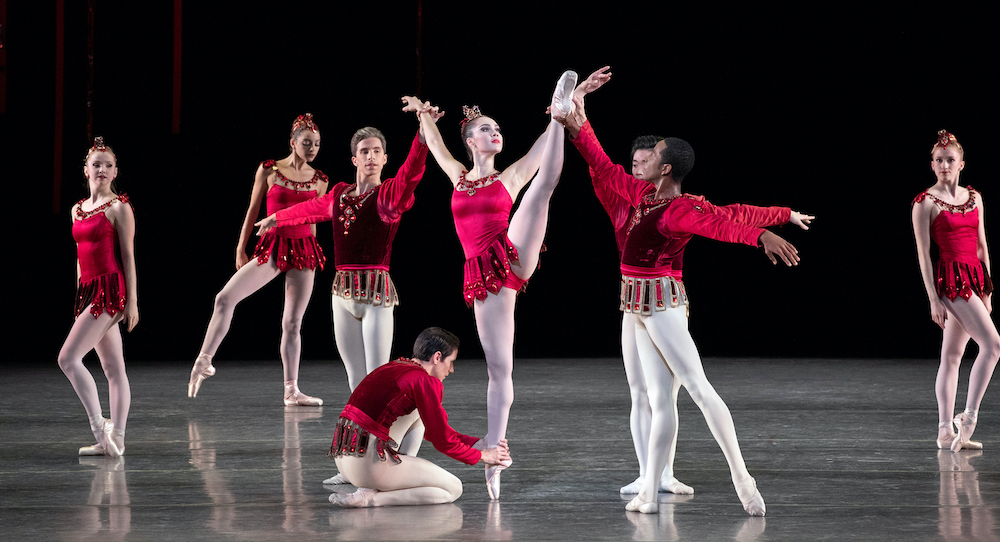
Tag Archive | "New York City Ballet"

Dwight Rhoden – looking back and leaping forward


By Chelsea Thomas.

At 17 years old, Ohio native Dwight Rhoden was playing the clarinet, flute and drums in his high school’s band. He had never taken a dance class and didn’t even know what the word “choreography” meant. He admits that while he was “good at social dancing” he was clueless to any real technique.

Rhoden even remembers the first time a friend suggested he take a dance class. “One day in high school I entered a dance contest at a local club. I didn’t have any formal training but I would just make up these elaborate steps and routines. My friend, who was actually a dancer, looked at me and said, ‘You know, you’re pretty good. Why don’t you take some real ballet and modern classes? See what you think. You really seem to love to dance.’” And as Rhoden explains, the rest is history.

Now the Co-Founding Artistic Director and Resident Choreographer of Complexions Contemporary Ballet, a celebrated and internationally-touring company hitting its 20th anniversary next year, Rhoden has established a remarkable and wide-ranging career. After beginning dance training late at 18 years old, he went on to successfully perform with Dayton Contemporary Dance Company, Les Ballet Jazz De Montreal and as a principal dancer with Alvin Ailey American Dance Theater.

As an accomplished dancer, Rhoden even appeared in numerous television specials, documentaries and commercials throughout the United States, Canada and Europe and was a featured performer on many PBS “Great Performances” specials.

Complexions Contemporary Ballet, Dwight Rhoden 'Mercy'

Complexions Contemporary Ballet performs Rhoden’s ‘Mercy’. Photo by Sharen Bradford

Yet, Rhoden admits that those first few years as a young dancer were hard as many people thought it was impossible to begin training so late and make it as a professional. He recalls, “There were a lot of naysayers… even my family thought I had no chance. They told me not to get my heart set on it.”

However, that time of persistence, grit and determination only sharpened Rhoden. He would “eat, drink and sleep dance” and push himself harder. He says, “I never really thought about what I couldn’t do, only what I could. And I didn’t sit around listening to people tell me what I couldn’t do. I just didn’t set limits for myself, and I still don’t… That is why I am where I am now. It was 100 percent dedication and not looking back. I immersed myself in the art form.”

With that kind of perseverance, Rhoden blazed his career path to where he is now. Named “one of the most sought out choreographers of the day” by The New York Times, Rhoden has created works for numerous companies, including The Joffrey Ballet, Miami City Ballet, New York City Ballet, North Carolina Dance Theatre, Arizona Ballet, Aspen Santa Fe Ballet Company, BalletMet, Dance Theater of Harlem, Pennsylvania Ballet, Philadanco, Marinsky Ballet (Kirov) and Washington Ballet, amongst many others. Rhoden has also directed and choreographed for TV, film, theater and live performances, including So You Think You Can Dance, E! Entertainment’s Tribute to Style and Cirque Du Soleil’s Zumanity. Plus, among many other famous entertainers, Rhoden has worked with high-profile artists such as Prince, Lenny Kravitz, Kelly Clarkson, Nina Simone, U2 and Patrick Swayze.

Yet even with the multitude of companies, dancers and performers he has worked with, Rhoden says his crowning joy is Complexions Contemporary Ballet.

Complexions Contemporary Ballet

Dancers of Complexions Contemporary Ballet. Photos by Jae Man Joo.

“When Complexions came on the dance scene in 1994, I really feel like we changed the landscape of what contemporary ballet is. We were one of the first companies in both New York and the United States that was really trying to integrate on all levels,” says Rhoden.

The company got started almost by accident, Rhoden recalls. After leaving Alvin Ailey American Dance Theater with fellow company member Desmond Richardson, the two created a choreographic variety show that brought together a lot of their dance friends who were performing in assorted companies.

“For the initial project, we just wanted the dancers to come from all different aspects of dance. So we decided to call the project Complexions and get a theater… During the tech rehearsal Desmond and I sat down and watched what was happening on the stage and we looked at each other and said, ‘We’ve got to do something with this. This has to go beyond these performances.’ So right then and there Desmond and I decided to start a company. That was the beginning of the idea,” he remembers.

Nearly 20 years later, the company has become widely considered as “America’s Original Multicultural Dance Company” and is celebrated for its pioneering spirit. Rhoden says it feels a bit unbelievable to have come so far.

“I really feel nostalgic. I’m grateful that I’ve had the chance to have this opportunity with our company. It’s not an easy thing to start a company from scratch – it’s truly challenging. But I look back and there have been so many rewards along the way. I think I have learned so much.”

Dwight Rhoden, Wendy Whelan and Desmond Richardson

Dwight Rhoden working with Wendy Whelan and Desmond Richardson. Photo by Jae Man Joo.

And there truly is much to be proud of. In addition to helping to build a universal brand that continues to challenge traditional ideas, Rhoden has choreographed more than 80 original works for the company that have been presented on five continents and in over 20 countries – including the US, Canada, South America, Mexico, Europe, Asia, Poland, Australia, New Zealand, Russia, The Baltic Region, Egypt, Israel and the Middle East.

As a choreographer, one of Rhoden biggest inspirations and passions is engaging and challenging dancers. He takes pride in being called “a dancer’s choreographer.”

“I am one of those choreographers who is 100 percent inspired by the dancers in front of me. I love taking the talents they already have and the talents they are discovering and building something for them to shine with,” he says.

Desmond Richardson says, “Dwight has trained so many amazing dancers and that’s his gift. In the industry many of the formidable dancers call him the ‘dancer’s choreographer’ because of the way he challenges your aesthetic, and because of his range. He can do anything from street dance to the classical. I don’t think there are many choreographers like him with his range. To work with Dwight is to let your passion flow, to be on edge, and to be educated in the unknown.” 

Rhoden is so passionate about working with dancers that he says: “If I was never able to choreograph another ballet, I would still want to work in the studios with the dancers.”

Complexions Contemporary Ballet presents Rhoden's The Curve. Photo by Bill Hebert.

Complexions Contemporary Ballet presents Rhoden’s ‘The Curve’. Photo by Bill Hebert.

Still, Rhoden is looking to the future with new, big dreams. Even while taking the time to celebrate his career and recent 50th birthday, he is not slowing down. With many projects in the works he keeps plunging forward. One of his upcoming projects is creating his own full-length Rite of Spring.

“I’ve always wanted to tackle the Rite of Spring so for next season I will be working on a two-piano version for Complexions. It will be premiered in Seoul, South Korea as part of a festival with seven other companies from around the world, which are all doing different versions of Rite of Spring. I will really start working on it in late July and early August.”

Also for his company, Rhoden is going to premiere a new Stevie Wonder ballet next season, saying, “Everyone can connect with some Stevie Wonder song from sometime along his career.” Furthermore, he will continue to choreograph for SYTYCD and the North Carolina Dance Theatre (where he is resident choreographer), and be directing Richardson’s solo show, which will feature Richardson dancing with a few guest stars. “I think that will be very exciting. We are hoping that will kickoff by the top of 2014, at the latest,” he says.

Somewhat secretively, Rhoden also revealed that he is currently working on a “very exciting Broadway project.” It comes out of one of his previously choreographed ballets and is in the works to go to Broadway next year.

One goal Rhoden and Richardson have for this year is to find Complexions a permanent home. Rhoden said they are scouting locations in New York City and elsewhere. Ironically, the company has had offices but not an actual studio space to call their own.

“Our education programs are very strong components of what we do – with Summer Intensives in three cities now – NYC, Detroit and Dallas. The programs are extremely competitive to get into and we simply can’t do all that we want to because of the lack of our own space,” Rhoden explains.

Complexions Contemporary Ballet

Complexions dancers. Photo by James Houston

“We have our feelers out in various parts of the country and have made some inroads in a few places. We have been nomads for nearly 20 years without a space of our own [and] Desmond and I are hot and heavy on the pursuit to have a permanent space.”

He says that there seems to be desire for Complexions to offer dancers training in the style of the company year-round. For that reason he is excited about finding a home where the company and school can continue to evolve. Moreover, Rhoden mentioned that Richardson and he have developed their own contemporary ballet technique through Complexions that is actually in the process of being trademarked.

“It’s basically taken classical ballet and added the torso. It encourages the movement of the upper body and is a very physical and athletic way of training. It will prepare dancers for anything off center,” he says.

Overall, when dually reflecting back on his momentous career and his formidable future, Rhoden sees one trend – hard work and diligence. He says that while many dreams are outstanding – like perhaps working with American Ballet Theatre’s Misty Copeland, producing some film shorts, being an “on-camera host to talk about art, dance and the creative process,” amongst other possibilities – he knows that success  only comes if you refuse to give up.

“When I look back, I see that there was no guarantee that I could ever have a career as a dancer starting so late and having absolutely no training. There was certainly no guarantee that I would reach the level of some of the companies I danced with. I look at that and think of what a huge testament it is to hard work and diligence,” he says.

“It goes back to something I really believe – that if you have the passion for something that you really love and you stay true and focused to it, there is no way you will not be able to accomplish the things in your heart. That kind of belief and energy is powerful. “

For more information on Rhoden and his upcoming projects, visit www.dwightrhoden.com. For more information on Complexions Contemporary Ballet and its 2013-2014 season, visit www.complexionsdance.org.

Photo (top): Dwight Rhoden © Jae Man Joo Photography

Posted in Feature Articles, Top StoriesComments (0)

When Choreographers and Composers Collaborate


By Laura Di Orio.

What came first, the dance or the music? Some choreographers are inspired by music, others seek out music to fit with their existing movement. And for some, the process is entirely creative, with choreographer and composer working together to create something original. Here, Dance Informa looks at artistic voices that have collaborated for dance, taking a gander into their process and outcome.

For most choreographers, the music to accompany their work is not an after-thought; rather it is an essential, meaningful ingredient. Choreographer Justin Peck, also a soloist with New York City Ballet (NYCB), says he normally finds music by searching the Internet, using Spotify or by listening for hours in the library. He says the process is “long, tedious and frustrating” but that once he finds something it’s really exciting. But in that case, the music is there, and then it is his job to set movement on top of it.

A couple years ago, however, Peck received a large commission for a work to be premiered at NYCB, and he would collaborate with singer-songwriter Sufjan Stevens to develop music for his ballet, Year of the Rabbit. Although the music already existed (Stevens’ album Enjoy Your Rabbit), Peck and Stevens met numerous times to decide upon its arrangement and to pick out several sections in the body of music that would be specific to the ballet.

“The ballet I had envisioned for the music was pretty large-scale – 18 dancers, to be premiered at Lincoln Center on the NYCB stage – and I wanted the music to have the same sort of weight and fullness of the cast size and of the space,” Peck explains.

Pecks says he and Stevens met probably 20-30 times during the process. “There were a few moments that were tweaked or added to better support my vision of the ballet,” he adds, “so we kind of tailored this body of music specifically for what I had envisioned choreographically.”

Choreographer Anne Kelly and composer Mitchell McCarthy

Choreographer Anne Kelly and composer Mitchell McCarthy joined forces to create their own company, Kelly/McCarthy • Dance/Music.

As in any relationship, it is this back-and-forth conversation that makes for the best outcome. For NYC choreographer Anne Kelly and composer Mitchell McCarthy, who together run Kelly/McCarthy • Dance/Music, it may help that they have known each other for some time. Both artists worked at a summer program where Kelly taught and McCarthy accompanied ballet classes, and they quickly connected and formed their company last winter.

Both had visions of what they wanted to create. “I knew I wanted to choreograph a piece for a group of women, and I wanted the piece to have a daring, fearless quality, yet also have a romantic lyricism that Mitchell composes so beautifully,” Kelly explains. “And Mitchell wanted to write an emotive piece for violin and piano for a solo dancer or pas de deux.”

Even with separate specific ideas of what they wanted to create together, they trusted one another for his/her half of the project. “I completely trusted him,” Kelly says. “I was already a fan of his work, and I knew he would produce something exquisite. And I really enjoy choreographing to challenging rhythms and counts, so I embraced all the complex meters that Mitch likes to write.”

As a composer who had previous exposure to dance, McCarthy did offer a choreographic idea during the process. During one of the movements of Kelly’s group piece, From This Point Forward, there are abrupt changes between phrases of music. McCarthy mentioned it may be interesting for the dancers to change the direction they’re traveling on every “1” count. Kelly was sold, and she now says that moment is one of her favorite parts of the work.

Other composers would rather leave the dance-making entirely up to the choreographer. “For the most part, I feel that my job as a composer in the world of dance is to appreciate and accentuate the poetic expression that can only be shown by a human body in this context,” says Jeremy Freer, a NYC-based composer and songwriter who is currently in the process of writing music for a short dance film by choreographer Trina Mannino. “If the composer can humble any arrogant tendencies for the sake of the choreographer’s vision while maintaining the same desire for passionate, clear expression they hold when writing for themselves, then good things will happen.”

Composer and songwriter Jeremy Freer

Composer and songwriter Jeremy Freer says he enjoys writing music for dance. Photo courtesy of Jeremy Freer.

Freer says another challenge that may occur in this type of collaboration is a “language barrier,” as artists in different fields tend to develop lingo and terminology for their medium. He adds, “But in my opinion, that’s the fun part and the part where you learn things that add to your artistic expression in ways that just working with other people in your own field can’t.”

Sometimes the two artists don’t live nearby, so most of the collaboration has to be done via mail, the Internet or over the phone. Denise Cecere, artistic director of Northeast Youth Ballet (NYB) in Boston, has worked with Bernard Hoffer, a New York composer who has written for film, cartoons and commercials. Initial communication was done over the phone, and during the process, Hoffer sent Cecere the score and then periodically CDs with certain sections. They made it work, however, and have since made four ballets together for NYB – A Boston Cinderella, Three Little Pigs, MaGoose and the new Sadako.

For A Boston Cinderella, Hoffer wrote the music and text, adopting the Cinderella story and revising it to contemporary Boston with the prince being Boston Red Sox shortstop Nomar Garciaparra. Cecere was contacted to turn it into a ballet.

“The hardest part for me personally is the first rehearsal with the composer,” Cecere says. “I want so much to do his music justice. I would be disappointed if I took away from the talents of an artist I admire.”

But Cecere did not disappoint. “I have all my life collaborated with visuals,” Hoffer says. “I, therefore, am able to write very descriptive music as if I were writing to picture. The astonishing thing was how beautifully Denise staged the dance incorporating every detail of the music.”

All of these artists say they enjoy collaborating with one another and would most definitely work this way again.

“You should always enjoy your spouse,” Freer says. “That’s what dance is to music.”

“It is very exciting creating something new,” Cecere adds. “It is not the finished product or performance that makes it so worthwhile. It is the process that takes you on a journey that makes it so special.”

And to those interested in collaborating in this capacity, Peck advises: “It’s a learning process, and it’s a different process than just choreographing a ballet. There’s a whole added dimension and it can be much more rewarding.”

For more information on these choreographers and composers, check out the links below. –
Denise Cecere and Northeast Youth Ballet: www.northeastyouthballet.org
Jeremy Freer: soundcloud.com/jeremyfreer/sets
Bernard Hoffer: bernardhoffer.com
Kelly/McCarthy•Dance/Music: kmdancemusic.wordpress.com
Justin Peck: www.justin-peck.com

Photo (top): NYCB’s Teresa Reichlen, aloft, and company in Justin Peck’s Year of the Rabbit. Photo by Paul Kolnik.

Posted in Feature ArticlesComments (0)

Queen Latifah & Richard Stoltzman to perform at NYCB’s 2013 Spring Gala


New York City Ballet has announced that award-winning singer and actress Queen Latifah and the legendary clarinetist Richard Stoltzman will appear as guest artists at the company’s 2013 Spring Gala on Wednesday, May 8 at the David H. Koch Theater at Lincoln Center in New York City.

A celebration of the 25th Anniversary of NYCB’s 1988 American Music Festival, and the centerpiece of NYCB’s six-week spring season (April 30 through June 9), the one-time only gala performance will feature Latifah performing George Gershwin’s The Man I Love with the New York City Ballet Orchestra as part of an excerpt from Who Cares?, George Balanchine’s 1970 classic ballet set to the music of Gershwin.

Stoltzman will perform the “Interlude” from André Previn’s Sonata for Clarinet and Piano, as well as Leonard Bernstein’s Sonata for Clarinet and Piano, both of which choreographer Christopher Wheeldon is using as the score for a world premiere pas de deux that will debut as part of the gala evening. The program will also include the NYCB premiere of a new version of Wheeldon’s Soirée Musicale, which is set to Samuel Barber’s Souvenirs, and was originally created for the School of American Ballet Workshop performance in 1998.

Richard Stoltzman

Clarinetist Richard Stoltzman. Photo by Lisa Marie Mazzuco. Courtesy of New York City Ballet.

In addition, the gala performance will also feature Cool from West Side Story Suite, and the third movement of Glass Pieces, both choreographed by Jerome Robbins, as well as the pas de deux and finale from Balanchine’s Stars and Stripes set to the music of John Philip Sousa.

Originally from Newark, New Jersey, Queen Latifah (born “Dana Elaine Owens”) is an actor, rapper, singer and producer whose work in a variety of disciplines has earned her a Golden Globe Award, two Screen Actors Guild Awards, two NAACP Image Awards, a Grammy Award (plus six nominations), an Emmy nomination and a 2002 Academy Award nomination for Best Supporting Actress for her performance as the prison matron Mama Morton in the award-winning film adaptation of the Broadway hit Chicago.

Richard Stoltzman, originally from Omaha, Nebraska, is widely regarded as the world’s foremost clarinetist, and was responsible for bringing the clarinet to the forefront as a solo instrument, giving the first-ever clarinet recitals in the histories of both the Hollywood Bowl and Carnegie Hall. During his acclaimed career he has appeared with more than 100 orchestras around the world, and has produced an extensive discography of recordings. Stoltzman is the recipient of two Grammy Awards for Best Chamber Music Performance, the Yale School of Music’s Sanford Medal, and in 1986, he was the first wind player to be awarded the prestigious Avery Fisher Prize, which is bestowed upon American instrumentalists for outstanding achievement in classical music.

Benefit-priced tickets for the gala evening, which include the performance, a pre-performance reception and a black-tie supper ball following the performance, are available through the NYCB Special Events Office at 212-870-5585. Tickets to the performance only start at just $29 and are available at the David H. Koch Theater box office, online at nycballet.com, or by calling 212-496-0600.

New York City Ballet’s 2013 Spring Season will open on Tuesday, April 30 with a three-week American Music Festival featuring 25 ballets and the music of 18 American composers. The six-week season will continue through Sunday, June 9 with the final three weeks devoted to a retrospective of NYCB’s entire 2012-13 performance year with highlights from the Stravinsky, Tschaikovsky and American Music festivals, featuring performances of 33 different ballets with no two performances alike. For more information or to order tickets, visit nycballet.com.

Photo (top): Queen Latifah. Photo by Cover Girl. Courtesy of New York City Ballet.

Posted in Top StoriesComments (0)

Tom Gold Dance’s New York City Season


Gerald Lynch Theater, NYC
March 13 2013

By Tara Sheena.

Rarely in ballet do I find the same smaller and more intimate showcases so prevalent to modern dance. The reasoning for this is, admittedly, unclear to me. Perhaps, the work in its grand tradition and even grander costumes, sets and live music harkens to the vast world provided by larger spaces. Perhaps it is the fact that pick-up companies are less common in the world of ballet as compared to the common freelance format of many modern dance companies. Perhaps it is that almighty elephant in the room: funding. Whatever the reason, anytime I am privileged to see a classical ballet company in a more intimate space, I jump at the chance.

This was the case on Wednesday, March 13 with Tom Gold Dance at the Gerald Lynch Theater in New York City. Mr. Gold’s troupe of nine dancers is a mixed bag of ballet artists, many of them currently dancing with New York City Ballet where Gold was a company member for 21 years. Noted for his straightforward style and comedic timing, his company’s New York season was a wonderful blend of ballet’s classicism, jazz’s rhythm and a touch of multimedia that worked to contemporize the evening.

The performance opened with Faure Fantasy, named for the composer of the work, Gabriel Faure. Dancer Gretchen Smith entered the stage first in a rose-pink tutu and took great care with the light, melodic music, which was played wonderfully live on piano by Susan Walters. Gold’s choreography is in its most classic sense in this piece: seven dancers traversed the stage in snappy piqués and briskly moving glissades. The bodies moved back and forth, revealing a soloist, then a pas de deux, then everyone en masse in a dizzying effect of fluffy, pink lightness.

Tom Gold Dance, Gerald Lynch Theater, NYC

Tom Gold Dance. Photo by Eugene Gologursky

Gershwin Preludes offered a much-needed theatrical break from the action. Luciana Paris and Stephen Hanna engaged in a playful duet set to an excerpt of the Gershwin Preludes. Hanna was especially captivating right from his first playful leap on to the stage; he has a boyish charm and sincerity that was completely effective. Paris was with him every step of the way—so trusting in their partnership as she effortlessly leapt toward his arms and allowed herself to put her full weight into their promenades, maintaining lightness and a pure lack of hesitation.

The centerpiece of the evening was also the least exciting piece of the performance: the world premiere of La Plage set to music by popular avant-garde composer John Zorn and made for the entire company. The video backdrop of various natural environments (first a forest then a beach scene) was largely drowned out on the vast Gerald Lynch stage. Though the musicality was most fine-tuned in this work, the bland costumes did nothing to complement the dancers’ bodies and the finale section, which harkened to a 60s beach party, seemed entirely contrived and overdramatic.

The final piece, Mad About the Boy, closed out the evening and fittingly showcased Gold’s theatrical flair. In a ballroom scene, the dancers entered the space clad in jewel-toned ballroom gowns for the women and classic tuxedos for the men, depicting a distinctly classy affair. Sara Mearns entered in a flowing black gown and engaged in a playful duet with Gold, jauntily chasing him around the stage in her coy, sly way. Her natural grace set against his nerdy charm was both heartwarming and hilarious. However, the exciting Likolani Brown stole the show as the lonely maid of the house, so precise in her steps and ever confident in her role. It was wonderful to see her fly around the stage and not miss a beat. For being portrayed as the hired help, she was, by no means, a lesser character. Brown allowed the final piece to end on the upbeat note it needed.

I appreciate Gold’s flair for the theatrical (how wonderful is it to laugh at the ballet?!), but through it all, I did not see a distinct voice that was all his own. Gold sacrificed many small vignettes in lieu of a larger, more developed work and it all lacked the innovation I was so desperately longing to see. I look forward to future performances where Gold embraces his cinematic theatricality and leaves the rest on the cutting room floor.

Photo (top): Tom Gold Dance performs Faure Fantasy. Photo by Eugene Gologursky

Posted in Reviews - USAComments (0)

Dancer Injuries: What to Do if the Worst Happens to You


By Leah Gerstenlauer.

Dance is a powerful drug. At best, it inspires adventurous bravery and euphoria, propelling artists to achieve incredible physical feats. But every drug has its downside, and in dance, one enormous risk is injury — the inevitable discovery that invincibility is merely a myth.

Five professional dancers from around the country recently shared their stories of injury with Dance Informa. With their careers back on track, all of these artists are more determined than ever to keep themselves strong, safe, and healthy in an industry laden with pressure to perform.

Disasters and Diagnoses

Sometimes, an injury is just an injury — an isolated incident that can alter the course of a career. Marshall Ellis was performing a soloist role in Orlando Ballet’s production of Don Quixote when he hit the ground. “An MRI showed a tear in my cartilage the size of a nickel, which I had stem cell surgery to repair. As a male dancer performing so many jumps and tricks, accidents can happen.”

But for many dancers, injury is progressive, stemming from overwork, improper training, or genetic traits that clash with the physical demands of dance. Ashley Flaner of California-based company Post:Ballet had wrestled with lower back pain for years when she was literally floored by a collision of spinal conditions. “During American Ballet Theatre’s summer program, I was on the floor stretching and something snapped. I couldn’t move for an hour. The doctor told me I’d fractured L4 and L5, had a bulging disc, had degenerative disc syndrome… The pain was excruciating, from the crown of my head to my feet.”

When New York City Ballet’s Megan Johnson was diagnosed with a similar condition — a bulging disc between L5 and S1 — she was told that she had probably been working with the condition since she joined NYCB over two years earlier. “Specialists believe it came about because I was being overworked while I was still growing. At first, my symptoms consisted mostly of tightness and tension down my legs, but ultimately, the disc area became so inflamed that I couldn’t relevé.”

Stephanie Wolf performing with Ballets with a Twist

Stephanie Wolf dancing with Ballets With a Twist. Photo by Joseph Zummo.

Stephanie Wolf’s career with Ballet Nouveau Colorado had barely begun when a severely torn hip ligament and a spiral fracture in her right femur sent her to the sidelines. “I danced on a broken leg for almost a month. One Saturday before a show, we did a run-through, and my partner had to pick me up from the ground because I couldn’t stand. My specialist said that if I had performed, I probably would have walked with a limp for the rest of my life.”

Former Miami City Ballet member Maira Barriga also grappled with a multi-dimensional injury, the full extent of which emerged only after several years and countless visits to doctors. “It started with pain and clicking in my ankle every time I went up and down on pointe. Finally, the pain [a symptom of inflamed tendons and ligaments] was too intense to mask. I was basically dislocating my foot every time I went on pointe.”

The Long and Winding Road to Recovery

For all five dancers, the prospect of taking time off to recuperate was terrifying, especially given little assurance of when they could resume their normal lives. Megan was out for 14 months, during which time she tried to focus on every possible positive. “I applied to Columbia University and took a class, I spent more time with family and friends… and I met my boyfriend.” For her treatment, she relied on the specialized team at Westside Dance Physical Therapy, where she began decompression and stabilization exercises that she still practices each day.

Stephanie feels fortunate that Ballet Nouveau offers exceptional workman’s comp. She has seen an orthopedist, a hip specialist, and even a sports nutritionist to ensure that her body is absorbing nutrients properly. As to taking it easy on herself while in recovery — well, that has been more of a struggle. “I sat on the couch for a week and a half, which I’ve never done before. This has been an incredibly humbling process. But as my body is healing, I’m becoming calmer and more positive.” And as a journalist for Dance Informa and cofounder of the dance blog DIYdancer, Stephanie gleaned comfort from alternative creative outlets.

Still suffering after two surgeries, Maira explored less invasive options in her home country, Japan. Combining the advice of her massage and physical therapists, she happily evaded a third operation. “They helped me understand what went wrong, giving me exercises specific to my condition. Slowly, the pain diminished and my foot got stronger.” For this dancer, dabbling in life off the marley actually proved to be an enjoyable adventure. “I moved to New York, made awesome non-dancer friends, and worked a bunch of odd jobs. I missed dancing a lot, but that ‘normal’ lifestyle was pretty interesting!”

Dancer Marshall Ellis

Dancer Marshall Ellis. Photo by Michael Cairns.

With no health insurance and little workman’s comp, Marshall, too, found himself taking charge of his own recovery. “For two weeks, I was on my couch with a machine moving my leg for me. It was the hardest time in my life. I attended only two physical therapy appointments. The rest I did on my own.” In spite of his dwindling finances and lack of support, Marshall proudly made a comeback after only nine months.

Though Ashley was lucky enough to have insurance, her real recovery began when she chose to finish her last year in the dance program at the University of California, Irvine. “I saw about six doctors and they all said, ‘You need to stop dancing. You can’t make a career out of this.’ But the dance department showed complete support. The kinesiology and body conditioning staff took me under their wings, giving me Feldenkrais and Pilates exercises. I did as much ballet as I could, and by November, I was dancing full out with the program again.”

Fresh Starts and Wise Words

Post-injury, each dancer holds new appreciation for and wisdom about the art and the physical act of dance. Marshall’s tenacity has driven his career to new heights, and in several new directions. He eventually left Orlando Ballet of his own volition and landed principal contracts in The Lion King at Disney World and with Cirque du Soleil. Marshall also launched his own media design business and a contemporary dance company, ME Dance. He maintains that, even in the face of injury and a daunting recovery process, “no one can stop you but yourself. Hard work and determination really do pay off.”

Ashley Flaner dancing for Post:Ballet

Ashley Flaner dancing for Post:Ballet. Photo by David DeSilva.

Ashley internalized a comparable philosophy, and upon graduating from UCI, secured a contract with San Francisco’s Company C. She also continued to explore the body conditioning techniques she had learned while fighting her way back to health, eventually embarking on a dual career as dancer and certified Pilates instructor. “After Company C, I started working with Robert Dekker and Post:Ballet. I can use my Pilates training for his grounded and sliding movement — my body feels so good working with him.” Her advice: “To avoid injury, you have to know your anatomy and build strength within your alignment. And if you do get injured, know that you’ll be wiser for it.”

Stephanie, whose injury has fueled her double-pronged career in dance and writing, is taking her own notes on self-empowerment, and learning that personal limits are not equivalent to insurmountable faults. “We’re not just artists; we’re artists and athletes. We need to acknowledge that it’s not always smart to push through pain.” When she returned to Ballet Nouveau last month, she entered the studio with a heightened awareness of her own remarkable, but undeniably human capabilities.

Upon her return to NYCB, Megan carried an increased sensitivity to her body and a firm commitment to creating a sustainable career for herself. “My injury is chronic, so I’m still learning new ways to manage my symptoms. Each week, I go to PT, in addition to getting massage and acupuncture. I wake up an hour early every morning to do my stabilization exercises, and I still decompress a few times a day.” Her routine is an enormous undertaking, but Megan knows the worth of her efforts. “Injury really tests your passion and resolve to dance… I’m so thankful I stuck it out.”

As for Maira, the future is bubbling with possibilities now that she is back in the studio every day. As she dives into audition season, she continues to follow her own treatment regimen, faithfully adhering to the simple systems that guided her back to wellness. “It’s hard to feel totally ready to work again — especially when so many doctors told me to stop dancing. I had my mother telling me not to give up. For those who don’t have someone pushing them forward, know that though there is no easy way out of injury, we are so much more resilient than we think.”

For more dancer-friendly injury information and advice, visit the Harkness Center for Dance Injuries website at http://hjd.med.nyu.edu/harkness/.

Photo (top): © Rmarmion | Dreamstime.com

Posted in Dance HealthComments (0)

Ballet: Method to Method


By Laura Di Orio.

Ballet has been around since the Italian Renaissance courts of the 15th century. It has shifted and molded according to history and the different cultures and people who have embraced the art form, and its traditions continue to be taught and learned all over the world. Over the centuries of ballet’s worldwide travels, several different schools, or methods, have been established, each one with its own notable characteristics and stylistic differences. Here, Dance Informa looks at several of those schools of ballet and what sets each apart.

The French School

From Italy, ballet spread to the French courts during the time of Louis XIV, in the 17th century. Seeing as the majority of the ballet vocabulary is in French, this shows that this time in history was very important in the development of the art form. The French School of ballet training stresses cleanness, fluidity and elegance. As the focus of this technique is on great speed and quantity of steps, the music is played more slowly.

Famed dancer Rudolf Nureyev, who also directed the Paris Opera Ballet, played a major role in defining and leading the French School of ballet. During the time of his leadership at Paris Opera Ballet, Nureyev also choreographed alternate versions of such classic ballets as La Bayadère, Swan Lake, Romeo and Juliet, Raymonda, Cinderella and Sleeping Beauty.

Bournonville Method

The Bournonville ballet technique was devised by Dane August Bournonville, who trained with his father, Antoine, and other French ballet masters. He was strongly influenced by the French School of ballet. Some characteristics of the Bournonville method include: a graceful épaulement, with the upper body often twisting toward the working leg; a lowered eye-line to exude kindness; extreme attention to the placement of the arms (often in a preparatory fifth position); quick footwork; a contrast between the speed of the legs and the grace of the upper body; pirouettes in a low leg position; and little visible effort.

Dancers such as Erik Bruhn, Nikolaj Hübbe and Johan Kobborg were trained in the Bournonville method, and the Royal Danish Ballet, which originated in 1748 and was once directed by Bournonville, still contains many Bournonville ballets in its current repertoire.

Vaganova Method

Agrippian Vaganova, a Russian ballet dancer born in 1879, devised her own method of teaching ballet, now known as Vaganova technique. A dancer with the Marinsky Ballet, Vaganova retired early in her career, in 1916, to focus on her teaching. Qualities in the Vaganova method include expressiveness of port de bras, where all parts of the arm (from hand to elbow to shoulder) are important; extreme flexibility, but in an artful way; and a mobile lower back. Dancers trained in this technique are taught to be strong and clean, without stiffness.

Some of the greatest dancers, including Anna Pavlova, Natalia Makarova, Nureyev and Mikhail Baryshnikov, were trained through Vaganova’s pedagogy. Vaganova believed in precision within the teacher’s instruction, and the Vaganova Ballet Academy continues to have high demands for its students.

Cecchetti Method

The Cecchetti method of ballet technique was formed by Enrico Cecchetti, an Italian ballet master. Its focus lies mainly in anatomy, and the hope for those studying the method is that they learn to dance by internalizing rather than just imitating. Qualities of the Cecchetti method include: balance, poise, line, strength, elevation, elasticity, musicality, artistry, clarity and purity.

The Cecchetti training system has levels from beginner to professional, and during this progression new movements are only added once other movements have been mastered and refined. The hope within this training system is that dancers become well-rounded and versatile.

Royal Academy of Dance

The Royal Academy of Dance (RAD), an international dance examination board, was established in London, England, in 1920. Its method of ballet is known as the English style and is a merging of Italian, French, Danish and Russian methods. RAD’s focus is on attention to detail when learning ballet’s basic technique. As a result, progression from level to level in this method is slow, as difficult steps are only taught once a maximum level of technique is achieved.

The RAD offers two training programs for students: the Graded Examination Syllabus, which consists of 10 levels and incorporates classical ballet, free movement and character dance; and the Vocational Graded Syllabus, a more demanding, ballet-focused path designed for older children and young adults who desire a career in professional dance.

Balanchine Method

A more recent ballet style in the history of ballet is the Balanchine method, a style invented by choreographer George Balanchine and one most widely used in the United States. Dancers trained in the Balanchine method are taught to utilize more space in less time, which results in increased speed, height and length. Characteristics of this style include: extreme speed, a deep plié, an emphasis on line, en dehors pirouettes taken from a lunge in fourth position with a straight back leg and an athletic dance quality.

Balanchine leaned toward a more neoclassical style, with a focus more on the dance and less on a plot. Today, the Balanchine method is taught at the School of American Ballet, the official school of New York City Ballet, as well as at the schools of Miami City Ballet and Pennsylvania Ballet, among others.

Top photo: © Andrew Ross | Dreamstime.com

Posted in Teacher Tips & Resources, Tips & AdviceComments (0)

Manhattan Youth Ballet – Redefining Dance Education


By Leah Gerstenlauer.

The world of classical ballet in America is riddled with abbreviations, from the training level — SAB, JKO, CPYB — through to the highest echelons of the profession — NYCB, ABT, SFB, PNB… The ponderous list of schools, companies and styles could easily send a dance parent attempting to determine the educational and professional fate of an eager, talented child into an anxious state. After all, choosing the wrong training program could positively destroy a promising career, could it not?

One successful school in New York City is leading by example to oppose this narrow mentality. Founded by Rose Caiola as Studio Maestro in 1995, Manhattan Youth Ballet (a.k.a MYB) provides pre-professional classical education to young dancers from around the nation. Alumni have gone on to dance with companies such as American Ballet Theatre, New York City Ballet, Nederlands Dans Theater, and Barcelona Ballet, among a wide range of others.

What makes MYB more than just another abbreviation for high-quality classical training? “We don’t try to be like any other school,” MYB Head Faculty Deborah Wingert says. “We just want the best out of our kids.” Wingert’s phrasing highlights a key aspect of the MYB ethos: talent, intelligence, and artistry all exist within the school’s students. The job of its teachers is to draw these possibilities out of their pupils — understanding that these possibilities vary from child to child — rather than impose a particular aesthetic or notions of right and wrong, good and bad upon them.

This open and encouraging atmosphere does not, however, bar the development of solid technique. MYB adheres to a clean, graded curriculum with a firm basis in the Vaganova method. But whether in the classroom or on the stage, students are reminded that ballet is not always black and pink, nor is it an insular, stagnant art form. “It’s important that our students get a strong base, but are well-rounded,” Director of Programming Erin Fogarty affirms. “Every company you see, from NYCB and ABT, to the Bolshoi and Nederlands Dans Theater — they’re all doing everything. The technical aspects of each style are so important and really relevant in today’s world.”

Daniel Ulbricht, Manhattan Youth Ballet Summer Intensive

New York City Ballet’s Daniel Ulbricht leading a men’s class during the 2012 MYB Summer Intensive. Photo by Igor Burlak.

In light of this reality, MYB both nurtures individual aptitudes and nudges its charges in new directions, a strategy facilitated by the academy’s diverse roster of educators. The permanent faculty includes Wingert, NYCB alumna and Balanchine repetiteur; Fogarty, once a member of Carolina Ballet and Ballet NY; Head of Classical Repertoire Marina Stavitskaya, a former Kirov dancer and a graduate of the Vaganova Academy; Head of Primary Levels Natalia Boesch, whose performance resume features contracts with PNB, ABT, and Staatsballet Berlin; Artistic Advisor Daniel Ulbricht, a current NYCB principal and frequent MYB guest star; and Choreographer-in-Residence Brian Reeder, an internationally-respected dance-maker whose performing career spanned continents.

Given this all-star team of artists, one might imagine that MYB has more than enough resources to provide its students with a comprehensive, versatile dance education. Yet one of the school’s greatest assets, its leadership insists, is that it refuses to remain an island. “The fact that we have a rotating group of guest teachers that is constant and consistent is a huge help” in creating the ideal learning environment, Wingert says. “We [the faculty] also try to go out and teach various places… We share those experiences and inform one another of those different worlds.”

By reaching into the greater dance community, MYB is not only enriching life within its studio walls, it is building an extended family for itself — a family upon which Wingert and her colleagues frequently call on their students’ behalf. “We have students in companies around the country, and we stay in touch with them,” says Boesch. “Erin knows a lot of directors, I know a few… and we call them when we’re sending our kids out to audition.” It is this notion of palpable care for and pride in its student body that sets MYB apart from the region’s larger schools.

And that sense of care and pride is naturally non-discriminatory. Wingert, Fogarty, and Boesch speak about alumni who chose to pursue other interests upon leaving the school with as much respect and admiration as they express for those working as dancers. “Sometimes, the kids realize they’re not going to be dancers,” Wingert reflects, “and that’s okay with them because they know that what they’re doing is real.” Boesch adds, “It’s a professional level of training, whether they’re going to be professional or not.”

A crucial facet of that professional education revolves around attitude — how students behave with teachers, peers, and guests. The positive, familial philosophy surrounding MYB comes from the top down, according to Fogarty, who cites the magnanimity and vision of Executive Artistic Director Rose Caiola as an inspiration to the faculty and their ever-receptive pupils. “I don’t want to paint a perfectly rosy picture that there’s no competition [amongst the students],” Wingert admits, “but there is a sense of generosity and sharing, and they do look out for one another.”

As far as competition is concerned, none of the school’s dancers need fear that he or she will be left off stage. MYB presents shows throughout the year in the black box theater of Manhattan Movement and Arts Center (MMAC), the modern performing arts complex that the academy has called its home since 2008. Caiola’s vast experience as a producer in the performing arts world ensures that students will always have ample opportunity to learn and present classic repertory and to experience new works, often as they are being created.

In June of 2012, MYB made history as the first school to perform Jerome Robbins’ jazzy Interplay. Earlier in the year, Wingert and Boesch collaborated to set A Midsummer Night’s Dream on their students, with Ulbricht guest starring in the role of Oberon. “We’re always lucky that we get beautiful Balanchine,” Wingert says, and with a full-length performance of Serenade in the works, this year is no exception. Selections from The Sleeping Beauty, set by Stavitskaya, will round out the spring season.

But before ringing in the New Year, MYB will revive a work that is rapidly becoming a local classic in its own right: The Knickerbocker Suite. Much more than a mere alternative to that other holiday staple, The Nutcracker, the hour-long Knickerbocker — scheduled to run from December 12 through the 16th at MMAC this year — presents a richly entertaining, family-friendly story set in culture capital New York City. The show gives kids and their parents something they can relate to, Fogarty and Boesch explain. It brings recognizable aspects of the city, like the Statue of Liberty, the angels at Rockefeller Center, and iconic sports teams, to the stage. The festive ballet even offers up a dancing posse of peculiarly coordinated pigeons. “Knickerbocker reminds our kids that art can be made out of what we live with every day,” Wingert asserts. “That’s the magic.”

For students at Manhattan Youth Ballet, such lessons about their practice are integral to the education they receive year round. The thriving school, fast approaching its 20-year anniversary, continually strives to address not only dance technique and artistry, but the intelligence and flexibility necessary to truly excel in the art form. And that type of three-dimensional training, Wingert says, “prepares you for life — it’s not just ballet.”

To read more about Manhattan Youth Ballet and it’s upcoming performances, visit www.manhattanyouthballet.org. For more information on Manhattan Movement and Arts Center, visit www.manhattanmovement.com

Top photo: Dancers perform in MYB’s June 2012 show. Photo by Erin Baiano

Posted in Dance News USA, Feature Articles, Teacher Tips & ResourcesComments (0)

Tom Gold Dance: A Fresh Face on Classical Dance


By Stephanie Wolf.

The New York dance scene is saturated with burgeoning choreographers and dance companies, giving Manhattinites an overwhelming catalogue of dance happenings to attend on any given night.  With so much established and new dance in the city, how is an ambitious choreographer to stand out?

Recognizing this surplus of dance, former New York City Ballet Soloist Tom Gold has decided to follow a less conventional approach to showcasing his choreography. By building an international touring company, Gold has succeeded in establishing a global presence with his troupe of dancers and avoided getting lost in the crowd. Now, riding on recent momentum from sold-out performances at the Guggenheim in Bilbao, Spain, Tom Gold Dance is evolving rapidly and ready to make its balletic mark on American soil.

Tom Gold Dance's Russell Janzen and Likolani Brown

Tom Gold Dance's Russell Janzen and Likolani Brown

The origins of TGD are almost out of the movies; glamorous and serendipitous. He formed the troupe in 1999 when he was invited to bring a group of dancers to the South of France. Word spread quickly and, shortly after, acclaimed international ballerina Alessandra Ferri asked Gold to help her assemble dancers to tour Italy.  From there, the Guggenheim in Bilbao extended an invitation to TGD and the company just completed its fourth year of performances as part of the museum’s Works & Process series. One opportunity led to the next, including tours to Bermuda, upstate New York, and more recently, Israel. Now Gold had a fledgling company. He enjoys the process and being “in charge of his life…and able to call the shots”—rather than at the mercy of an artistic staff’s creative will.

Yet founding a ballet company has not always been Gold’s ambition. He began experimenting with choreography in his high school years at the Chicago Academy for the Arts. But when Gold moved to Manhattan to join the New York City Ballet, “choreography took a back seat.” He asserts, “I’ve always loved dancing and choreographing,” but he was fully focused on dancing during his performing career. It wasn’t until well into his time with New York City Ballet that the choreographic itch came back into his life.

In a trend of edgy, contemporary dance, Gold sticks to what he knows best, classical ballet.  His company performs “ballet at its best [with] beautiful movement and beautiful dancers.” The repertoire is a “nice range of American ballet,” including works by George Balanchine, Jerome Robbins, Twyla Tharp, as well as Gold’s own choreography. There’s usually a narrative because Gold loves to use movement to tell a story, and he often pulls his choreographic inspiration from music. “I always try to do something that is challenging, educational, but entertaining for the audience. I want the audience and dancers both to have a great time,” he says enthusiastically, “like sugar, but it’s educational. It goes down easy but it will teach you something.”

Currently, the company is mostly comprised of dancers from major companies like New York City Ballet, American Ballet Theatre, and Pacific Northwest Ballet. But Gold hopes to build his own roster of dynamic artists and, eventually, bring in more emerging choreographers. It’s still in “the infant stage,” but prospering rapidly. Recently TGD gained its nonprofit status and is now actively fundraising to enable more domestic performances and expansion.

Tom Gold DanceThe company is based in Manhattan, using the city as a “springboard.” And while Gold intends to build a stronger national presence, particularly in New York, he loves travel and believes “global growth” will always be at the heart of Tom Gold Dance.

Down the road, the company has a lot to look forward to. At the beginning of November, it tours to Cuba for the International Ballet Festival of Havanna, performing works by Tharp, Balanchine and Gold. It’s a huge honor for the troupe as the festival is one of the oldest of its kind in the world and occurs only every two years. Additionally, Gold plans to expand the company’s New York performance season and there is the possibility of a tour to Hawaii in 2014. Energized and excited for the future of his company, Gold’s passion for choreographing, his dancers, and the art form in general shines through. His infectious attitude will surely take the troupe far.

Top photo:
Tom Gold Dance’s Amanda Hankes, Sara Mearns and Abi Stafford. Photo by Arthur Elgort.
Photos courtesy of Dan Dutcher Public Relations.

Posted in Feature Articles, InterviewsComments (0)

Handling Nerves


By Rain Francis.

As we step onto stage or into that audition room, we all tend to get a rush of nerves. How do the professionals in the industry control their anxiety and nervousness? Dance Informa spoke with three talented performers to see how they cope when the pressure’s on.

How nervous do you get before performing?

Daniel Ulbricht
Principal Dancer, New York City Ballet
Generally speaking, I don’t get very nervous.  If it is a new ballet or new role I am dancing, I try to focus on the steps.  Most of our ballets are rehearsed pretty thoroughly.  Sometimes when I know a family member or friend is there I feel a little nervous, because I want to really show my stuff.

May Yen Cheah
Singapore Dance Theatre
It depends on what I’m performing. Usually I don’t suffer from uncontrollable nerves, but I think if I had to go on and do 32 fouettes, I would be very nervous! I definitely used to get very nervous when I was younger. I guess over time and with accumulating performance experience you become more confident.

Expressions Dance Company's Riannon McLean

EDC's Riannon McLean, Richard Causer and David Williams. Photo by Fiona Cullen

Riannon McLean
Expressions Dance Company, Australia
I get very nervous!  No matter what I am performing, I have always experienced nerves throughout my career.

Do your nerves subside as the season progresses?

Daniel Ulbricht
Performing definitely gets easier as you go through a season.  The first couple shows of a season you are really trying to get your rhythm together.  That includes warming up, doing your show, cooling off and the small things in between.  As you go throughout the season you find you know how long everything takes and can relax into things a bit more.

May Yen Cheah
Definitely, because you become more comfortable with the choreography. It becomes an extension of yourself. After repetition and time, you learn not to stress about the steps but to trust your body and muscle memory. Then you start to really experience the freedom of dance and the art of expression.

Riannon McLean
Yes, they do tend to subside. You become a little more confident with your role, allowing you to relax and enjoy it.

What is your best way to deal with nerves?

Daniel Ulbricht
The best way for me to deal with nerves is to turn the situation around.  I try to use it as energy. Instead of thinking that the audience is a group of judges, I think of them as support.  They are there to cheer on art, not pull it apart.  They appreciate it.

May Yen Cheah
It is absolutely necessary to adjust to and get comfortable with the new surroundings: the size of stage, floor material, lights and not having a mirror. Before I go on stage, I like to be alone and get into a zone to prepare myself mentally. This is very calming and helps me to focus.

Riannon McLean
Breathing and staying focused on what I am about to do.

What does your pre-show routine entail?

New York City Ballet Daniel Ulbricht

Daniel Ulbricht of New York City Ballet in Tarantella. Photo by Paul Kolnik.

Daniel Ulbricht
I kind of have a pattern.  I don’t like to eat too close to the show. I don’t want to feel too full. Depending on when we go on in the program, I do hair and make-up, and then try to get in a full warm-up. Then I get my costume on, go onstage and walk through the choreography lightly.  Last, I always take a knee before I start the piece.  I always want to take the opportunity to be thankful for the opportunity I am about to share with 2,500 people.  It is truly a blessing to do what we do!

May Yen Cheah
My preparation begins days before the show. Eating well and sleeping well all contribute to dancing well. For warm up, I like to do a ballet class. Then I spend a little time on any problems I had from the previous show or rehearsal. I do my hair and make-up and stay warm as long as possible. Before the show, I revise parts of the choreography in my head to try to imagine what I’m trying to achieve, or to think how I could do something better, and importantly, to remember corrections. Then I am both physically and mentally prepared.

Riannon McLean
I always have to listen to music while I put on my make up and walk the corridors (as I like to pace around). Just before the show I have one track that I listen to to get energised, focused and get my heart rate up.

Are there some situations, or ballets, that make you more or less nervous, and why?

Daniel Ulbricht
The one ballet I get nervous for, even after 10 years, is the Gigue in Mozartiana.  It was one of Mr. B’s last works and has a special solo that is very quirky.  It is genius the way he made it.  The reason I constantly go over it is because there are many familiar sequences that happen to repeat but each time it comes around there is a slight variation.  It is stimulating and you have got to be on to show how great the piece is.

May Yen Cheah
I recently modeled for a runway show for Singapore Fashion Festival 2012, and I was so nervous. All we had to do was walk and do a couple of ballet poses. It was SUPER EASY and yet I was more nervous for this than I’ve felt in a long time. Everything was put together so fast. So for me, preparation is key. I dislike running late, having to rush, and feeling so unprepared.

Riannon McLean
If it’s a premiere season then I am extremely nervous on opening night. It’s the first time performing the new work, so there is a lot of expectation for it to be a success and I want to be the best I can possibly be in my role.

Can you describe a time when something didn’t go right on stage, and how you handled it?

Daniel Ulbricht
There have been mishaps on stage that I have both seen and experienced.  The bottom line is: it is not a mistake until you show it. Usually, I can notice it in someone’s eyes first, then the rest of their face.  But it does happen to us all at one time or another.  In the end great technique, experience, and confidence help.

May Yen Cheah of Singapore Dance Theatre

May Yen Cheah of Singapore Dance Theatre

May Yen Cheah
Most of the time, it is not as noticeable or as big a deal as we feel it is. I’ve fallen over, missed a climax lift, had a costume malfunction, and fallen out of a lift! My partner threw me up in the air and our grips didn’t work out for some reason. He caught me at the very last minute as my knee hit the ground. I also kneed him in the eye. We whispered to each other “Are you ok”, “Yeah I’m ok. Are you?”, “Yes. Let’s keep going”. We kept dancing until our next exit which is when we realised he had blood dripping down the side of his face! We had a few minutes to freshen up and we then continued on to finish the entire show. The next day he woke up with a black eye. Oops…Sorry! So yeah, it is humiliating at the time, but you have to remember that it happens to everyone, even some of the biggest stars in the world.

Riannon McLean
Most dancers have experienced a time on stage when the mind has a forgetful moment and the body kicks in to take over.  I have had a few of these and those moments can feel like an eternity! You recover yourself quickly and hope the audience never noticed.

What advice would you give to other dancers who suffer from nerves?

Daniel Ulbricht
Just remember to stay calm.  When you are calm, you can think, listen, decide, gauge things, and enjoy it.  When we get nerves or panic we usually hold our breath, get tired faster, and it is not as fun.  Remember the audience is there for the art.  Lastly, remember Lombardi who said, “It is not how hard you fall, but how fast you get up.”  The audience will know what that means….

May Yen Cheah
The more you perform, the easier it gets. It takes practice, like anything else. Taking slow, deep breaths is very helpful. Go somewhere quiet, close your eyes and try to become more aware of your other senses and of your body internally. I find this is very calming and brings focus to the body and mind. Also, don’t focus on the fact that you’re nervous. The mind is very powerful and you will only make yourself more nervous. Think of positive things and the reasons you do what you do. Reassure yourself of your talent and renew your confidence. Remind yourself to be thankful for your opportunities, your passion, and ability. Dance is a gift.

Riannon McLean
You need to acknowledge your nerves and know yourself well enough and how best to deal with them. Never let nerves get the better of you. As a performer I rely on my nerves for every performance and they are a very positive feeling for me.  I know I am ready to step out on the stage and perform. Without those butterflies, I know I would be more anxious and nervous trying to find them.

Top photo: May Yen Cheah

Posted in Tips & AdviceComments (0)

Swan Lake Quiz


By Rain Francis.

How well do you know the ballet classic?

1. Who composed the original score for Swan Lake?

a) Prokofiev

b) Mozart

c) Stravinsky

d) Tchaikovsky

2. Who choreographed the original production of Swan Lake, which premiered in 1877, one year after the composer’s death?

a) Marius Petipa

b) George Balanchine

c) Michel Fokine

d) Julius Reisinger

3. The black swan’s name is?

a) Odette

b) Odile

c) Ophelia

d) Octavia

4. Name this character from Swan Lake:

a) Siegfried

b) Carabosse

c) Von Rothbart

d) Dr. Coppelius

5. Matthew Bourne’s version of Swan Lake is well known particularly because:

a) The corps de ballet consists of black swans, not white swans

b) The swans are danced by men instead of women

c) It does not use any of the original score

d) All of the above

6. As part of their 2012 season, The Australian Ballet presented Swan Lake at New York’s Lincoln Center. Who is the choreographer of this version?

a. Stephen Baynes

b. Graeme Murphy

c. Twyla Tharp

d. Christopher Wheeldon

7. In the 2011 film Black Swan, which dance company was used as the corps de ballet?

a) New York City Ballet

b) Miami City Ballet

c) Pennsylvania Ballet

d) Mariinsky Ballet

8. Who danced the roles of Odette/Odile in the premiere of Petipa/Ivanov’s Swan Lake?

a) Pierina Legnani

b) Olga Nikolayeva

c) Anna Pavlova

d) Tamara Karsavina

9. How many dancers traditionally perform the dance of the Cygnets?

a) two

c) three

c) four

d) six

10. True or false: Swan Lake was the first ballet to be staged by Mikhail Mordkin, the first Artistic Director of what is now known as American Ballet Theatre?


Answers: 1 – d, 2 – d, 3 – b, 4 – c, 5 – b, 6 – a, 7 – c, 8 – a, 9 – c, 10 – True

Top photo: Adam Bull & Amber Scott in The Australian Ballet’s Swan Lake. Photography Jim McFarlane.

Character photo: Christopher Saunders as Von Rothbart. Copyright John Ross. Photo source: www.ballet.co.uk/gallery/jr-royal-ballet-swan-lake-roh-1008/jr_swan_saunders_onsteps_067_500

Posted in Teacher Tips & ResourcesComments (0)