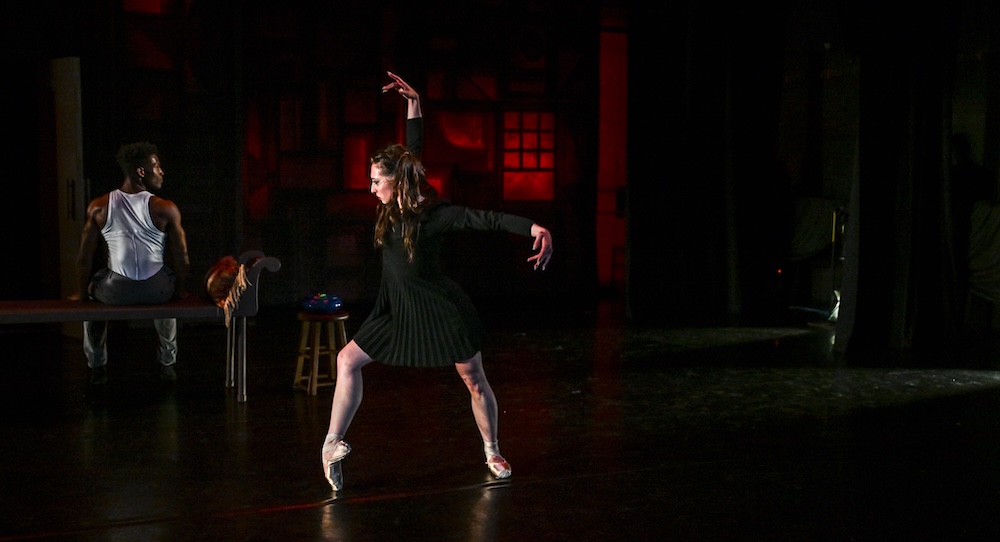
Ballet RI Black Box Studio, Providence, RI.
May 8, 2026.
The intentional physicality of a theater actor, the crafted expressive qualities of a dancer: actors must have a mastery of movement, and dancers – while they most often don’t speak – must convincingly act. Dance and theater are undeniably kin. When their respective artists and communities leverage that kinship, magic can happen – magic like Ballet RI’s Machinal.
The program was adapted from Sophie Treadwell’s 1928 play of the same name. University of Rhode Island theater students staged it, and their director Rachel Walshe believed that it also had life as a ballet, explained Artistic Executive Director Kathleen Breen Combes in her curtain speech. She described the process as quite challenging, but which ultimately created something rather special.
Both she and Walshe were quite right, it seemed to me; the play very much had new life as a ballet, and quite singular life at that. Walshe and ballet RI Artistic Curator Yury Yanowsky co-adapted the play, while Yanowsky choregraphed.
The first scene opened with the sense of an assembly line: dancers swerving and swooping side-to-side, yet remaining confined to the line. The speed and force of the movement evoked the pressures of the corporate world: more, faster, better. Yanowsky’s highly athletic, deeply intricate style served this atmosphere remarkably well. Costumes (designed by David Howard) reinforced the conformist feel – with touches of individuality, yet of a uniform style.
The clean grey and black of Renée Surprenant Fitzgerald’s set reinforced the lack of vibrancy that such uniformity creates. Glimmers of personality and joy underscored that despite such pressures of the corporate machine, authentic humanity isn’t easily squashed nor subverted. Then entered our “Young Woman” (Alexandria Troianos), as the program identified her – not wearing the uniform look of her colleagues; that felt significant. Even with this individuality, the vagueness of her name highlighted her universality.
A prologue voiceover (voiced by Eva St-Germain) told us that this woman – a regular woman like any other – would find temporary solace, an escape, from this world…and it would be her end. This was just enough for me to want to know how it all happened; the program had my 110% undivided focus right from there.
The “Young Woman” seemed isolated and overwhelmed. Her colleagues threw files at her (we’ve all felt like that, right), then surrounded her – creating a sense of confinement that would continue throughout the work. Also continuing from here – notably deepening as the narrative progressed, really – was Troianos’ astounding honesty and immersion in the character.
Her uniquely commanding movement artistry has always been clear, but this role pushed her to newly vulnerable, openhearted theatricality. The fact that this woman became one to deeply empathize with, even with her morally questionable choices, is a key indicator of Trioanos’ theatrical command. Her choices helped me, at least, experience her as someone tortured by inner demons rather than as someone causing harm.
This “Young Woman” did have one friend, however – “the Telephone Girl” (Heather Nichols). A duet between them evoked their visceral bond, a friend’s deep concern and pain to see someone loved so anguished. Later, all in the office leaned in towards a closed door, where – the synopsis told us – the “Young Woman” became engaged (to “The Husband”, danced by Stephen Gunter).
The next scene brought us to the woman’s mother – Katherine Vigly, who danced with all the intentionality and mastery she always brings. She rolled her torso over a table and then lay herself flat on it; while her daughter’s turbulence seemed angry, simmering just below the surface of her despondency, she exuded exhaustion. Them dancing in unison, yet in juxtaposed directions, underscored their commonality in disquiet but opposing qualities of that disquiet.
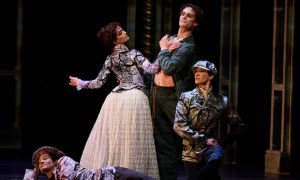
The Young Woman and her new husband (this scene being the “Honeymoon”) made clear that – whatever her mother might have wanted for her – she didn’t want this. She rubbed her neck and closed in on herself, shrinking as if to escape. This confined, anxious physicality (masterfully crafted by Troianos) became a motif that made her turbulent inner life clear – and the moments when it lifted even clearer. Gunter and Troianos partnered with the harmony of fluid breath, yet a sense that she wanted to escape remained. Yet there was no escape for her, at least not a sustainable one.
The next scene brought us into a hospital: with white coats, nurse hats, and a mechanized sense of movement placing us in a very conventional form of that setting…seemingly too conventional, again too confining, for our heroine. Just as workers in her office moved in straight lines, muscular and unison in timing, these workers moved in their own kind of assembly line; there was no escape for her. A nurse brought her newborn to her (implied through a hospital-style wheeled bassinet), yet she turned from the child.
Whether this reaction came from postpartum difficulty in her mind and heart, or from her seeing it as a writing in stone of a union she didn’t desire, one thing was clear – she didn’t want this, not any of it. In a heartbreaking breaking of the fourth wall, she reached through the hospital bed’s headboard towards the audience – as if pleading for our help. All of me wanted to offer her that. At other points in the narrative, she would bourrée with palms open to her side, heart lifted, as if pleading to some power above for deliverance. But there would be no lasting alternative for her.
“Telephone Girl” could bring her a temporary alternative, however – a party atmosphere of free dancing, fierce joy, and just a dash of something edgy, daring. The visceral sense of release and freedom here, as compared with the confining work settings of earlier scenes: palpable. While at first wallflowering – sheepish, just observing – she came to dance with a new “Lover” (Styles Dykes). This was a union she, for once, wanted.
The difference between her physicality in implied intimacy here versus with her new husband: even more palpable. Troianos and Dykes danced together with both high passion and soft ease, something highly desired gained – because they wanted it, and could take it for themselves. The circularity in Yanowsky’s vocabulary, erstwhile building that feeling of confinement, now felt like continuance and abandon. There was a heart-stirring tenderness between the lovers that I don’t think I’ve yet seen in his work before – and I absolutely loved to savor it here.
He gave her a lily in a bowl before she left, which we saw in the next scene back with her husband: reading a newspaper, dressed in a suit, cookie-cut out of the corporate mold. Something cracked; lights flashed off, then came back up on the husband lying lifeless (lighting design by Maddie Laxo). She shook, slipped and fell backwards, eyes popping: horrified to see what she had just done. Troianos’ immersion in the character, the vulnerable depths to which she took it, felt particularly heart-rending in this moment.
The next scene brought us to the consequences of this action, whatever her intention or feeling about it might have been. Dancers in black suits, seemingly jury members and witnesses, moved in and crowded her – bringing their judgement, one she could not escape (indeed, it would not come).
The judge (Darius Mealy), a priest (Garret McNally): all part of the machine still confining her. Something shifted as she faced her fate (chillingly, we saw a chair at the back of the stage that confirmed what that would be): calm, yet still defiant, holding on to her dignity in the face of what was before her…chin lifted, eyes forward, shoulders rolled back.
Guards led her to that chair, and the door closed: she was gone. Reporters swarmed, then dispersed. Yet one remained: looking forward, breaking from the group, expression curious and potentially even skeptical. Would this individual dig deeper into her story, to then tell it with a different voice, seeing it with different eyes?
That was one of the many questions with which I left the black box space. What happened to the baby? What about the “Lover”? Her friend and mother? Potentialities for further narratives abounded. I am inspired to read the play and see if it satisfies some of my curiosities.
Yet a special thing about dance is that it can leave us with such curiosities, being without words to clearly answer our questions (and I did wonder what more voiceover later in the narrative might have contributed…or not; only process could reveal that as an effective or ineffective choice). That can get us digging deeper and learning more. Short of that, we might feel more than we know – and that’s also invaluable.
Thank you to Ballet RI for, with the boldness of telling an emotionally rich story in a wholly different way, inspiring both curiosity and embodied feeling (at least in me!). With more such boldness, artists availing themselves of the malleability of story and how art forms can converge, possibilities are limitless.
By Kathryn Boland of Dance Informa.
Share this: