The Joyce Theater, New York, NY.
September 29, 2026.
Preserving ballet’s choreographic legacy is always a profound challenge. In an art form that exists solely in the present moment, merely replicating historical steps results in stagnant museum pieces; instead, dancers must breathe fresh life and essence into works, respecting their heritage while carrying them forward into the contemporary space. The Sarasota Ballet returns to The Joyce Theater with a rich all-British program featuring works by Antony Tudor, Sir Frederick Ashton and Sir Peter Wright. Entering its 2026-2027 season after a massive roster turnover, the company feels distinctly youthful, vibrant and eager, even as it works to solidify its cohesion onstage.
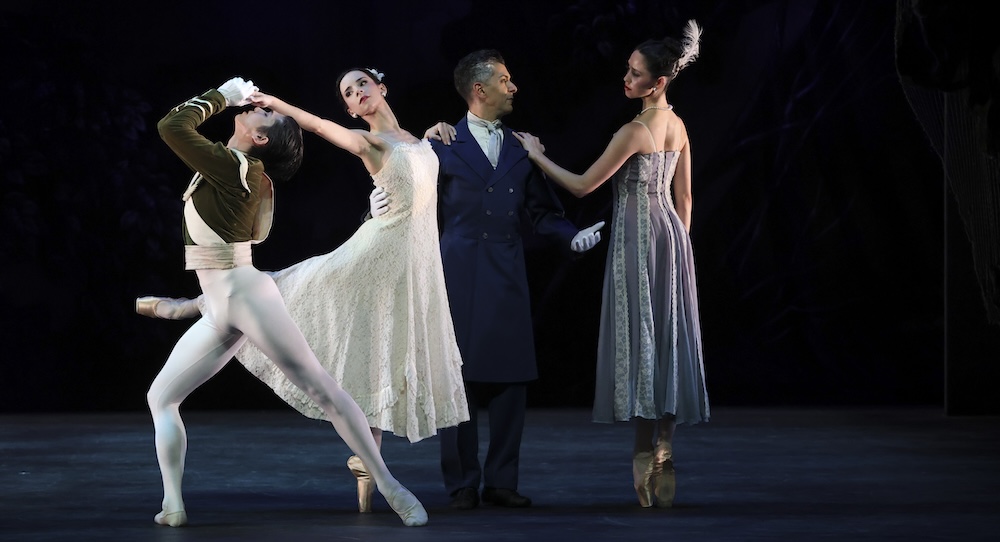
In Antony Tudor’s Lilac Garden (Jardin aux Lilas), the dramatic tension was palpable. While an underlying friction is certainly required by the ballet’s repressed bourgeois setting, an unmistakable current of opening-night nerves compromised a performance whose emotional resonance depends upon the slighter, more delicate choreographic moments. Created by Tudor in 1936, the work anchors a complex psychological narrative around Caroline (danced by principal Marijana Dominis), “The Man She Must Marry” (Ricardo Graziano) and “Her Lover” (Samuel Gest), a dynamic further complicated by the arrival of “An Episode in His Past” (Brooke Wilson). Longtime principal Graziano brought the greatest nuance and magnetic stage presence to the evening. While Wilson had moments of distinct glamour, Dominis — although lithe and elegant — failed to fully draw out the aching undercurrent between herself and Gest. Technical wobbles from the corps de ballet further indicated that opening-night jitters had unfortunately overshadowed the carefully navigated social codes of an Edwardian garden party.
A delightful suite of Sir Frederick Ashton excerpts concluded the first half of the performance. His Meditation from Thaïs — an exceptionally demanding pas de deux originally created for the legendary partnership of Antoinette Sibley and Anthony Dowell — carries formidable historical expectations. Kaitlyn Casey and Ricardo Rhodes approached its ethereal demands with earnest commitment, but the choreography appeared to test them throughout, with moments of technical uncertainty disrupting the weightless quality the work demands.
The “Pas de Trois” from Sir Frederick Ashton’s Les Rendezvous — charmingly danced by Andrea Marcelletti, Pasha Levy and Gus Payne — was gloriously light and effervescent. The blistering speed of the footwork appeared to pose no hurdle whatsoever for Levy. She performed with an exquisite clarity, magnetism and natural charisma, all topped off by a luscious sense of épaulement.
Sir Frederick Ashton’s “Pas de Cinq” from his ballet Illuminations — originally created for the New York City Ballet in 1950 — contrasted the lighthearted charm of Les Rendezvous with a sharp geometrical precision and purity of line. In this striking segment, Iku Okura appeared constantly held aloft by a quartet of attentive male dancers. Performing with an appropriate, serene self-containment, Okura beautifully embodied the abstract ideal of Sacred Love.
The final Ashton excerpt was the rarely seen “Balcony Pas de Deux” from Romeo and Juliet. Samuel Gest, as Romeo, was well suited to this youthful role. With Sierra Abelardo as his Juliet, the pair beautifully captured the raw essence of young passion in an Ashton pas de deux that relies on emotional intimacy rather than flashy pyrotechnics. Abelardo was perhaps even more captivating in her solo moments. With her fluid, highly expressive port de bras and a stage presence deeply rooted in the immediate, all-encompassing reality of first love, she left the audience longing to see her dance the full-length ballet.
It was during the evening’s second act that the company appeared to find its collective footing and truly gel. Sir Peter Wright, a master choreographer most frequently associated with grand, full-length narrative ballets, created Summertide in 1976 for Sadler’s Wells Royal Ballet. Once thought lost to time, the piece has been meticulously revived and restaged by the company’s Assistant Director, Margaret Barbieri — upon whom the original ballet was created.
The ballet’s first movement — athletic yet delivered with refined restraint, free of unnecessary flourishes or forced, pushed partnered pirouettes — was supremely successful and thrilling. The segment was buoyed by the exemplary pairing of Pasha Levy and Iku Okura, both of whom sustained a pristine technical clarity throughout.
The second movement, shifting into a more languid and reflective atmosphere, was executed with an attentive sensitivity by Ricardo Rhodes, Nathan Smith, and Simon Plante. Together, they seamlessly supported Marijana Dominis, who appeared beautifully weightless, as if wafting through a warm summer breeze.
By the concluding third movement, the entire ensemble unlocked their full cohesion. As the curtain fell, Dominis was held gloriously aloft in a pool of warm light — a striking image of a young Florida company embracing the formidable task of carrying the English ballet tradition forward.
By Richard Philion for Dance Informa.
Share this: