Seattle Center’s McCaw Hall, Seattle, WA.
September 24-October 5, 2026 (viewed virtually).
There’s an intriguing tension at hand with Balanchine work: highly classical and formalized, yet also with quite singular styling – groundbreaking for its time and formative for the art form. That’s arguably present in concert dance overall; codified technique and structure are the launching pad for unique creative discovery and artistic achievement.
Pacific Northwest Ballet’s Season 2026-2027 opener Serenade had me reflecting on this spectrum of ease and effort in dance art. The title Balanchine work began the program, but this dynamic also resonated from the two other works – to quite satisfying effect.
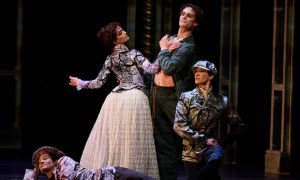
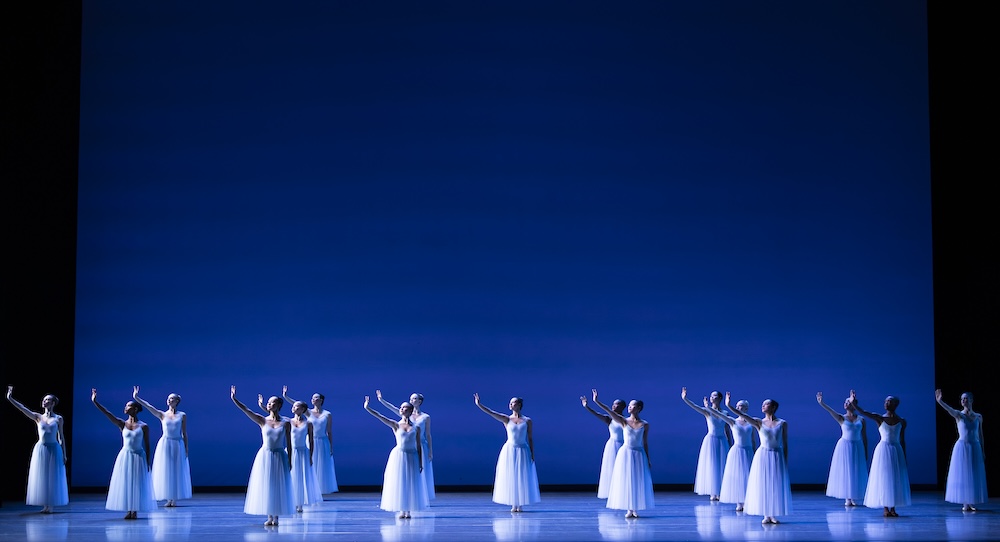
The harmonious, dreamy Balanchine classic Serenade (1934) opened the program. It began with dancers posed in clean stage organization, with an elegant aesthetic of light blue lighting (lighting design by Randall G. Chiarelli) and plain Romantic tutus (costume design by Karinska). A reach led into simple, elegant port de bras. In all aspects, the work was an Exhibit A of Balanchinian minimalism.
Movement accrued dimension and layers – in both time and space – yet clarity and formal organization maintained that feeling of elegant simplicity. The corps kept the stage picture of shifting formations feeling both visually crisp and like a living, breathing organism all on its own.
Those qualities followed the score (Tchaikovsky’s 1880 Serenade in C), adding layers as it progressed yet retaining a clear central melody. Performance quality reflected that interplay, with the corps highly unified yet not at the expense of each artist bringing their own signature to the movement.
Before the corps returned, a waltzing, lilting pas de deux interluded that unity in new form. A soloist offered her soulful execution, with impressive expansion and strength from a smaller frame (don’t underestimate the shorter ballerinas!). Her partner was rock steady while also exuding something light and playful.
None of that involved “pyrotechnics” of technique and athleticism, the flash bangs for the sake of it – which was refreshing in a time when the technical ante keeps rising. At the same time, with fast small jumps and complex weight shifts galore, Balanchine’s choreography called for plenty of nimble speed.
Also interluding were references back to the work’s opening – the palm held out to the side and slightly up, as if in reaching for something just beyond grasp. The corps even brought a yearning quality to the gesture. Balanchine understood structure; such slower, more contemplative moments throughout helped to make the high-energy sections feel all the more fun and memorable.
A variety of energies on offer could also leave audience members feeling more fully satisfied, as art like a balanced meal for the soul. A quartet section in which the ballerinas (literally) let their hair down even contributed a dash of wild abandon; long tresses added dimension to turns and expansive shapes, and a feeling of freed release from certain norms of the context at hand. A beautiful image ended the act – one of those women lifted and walked toward offstage light, her arms high. That powerfully embodied the exaltation that such release can offer.
Jessica Lang’s atmospheric and intriguing Pages (2026) brought quite the change of tone. Ethereal singing accompanied dancers moving in and out of shadows – navigating space with one another and set pieces that themselves sometimes moved. A certain eeriness in the ether – from elements like those enticing shadows and a single chair suspended high above the stage – made the work feel like the perfect one for “spooky season” (and fans of that sort of thing can look forward to the company’s Ghost Stories next month!).
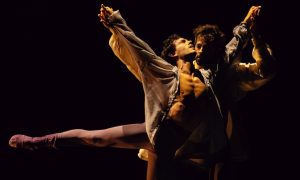
Lang’s singular movement idiom – technically grounded but with thrashes, unexpected gestures and kinetic struggle sometimes apparent versus hidden – also signaled that we had very much moved out of Serenade’s world. Technical feats, such as multiple turns in arabesque, cohered with a feeling that physical weightedness is no evil – all fair game in this world.
Spatial and rhythmic organization also presented a good deal of multiplicity. Dancers at times found unison. At other points (and arguably more often), they acted as autonomous agents – negotiating time and space together – in this setting of light and shadow, release and tension.
Use of props also felt fresh, presenting much to feast one’s eyes and mind on. A red-carpet style fabric (but white) became something for one dancer to just rip away, leaving a large white block unadorned (scenic design also by Lang). She then wrote “TRUST” in large black letters. The work presented much of the unexpected, uncertain, and unconventional, but ultimately left us with a reminder to trust and feel assured no matter what transpired.
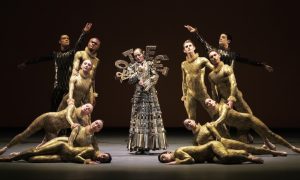
Closing the program was Alexei Ratmansky’s effervescent and pleasing Pictures at an Exhibition (2014). A block of large paintings, abstract and highly multichromatic, hung above and behind the dancers (projection design by Wendall K. Harrington, from Wassily Kandinsky’s 1913 Color Study. Squares with Concentric Circles). The ensemble spread out from a clump to immediately meet the energetic score (from Modest Mussorgsky, 1874): quick jumps, fast turns, big smiles. Their costumes were just as bright and fun, multicolored and with varied shapes in patterning (designed by Adeline André).
Such exuberance before long shifted into a solo with a bit more mystery, the jazzy cool of swiveling hips and snaking spine through otherwise classical vocabulary. The painting behind the soloist, changed from the prior, featured dots haphazardly placed on a blue background – the mystery there matching the playful exploration in her movement.
The work, just as the two before it, also demonstrated its own relationship with gravity and weight – chiefly, the beauty of rising from the release into gravity’s pull, of surrendering to weightedness and then pulling away from it. Such rise and fall ultimately instilled a visceral sense of hopefulness. That effect was thus another example in this program of the tension between classical and contemporary qualities effectively leveraged.
At the same time, the mood continued to shift with each time the score and backdrop painting changed (the score remaining classical, the paintings abstract: color, line, shape). Movement made the art and the music visceral: an embodiment of accompanying art forms. With enough imagination, we could imagine the dancers as the varied shapes in the paintings, each with their own texture and directionality, come to life and moving, interacting with each other.
Through subtle physical comedy and clever interactions between dancing pairs, dashes of humor even worked their way in. The ensemble demonstrated keen and thoughtful versatility in executing all of these varied ways of moving and being.
The piece concluded with a section full of harmony and jubilation – even ending with dancers lifted high, facing the audience with joyful expressions. Abstract art with fields of vibrant color and continuous shapes can bring that sort of enhanced ease and harmony to the spirit: a certain calmness simply from witnessing something with peacefully co-existing elements. Ratmansky’s work embodied that effect with care and heart.
All three works in this program were similarly thoughtful and soulful, balancing raw creative impulse and considered artistic choice. It was therein a strong start to the company’s 2026-2027 season. It also granted us a reminder to take into busy fall and holiday seasons: to move forward with both rigor and release, effort and ease. Onwards!
By Kathryn Boland of Dance Informa.
Share this: