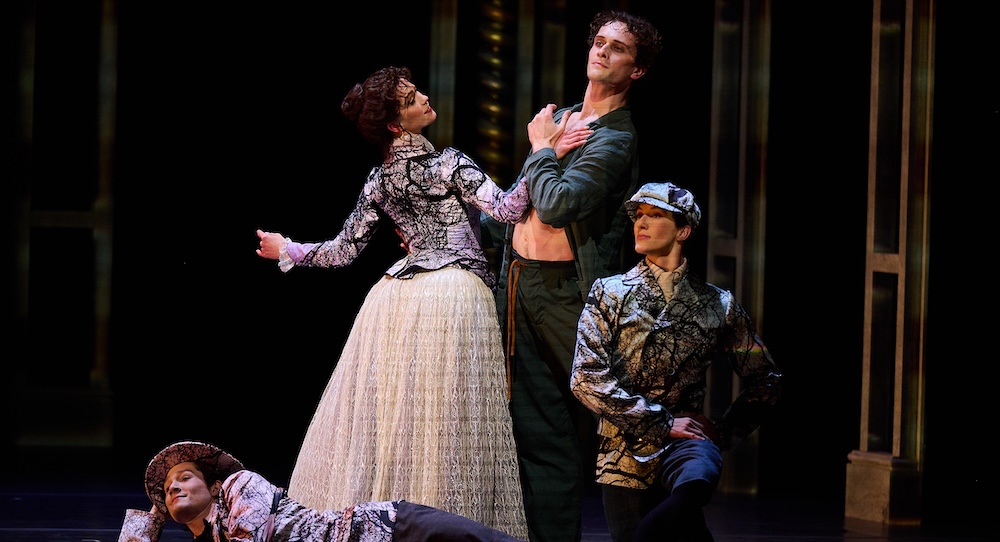
New York City Center, New York, NY.
October 8, 2026.
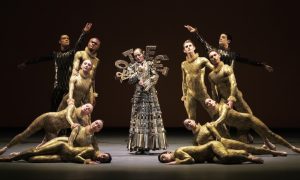
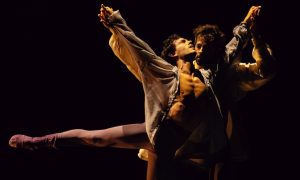
The Australian Ballet presented the New York City premiere of Oscar, the story ballet about the life of Oscar Wilde, choreographed by Christopher Wheeldon, in early October 2026. The full-length ballet weaves the life of the writer into his own stories. On opening night, and the night of my attendance, the house was entirely sold out and many audience members donned the famed green carnation on their lapels, Wilde’s coy nod to queerness in a time when homosexuality was, quite literally, against the law.
The dancers of The Australian Ballet, under the artistic direction of David Hallberg, are stunning. Long beautiful lines, combined with clean, crisp and daring technique, left me wishing the flight from NYC to Melbourne wasn’t so long. The creation of a new (2024) story ballet about famous figures in the gay community is long overdue, and seeing representation in that manner makes one realize just how absent so many parts of history are tucked away, each one a color dulled from the potential vibrancy of our collective human experience.
For a dance show, it had the sets of a Broadway extravaganza. Moveable parts flew in and out, creating distinct worlds and helped provide context for the narrative that flowed in and out of reality and fiction. Accompanied by a the full Orchestra of St. Lukes, the music was rich and filled the theater with nuance, in a way that recorded music just never can. The period costumes seemed deeply authentic to the era, but obscured much of the dancing (notwithstanding were the Nightingale sections that had whimsical attire, fitting of both the story and being able to actually see the dancing).
Choreographically, the ballet had it all – from classical movement to contemporary, to jazz and vaudeville-esque. Yet, at no point did any of the variety appear out of place and the transitions were seamless. This is clearly the work of a skilled craftsman. In particular, the partnering sections were complex and quite interesting. Again, it’s worth mentioning the incredible skill and talent of the dancers. The production had a lot to it, but the defining element of greatness for me was the dancers.
I came to this show with a basic knowledge of Oscar Wilde and a high school education of his writing. The Picture of Dorian Gray was a big part of my Sophomoric English class, which now feels like mature material for 15-year-olds, but it certainly left an impact on me. That said, despite reading the synopsis, I got lost (read: confused) about the plot more than once, which took me out of the magic of it all. There’s a fine line in story ballets between being too obvious with the plot and being too obscure. For me, this production lent itself toward the latter. Perhaps with more knowledge about history would I have had a better understanding of the shifts between the truth and the imagined.
Unequivocally, stories of queerness and homosexuality have long been absent or minimized on large stages, and this production fills a massive gap in representation. As audiences, we would be well served to see more of them, to better understand our fellow humans and be better equipped with love and acceptance.
By Emily Sarkissian of Dance Informa.
Share this: