Brooklyn Academy of Music, Brooklyn, NY.
May 3, 2026.
Moby Dick — directed, designed and lit by the late Robert Wilson — is a masterpiece of atmospheric distillation. Created in collaboration with the Düsseldorfer Schauspielhaus and featuring a score by Anna Calvi, the work transforms Herman Melville’s sprawling epic of Captain Ahab’s vengeful obsession with the great white whale and Ishmael’s wanderlust into 100 minutes.
Performed in a blend of German and English, the show opens with a luminescent projection of a whale, a soft whisper of singing voices, and a percussive crashing of waves. Wilson immediately signals a departure from tradition. The novel’s iconic first line: “Call me Ishmael” is inverted. Instead, Ishmael (Raphael Gehermann) declares, “Do not call me Ishmael,” as he recounts the voyage of the Pequod.
The Boy (the lithe Christopher Nell) — a character who does not exist in the novel — twirls with frustration as he retorts, “You’ve told this story a thousand times.” Yet, Ishmael’s desire remains palpable. He sings, “My wanderlust is voluptuous. It’s a black cherry, it’s sumptuous. I’ll take a bite from every life. I’ll lick the diamonds from the sky.”
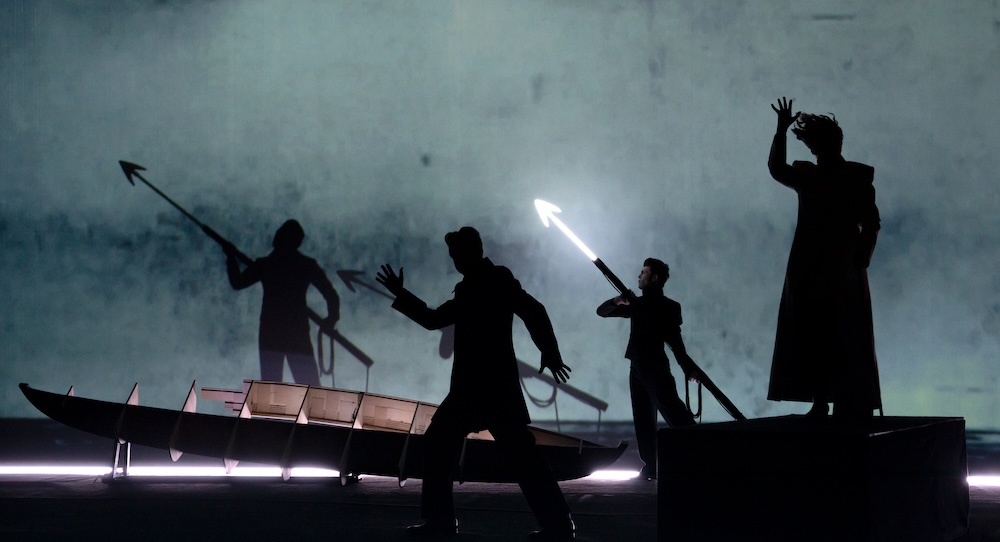
Moby Dick is not physical theater or dance, but actors demonstrate a level of physical control on par with dancers. Ahab, The Boy and Ishmael, along with the crew of the Pequod: Officers Starbuck (Heiko Raulin) and Flask (Jürgen Sarkiss), Harpooners Queequeg (Yaroslav Ros), Tashtego (Moritz Klaus), Fedallah (Roman Wieland) and Perth (Jonas Friedrich), and Sailors Manxman (Yascha Finn Nolting) and Bulkington (Michael Fünfschilling) walked across the stage with arms at right angles, torsos turned toward the direction they were going, creating the effect of Indonesian shadow puppets come to life. In the Playbill, Helga Davis, who worked with Wilson for many years, wrote that “he taught a generation of performers to walk slowly across the stage with grace, determination, and ease.” In this way, they reminded me of dancers who doggedly train to make even the most complicated jump, or a simple walk across the stage, look effortless.
A live orchestra, led by Dom Bouffard (with additional music by Chris Wheeler), complimented Torben Kärst’s sound design which created another layer of intrigue such as turning the tap-tap-tap of Captain Ahad’s peg leg into an ominous soundtrack of loud thuds at each footfall. Tomasz Jeziorski’s masterful grainy black and white videos had the feel of a 1920s silent film. Julia Von Leliwa’s simple costumes — the harpooners’ black trousers, Ishmael’s very long black coat and Captain Ahab’s long white coat — created sharp silhouettes and captured the austere air of the early American Puritan style. Manu Halligan’s hair and makeup furthered the image of an Indonesian shadow puppet with Captain Ahab’s hair which stiffly pointed upwards and to one side, as if permanently windswept. Wilson’s set was a hydraulic wonder and the few set pieces — a house, a tavern and the ship — breezily descended and ascended to and from the ceiling or slid into place from stage left and right.
Wilson, in his signature way, through the slow exploration of space, time and sound, and by distilling the novel’s chapters into vignettes, allows the story to swell in our imagination. Although Wilson’s characters appear flattened, fundamental human desires and longings emerge through the music and text. Ishmael wants to join the crew and, the mad Ahab whose vengeance jeopardizes the schooner, to slough off the tedium of everyday life. Despite the perils, Ishmael is eager to discover new things. He sings, “Cause if I dream it, maybe it will happen.”
In old age, Ishmael revels in retelling his story. Although The Boy complains that the story has been told a “thousand times,” Wilson’s production of Moby Dick underscores that, without the willingness to seek out adventure and new experiences, we would have no stories to tell.
By Nicole Colbert of Dance Informa.
Share this: