New York City Center, New York, NY.
April 25, 2026.
Clack clack-a-clack swoooosh: as we entered the lobby for Ballet Hispánico New York’s 2026 City Center Season, my friend and I were treated to the castanet clicks, precise steps and swirling skirts of students dancing flamenco. When we were seated, a former Ballet Hispánico dancer (I overheard another patron say) offered more castanet beats and hippy steps down the aisle.
The curtain announcement came in English, then espanõl. The paper program welcomed all attending with a “bienvenidos.” All of this felt like cultural immersion at its finest. It also felt highly, intentionally communal.
As Artistic Director and CEO Eduardo Vilaro noted in his curtain speech, inclusion is the name of the game; no matter who you are or where you come from, you are welcome in this experience…bienvenidos indeed. The program’s three works were all highly specific, and quite singular in their own ways – but together created quite the night of dance.
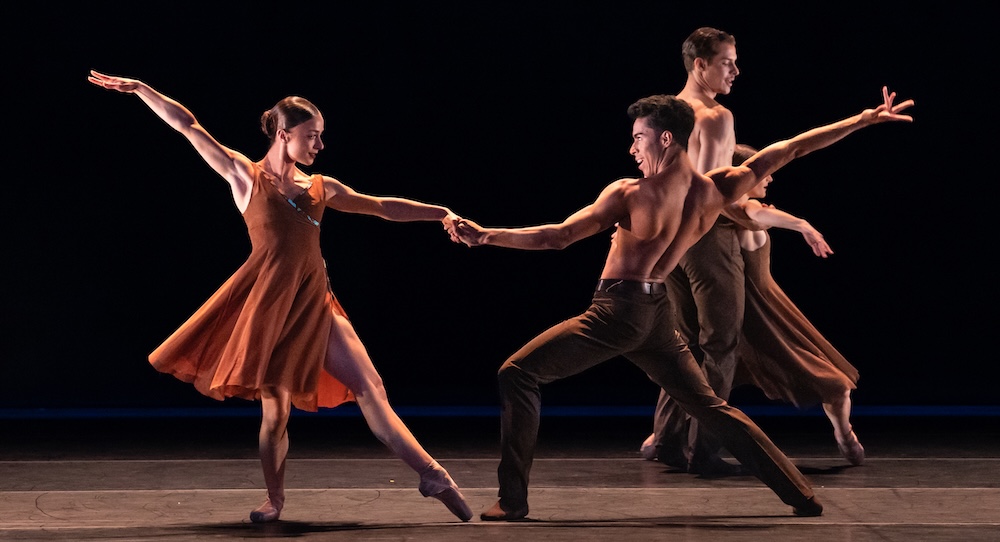
Stephanie Martinez’s Otra Vez, Otra Vez, Otra Vez (2019) was an evocative embodiment of an idea reflected in Picasso’s The Old Guitarist (1903-04): how we encounter people with histories, struggles, and joys we know nothing of. The title translates to “again, again, again”; again and again this happens in our lives. Frequent shifting of groups, from numerous entrances and exits, reinforced this idea of how many people we come across in life but how little opportunity we have to truly know them.
Also compelling was a certain playfulness with timing, of the relationship between movement and score. At times, dancers rode the edge of being “off count”, creating a compelling tension. At other points, they fully moved away from the score’s timing, yet then came to it: an ultimately satisfying divergence and convergence. The ensemble moved through all of that with both precise curvilinear shaping and the softness of full breath.
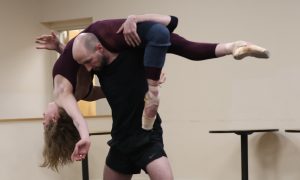
Partnering was also highly memorable; a blend of manipulated physics, notable range of motion, and pure strength combined to create something not quite like anything I’ve ever seen before. Through bold choices such as one dancer caught by her partner mid-air, settling in a safe embrace, the vocabulary was equal parts athletic and soulful.
The work was not a kinetic representation of Picasso’s painting; it transcended that by portraying on moving bodies a central idea permeating from its canvas. Yet the aesthetic – both in movement and the spare, limited design aesthetic – did reflect Picasso’s work; I thought of the clear geometry of shape and simple range of hues in his still lifes and figure paintings.
The work suggested these qualities rather than screamed them. Hearing the suggestion on my own, I appreciated them all the more. All in all, this work – conceptually sophisticated, technically astounding, and plain emotionally affecting – is not one that I will forget any time soon.
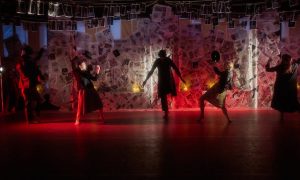
Marianela Boán’s audacious Reactor Antígona, a reimagining of the Greek myth colored with Caribbean cosmology, created a mystical atmosphere punctuated by muscular movement. The first thing I noticed as lights came up was a stage covered in bright plant life (props and costume design by Rául Martín).
That element starkly contrasted the black backdrop and wispy rising smoke, entrancing in bright lighting (designed by Dominick Riches). Were these fallen autumn leaves or flower petals? Perhaps the form and function mattered more than such a detail. Towards function, the flora pliably assisted with various effects and narrative turns. The female protagonist, Antigone, took on a wildness as it nestled in her long, thick hair.
At other points, she seemed to bury her two ensemble mates under this plant life. I thought of the death of parts of us as life runs its course…and how much that comes from inside versus from external influence. Goggles also spoke to blindness, lack of foresight and perspective: a key theme in mythology and classical storytelling more generally.
The other main prop of large black bags had a sense of weightedness, of a heavy burden. These also became literal punching bags as one dancer wore boxing gloves and air-boxed to the point of seeming windedness.
That felt par for the course in this piece’s raw, earthy movement: feet flexed, palms pushed, elbows out. The trio danced with absolute wild abandon, throwing anything “pretty” or “soft” to the wind. The score (by José Andrés Molina) – replete with stirring drum beats and ethereal voices – enhanced this primal, mystical sense.
While with inflections of modernity, the work felt like a reflection of a time when we understood life’s mysteries through the natural world and the forces we believed ruled it.
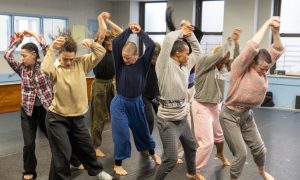
Cassi Abranches’ Trança (Braid) was an electric unifying of disparate elements. The work reflected the “ancestral art of braiding” through weaving “Brazil’s cultural references” into a “fabric of movement, identity, and community,” the program explained. A certain freneticism of movement – large ensemble, breakneck speed, layered nuances – somehow came together in a soothing harmony, like unruly hair tamed into a neat braid.
As with timing in Martinez’s piece, the energy rode the edge of something out of control. Yet the fact that cohesion remained brought something calming, for all of the high energy at hand. With simultaneous kinetic nuance and relentless top speed, the movement seemed to push the dancers to give all they had – and they very much did. Tonal variance in the score (by Beto Vilaris) and lighting changes (lighting design by Clifton Taylor) allowed that consistent maximum energy to not become stale.
As a base for this explosive energy, Abranches blended the speedy intricacy of Latin and street dance forms with the fluid expansiveness of contemporary styles: a significant challenge that the dancers met with command and pure joy. I felt that joy too. With the audience leaping to their feet as the piece closed, I don’t think I was the only one.
There is something to be said for a “crowd pleaser”, something that excites audience members in the moment and has them leaving the theater smiling. Abranches and the extraordinary ensemble delivered on that. It’s another work that I won’t forget for some time.
I’ll remember each of these three works for different reasons, in different ways – but the important thing, to me, is that I will – that they had that sort of impact on me. Individuality need not come at the expense of unity, and vice-versa.
When artists have a space to share their culture, their voice, their view, and audiences can receive that with respect and curiosity: just watch the magic of creative exchange happen. I hope you’ll be there next time to feel it, too!
By Kathryn Boland of Dance Informa.
Share this: