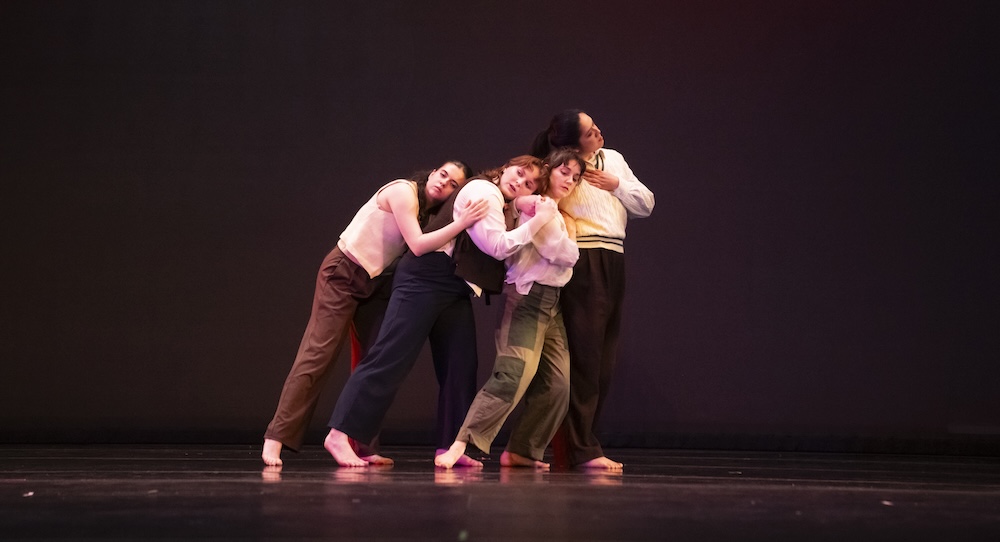
The Strand Theatre, Dorchester, MA.
March 14, 2026.
Have you ever looked up at the night sky and thought about how much movement is actually happening: orbiting planets, collapsing and growing stars, propulsive foreign bodies? Maybe not – maybe you’ve just felt awe (or, if you’re in a bright city, wished that you could see stars).
Madison Florence’s Finding Space reflects the stories of those who did look up and become absorbed in questions of the cosmos (as well as personal stories of its artists). Given all that movement, and all its visual richness, contemporary dance seems quite a fitting vessel for exploring and illuminating these stories.
I may not have discerned the specifics of those stories, in a narrative sense, yet I felt their emotional truth. That effect demonstrated movement’s unique power to evoke, to reveal, to tell without a word. It also showed how dance can move in concert with varied disciplines – and what singular work can come from artists like Florence, who bring unique expertise to the art form….as “unlike” dance as that experience may at first seem.
The imagistic and soothing In Resonance opened the program. Dancers began the work by rising from a clump and spreading out across the space, the spacing without discernible patterning – reminiscent of scars spread across the night sky. Movement accumulated under midnight tones. The individual movement qualities on offer, each piquant yet also soft, also reflected the qualities of varied cosmic lights. Turning on two feet felt orbital, while softly swaying arms evoked Milky Way wisps.
This action continued for some time, to a soulfully meandering score – creating a meditative feel; I could turn my mind and its worries off and just savor the beauty and harmony at hand. To end the work, the ensemble settled to the opening tableau, seated; the universe and its cycles continue – and perhaps there is a certain peace to that.
The tenacious Overview Effect followed, changing the tone to something more active and athletic. Dancers repeated a running motion of forward and back, a plane in motion linked with “doing.” The movement quality was more muscular and accented than in the opening piece – yet the score encouraged a soothing continuity. The work thus created balance through mindful merging of seemingly disparate atmospheres. I felt both invigoration and calm.
Proximity Principle then brought me into a more poignant place. The quartet offset two pairs of dancers. Oppositional facings and spatial tension drew me in, yet tenderness kept me invested.
Altered Fate, danced by Meredith Price, enticed me through a unique blend of qualities from prior pieces: some of the ambient feel of the first section with the active feel of the quartet following it. It therein called to mind for me the tension between “doing” and “being.”
The motifs of orbiting movement and images evoking Milky wisps returned towards the end; was such tension eased? I like to think it could be. The ending image was also memorably poignant: her gesturing to her heart and then that arm reaching forward, energetically longer than she could physically manage. It felt like a sharing of her heart far beyond itself.
Branches of the Same Tree brought another resolution: one of finding human relating. It began with a lack of connection. Yet unison gradually emerged, as did eye contact: two key markers of embodied connection. Such connection (which was touching to watch grow) ultimately came to a circle, an ancient form of human interdependence as well as celestial balance.
The keen choreographic choices of Apart of a Whole made it highly satisfying. Florence arranged the quartet in ways that created further interplay of tension and harmony. By the end, with them moving in clean unison, the ensemble felt like a collective that would remain a collective through any challenge. The ending of leaning into each other in a clump spoke to such unity including emotional support, too.
In The Face of a Luminary, danced by Sophie Nash, slowly built size and speed. That seemed to signify this persona gradually exploring, and then fully finding, their own power. Nash kept intentional gaze while smoothly shifting weight throughout the space, redirecting energy. She found support on the floor, then rose from it with an understated expressiveness; less was certainly more here. Her committed emotional life in performance seemed to say that more soulfulness can feel like more, though.
The vigorous Celestial Bodies featured more of that meaningful collectivity. As they danced with that orbiting, Milky Way-feel of movement, unity accreted once again. That established, they faced outwards and moved even more tenaciously – as if together facing sincere external challenges. Shapes in partnering struck me as particularly adept crafting of moving bodies, something else from this program that I believe will truly stick with me.
Tethered, danced by Carmen S. Rizzo, closed the act. It shifted us into turbulence – that which went to the enticing edge of the unsettling. Rizzo moved alone across a darker stage, reaching and gesturing with accent and force. That softened some as she seemed to find more agency in her path through space: still with notable force, but now with a more self-empowered bearing.
It was another satisfying development to watch, not to mention her nuanced and commanding movement quality. She reached and walked towards an offstage light in the end. I like to think she found her own light and kept going right towards it, just as did all the other personae we’d seen thus far. A rising, hopeful sense in the score enhanced that inspirational feel.
The dynamic trio Discovering the Unknown opened the second act. Lights came up on a dancer already moving, her movement both multifaceted and athletic. That intensity increased with more dancers joining her. Yet, through the score and their easeful movement quality, that active sense did not come with pressure or tension. I thought of active flow state and its pleasures. Such pleasure also came with care; physicality reflected support and closeness, including hugs that shifted into balancing each other’s weight and hands on shoulders, together facing offstage.
NGC 6240 further offered that sense of both strength and receptivity. Duet partners (Lila Klaus and Shira Weiss) found both independent action and shared momentum. They even, in a quite touching moment, swayed through their spines to join hands and then sway together. That unity continued with a group moving in unison – one harmonious force I nevertheless would not want to challenge, showing an implicit power. It ended with the two original dancers, the seeming heart of the implied story here.
The multifaceted On the Shoulders of Giants began with movement accumulating from a clump. It therein reminisced the work that opened the program, yet there was a bit more ferocity to it here. As they continued to move, with tenacity yet also malleability, these were clearly women fully standing in their own power.
Their softness seemed an indispensable part of their strength: in how they navigated the space around them, their own bodies, and each other. Their soft gestures – textured with a reaching, yearning quality – spoke to exploration, a desire to discover. I once again thought of joyful curiosity. The ensemble walked backwards to offstage, facing the challenges before them to the very last moment.
The layered, evocative Binary System (danced by Holly Stone and Shira Weiss) carried on that exploratory sense: gestures and shapes out into space and in fresh configurations through the body. The dancers gradually found unison: a reminder that connection is often not easy, but is worth it in the end. Even as they moved a bit more restlessly, evincing agitation, they did it together.
The thought-provoking Event Horizon underscored the value of individual pathways. One clump moved with that orbital feel, yet a few moving pieces here did not adhere. At the same time, the intrigue and force in their individual action was undeniable. I wondered: what we might have lost without their standing out from the crowd!
Blazes Across the Glittering Sky had the commanding Cas Glover dancing under darker lighting: portraying a certain moodiness. The score reflected that feeling as well, but also carried a certain resilience. Glover reflected that duality in her movement quality: dancing with a certain weightedness, almost a viscous feel, yet also a smooth continuity. Resilience, indeed! Her presence and action also felt exploratory, with traversing much of the stage as only one dancer – seemingly hungry for both space and time to move.
The explosive, yet also emotionally rich Galactic closed the program. Dancers accumulated across a brightly-lit stage (relatively, for the program), coming in and out of unison: a fluid dance of both connection and individuality. That idea became all the more impactful as the group grew, because the atmosphere remained calming, if with a note of yearning. That remained true no matter how many at hand sought individuality, and the heartbeat kept returning to collectivity.
That effect built to the ensemble moving in unison in a long line, creating power through their unity. It all once again returned to exploration and curiosity as they looked up to infinite sky, colored in nocturnal tones. They slowly decreased their momentum as they did so – and ultimately settled into the pose that opened the program, of looking up at stars…lights faded down, curtain dropped. Infinite indeed: both the mysteries of the cosmos and our desire to know it more intimately, more assuredly.
Movement can be an invaluable piece of the puzzle, a tool in the toolbox for unlocking those mysteries. I thank and applaud artists like those of this program for showing us just how much specific subsets of knowledge, when brought to dance, can reveal. I’m listening and learning: awed, intrigued, and inspired. We dance on!
By Kathryn Boland of Dance Informa.
Share this: