Tag Archive | "dance review"

City Gate Dance Theater Company – Just Be


The Academy Theatre, Avondale Estates, GA
Sunday November 11 2012

By Chelsea Thomas.

On a Sunday afternoon in a small theater outside Atlanta, the new City Gate Dance Theater Company debuted its four-member ensemble with a dramatic, heartfelt evening of contemporary and lyrical ballet.

The company was founded in January 2011 by the husband-and-wife duo Robert E. and Jennifer L. Mason. Seeking to combine “performing and visual arts, dance theater and cinema into one stimulating and timeless event,” the pair pulls from their individual backgrounds in theater and modern dance.

Holding a B.F.A. in dance from Florida State University, Jennifer L. Mason is a triple threat in the dance world: muscular, flexible and graceful. With an inclination towards drama and a knack for breathtaking extensions, she also calls upon her training with Alvin Ailey American Dance Theater with Lester Horton-inspired movement.

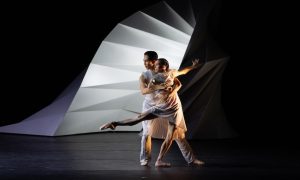
City Gate Dance Theater Company Atlanta GA

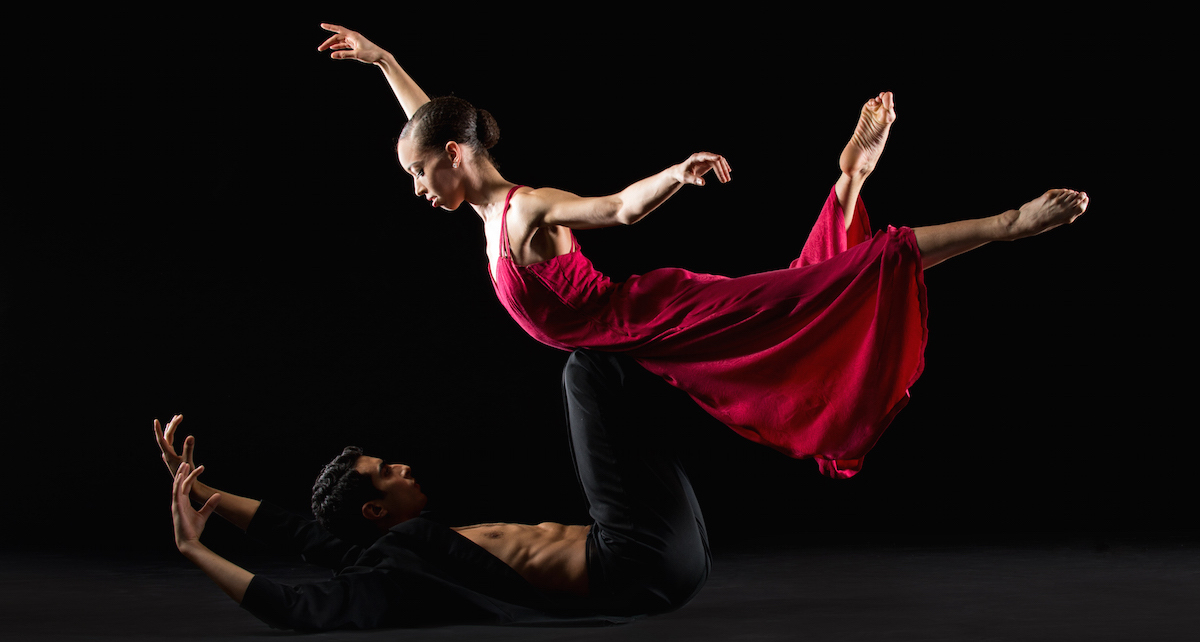
City Gate Dance Theater Company of Atlanta presents ‘Just Be’. Photos by Richard Calmes.

Before marrying Robert and founding the company, Jennifer danced with Urban Ballet Theater, Dance Iquail and Surfscape Contemporary Dance Theater. She has also been a guest artist for local Ballethnic Dance Company and a soloist for UniverSoul Circus. While she is relatively new to choreography, it appears she takes no dreams captive.

Her husband Robert E. Mason brings a dramatic, theatrical flair to the close-knit outfit. Also sharing instruction under Alvin Ailey American Dance Theater, he mostly received formal training with Atlanta Ballet. Recently, he was a member of New York’s Amalgamate Dance Company and he has toured with the cast of Oprah Winfrey’s National Tour of The Color Purple.

The couple’s company is clearly their love child, making evident his theater experience and her contemporary balletic style. Opening the show, the couple performed a short, yet extremely intense pas de deux.

Set to the music of Carmina Burana, the work Bold was certainly just that. Fusing solemn expressions with many jumps, lifts and tricks, the Masons exhibited their clear trust in one another. Unfortunately, the small stage size limited their ability to feel and dig into the work. The space constrictions left the piece feeling restricted and somewhat jilted. This attendee is left wondering how Bold might have appeared in a larger venue.

Yet, for all the constraint evident in Bold, the next work, perhaps the most natural and seamless of the evening, Transformed, held a graceful, freeing sensitivity. Even though more dancers filled the stage, audience members forgot about the small space and were allured into the vulnerable, aching movements.

Perhaps the most memorable image is that of the dancers pulling upon their loose dresses’ soft fabric, almost Martha Graham-esque. When pulling the thin fabric from their bodies their hips would jut out to the opposite direction and their heads would fall back, portraying a deep, burning desire to be liberated of the dresses’ emotional bondage.

Although the meaning was left broad and undefined, Transformed still accomplished an intimate rendering of the classic redemption story – women struggling, women triumphing. In the end, the dancers removed their dresses, representing their burdens, and welcomed life free of guilt and pain. If City Gate Dance focuses on this work’s vulnerability and its soft, organic storytelling, they will have a successful, relevant company that will make it through the rough economy.

Next on the bill was Loved, a humorous, albeit strange, duet. Regine Mayter, an experienced modern dancer hailing from Haiti, joined Robert for a back-and-forth love affair that first introduced him as a drifter and then as a desperate lover. Set to a montage of various love songs, the three-part work climaxed with Mason’s dramatic, gesture-heavy pleas for Mayter to come back to him. At its worse it was playing the border of interpretive dance as Mason cried and plunged to the floor with the lyrics, yet at its best, the work gave the show passion and the audience a good chuckle.

The last two works of the evening were contextually confusing, one vague and bewildering, and the other somewhat unrelated. However, the Masons managed to pull them into the broad theme of Just Be with heart and candor.

The work Fearless came first, with a contradictory and ominous underlying subtitle of “broken hearts” in the bulletin. At first introducing the recently-transformed women dancers as confident and reaching for the stars, the piece took an unexpected turn with odd adulterous sentiments and manipulative ties. While the movement was strong with smooth transitions, the context distracted from the evening’s larger tone.

The shows final piece, Healed, was a reworked dance originally performed at Atlanta-based Dance Canvas’ fourth annual showcase in January 2012. Interestingly enough, Healed resulted in death when the protagonist passes away from breast cancer. It was a touching, yet an unusual choice for ending the company’s debut performance. At once it exhibited the company’s strengths – lyrical, tender movement with strong extensions – and it’s weaknesses – the tendency to push too far for the theatrical and the predictable.

All in all, keep an eye on this company. The Masons have drive and passion that may mold and breakthrough with the times.

Posted in Reviews - USAComments (0)

L.A. Contemporary Dance Company’s “5×5” gets a full 5 star rating!


Nate Holden Performing Arts Center,  Los Angeles
May 13 2012

By Alex Little.

On May 12 and 13 L.A. Contemporary Dance Company produced its first ever repertory showcase of dances from the past, presenting pieces that premiered between 2005 and 2010. Seven years have passed since LACDC, founded in 2005, emerged on the contemporary scene and boy, do they have a wealth of great material to show for it! I was excited to take in the choreography of renowned artists Terri Best, Adam Parson, Ryan Heffington, Nichol Mason and Artistic Director & Co-Founder Kate Hutter. I learned that Hutter’s three pieces were intended to document the journey of her own personal experience with LACDC. Clearly it has been a beautiful journey for all, as explained through the movement and expression by the 18 company members on stage. This is LACDC’S largest company to date.

I was enthralled by Adam Parson’s piece The Initiator, and when intermission hit, I found him immediately, excited to reflect on the profoundly moving experience I had as a spectator. He explained that this work, created in 2009, was rooted in the discoveries he made on a trip back to his home country of Kenya.  The broad theme was the suffrage of women in third world countries, and how, despite their limitations as females in society and the ever-threatening male hand, they continue to dream for a better life. Their determination to use their minds leads them to escape and walk miles to schoolhouses to learn to read and write. Parson depicted this exact story with the six females in his piece. I was struck by the way he used clear conceptual gestures and movements to mark each phase of the women’s journey towards hope. Parson expressed the monotony of the chores clearly felt by the repeating choreography. When the women were being struck, in which a light was shined from stage left, they sat into a prayer position. “The men could not threaten them if they were praying”, explained Parson. Their joy of learning and communicating was felt by their expressive faces, big glorious steps and partnering. One of my favorite elements was the pictures that streamed behind the dancers of third world women, who were smiling with hope. It makes our problems feel so little.

L.A. Contemporary Dance Company

'The Union' by Terri Best. Photo by Joe Lambie.

I thoroughly enjoyed what seemed to be a color wheel revealing itself before my eyes in Terri Best’s The Union. The men and women began walking across the stage, almost nude, to then put on white and black costumes. As the piece continued blossoming, so did the colors of their wardrobes. Best described in the program: “The Union explored themes of incarnation, duality and cycles of order and chaos. In it, we witnessed the coming of age of a woman, and the perpetuation of life through the attraction and union of opposites.” This was such a tall order to create through dance, but not for the immensely talented Best. I enjoyed how honest and nurturing this piece felt. I could tell the dancers honored their place on stage, as they took us through these concepts, embodied in large part by the journey of a woman (in red) and her coming of age. I particularly liked the intimate pas de duex with her partner with whom she fell in love. The lifts in this piece were sensational. Leave it to Best to present explosive and sweeping movement, full of classical technique. These dancers were both athletes and I felt as though I was watching wild flowers bloom by the end!

Diary Entry Final was the brainchild of the extraordinary Ryan Heffington. His contemporary movement was clear, tight and crisp in this piece about three life-changing events in his life, all mixed into one memory. Heffington has a way of story-telling that you can easily grasp onto. My eyes never wavered, as I was transfixed by his staging and articulate phrases, and how they seemed to seamlessly work with the concoction of music and orchestra noises. The dancers were committed, especially the trio of women mid-way through the piece. I appreciated the difficulty behind his ideas and patterns.

Los Angeles Contemporary Dance Company

Kate Hutter's 'Passion Plays'. Photo by Taso Papadakis.

Kate Hutter – well what can I say?! This woman is equally as strong a dancer and performer as she is a choreographer. Of her three pieces, although I thoroughly enjoyed the duet Passion Plays (2005) danced by herself and Kevin Williamson, I was most enamored by Looking Back (2010). This was extraordinary! The entire piece faced upstage, and was guided by the dancers’ breaths, as there was no music. Looking Back referred to a step back in history as well as the anonymity and new identities created as the dancers performed the piece facing upstage. The large cast of men and women were adorned with long maroon skirts with their backs exposed to the audience. The skirts moved like another graceful appendage as their spacious movement traveled them downstage to upstage, and back again with mesmerizing patterns and structure to each phrase. Hutter’s remarkable staging and craftsmanship of phrasing could be a documented in a textbook of “how to choreograph a piece”.  The dancers executed her vision with intuitive fluidity, control and depth.

I was pleased with the entire presentation by LACDC, but the above four pieces were the stand-outs of my experience. More so, I am ecstatic that LA has a contemporary modern company, who is thriving, growing and testing the boundaries with every next step. Taking a look into the past certainly revealed the diversity of LACDC’s repertory. Needless to say, I can’t wait to see what the future holds!

Photo: L.A. Contemporary Dance Company present Diary Entry Final. Photo by Joe Lambie.

Posted in Reviews - USAComments (0)

Peridance Contemporary Dance Company Spring Season


Salvatore Capezio Theater, New York
May 2012

By Laura Di Orio.

For its second season after a hiatus from 2007-2010, the Peridance Contemporary Dance Company, under the direction of Igal Perry (who originally founded the company in 1984), took the stage at its home theater, the Salvatore Capezio Theater.  Over two weekends, May 5-6 and May 12-13, the company presented an evening of works not only by Perry but also by guests Sidra Bell and Kristin Sudeikis. Jose Manuel Carreño also joined the company during its first weekend, as he danced a Perry solo, Ave Maria.

Even without the ballet star and obvious crowd draw, PCDC danced to a sold-out house during its second weekend of shows, proving its professional and artistic worth. The 10-member ensemble executed an impressive and expansive evening of interesting work. Most of the dancers performed in every piece -a seemingly exhausting feat – but came back refreshed and ready at the start of each work.

The evening opened with the premiere of Perry’s Conflicted Terrain, which began with a lone dancer, the tiny yet powerful Midori Nonaka, dragging a rope connected to a platform carrying an empty musician’s chair and music stand. A live string quartet quietly started to play, with each musician on a similar platform. One by one, and two by two, the dancers appeared in dim light, welcoming us to a series of recurring partnerships.

Peridance Contemporary Dance Company Spring Season 2012

Joanna DeFelice and Leigh Lijoi in Kristin Sudeikis' 'I am you'. Photo by Krista Bonura.

Perry seemed to play with the sense of space and also the occasional separation or unity of audience, stage and “orchestra pit”. When the dancers performed a traveling box-like step, the stage appeared to move; and the space transformed again each time the dancers dragged the musicians to change their formations.

Conflicted Terrain was an opportunity to showcase the talent and technical capacity of the PCDC dancers. Leigh Lijoi’s long lines and Joanna DeFelice’s striking presence became recognizable right away.

In I am you, a premiere choreographed by Kristin Sudeikis, the dancers appeared almost bare (the women wore nude halters under their black leggings) and seemed to embody the phrase “dance like nobody’s watching” as the piece opened in a light, fun way as the dancers swayed and interacted with one another. In a musical change, the dancers moved in near slow motion.

The dancers soon lined up to face the audience and voiced self-proclamations: “I am so nervous,” said one dancer. They were naked in a new way – their honesty was exposed and raw. The moment passed, however, and the performers broke into fits of dancing freedom. Despite the musical changes seeming slightly too random, Sudeikis’ piece did showcase the PCDC dancers as once again being talented artists and movers.

During a pause in the program, the house proceeded to fill into a foggy cloud. This was an interesting effect, although it may have made the audience in a small, converted studio-theater space feel uncomfortable at first. Nikki Holck opened Sidra Bell’s The Ungathered with a stunning solo, and she became an interesting character and mover to watch throughout the remainder of the work. The dancers, dressed in variations of black leather bondage, continued to become more trapped, more possessed, in a cell-like world, at times pulling at the walls to try to escape.

Bell created interesting shapes, even in a sickled foot or a simple balletic grand plié. She also incorporated repetitive tendus – a darting of the foot as it slides along the floor to point – that made the step appear tedious and mad. Bell is interesting in her vocabulary and ideas, but the story of The Ungathered went on for just a bit too long.

The audience seemed to be most excited for Perry’s El Amor Brujo, the program’s closer. Perry impressively placed almost an entire orchestra at the back of the stage behind a cloudy scrim, and the live music was so nice in such a small concert venue. El Amor Brujo was a dramatic piece filled with Spanish dance nuances and a lovely balance of structure, stillness and movement.

Attila Csiki made his first appearance of the evening in El Amor Brujo and was a stand-out in the work, serving as a partner for Holck and as a remarkably fluid performer on his own. Holck and Csiki looked lovely together, and again eyes were also drawn to DeFelice.

Flamenco singer Marija Temo wandered on and off the stage, singing and acting as a storyteller for the love tale. Nothing seemed forced in El Amor Brujo; rather, the piece was seamless and natural in visual swings and levels, and also in mood.

PCDC is a wonderful ensemble of dancers, and the works presented in this season’s program allowed a chance for each to individually shine. I am glad that Perry also welcomed the work of other choreographers, as it was a nice balance for the audience and also for the dancers.

Top photo: Midori Nonaka and Kentaro Kikuchi in Sidra Bell’s The Ungathered. Photo by Karli Cadel.

Posted in Reviews - USAComments (0)

Ghost the Musical Opens on Broadway


Lunt-Fontanne Theatre, New York City
April 2012 Previews

By Deborah Searle.

You may ask, how can the Patrick Swayze and Demi Moore 80s classic film Ghost be adapted into a singing and dancing stage show? I, too, was a skeptic, hoping that the show wasn’t going to be a corny rendition of the much loved story, as I took my seat in the gorgeous Lunt-Fontanne Theatre on 46th Street, New York.

From skeptic to fan I was hooked from the very first seconds.  Ghost the Musical is a must see for any theater lover, or for anyone really. It is gripping, romantic, heart-wrenching, hilarious and thoroughly entertaining. At times I was holding back tears, clenching the arms of my seat, laughing out loud or tapping my toes. The story takes you on an emotional journey that feels real and relatable.

Caissie Levy and Richard Fleeshman as Molly and Sam

The cast is outstanding. Caissie Levy and Richard Fleeshman as lovers Molly and Sam were believable with undeniable chemistry. Both with impressive stage credits to date, the couple were the original main characters of the London West End production of Ghost.  As a preview showing, I expected to see actors still warming to their roles, but these two were obviously very comfortable with their characters and each other, and they shone.  They have impressive vocal and acting abilities.

However, if you go by the audience reaction, Da’Vine Joy Randolph playing Oda Mae Brown, was the star.  She was hilarious! Every time she came on stage the audience would erupt in laughter in no time. She is a true entertainer and seemed made for the role of the quirky, outspoken and brash Oda Mae. In her Broadway debut, with basically only a college theater degree to her name, Randolph is one to watch. It was exciting to see a new young star take her place on the stage.  She must be thrilled to be receiving standing ovations in her first Broadway role.

The musical is full of special effects using projections on large screens. The subway train scene is powerful and exciting. The scenes where Sam, as a ghost, moves through doors or objects are clever. There are many effects used to portray the ghosts and to show spirits taken to heaven or hell. These are chilling! With so many special effects the show could easily feel overdone, but it isn’t. Every effect is well incorporated, has a purpose and adds to the story.

Da’Vine Joy Randolph as Oda Mae Brown with the dancers

The musical is full of dancing and singing, as you’d expect from a musical, but not so much from the story of Ghost. Every song and dance number fits well into the story and is well written or choreographed to fit with the theme and build the story. My favorite song and dance scene was performed by Randolph as Oda Mae Brown when she thinks that Sam has just given her 10 million dollars. She sings and dances up a storm on top of suitcases with the dancers showing their prowess around her in sparkling suit jackets and sunglasses. It’s highly entertaining and was performed with energy and cheek.

I hope that Ghost the Musical has a long Broadway run, and even tours the country with Broadway Across America. It is an honest and captivating musical.

Published by Dance Informa digital dance magazinedance news, dance auditions & dance events for the professional dancer, dance teacher and dance students.

Posted in Reviews - USAComments (0)

A Preview of Tomorrow’s Corps de Ballet: Manhattan Youth Ballet’s Spring Performance


Manhattan Movement & Arts Center
March 31 2012

By Leigh Schanfein.

When was the last time you went to a school dance performance?  When was the last time you even had the inclination to do so?  It may have been last week, it may have been a decade since, and chances are it was because you were related to one of the budding star performers.  Of course we tend to associate school shows with baby ballerinas, simplistic choreography, and immature dancing, but we have to remember that not all dance schools put on the same show, especially in a locus like New York City.  Perhaps we should not be so quick to dismiss amateurs when seeking a dance fix at the theater, and I can say this now because I have recently witnessed the unexpected.  On March 31st the Manhattan Youth Ballet pulled off a great feat for any dance school; it put on a performance worthy of an audience that is comprised of more than family and friends.

The Manhattan Youth Ballet is a non-profit curriculum-based dance academy founded by Executive Artistic Director Rose Caiola, who is also a Broadway and film producer.The Ballet has a small but impressive faculty roster, including Head of Faculty Deborah Wingert, Choreographer-in-Residence Brian Reeder, and Artistic Advisor Daniel Ulbricht, the last of whom would also make a surprise appearance mid-show.  The ballet’s Spring Performance opened with a new ballet by Reeder. Holding Court was a minimalist neo-classical piece that was far too dependent on a sense of irony that was completely lost on the youthful cast.  The dancers looked beautiful in their vaguely baroque costumes, but there was better work to come.  Le Jardin Anime, from the classic ballet Le Corsaire, was nicely done.  Nicole Zadra did a particularly lovely job, looking very composed, soft, and elegant.   The younger girls who made up the corps were very cute and not the least bit clumsy.  What followed was a scene from another major ballet, Don Quixote, in a smartly staged series that notably included the delightful Liza Knapp-Fadani as a Kitri who pierced the stage with her flight and fire.

The second half of the show opened with an excerpt from George Balanchine’s A Midsummer Night’s Dream, that first struck me with the visual delight of colorful bug costumes that adorned the young cast.  The shimmery fabrics were ingeniously twisted into wings and shells appropriate for the stage and cast, by a trio of costume designers who, as we were told in the opening remarks, are former professional dancers.  After being thoroughly bowled over with the cute, I was doubly blown away by Daniel Ulbricht, appearing as King Oberon.  He more than impressed me with his impeccable batterie, downy-soft landings, butter smooth turns, extremely smart use of space, and, oh yeah, his muscles.  Ulbricht not only serves as Artistic Advisor to MYB, he also serves as a magnificent guest star and incredible model for the young cast.  He was a fantastic surprise that momentarily carried my imagination to the majesty of Lincoln Center, and brought the level of the performance to that of the company with which he performs, New York City Ballet.  Of course, my eyes and my mind had been seared.  I was worried that I’d be unable to objectively review the remainder of the performance after Ulbricht magnificently manipulated my perspective.  However, I continued to find the second part of the program to be a delight, my view perhaps prejudiced in favor of this talented group.

The second part continued with a series of variations: from La Fille Mal Gardee, which lacked confidence, Four Little Swans from Swan Lake, which required more teamwork and facial control, Raymonda, which had dramatic countenance but bumpy bourres, and August Bournonville’s Jockey Dance, which stood out as a winning performance.  Both boys, Thomas Barnea and Julian Donahue, did a commendable job.  The show closed with a short excerpt of Balanchine’s Stars and Stripes.  The energetic corps looked great posing to Sousa, and soloist Savannah Green shone with strength.  If only her smile were as unwavering as her pirouettes!  I was left a bit disappointed that there was no solo variation, but the excerpt was a bright flash of color and enthusiasm that left a glow after the lights went down.

This pointe-predominant performance was entirely cringe-free, a feat for which I enthusiastically applaud MYB’s instructors.  I find it strangely common to find dancers very weak en pointe in performance, even at a professional level.  I’ve all too often held my breath, waiting for the imminent twisted ankle, precipitated by the “deer in the headlights” look in pre-professional, collegiate, and regional company performances.  MYB should be proud of that. Even its youngest dancers look downright comfortable in pointe shoes.  A problem remains, however, and it lays with the men.  Usually, when there is a dearth of male dancers, those that are present carry a disproportionately large amount of the work.  With MYB however, the four boys were a minimal presence, which was sad considering the budding talent these boys demonstrated.

If you seek cheap seats to see classical ballet and you are tired of the nosebleed section of the theater, you can easily satiate your craving with Manhattan Youth Ballet.  With guest stars like Ulbricht, a smart program, and up-and-coming young dancers, you’ll be inspired to seek out the unattainable beauty of classical ballet.

For more information about Manhattan Youth Ballet, visit manhattanyouthballet.org

For more information about MYB’s home Manhattan Movement and Arts Center, which holds a limited selection of open classes and workshops, visit: manhattanmovement.com

Posted in Reviews - USAComments (0)

Cloud Gate 2’s NY Debut at The Joyce


Joyce Theater, New York
February 8-12, 2012

By Laura Di Orio.

During its New York debut, Cloud Gate 2, a Taiwanese modern dance company, presented at The Joyce an evening of five works by four choreographers and provided a glimpse into the emotional and physical range for which this company has the capacity.

The group, despite being called “number 2”, is not second to Cloud Gate Dance Theatre; rather, it is its own entity, one that prides itself on creating substantial works by a number of young Taiwanese choreographers. Both Cloud Gate and Cloud Gate 2 are directed by Lin Hwai-min, and while Cloud Gate performs mainly his works, Cloud Gate 2 is a springboard for newer creative voices, but is definitely just as strong.

During their four-performance run at The Joyce this February, the troupe seemed to fuse dance theater and pure dance phrases, along with interesting musical choices and standout lighting. Cloud Gate 2 seems to not be a company of hierarchy. Each dancer had his/her own individual voice, and the group as a whole was nothing less than connected.

The mixed program began with “Wicked Fish”, choreographed by Huang Yi, who also danced in the piece. It opened with a string of dancers across the stage, with overhead lights casting down on the dancers, dressed in blues and grays, and shrill music that at first seemed obtrusive. Within just a few moments it was apparent that these dancers were extremely well-rehearsed – their movements so in sync and their bodies moving in a most aesthetically-pleasing wave.

Cloud Gate 2 in Huang Yi's "Ta-Ta For Now". Photo: Liu Chen-hsiang

At one moment, only knobby body parts like elbows and knees could be seen under the lights. At the next, the group moved in canon and in slow motion, and then they’d quickly rewind. A series of duets – boy and girl, boy and boy, girl and girl – graced the stage. The couples’ bodies seemed to never depart contact through the slides and around-the-body lifts. The dancers were so athletic, so committed, but the best part of “Wicked Fish” was that the movement was so beautiful and fluid that we almost forgot about how piercing the music was overhead.

Next was Wu Kuo-chu’s “Tantalus”, which opened with six dancers in pedestrian clothes standing hunched over, eyes out to the audience under a square of light. They remained still for a long, long moment. Then one dancer stirred, out of discomfort, and then the whole group was awoken. One by one, an individual’s movement became contagious through the group, which was only brought back to neutral with long, loud breath patterns.

After several minutes of only sounds of claps, breaths, sighs and foot stomps, we welcomed the music of Meredith Monk, a storyteller herself. The piece became funny and human in that we recognized that we, as people, exhaust ourselves, constantly running and not getting far enough or even fighting with the air.

“Passage”, choreographed by Bulareyaung Pagarlava, pinnacled the evening in showcasing Cloud Gate 2 as a group with a strong dance theater element. A pretty girl was unwillingly clothed in different dresses and fabrics by four characters who seemed to be her caregivers. The girl was distracted, seemingly possessed, longing for something beyond her room. Meanwhile, a strong presence – a figure covered from head to toe in white – slowly strode around the scene, as he carried a large umbrella and wheeled a black suitcase beside him.

One by one, each character stripped off their black coat and danced in a powerful fit, as if they, too, had become possessed. Towards the end, clouds of white powder were thrown to the sky, creating a most strikingly beautiful image, and the dancers lay under a white sheet, where the girl had preceded them.

In Huang Yi’s second piece on the program, the quirky “Ta-Ta For Now”, was like a day at the office without the boss. The dancers, wearing office clothes, spun on, climbed over and stacked desk chairs. They interacted with each other, passing along imaginary objects, making finger people and even throwing their shoes. Despite its apparent light feel, the piece involved such incredible precision. There were times of amazing body response to the music as the tale was told via the violin in Aram Khachaturian’s Violin Concerto in D minor.

Cheng Tsung-lung’s “The Wall” closed the program. The dancers, all in black, began by walking the perimeter of the stage, creating some kind of wall, encasing themselves in a world of their own. Again, one by one, the dancers broke the mold, stripped their black and burst into their dance, nearly naked but so sure of their decision.

“The Wall” displayed the company as incredible movers, and some of Tsung-lung’s phrases appeared to have the feel of hip hop’s body isolations. At the end, one figure, who remained in black, walked into the field of what may have been mistaken as “chaos” but was surely just the temptation of the freedom of dance. Will he, too, be tempted?

During much of the evening, it was sometimes hard to tell the dancers apart. Aside from the choreographed moments of staring out into the house, their dancing was so internal as a whole, as if they were one body, each dancer just a different limb and one expression of a larger voice. And their bows were so gracious, their eyes almost in awestruck of what sat before them.

Cloud Gate 2’s engagement at The Joyce was one of such interesting, engaging work. It wasn’t dance for the sake of dance; rather, it was movement for the sake of saying something, and each of these young artists seems to have something profound to say.

Top photo: Cloud Gate 2 in Bulareyaung Pagarlava’s “Passage”. Photo by Liu Chen-hsiang

Published by Dance Informa dance magazine – dance news, dance auditions & events.

Posted in Reviews - USAComments (0)

Seeing Double: Abraham.In.Motion at The Kitchen


The Kitchen, New York City
December 8 2011

By Tara Sheena.

The mark of a truly great artist – some may say it is technical virtuosity; some may deem sheer creativity; some may think public persona defines ultimate artistry. In my humble opinion, duality in artistic works is a telling feature. Work that exposes the relationship between two seemingly unrelated things; work that reveals connections between two worlds; or, work that strives to show that our world has greater levels of interconnectedness than we previously thought true. On these claims alone, Kyle Abraham is, in my mind, a great artist. His Bessie-award winning evening-length work, The Radio Show, dealt with the expiration of famed Pittsburgh hip hop radio station WAMO, while simultaneously exploring the debilitating conditions of his father’s Alzheimer’s. In his newest work commissioned by The Kitchen, Live! The Realest MC, Abraham pairs the story of Pinocchio with a young male’s emotional journey of coping with his gay identity. Abraham and his company, Abraham.In.Motion, displayed this evolution of sorts via the mark of hip-hop culture. From the music to the video projections, to the fashion, Abraham’s work, presented in early December, was a whirlwind of urban energy from start to finish.

I entered the venue on Thursday, December 8th to the preshow music of pop songstress and icon of the gay community, Robyn. Beginning with a delicate solo by Abraham, donned in gold sequin racer back top and metallic gold pants, he filled the space with subtle pops and locks that were game for explosion at any second.  Making a motif out of effortlessly balancing on his toenails, he established the duality of vulnerability and strength that effectively coexisted throughout the entire work.

Outfitted in ‘old school’ Adidas jumpsuits, Elyse Morris, Maleek Malaki Washington, and Chalvar Monteiro then charged through the space, and Abraham backed away, as he shed light on a moment of nostalgia. The video backdrop (impressively designed by Carrie Schneider) revealed the daily adventures of a young boy in urban America running through the city streets, jumping fences and chasing friends. This was just one of many memorable vignettes Abraham provided his audience.

The scope of hip-hop culture and attitude permeated throughout the work, in equally thrilling and notable moments. At one point, Hsiao-Jou Tang and Rachelle Rafailedes engaged in a fast-paced series of harsh leg tosses and quick spirals to enliven the heavy pounding of the bass in the diverse musical score (edited by Herman “soy sos” Pearl). At a split second’s notice, the ladies both slowed down to pedestrian walking, as if their flurry of movement never happened. This ‘too-cool-for-school’ attitude worked as a practical narrative as much as it did with satire for the piece (more duality!).

In a standout moment, Chalvar Monteiro entered the space, clad in short shorts that put Daisy Duke to shame, to give us his own brand of voguing. Strutting and shaking through the space, Monteiro was unapologetic about sky-high battements, punctuating his smooth, sassy movements. Stopping short of satire, he impressively displayed another important duality in the work: the gender economics of hip-hop culture. Monteiro clearly displayed a decidedly feminine aesthetic, further emphasized against Maleek Malaki Washington’s overpowering masculinity (at one point causing him to utter the insensitive male quip, “Damn, can I hit that?”).

Seamless in its duality, Abraham’s newest evening-length was enthralling from start to finish. The dancers were fierce, the lighting (designed by Dan Scully) was expertly crafted, and most importantly, the work made me think.

Photo: Kyle Abraham and Chalvar Monteiro. Photo by Cherylynn Tsushima

Posted in Reviews - USAComments (0)

Some Like It Hip Hop – ZooNation Dance Company


Sadler’s Wells- Peacock Theatre, London
November 2011

By Lara Bianca Pilcher

Some Like It Hip Hop is an original and highly entertaining dance theatre masterpiece that is fun, fun, fun! This innovative production showcases company founder Kate Prince as the director but also as lyricist, co-choreographer and co-writer.

ZooNation attracts an audience to the theatre that is varied from long time dance lovers and children to even those who usually just watch MTV; attracted to commercial music and dance.

Many children were in the audience. It’s so refreshing that founder Kate Prince has made a family friendly show that will encourage many children to pursue the arts. The stereotypes of hip hop being violent and overly sexualised are broken and hip hop is portrayed in a way that creates a safe show for anyone to come and see.

The story hooks the audience in, continually introducing more dance characters and further evolving others. The live song and acting moves the company from a dance only company to a revue.

The number ‘Invisible Me’ was like a hip hop version of Chicago’s ‘Mr Cellophane’, showing an oppressed character. It demonstrates how hip hop dance can be fused with music to further evolve the dance narrative and allow dance to be a much more communicative theatre language.

I’m a big fan of clean comedy (believing that it takes more skill than reverting to toilet humor) and there are so many moments to make you smile. Natasha Gooden’s doll like face is simply delightful as the dance character ‘Oprah Okeke’. The dancers’ faces and acting skills move them beyond dancers alone into true performers.

The lighting design by Johanna Town, is intricately designed and sets by Ben Stones are well integrated. The sets are as big and transformable as any top West End musical. So often dance is executed on a rather empty and bland stage but not in this show, the sets move and are constantly changing. There is never a dull moment.

The music by DJ Walde and Josh Cohen is original, enhancing the dance communication. There is a symbiotic relationship between the movement and music, true to the foundation of hip hop in the 1970s in Bronx NYC.

The big numbers at the end are a bonus and the whole cast, including the vocalists each have a short freestyle solo, reminding us of the spontaneous and competitive nature of street dance. Many of the performers move with explosive speed and risky air-born lifts and flips. The show is simply invigorating.

Posted in International ReviewsComments (0)

American Ballet Theater Brings Mixed Bill to New York’s City Center


City Center, NY
November 2011

By Stephanie Wolf

American Ballet Theater is best known for its masterful presentations of full-length ballets. But, every fall, the company treats New York City to an array of more intimate repertoire at Midtown’s City Center. This year’s Thursday evening performance showcased the work of two iconic modern dance choreographers, some virtuoso dancing, and a world premiere.

The evening opened with Merce Cunningham’s Duets, appropriately named for its successive appearances of male/female pairings. With eclectic music, bare bones costumes, and angular movement, Cunningham’s work can sometimes be difficult for a ballet audience to digest. But Duets ended up being a pleasant start to the performance.

Set to the composition of Cunningham’s longtime collaborator John Cage, the highly technical and precise choreography translated well to the ABT dancers. At times, it was slightly mechanical, as if the dancers were individual cogs in a machine, which made the exactitude of the movement serve a greater purpose. The choreography involved a lot of fast footwork with arms held in a Bournonville-esque demi seconde and the most interesting movement was within the partnerships. There were several compelling moments of partnering such as an assisted jeté that landed in a penchée.

The Garden of Villandry, a pas de six for three dancers, a pianist, a violinist, and a cellist, was the next ballet on the program. Featuring the choreography of Martha Clarke, Robby Barnett and Felix Blaska, the piece mimicked a mini ballet soap opera. Veronika Part, Roddy Doble, and Gennadi Saveliev gave the impression their characters were caught up in some type of social entanglement. Was it a love triangle? Was there hostility? The audience had some artistic license in deciding for themselves.

The ballet was sleepy at times, but had merits; the live music was divine and the dancers executed the sometimes cumbersome partnering exceptionally well. It left me a bit indifferent, neither disliking it nor loving it.

From there, the evening took a change of pace with Twyla Tharp’s quirky and mischievous Known by Heart (“Junk”) Duet, set to Donald Knaack’s “Junk Music”. Tharp is notorious for her unyielding choreography and this duet was no exception, but the piece worked. Gillian Murphy and Blaine Hoven were an ideal pairing to tackle the difficult movement.

Known by Heart made me feel like a ‘ballet nerd’. I giggled along with the rest of the audience as the two dancers entered into a playful competition. There were a few cheap ploys for laughs – at one point Murphy tap dances on pointe – but all and all, I liked the ballet’s light, jazzy attitude.

I was most curious about the world premiere of Demis Volpi’s Private Light. Unfamiliar with the young choreographer’s work, I had no idea what to expect. The ballet opened with all ten dancers onstage. With the ladies’ backs to the audience, the five couples ‘danced’ exaggerated kisses and embraces. The ballet then evolved into an exploration of human gestures and the need for human touch, utilizing the sound of the dancers’ breath and the ladies’ pointe shoes. Misty Copeland took to the movement beautifully and breathed life into every step she danced.

Volpi’s ballet had an effect on me, but I’m unsure how to identify these exact emotions. I feel compelled to see it again, needing more time to process what I saw. It’s possible the more I watch it, the more it will register with me.

Rounding out the evening of dance was Paul Taylor’s always fun Company B. It’s a crowd pleaser, full of well-known tunes and stylized movement. There were a few standout dancers. Daniil Simkin, who is smaller in stature when compared to other men in the company, moved as if he was seven feet tall in the “Tico-Tico” solo. Simone Messmer was expressive and expansive in “There Will Never Be Another You”. However, several moments could have been stronger. Isadora Loyola is a lovely corps de ballet dancer with great potential, but she could have connected more with the gentlemen in “Rum and Coca-Cola”. Because the characters in Company B are just as important as mastering the Taylor technique, an occasional flirty glance would have gone a long way.

It was nice to see some favorites such as Company B, but it was even more exciting to see ABT showing New York audiences something new and different. The company has a lot of up and comers, both in dancers and choreographers. It will be interesting to see how the company evolves over the next several years, especially when it comes to its City Center repertoire.


Photo: American Ballet Theater performs Company B. Photo by Gene Shiavone

Posted in Reviews - USAComments (0)

The Dark Allure: a night of surprises


Atlanta Dance Connection

Maynard Jackson High School, Georgia
October 28-29, 2011

By Rebekah Bennett.

I love to be surprised; but let me tell you, it is not easy to surprise me and it is not easy to impress me. I am also, (and I am embarrassed to admit this to the world), of the belief that male dancers have it much easier than their female counterparts. Do you know what else I love? I love to be wrong. Allyne D Gartrell, thank you for not letting these male dancers off the hook.

Let me tell you about the men of Atlanta Dance Connection. Their technique was astounding, their bodies, strong and powerful. These men moved through the space, soaring through the air one moment and rolling to the ground the next with flawless controlled power. They seemed contained and in control of the movement but only barely. There was an underlying current of caged energy that pulsated from ever perfect extension and movement.

While I am on the topic of male dancers, I need to give props to one in particular, Xavie Demar. I asked him how he managed to get that tall body to the ground so quickly and then manage to have his legs to his ears the next second! “In my training,” he shared, “I danced with a lot of shorter people. My ballet teachers would tell me, you need to move as fast and as big as that person, that little girl, standing next to me. That was my push. I wanted to be a professional dancer from the time I started training and I can’t hide.” Hide he cannot, however, he fits in this company. He blends in and only adds to the beauty of the whole picture.

There where beautiful moments through the whole show. The different choreographers showcased the dancers’ incredible abilities with gorgeous turning sequences and a wonderful fusion of ballet, modern and jazz movement.

The gem of the show was Movement III from My Inspiration, dedicated to Talley Beatty, a great pioneer of Jazz dance. The dancers, robed in stunning velvet dresses, moved quickly and flawlessly through the fast paced, joyful movement. These dresses, by costume designer Maurice Smith, perfectly showcased the dancers’ diverse and beautiful body types. It was obvious that they loved performing the choreography as much as I loved watching it. That is because it was everything that I as dancer, love about dancing – hard core modern-jazz fusion moves wrapped in an air of sassy groove. It was nearly impossible to stay in my seat! It was pure dance happiness.

So, Mr. Gartrell, thank you again for a night of surprises and of great dance. Your dancers of Atlanta Dance Connection are incredible artists who, in their own words, can’t imagine dancing anywhere else. Thank you for bringing your style to Atlanta. We are lucky to have you here.

Posted in Reviews - USAComments (0)