The Joyce Theater, New York, NY.
September 17, 2026.
The Surge: An Ode to Sinéad O’Connor, a dance tribute (more like an honoring) to the music and words of the singer/songwriter is currently running at The Joyce Theater in NYC. The piece for 10 women is the reverent brainchild of Tony Award-winning choreographer Sonya Tayeh. I don’t think you could have been a defiant, proud feminist girl (grrl?) in the ’90s who didn’t love Sinéad. As such, I walked into the theater with a great deal of excitement. I also walked in with my reusable Joyce Theater branded wine cup, that until this day, I had forgotten to bring 100 percent of the time. The night was already off to a great start, as I was thrilled to sip my wine and vibe out to some excellent dancing to music that had a profound impact on me as a young woman.
For the next 60 minutes (run time: 70 minutes), I sat leaning forward in my chair, pen and paper to take notes clutched in my hand (notes taken: 0), tears streaming down my face, wine entirely forgotten. I remembered an audition notice for this show from months ago, one that I submitted to, because it asked for dancers of a certain age; that age being one where you would have definitely remembered the day O’Connor ripped a photo of the Pope on SNL, live, to protest child abuse in the church. Obviously, I didn’t end up in the show, but for the first time, I was almost glad, because it meant I could experience it as an audience member…almost. Watching these dancers take on the subject and feeling of the work, all over 40, both gutted me and then refilled me with a particular hope and an appreciation for the both the experience onstage, and my own amassed experience in dance over the last 40+ years.
The combined power of expertise and experience onstage lifted the piece to a place where anything is possible, even daring to imagine dancers in ways we should have never disregarded in the first place. At the talk back after the show, Lisa Race joked that she hadn’t been to an audition since 1989, until Tayeh asked her to audition for this work. Now in her mid-60s, Race, along with every other dancer onstage, showed us what the quiet penetrating power of women working together can do to shout art into the world. It took great, conscious effort to ensure I watched each dancer as equally as I could, because every one of them shared such compelling movement and presence onstage. It was a blissful problem to have.
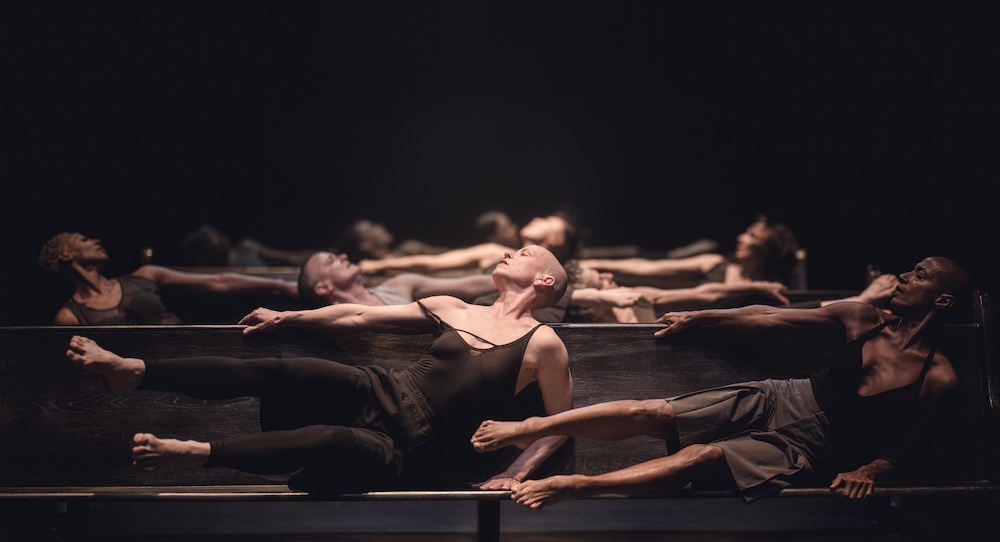
The only set pieces were church pews, shifted throughout, to create mise-en-scènes of varying scope. The pews became another character in the work, manipulated with apparent ease by the dancers to create refuge, obstacle, height and play. The push and pull of their utility, seamlessly transformed by the group of women, was emblematic of how women often move through the world, using the barriers of a society that leans patriarchal as trampolines instead of shackles. Lighting by Tom Visser was stark and minimal while maintaining a rich texture, evocative of the notion that with deep experience, superfluous effort is unnecessary.
Tayeh used the great connection she feels toward O’Connor and her music to create choreography that is both daring and intuitive (none of it felt “put on”). The devotion O’Connor had to art, to music, and to being authentic revealed itself over and over as we watched it explored through the eyes and bodies of 11 women with equally astounding artistic riches. Thank-you to Sonya Tayeh, Betsy Cooper, Alison Clancy, Gabrielle Malone, Mor Mendel, Amy Miller, Jennifer Nugent, Karine Plantadit, Lisa Race, Monique Smith and Jin Ju Song-Begin…and of course, Sinéad O’Connor.
By Emily Sarkissian of Dance Informa.
Share this: