Woodman Family and Community Arts Center, Providence, RI.
October 24, 2026.
A seed takes root – then thrives or struggles, depending on a variety of environmental factors. A story, a concept, a vision is like a seed in an artist’s mind; how it grows into a work of art hinges on innumerable factors. Artists show up and tend to the vision regardless.
In her curtain speech for In Motion, Ballet Rhode Island Executive Artistic Director Kathleen Breen Combes spoke to this idea of how an artistic seed grows. A human story – directly or indirectly experienced – takes shape into art via personal interpretation (and nuances of process and craft, of course).
She named this as a connecting thread through the three distinct pieces in the program, the company’s 2026-2027 opener. Indeed, the works offered uniquely human depth and a view of how a work can evolve through intentional process.
The program began with the memorable and deeply poignant Nachtigal (2026), choreographed by Artistic Curator Yury Yanowsky in collaboration with The Sandra Bornstein Holocaust Education Center and Rhode Island resident Lilliane Birch. Birch’s mother, Anka Nachtigal, survived Auschwitz because someone returned the kindness she had once shown them (and other personal attributes, such as fortitude and grit, to be sure).
Yanowsky’s work is often abstract, non-narrative, and highly athletic – so it was wonderful to see what he could bring to bear with a loose narrative structure, sincere emotional depth, and high stakes. Many of the narrative moments that we learned about in a pre-show video, from Birch directly – such as her mother stepping up to high school bullies, and then reuniting with the person for whom she stood up, years later, when sentenced to the gas chambers – were some of my favorites.
Part of me wanted to see those moments extended, to breathe a bit more and feel even weightier. Some of the longer movement sections could be shortened to accommodate that – yet that could be at the expense of energetic arc, and simply the spectacular artistry that the dancers therein displayed. Structure is often a complex puzzle, and these choices are never simple!
The dancers’ supreme theatricality – particularly from Alexandria Troianos, dancing the main character role, and as spellbinding a technician as always – did much to carry that emotional weight. Tara McCally was another notable standout; she brought vulnerable tenderness to visceral stregnth. Yanowsky’s richly layered and textured movement vocabulary, in both shaping and pathway, was fertile ground for such emotional nuances and theatrical choices.
Interestingly, his bent towards non-narrative abstraction helped to kinetically and clearly depict those key narrative moments – such as through keen gestures and staging. For example: dancers faced away from center stage, feet wide, arms up, palms flat, chin down…caught, condemned. The prompt of a single touch led dancers to turn away, body lowering and spiraling, into one of two lines: one for grueling, crushing work, one for the ultimate punishment.
For those craving the athleticism his pieces most often bring, there were plenty of longer pas de deux toward the end with such stellar virtuosity. These sections were also soulful enough to feel aligned with the overall work and its concept.
Given that those sections were after the moment of the main character’s rescue, I took them to signify life in Auschwitz. If so, they could have arguably been more laden and angsty, at times feeling hopeless. Yet perhaps the approach there allowed the work to convey some of that inconceivable suffering in a more digestible form. Again, these choices are never simple.
In the video before the work, Breen Combes noted the work’s threads of hope and the power of kindness; perhaps that indeed allowed the work on this heartwrenching subject easier to experience. History rhymes and people suffer – yet, through art and a firm belief in each other’s basic humanity, we can hold on to such values. Nachtigal was a dynamic and powerful reminder how doing just that can make a difference. Even if it’s for just one other human on this spinning orb we call home, that can be enough.
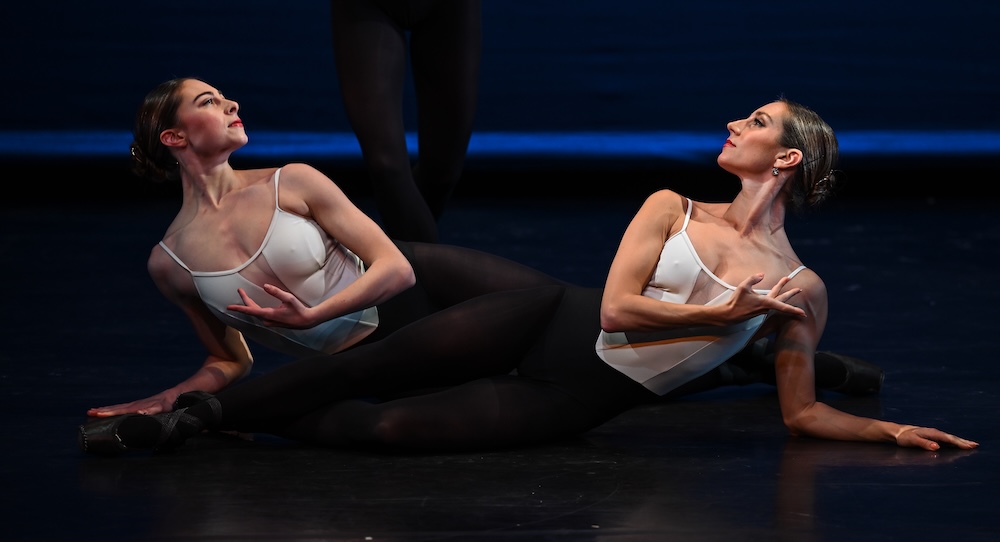
James Whiteside’s trio City of Women (2021), following intermission, burst with elegance and personality. Whiteside originally choreographed the work to bring together three dancers from different stages of their career (Gillian Murphy, Isabella Boylston, and Catherine Hurlin), and thus explored the idea of legacy and mentorship in our art form. That concept gave this lighthearted work deeper significance – and it smoothly held both intents.
Through costumes – unadorned, chic, and in muted colors (from Elevé Dancewear) – as well as unison movement, commonality reigned. Yet each dancer also exhibited unique personality: Heather Nichols with breezy and bold confidence, Anjali Hern with youthful sweetness enhanced by mature artistry, and Anna Lisa Wilkins with a subtle and mysterious je ne sais quoi. Such individuality harmoniously blended with the unity also present. These were women working in tandem, yet doing so with their own approaches to life and art.
In that unity was support, embodied in kinetic connection: a hand to the lower back of another dancer, palms together overhead. The dancers also had ample time to dance their own movement, apart from the group – each even enjoying a solo section. Both things could be true, both community and independence thrive.
Whiteside’s movement was just as elegantly spare as the costumes: bourrees, bevels, strong port de bras, with turns and legs rocketing through space to spice things up a bit. It was a neoclassical foundation for the personality that these stellar artists brought to the stage. Filled the stage, really: needed with small groups, and also no easy task. Here, in a choreographic sense, less was very much more.
Toward the end of the work, the dancers literally let their hair down – a metaphor for relaxing and releasing stress and expectations, yet which also offered an opportunity for further distinctiveness and dimension in movement. If the stage could be their own city, it definitely was. Through singular theatricality, classiness, and effective understatement, they fully claimed it.
Closing the program was Yanowsky’s atmospheric and edgy The Bathers (2025), which I very much enjoyed last year. Yanowsky explained in a video before the work how they worked on refining it for this program. That hard work was quite evident to me. The work was always spectacular, in the strictest sense of the word; one couldn’t help but be captivated by its athleticism and kinetic sophistication.
Yet, this iteration brought dynamics that made the work more pleasing than captivating: rhythmic variance, degrees of expansive through space, overall energy sometimes softening so it had somewhere to go and feel really explosive. What a joy to see a work evolve this way, and congratulations to Yanowsky and the ensemble for making that happen!
This year’s In Motion reminded me that sometimes we don’t know what such extra time in the studio might produce. We don’t know where a vision from a song or poem could lead us. We may never know that someone living in our community has an incredibly meaningful story that needs to be told…until we do.
As Breen Combes astutely discussed, if we bring our own unique interpretations and voice to artmaking, the essence of our singular humanity can guide us to something beautiful. The sky’s the limit. We may never touch it, but it still feels good to soar. Make some movement, paint something, write a poem: go ahead and fly.
By Kathryn Boland of Dance Informa.
Share this: