David H. Koch Theater, Lincoln Center, New York, NY.
October 13, 2026.
What a treat to see an all-Balanchine program performed by Balanchine’s own company, New York City Ballet (NYCB). With four vastly different works, All Balanchine I was a fascinating celebration of the choreographer’s creativity and the versatility of the company he founded.
From haunting theatrical storytelling to abstract, mathematical movement, ethereal beauty and the grandeur of Russian classical ballet, the evening showcased just how varied Balanchine’s choreographic language could be.
Opening the program was La Sonnambula, originally titled Night Shadow. Traditional in its theatrical presentation, the ballet was colourful, haunting and mysterious, transporting us into an intriguing world of dreams and intrigue.
Principal Dancer Unity Phelan was captivating as the Sleepwalker. Her movement was beautifully controlled, yet she appeared almost weightless, gliding through the choreography with an otherworldly quality. There was an exquisite stillness and delicacy to her performance, even as she moved, which made her utterly compelling to watch. She was certainly the standout of the work.
Daniel Ulbricht brought a completely different energy as the Harlequin. Jovial, playful and full of life, he attacked the role with gusto and clearly enjoyed every moment on stage. His exuberance was a delightful contrast to Phelan’s mysterious presence.
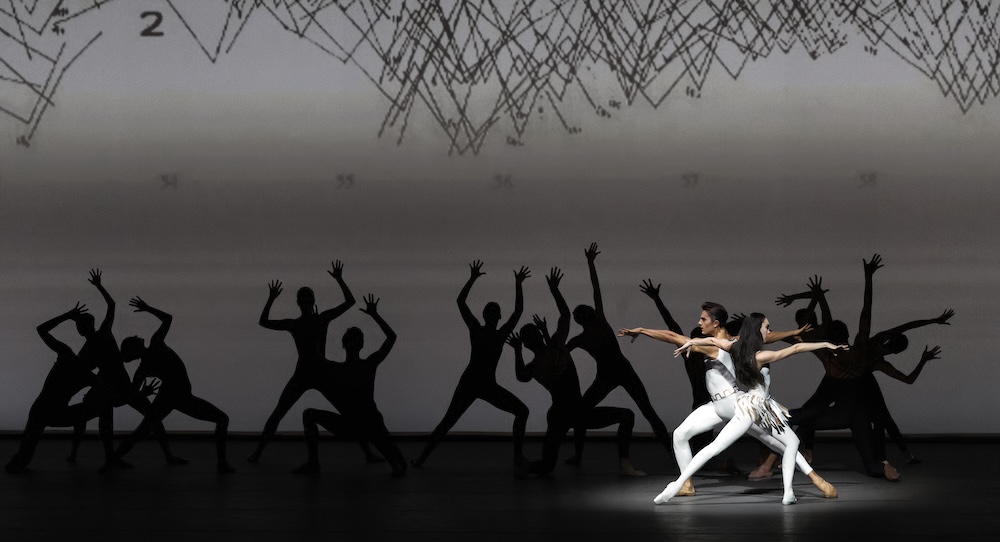
Next came Pithoprakta, and what a change of pace. Suddenly, we were transported from a traditional theatrical ballet into a stark, almost futuristic world of shapes, sounds and patterns.
First performed in 1969, Pithoprakta must have seemed incredibly cutting-edge at the time. With its mathematical formations, unusual partnering and space-like, almost intergalactic score, it was a fascinating example of Balanchine’s more experimental choreography.
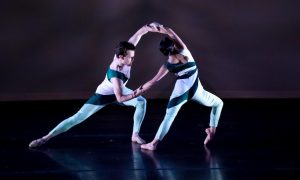
The dancers wore black unitards, with the featured performers in white, creating a striking visual contrast that emphasised the shapes and patterns of the movement. The choreography was angular and inventive, with bodies forming intriguing configurations and continually shifting relationships across the stage.
What impressed me most was the dancers’ ability to perform with such exacting precision, yet with a sense of abandon. This is an incredibly difficult balance to achieve, particularly in choreography that relies so heavily on timing, spatial awareness and coordination. The company executed it with remarkable confidence.
Although it would have been considered very modern and contemporary in the late 1960s, today Pithoprakta has an almost retro-futuristic feel, which I thoroughly enjoyed.
The third work, The Unanswered Question, continued the black-and-white colour palette but took us into an entirely different world.
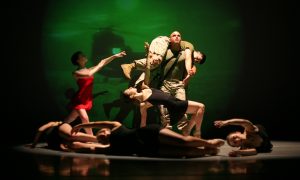
Ashley Laracey, dressed in white, was carried across the stage by male dancers clothed completely in black. The effect was mesmerising. As the men moved seamlessly beneath and around her, Laracey appeared to levitate, floating through the space as though untouched by gravity.
Cainan Weber portrayed a yearning figure, reaching for her as she drifted beyond his grasp. There was something beautifully poignant about the relationship, with the choreography creating a sense of longing for someone who could never quite be reached.
The cleverness of the partnering was particularly impressive. The supporting dancers worked with such precision and subtlety that the mechanics of the lifts seemed to disappear, leaving us with the illusion of a woman suspended in midair.
Ethereal, mysterious and wonderfully otherworldly, The Unanswered Question was captivating. It was also frustratingly short – I wanted more!
And then came Theme and Variations. What a glorious finale!
After the contrasting moods and styles of the first three works, this was Balanchine in all his classical splendour. A jubilant celebration of Russian imperial ballet, Theme and Variations was, for me, the triumph of the evening.
Visually, it was exquisite. The rich colour palette of ice blue, peacock blue, ivory and mandarin orange was stunning, particularly against the elegant backdrop of chandeliers. There was a wonderful sense of royal grandeur, and the stage seemed to sparkle before the dancing had even begun. And what dancing it was!
The choreography demanded intricate, lightning-fast footwork, crisp batterie, musicality and seemingly boundless energy. The dancers rose to the challenge with confidence and flair, delivering a thrilling display of classical ballet technique.
I particularly enjoyed Balanchine’s use of the corps de ballet. Rather than simply providing a static backdrop for the soloists, the ensemble was continually involved, creating complementary shapes and smaller movements that enhanced the featured dancers’ choreography. This layering of movement was fascinating to watch. Even when the focus was on a single dancer, the stage remained alive with activity, the corps adding texture, energy and visual interest without distracting from the soloist. It was a wonderful example of Balanchine’s musicality and his ability to choreograph for the entire stage.
Principal dancers Indiana Woodward and Joseph Gordon led the cast with accomplished, assured performances, displaying the technical precision, speed and energy that this demanding choreography requires. They were beautifully supported by the corps de ballet, whose impressive unity and musicality added to the excitement. The energy continued to build throughout the work, culminating in a magnificent flourish of movement, colour and classical virtuosity.
It was exhilarating, joyous and utterly satisfying. I could have happily watched it all over again!
What made All Balanchine I so enjoyable was the sheer diversity of the program. Across four works, we experienced Balanchine the storyteller, the modernist, the dreamer and the classical master. Each ballet offered something completely different, yet all bore the unmistakable inventiveness of his choreographic voice. Balanchine’s legacy is clearly in very capable hands, with today’s NYCB dancers demonstrating not only the technical strength required to perform his choreography but also the versatility to bring such contrasting works to life.
By Deborah Searle of Dance Informa.
Share this: