The Elks Lodge, Newport, RI.
October 18, 2026.
“When you look inside, everything else escapes,” poetically quipped Danielle Genest while introducing Newport Contemporary Ballet’s 2026-2027 Season Opener Kaleidoscope. She discussed how through a kaleidoscope, elements such as light, shape and color constantly shift and change. Art evolves in the same way. And so do we.
Much food for thought before anyone danced a step! Yet, the program offered such a kaleidoscopic view: of varied atmospheres, aesthetics and moods. All in all, the program set the tone for an exciting season to come. It had me leaving the venue with much to turn around in my mind – after this commendable company danced many steps, indeed.
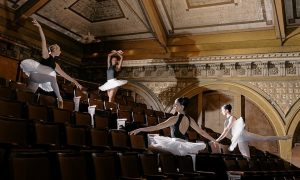
The program kicked off with the atmospheric and poignant Nightshades (2026), from Genest, the Company’s Artistic Executive Director. The ensemble began with rising slowly, holding a gesture. They found variance of direction as they moved in unison – variance that they brought farther into the stage space as movement gained size.
As movement so escalated, it displayed memorable kinetic resonance: spines rippling, a reach extending past its endpoint, momentum transferring from one dancer to another in a weight shift. These reverberations created a soothing sense of continuity, but also mystery; where a movement would lead felt uncertain. Such diachotomy seemed to underscore the “duality, secrets and forbidden knowledge” within Genest’s stated theme: light and shadow texturing the view in the kaleidoscope.
A solo from Sarah Murphy carried the ensemble’s quality of continuity – her rock-solid strength as foundation for fluidity. A following duet added dimension through another moving body. I thought of moving shadows in the night, fluctuating in thickness and texture. The midnight hues and variable shapes in Josh Thake’s costumes undergirded that feeling.
The ensemble returned. They moved through complex timing and formation shifts with true unspoken understanding – including those new to the company this year, Ena Nomoto and Erik Osterkil. I also noticed at this point a reflective, internal quality in certain gestures: a hand drawing under chin and across forehead. I thought of looking up at the night sky and reviewing the day behind, anticipating the day ahead.
Concurrent with that inwards sense was one of support: catching before a fall, lifting through a turn. That looking backwards or forwards in time need not be done alone. The ending section was vibrant, full of zippy jumps and high lifts. The ending reversed the beginning – pointing to the endless cycle of day and night, perpetual shadow and light. Duality is the constant.
The shadow part notwithstanding, both the unity and energy at hand had hope rising in the ether – more so than I’ve felt with Genest’s works in the past. I would love to see her continue in that direction; we could all use it. Yet, with works like these, I’m ready for whatever she might keep offering.
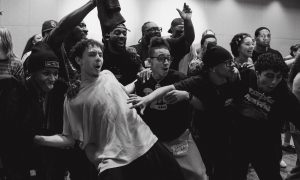
Next came the thoughtful and rigorous Judgement and Justification (2026) from former Newport Contemporary Ballet Dancer Lauren Difede. The work explores “our perceptions of manipulation, power, closeness, and love in our interpersonal relationships and worldview,” noted the program. Costumes of stylized pedestrian wear (from Difede) placed the ensemble as everyday people. Dancers took to their feet, in their own turns, to interact.
There was support in how they moved together, but perhaps more so a sense of constraint: of stopping another dancer’s path short. Other webs of constraint emerged from dancers following the paths of other dancers – fitting into a groove of conformity. Intentional gazes translated interpersonal tension – arising in those moments of judgement and justification.
Difede’s movement was plenty virtuosic and technically-grounded, yet the dancers came off as humans shifting through interactions rather than dancers moving through sequences. That felt effective, even important, for this piece in particular – given its theme.
Musicality also felt effective; the dancers rode the continuity of the score’s melody (by a number of artists, including Philip G. Anderson and Max Richter), yet were also precise with the harmony line’s driving accents. Slower sections toward the end translated the moments of silence within such interpersonal tension.
Perhaps that’s when someone leaves the room and the situation feels unresolved – as occurred here, with one dancer exiting stage left and tension humming in the air. Then came the opening tableau and lights down – bringing another full-circle ending. That made me reflect on the truth that such interpersonal strain will transpire so long as humans do. We move forward regardless.
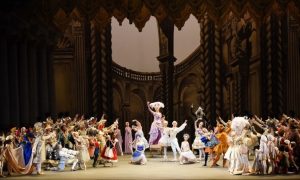
Katarzyna Skarpetowska’s wholesome and uplifting The Wanderers (2026) closed out the program – and thus brought quite the tonal shift! Also the most classically styled of the program’s works, it reflected the easy, breezy formalism of work from dancemakers such as Alexei Ratmansky. In its effervescent locomotion, it reflected pieces like Paul Taylor’s Esplanade.
The allegro instrumental scores (by Elena Kats-Chernin and Jean-Baptise Barrière) supported such soft and bright classicism. Frequent use of canon timing instilled the sense of a babbling brook, flowing on and on but from time to time bouncing up on a stone.
The dancers really did seem like wanderers – continuing to explore different formations, interactions, and kinetic possibilities. It was plain lovely to see them smile through it all, with many works that this company does calling for a graver expression. Those more somber works have their meaningful place. So do works like these that can make us smile and feel lighter.
As in all works in the program, the work’s varied speeds and orientations of dancers reinforced the qualities at hand. A pas de deux (danced by Ena Nomoto and Erik Osterkil) slowed down the speed of movement, but maintained the light, bright mood. They settled into refined elegance as they expanded into and moved through Skarpetowska’s vocabulary: sometimes partnered, sometimes independent. An all-male section following that brought a sense of high-flying bravado to the continued lissome and joyful tone.
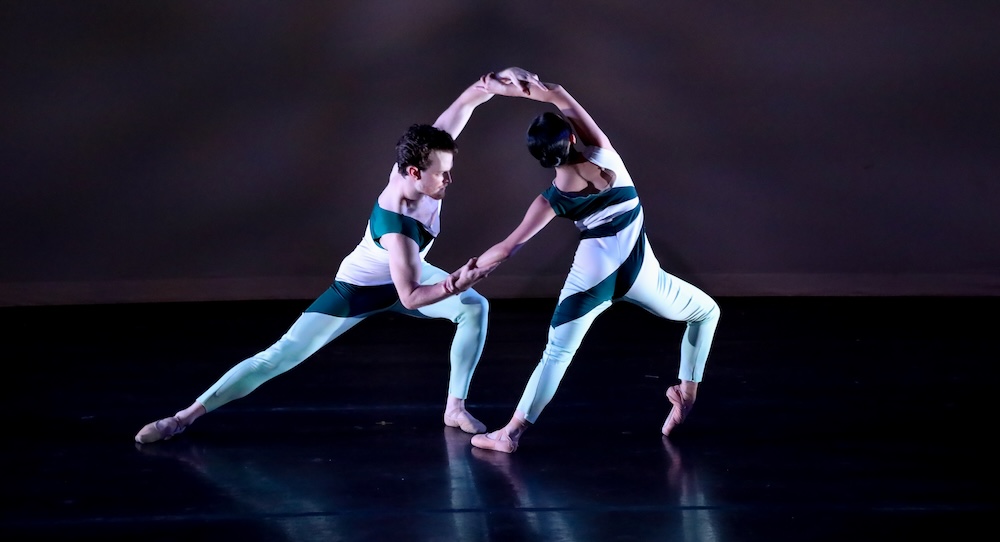
All of this continuous action brought to mind spring, with new life buzzing throughout the natural world. Perhaps, now in October, we could also think of that as creatures busily preparing for winter’s chill. Either way, natural harmony resonated (which Brianna L. DeLuca’s white and green costumes also supported). Nature’s cycles persist; continuous movement continued until just before the lights dimmed.
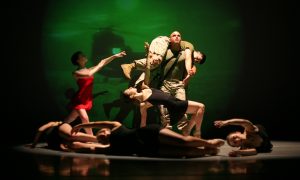
I also enjoyed seeing Emily Baker’s Shattered Glass (2026) again, coming after intermission and before The Wanderers. I saw things I hadn’t seen when I reviewed it this past summer – such as incorporated gestures, nuances of elements like levels and spacing, and implications of costuming. The theme of systemic limitations and repressions hit home even more profoundly for me because of these far more personal, small-scale choices.
Just as with gazes into a kaleidoscope, we won’t experience a work of art the exact same way twice. Our lens each time has changed – whether from a changed context and/or how we have changed. Each look in a kaleidoscope brings innumerable things to see: angles, colors, shapes, movement. We can only appreciate what we can manage to catch each time. The next view will bring a whole new set of endless possibilities. I’ll be there for it – until next time, Newport Contemporary Ballet!
By Kathryn Boland of Dance Informa.
Share this: