Emerson Paramount Center, Boston, MA.
November 15, 2026.
“Dance is what happens between here and there,” a college dance professor of mine used to quip. There’s of course a lot more to it than that, but the art form of dance lies in change on a spectrum: stillness to action, internal to external, slow to fast, so on and so forth.
The concept of “continuum”, the very title of Lam Dance Works’ latest program, got me thinking about dynamics on a spectrum. John Lam himself even described how for him, the idea implies that “we are never still”; there is always evolution.
The program’s six works – all world premieres or at least premieres to Boston, each from a different choreographer – demonstrated varied relationships with this idea of dynamics evolving. For me, that relationship had a big impact on how I received each work. Apart from that, each work sprung from a singular conceit and kinetic voice.
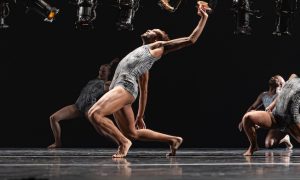
Ali Cederholm’s rooted, earthy trio Cisne kicked off the program: danced by Molly Jane Dunne, Ekko Greenbaum, and Aja E. Simms. It began with simple gestures and movement in the side-to-side plane – movement which took on size, speed, and layering, yet also maintained essential characteristics of where it started. We thus saw movement evolve in real time.
The design aesthetic was uncomplicated: monochrome background, two tones in straight-angled costumes, wide berths in warm lighting (lighting design by Kahnor Mulligan). Even with the body-level complexity of Cederholm’s movement vocabulary, it also offered a straightforwardness: clear stimulus catalyzing intuitive response.
In program notes, Cederholm described individual and community dynamics: “observance of our individual sensitivity, tendencies towards conformity, and attachment to the self in relation to the pressures of the world.” Dancers built community with such choices as moving together while back-to-back in a circle: all of them united in the face of any external force.
Inevitable individuality also came; at times, one dancer moved alone concurrently with the other two in a duet. Such orientations smoothly shifted, dancers spinning off into new positioning like orbiting celestial bodies.
This continuous motion created a certain level of restlessness, yet the unobstructed and unaffected qualities at hand also infused harmony. The dancers embodied both feelings, holding that spectrum within themselves, such that I could settle into the dichotomy and savor the richness at hand.
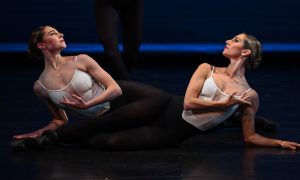
Chloe Crenshaw’s Synthetica, danced by D’Angelo Castro and Zack Sommer, brought quite a tonal shift: into something with a unique, even bold and edgy, atmosphere. Yellow lighting illuminated the duet pair (also by Mulligan). Their white and silver costuming (costume design by Jules Pryzbylska) took on that color.
They moved, with much muscular accenting yet also pleasing continuity, to electronica tones. A switch to a new score brought a new flavor of visceral nuance. The pair danced with musicality keen enough to make such a distinction both overt and interesting.
They rarely separated, most often physically connected: by the crowns of their heads, arms, or even presence in each other’s negative space. I thought of the mythical Janus, the two sides of a coin.
In program notes, Crenshaw described how the work investigates the distinction between separation and closeness. I wondered if that theme might have resonated more with the dancers moving in more of the stage space and farther apart from each other for more of the work: something to perhaps uncover with further iterations of the work, if there are those!
What did feel surprisingly apparent to me, for a non-narrative work, was emotional range: particularly towards the end, with a shift from borderline aggressiveness to notable tenderness. The pair also danced with both intricacy and expansiveness, specificity and speed: continuous evolution on various continua. The dancers kept vigorously moving as lights came down on them to end the work. Evolution continues.
Jon Ole Olstad’s evocative duet Dust and Water brought another shift of tone and atmosphere, to the feel of a shadowy, foggy night. Lighting (from Mulligan) refracted through rising smoke. Grays, blacks, and whites in costumes (from April McKoy) added to the shadow aesthetic.
The movement was again unquiet: continuous and unsettled. High speed and notable expansiveness contributed to that feeling. Styles Dykes and Karina Isabella Jiménez moved sometimes together, sometimes with one still as the other danced.
Repeated patterns of reaching and contracting brought a strong sense of yearning and pathos. Reaching and circling movements continued even as they seemed to break from the pattern – as if they were somewhat stuck in grasping for the unattainable. The agitated cycle continued, yet they were at least not alone in that; partnering offered a palpable sense of support and connection.
The evolution of dynamics struck me as less effective in this work; speed and expansiveness didn’t vary enough to make virtuosic extremes as enticing as they could be, it seemed. That was likely the effect of creating that feeling of restlessness, which may not have come through as much with more dynamics. It’s always a give-and-take, and there’s rarely – if ever – a “perfect” choice! All in all, the work was pleasing in its fresh aesthetic and robust, tenacious movement.
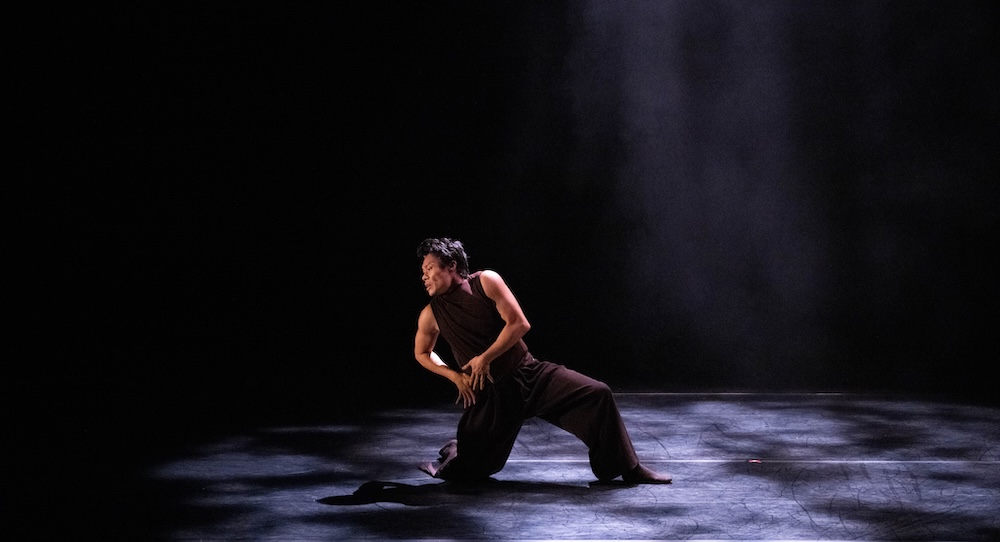
John Lam danced Ken Ossola’s memorable Moving Mountains. He walked forward into a smoky spotlight. His soft articulating gestures gained size. These gestures evolved to ride the layers in the polyrhythmic score. Lam’s textures – nuances of timing, gaze, force, and more – kept me absorbed in his kinetic exploration.
The atmosphere was almost mystical, ethereal: via tones in the score, smoke rising through light, and the searching quality of his movement. We were all along for the fantastical adventure in movement. Lam brought assured, confident command to that adventure – like an expert climber trusting in each foot- and hand-hold, slowly but surely summit-bound.
Robert Stephen’s duet Re:Connection brought something more tender, emotional, even narrative – brought it with both depth and sincere care. Making tangible Stephen’s stated theme of communication (and miscommunication) in relationships, Jenna Savella and Robert Stephen (also dancing in the work) moved towards and away from physical connection. They began by bringing the shape of a slow dance toward each other – holding it for themselves as they traversed the stage to meet at its center (just a pinch endearingly awkward!).
From there, movement certainly had distinct elements of technique and virtuosity – yet at the same time maintained the unforced, unperformative quality of a slow dance. Presence and connection were what mattered.
When they separated, that separation was palpable, yet so was the warmth that remained. In one poignant moment, they reached towards each other while rolling across the stage: something simultaneously frenetic, yearning, and dynamically rich.
Energy rose and became lighter, less laden with turbulence, towards the end of the work. Joyful turns and small jumps had my heart leaping right along with them. It felt like reconnection – which, by the work’s ending of them easefully resting together, felt like theirs to keep.
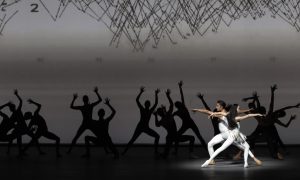
The program closed with Yury Yanowsky’s The Bathers (from 2025, yet making its Boston premiere in this program). I’ve seen the work on three other occasions, and I still saw new things this time. So it can go with bold, complex works like this one!
Perhaps it was the effect of thinking about dynamics, perhaps the recent evolution of the work that Yanowsky has described, yet I saw more of that here: more levels in speed, force, weight, and space. That helped me feel more absorbed in the work’s world: atmosphere, energy, and the suave confidence that the dancers delivered.
In his opening curtain speech, Lam also discussed the choice to support live art – like everyone at the theater that afternoon had. Such presence and support are necessary for art to have its own evolution: like The Bathers has, like (I’m sure) each of these works has in their own ways, like they still could have. That’s how we experience the dynamics, the spectrums in which meanings lie, that make art art. I hope to see you in the theater!
By Kathryn Boland of Dance Informa.
Share this: