Boston University Dance Theater, Boston, MA.
March 8, 2026.
“Ballet can be so many things,” affirmed Margot Parsons, Producer/Artistic Director of Boston-based DanceVisions, Inc., in her curtain speech for Curtain Call. The program, which the company curated to include a variety of voices from across the local ballet community, stood as an Exhibit A of her claim.
It made me reflect on the “post-postmodern” ethos: neither holding firm to tradition or outright rejecting it. From this perspective, what matters most is what supports the art at hand, and the rest is – arguably – just labels.
Either deriving from tradition or its eschewing, so long as crafted with intention and rigor, anything can work well…rather, it can be great. That offers concert dance boundless possibility, its only limitation how daring and imaginative its artists can be. Curtain Call demonstrated all of that as well. The program’s nine works were all world premieres, unless otherwise here noted.
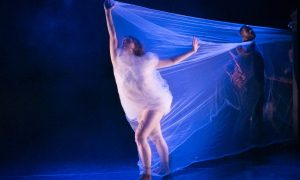
Ruth Fentroy’s meditative Between Waters, a short work of big ideas, opened the program. In front of projected video of a shoreline, she moved with notable ease: unforced, with no pretensions or anything to prove.
The white of her costume reflected the purity of water, its flow liquidity. Her shapes and lines were precise, but also aqueous: entirely satisfying entirely without gigantic leaps or sky-high kicks.
In voiceover, she asked if the divine could be in water – if that could be why she’s always been so drawn to it (thus far a mystery, she also noted). I reflected: if the divine might be in water, we are 60% water…so is the divine in us?
Fentroy’s voiceover implied as much; in the work’s closing, she called us to meet – with a small movement or even a whisper to ourselves – the divine in the water out there with the divine in the water in us.
My head might have exploded with the immensity of that idea. Yet, I was also quite pleased to savor her movement in soothing harmony with the water images behind her: a magical confluence.
Katherine Vigly’s Artificial Moonlight, featuring her fellow Ballet RI company members Alexandria Troianos and Stephen Gunter, served up equal parts soul and technical mastery.
Troianos’ movement, with her alone in a spotlight, spoke to me of resilience: through accents and gestures of crafted tension, to find length and lift on the other side. Intentional gaze and a lift of her heart added to the sense of hope that such movement created.
Gunter entered to support her weight, in various ways – yet she still moved forward from her own strength and volition. In both time and space, they came together and apart: a dance of tender relating.
With their keen kinetic attunement as a pair, it wasn’t hard to see that they dance together professionally. The ending, in particular, also struck me as a lasting image: her softly releasing into his shoulder as the score (by Dvořák) hit a poignant accent.
Robert VerEecke’s Seasons Suite (Autumn/Winter) entwined poetry and movement in a way that similarly left me thinking big thoughts, asking perhaps unanswerable questions – but I would also have been more than content to enjoy the beauty on offer.
Poetry from and read by VerEecke instilled the theme of breath and its cycles. Movement danced by Wendy Rose and Cha-Cha Epps depicted the qualities of autumn into winter: active, yet easeful, shifting into something more constrained and accented…of course another perpetual cycle.
All of the movement, however, carried that same idea of “less is more”, the same that helped Fentroy’s work feel so effective for me: nothing jaw-droppingly gymnastic or athletic, but immensely pleasing through its integration and intention.
Epps, in particular, danced with a balance of propulsive power and fluidity that had me wanting to watch her dance for longer. On that note, I might have enjoyed more time for the two dancers to dance together at the end (they did, briefly) – yet perhaps there’s opportunity for that in future works. I hope to see it happen!
Margot Parsons’ trio The Eternal Feminine (2024) came next, bursting with elegance and grace. Christine MacDowell, Maria Rogler and Elizabeth Rookey danced together as one unit, but also as a set of distinct personalities: the result of both their performance quality and Parsons’ skilled crafting of space and time.
There was just enough action across the stage to keep the relationships between these personas dynamic, yet not so much as to clutter or overwhelm. Flowing dresses designed by Freda Romberg added dimension and further flow to Parsons’ lively movement vocabulary.
I might have expected something with this work’s title to have more overt images, assertions, et cetera with respect to gender and even gender equality. Yet perhaps the work made such a statement without making it, “showing” feminine grace and power rather than directly “telling” us viewers about it – and may have spoken all the louder as a result.
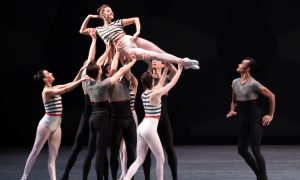
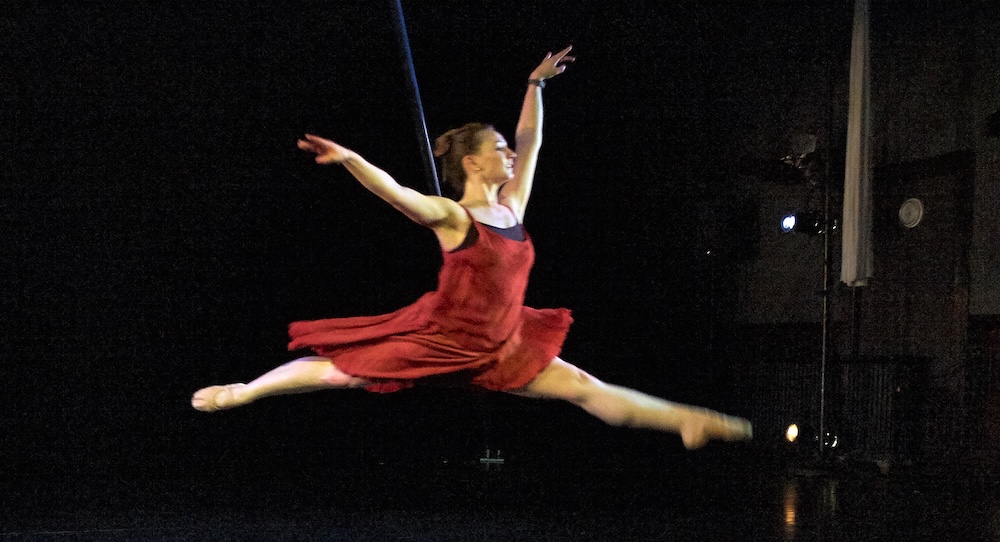
Janelle Gilchrist’s Crimson Shadows (2024), an intriguing look at something breaking the mold of a classical context, closed the first act. By and large, the movement was the most classical in the program: fully lifted, based in that vocabulary, and often employing traditional pas de deux.
Yet, the persona of one dancer wearing something different (dress designed by Ruth Bronwen) and moving with a more released, softened quality brought something new to the group: a new way of seeing, of being, of understanding possibility. The larger group surrounded her; difference is almost always challenged.
To end, the dancers all surrounded and created a clear shape over her: protection or constraint? Those are just the sort of open questions that keep me endlessly fascinated with this art form.
Yury Yanowsky’s Fading Creatures (2025) opened the second act. Like most of his work that I have seen thus far, it was compellingly edgy: through electronica music supplying a certain tension to the ether (by Senking for this one), uniquely intricate, athletic movement vocabulary, and dancers who more than meet the considerable challenge at every count.
I always wonder what sort of other moods and atmospheres he might bring that choreographic command to creating – I bet those could be remarkable. What he does present, however: I’m spellbound every time.
Kathy Hassinger’s The Source (The Deep – Streams – Still/Moving), danced by Mitzi Eppley and Li-Ann Lim, brought understated ease back to the stage. They moved with an Isadora Duncan quality of finding bliss in simple steps, leaps and locomotion. Their breezy skirts enhanced that free-flowing feeling. Score (from Beethoven) and lighting (by Lynda Rieman, as throughout the program) met that visceral joy through bright, uplifting tones.
Like with VerEecke’s work, Eppley and Lim were distinct as personas – both through performance quality and intentional choreography (and as with Parsons’ work, being just dynamic enough in time, space, and through the body). Yet, they also moved together with harmonious understanding: a powerful reminder that individuality and collectivity are not mutually exclusive – and beyond that, are both necessary.
Naoko Brown’s The Path presented her exceptional movement quality and unique choreographic voice. Effective variance in the tempo of her movement – through pauses, acceleration and deceleration – allowed each speed of movement to resonate more.
I wondered if the same variance in the intensity of her movement – in size, in the power she put behind it – could have had a similar impact. Either way, she danced with both inspiring passion and committed command, and I hope to enjoy more from her before too long.
Another work from Parsons, the intriguing Prelude for The Three Women (2025), closed the program. I say “intriguing” because while the movement and color palette were largely smooth and calming, the score (from Jeroen van Veen) was driving and accented – and thus brought a turbulence to the atmosphere. I wondered about a potential significance to such dichotomy. As this was a “prelude”, perhaps the longer work to which it belongs answers that question.
In any case, the same three dancers (McDowell, Rogler and Rookey) moved together with wonderful attunement: a group that clearly knows each other and itself inside and out. Parsons applied some fresh, mysterious gesture in this piece – perhaps with significance becoming clearer in the context of the larger work, but kinetically satisfying even without that.
“Kinetically satisfying”, as well as satisfying in many other ways, is how I’d characterize the program overall – even as it presented a smorgasbord of varied concepts, atmospheres, and movement styles. Parsons was right: that is all possible under the umbrella of “ballet”, and all of it can be wonderful.
For my part, dear reader, that’s one reason (amongst many others) why I love this art form: so much is possible, and – so long as it’s created with sufficient thoughtfulness and rigor – none of it is “right” while something else is “wrong.” That leaves so much to be explored and to be enjoyed. So let’s dance on!
By Kathryn Boland of Dance Informa.
Share this: