Park Avenue Armory, New York, NY.
March 14, 2026.
A tale as old as time, that of unrequited love, with some modern twists took the stage (and much of the other space) at the Park Avenue Armory in March, in a retelling of Romeo and Juliet by Benjamin Millepied and the L.A. Dance Project. Audiences entered into the grand drill hall to a bare stage, save for one red couch in its center. That, and a massive video screen suspended above the stage. In this production, the live filming element plays as much of a role as the dancing on the stage.
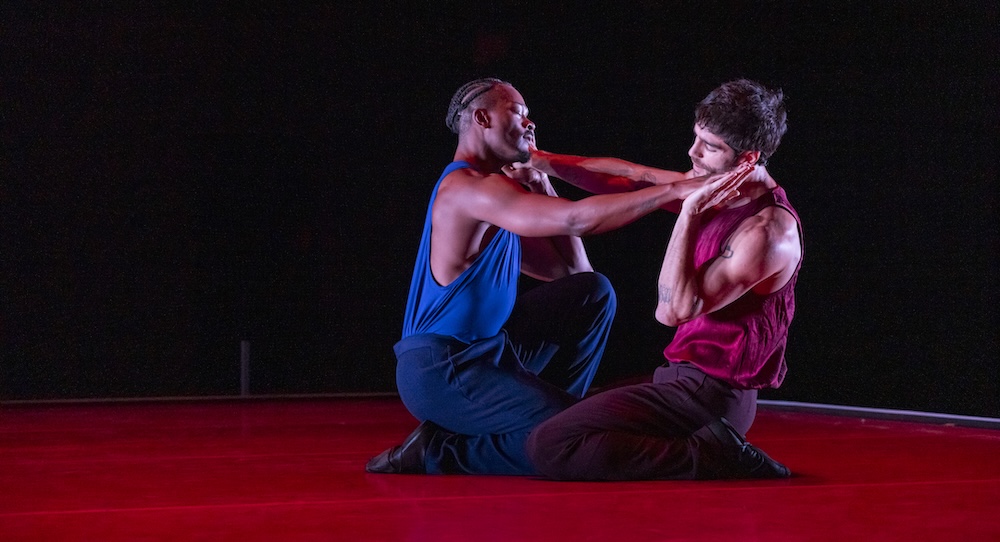
It’s a spacious telling of the story. There were wide liberties with story and characters. The leads, Romeo and Juliet, might be danced by two women, two men, or a woman and a man on any given night. In the way that love is limitless, Millepied unbinds the traditional gender pairing on some nights. On the eve of my attendance, we saw two men as the leads – identifiable by each standing next to their names (Romeo or Juliet) scribbled in chalk on the wall prior to their first entrance. For me, the gender did not influence the power of the story. That said, in conjunction with some of the other elements of the show, the characters throughout became confusing from time to time. As this production was far from a literal interpretation of the play, certain characters (both characters’ parents) were fully absent and others became absorbed in the ensemble. Without the bedrock of warring families, the tragedy of forbidden love between two of their youngest members is diminished. Certainly, the story can endure some simplification, but there’s a particular agony negotiating one’s family and one’s love, and that we did not see.
Visually, it’s stark. Aside from the couch, the only set pieces are long, fluorescent light tubes the dancers use to create various structures, barriers and elements. However, this is a cinematic work as well, and the live shooting takes the audience all over the Armory, which is anything but stark, and deeply ornate. The juxtaposition is odd in the sense that the action onstage feels modern, but the filmed portions show a more specific time (based on the architecture of the late 1800s, when the Armory was completed). Part of this process utilizes the idea that the location is its own character. This production, performed in several places globally, inherently produces a different a feeling each time, given the different architectural qualities.
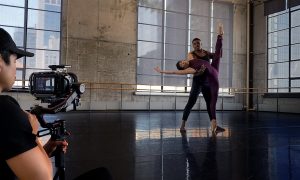
According to Millepied, integrating the film work so much into the proscenium experience allows the audience to have a more intimate view of the dancers – in fact, the camera work is done by a former New York City Ballet dancer who viewed the task much like being a partner in a ballet. Mixing film and dance is an interesting task. Having a closer and more personal experience as a result of the filming feels raw and visceral, almost like being in the rehearsal room or onstage with the dancers. It offers value to audience members who may never encounter dance in that manner. It can also be difficult visually to volley from the filmed portions to the stage portions. I’ve felt this in past performances that employed a similar technique. It’s cool, but it’s also like being tossed between two worlds. Compared to the large screen, when the dancers were onstage, they seemed tiny. But their impact felt more real and more present on the actual stage without the barrier of digitized representation.
But we were all here for the dancing, and it was delightful. It was a bit more conventional than I expected, but exceptional in its execution. When dancers possess such high level technical skills and expression, the style takes a backseat. Given the boldness in the design of the show, seeing more typical choreography felt mildly misaligned, but on its own, pleasurable to watch.
A lot happened over the course of the performance, much of it juxtaposition. I enjoyed the experience of witnessing an old and well told story from a new perspective, even if that effort pulled me out of the new world created by Millepied from time to time. I like multi-media approaches to live performance, even if it takes my brain some time to adjust, and I liked being whisked through the depths of an old and grand building, even if the footage could have been shot anywhere, at any time. Art should be challenging, both for those who create it and those who consume it. I left with much to think about, both in what was presented and my response to it. Ultimately (and always), I greatly value anything that forces my mind to reconsider its patterns and expectations, and for that, this production delivered in many ways.
By Emily Sarkissian of Dance Informa.
Share this: