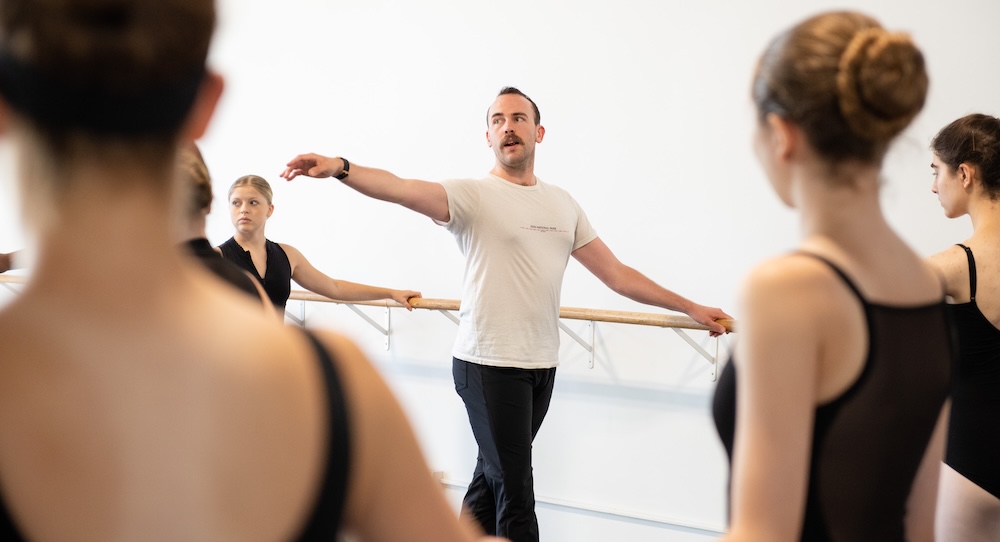
Every dancer has key memories of their early training: performing in their first show, important lightbulbs going off, reaching technical milestones, et cetera. Unfortunately, some memories may be less positive and wholesome. The dancers who go on to teach carry their education with them, as well as their broader experiences as dance artists. At the same time, advancements in both art and science can allow us to refine dance education, in the process leaving behind what no longer serves us.
All of that is in the mix with Austin Crumley’s Ballet Reeducation, a set of resources and community of educators working toward more evidence-based, holistic and effective dance education practices – and therein “improve upon, readjust and transform our knowledge to fit the standards of the twenty-first century” (balletreeducation.com). Dance Informa speaks with Crumley to learn more about how it started, what it’s all about, why it matters and more.
The origin story: How it all began
It all really started, arguably, with Crumley’s entrance into ballet at 15 years old. Already a baseball player at that point, he brought to the art form an awareness of cross-training as well as a broader lens on movement.
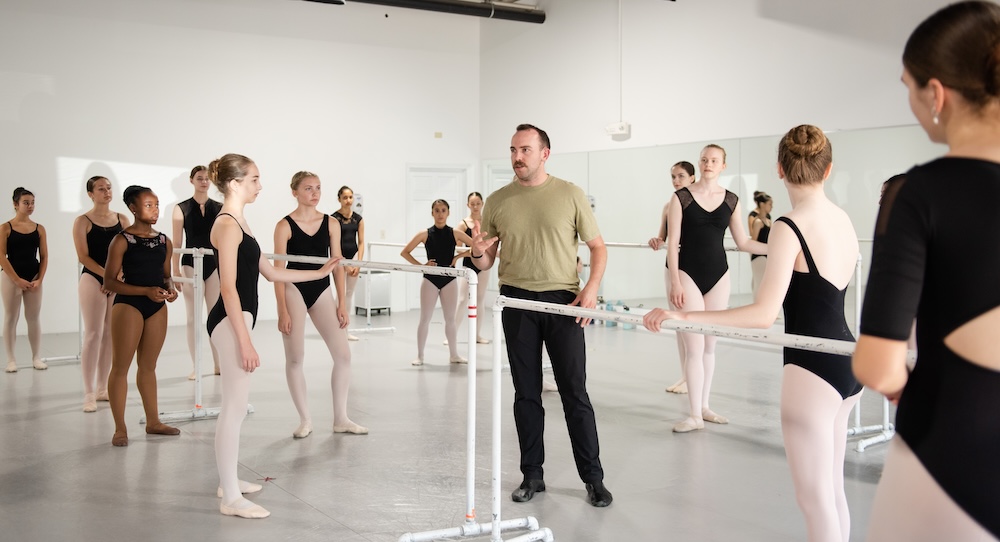
He kept working hard at his ballet craft, eventually leading him to the professional performance world. It was there that he noticed, in earnest, the need for certain systemic changes: for example, dancers’ all-too-frequent negative self-talk and competitiveness. He observed his peers, and the broader industry, and it just hit him – “these people don’t feel like they’re enough.” He saw dancers accepting less than their worth.
“Overall it was amazing, and tradition is great in its own way…but sometimes you step back and say ‘wow, this could be even more amazing,'” he shares. He came to see that such changes needed to come from the ground up – targeting issues at the source rather than applying surface-level solutions.
For Crumley, that source lay in ballet training itself: how teachers deliver information and interact with their students, for starters. “I saw what wasn’t happening in ballet pedagogy that I think needs to happen.” To do what he could to catalyze the changes he wanted to see, he left professional performance and began teaching. “I had to be outside the system to change it.”
To back it all up with hard science and proven best practices, he also obtained an MA in Education. He’s even contributed to pedagogical research. “I have an analytical lens,” Crumley notes with a small laugh. Inspired to share what he was learning and thinking, he began posting about it all on social media.
A friend encouraged him to put those thoughts out there on the internet in a more formal structure, posted on a blog. And so he did – which then brought a following of “gung-ho” ballet educators interested in his ideas and similarly inspired to be part of positive change in ballet pedagogy. “It all sort of took off from there!” Crumbley says with another laugh.
The work and mission in a nutshell
Next stop on that path: the Summer Teaching Lab, where educators gather to learn, skill-share, disseminate knowledge and more. “We call it a lab because it’s ever-changing,” Crumley notes. Like scientists, educators can hypothesize, experiment, make conclusions and share their discoveries.
Whatever such experimentation may bring, it’s always “community first; we can’t have anything without each other.” Crumley strongly believes in building a community of individuals with varied capacities, areas of expertise, networks and ways of reaching people.
A second standing and fundamental principle is science-backed best practice, Crumley adds. Finally, “it’s about deconstructing and reconstructing…not abolishing what we already have, but refining and polishing it.”
All of that should work under the ethos of human/artist first; “we don’t have the company, the art form, et cetera without them,” Crumley asserts. So many issues can be addressed by meeting basic human needs, he believes: to be seen, valued and nurtured, for one. He maintains that “so often, we can achieve artistic and technical goals from there.”
Working through these perspectives, the teacher is not a gatekeeper of knowledge but rather a collaborator in meeting the student’s highest potential. Such a collaborator is problem-solving with the student, right in the mix investigating and learning about what’s happening as they work and grow.
Student and teacher are a team, and first and foremost, the learning is about the student first. Over time, skills build and scaffold with each new achievement toward the student’s aims. This is the Ballet Reeducation way.
Learning more about this pedagogical approach, some teachers do have concerns – for example, it’s already hard enough to fit everything on the syllabus into classtime…how can I take the time for this more individualized, exploratory method?
Crumley’s consistent response: it may not take as much additional time as you think, and that bit of extra time builds foundational understandings and skills that can continue facilitating student development – technically, artistically and beyond – far down the line of their dancer journey.
It’s not about telling the student that there is one “way” to do something, but about giving them resources that they can adapt to help meet whatever challenges may come their way. “I think that also has something to offer the ‘real world’ beyond the dance classroom: building resilient dancers and people,” Crumley says.
A holistic and accessible approach
In addition to resilience, Ballet Reeducation seeks to nurture the whole person, the whole artist. “I’ve always taken that holistic approach…a person is like a city, a complex system that doesn’t work if one part isn’t working,” Crumley shares.
Evidence to support such a holistic approach comes from his own journey as a dance artist – for example, re-evaluating nutrition when he needed additional energy for his rehearsal schedule and learning tapering from sports medicine to address a certain pain issue.
As such, Ballet Reeducation’s offerings go beyond resources on teaching technique; there are those on human development, social/emotional learning, nutrition and beyond. “The mission is to offer information to meet any and all needs this person, the student, has,” Crumley affirms. Quite simply and practically, “I can’t reach this human if their needs aren’t met.”
There are often very simple things that teachers can do to help meet their needs, he adds – for example, asking them about their day or weekend and thus making them feel recognized and cared about. “Then you have their buy-in, and the experience can be enlightened. They can accomplish their objectives as a dancer and as a person.”
Accessibility is yet another value by which Crumley works – for example, with offerings in a variety of formats (online and in-person workshops, downloadable guides, blog posts and more). He also seeks to keep resources as reasonably priced as possible. “I love giving sales and building the community!” he affirms with excitement.
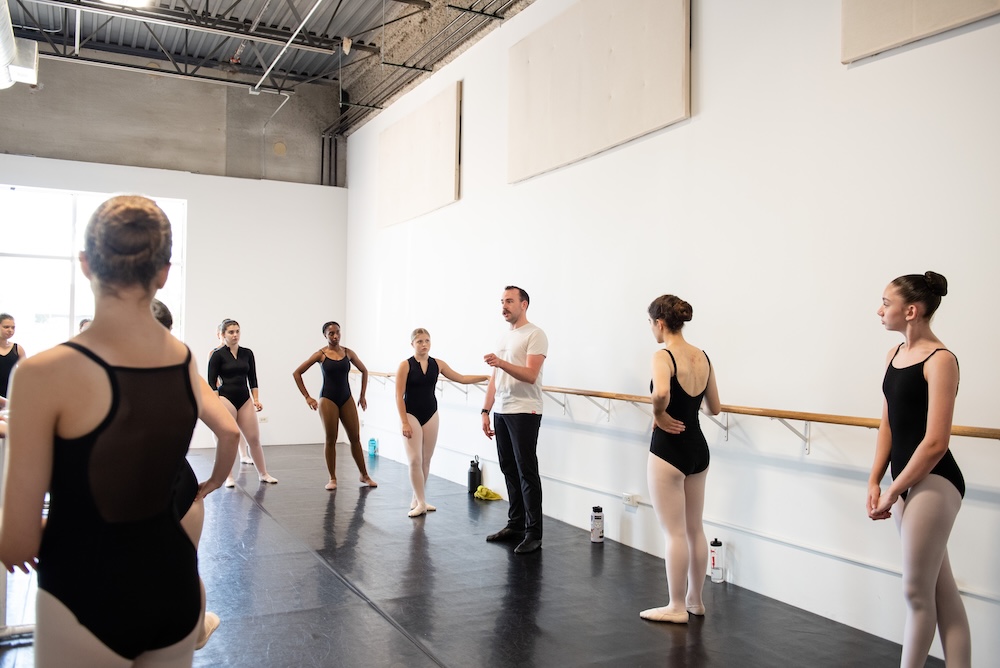
“Of course, it’s always a balance of what’s my worth and what can I offer to address this need that I see” – a balance many dance world professionals know well. Another challenge can be building a consistent community when it comes to online resources, as good as those offerings can be for keeping things more widely available. Crumley is also working to open more access points for those with varying learning challenges – those with dyslexia, for instance.
Forward, together, from here
Where does it all go from here? The next step is a new program called Year of Growth, running from January-December 2026. Registrants will have access to a variety of Ballet Reeducation resources, from masterclasses to Summer Training Lab offerings. Dance educators outside of ballet can still benefit, as the information resonates through other styles, Crumbley notes. Registration will open soon. Educators can design their own experience and choose their “niche”, he adds.
Crumley also encourages anyone interested, anyone with questions, et cetera, to reach out to him. “I’m just a DM away! I love chatting with people and being as involved with the community as I can.” He is quite clear: the point of what he does, of Ballet Reeducation overall, is to help educators make their biggest and best impact on students – and for that positive impact to keep rippling out from there. “Plant so that others can appreciate the blossom that grows…that’s the legacy, that’s what matters.”
For more information on Ballet Reeducation, visit www.balletreeducation.com.
By Kathryn Boland of Dance Informa.
Share this: