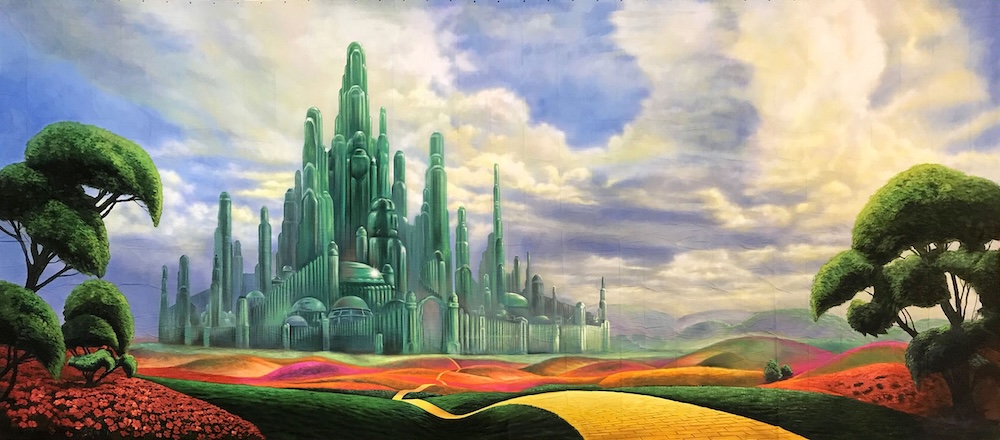
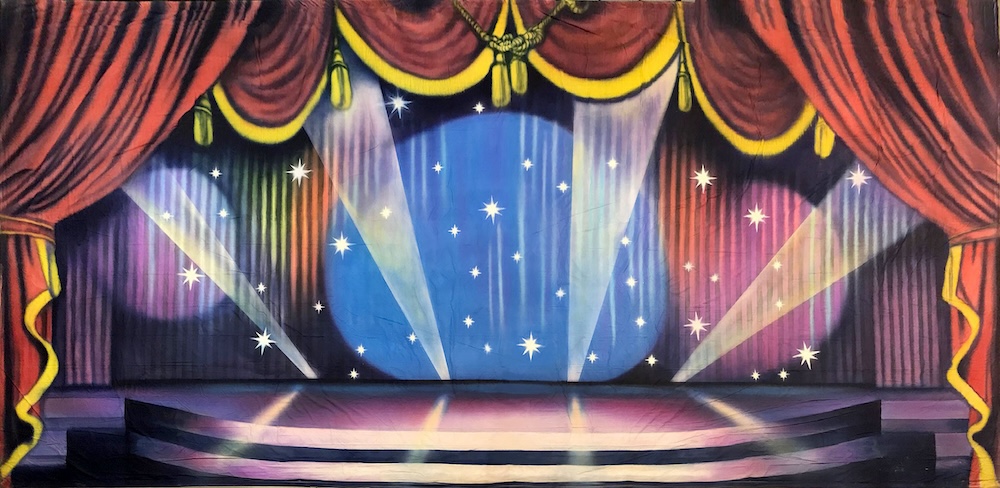
The lights go down, a hush comes over the audience. The orchestra begins the overture and the main curtain slowly rises. The stage lights glow as the backdrop sets the scene for the story about to take place. A good backdrop can set a mood; a great backdrop can transport a production to another place and time.
For over a century, Charles H. Stewart has been making and renting backdrops for all kinds of theatrical productions. The company, located in North Andover, MA, began as the O.L.Story Scenic Company. Stewart worked for and eventually bought the company, renaming it. The company was sold to George Christo. George’s son, Gregory, is the current president of the company. “George asked me to come help out in 1994. And here we are. I don’t think the mission has changed too much in that we try to provide a quality product at reasonable prices,” Christo explains.
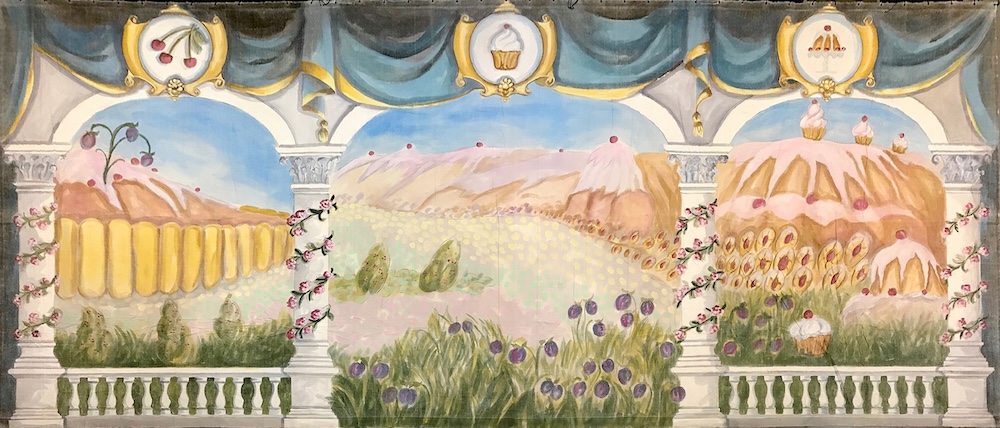
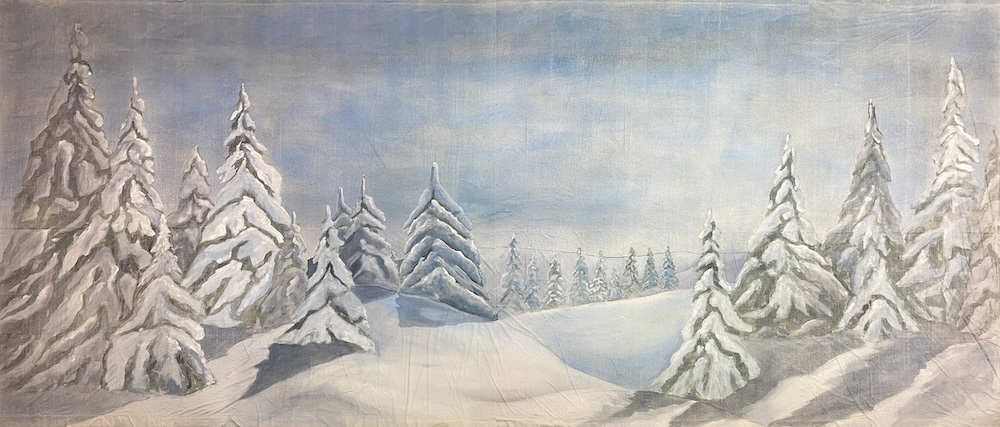
From concept to completion, a new backdrop can take five to six weeks. “First, we try to come up with ideas that we know will last through the years. Obviously, there are some designs that will wear out their welcome due to it becoming outdated or if a fad passes,” Christo says. They capitalize on a design quickly if the company thinks it falls into the fad category, expanding their inventory with as many ideas as possible. Christo comments, “We also have to weigh whether we could use one more snow forest for our Nutcracker inventory, for example, or if we want to create a completely new design that we do not have.” Like anything in theater, he says, most of the time, it simply comes down to timing.
The alluring, museum-like quality of the artwork is not painted in-house. “I do not paint (wish I did),” Christo confesses. Their artist has his own studio and uses dyes. The prep work is essentially stretching the fabric, treating the fabric and painting. Christo explains, “Of course, artistic styles have changed over the years. The people who painted back in the early 1900s painted differently than the artists painting today. It’s just evolved.”
The company is constantly striving to keep its inventory fresh and up to date. “If a new show hits the scene, you have to stay on top of it,” he says. “I remember when High School Musical stormed onto the scene. We received many requests for that show.” The company worked hard, put in extra hours, and added backdrops to keep the inventory up to meet the demand.
There is a trend for theaters to use digital projections instead of hand-crafted drops. This can leave the stage looking hollow and lifeless. Christo feels that the nostalgia gets lost. “The projections are not as vibrant as hand-painted backdrops.” He adds that the overall quality of the production just feels different. The hand-painted drops add life.
The projections can look overly busy or cast shadows on the performers. “Some of the projection backdrops incorporate movement within the scene like fish swimming in an underwater scene. It can be distracting,” Christo notes. He explains further that most of their customers are dance schools and school productions. The audience is truly there to see their children. The movement in these digital backdrops can take away the focus of the audience. Something special can be missed if an audience’s eyes are taken away from the performers, even for a split second. Christo says, “The painted backdrops draw ooohs and ahhhs due to their vibrancy and artistry.”
Digital backdrops can be tricky to work with. Switching from day to night requires two different projections. With a painted backdrop, a day-to-night scene can be changed simply by using light directly on the drop. Christo mentions that spotlights don’t mix well with digital drops. “It washes out the scene. Not so with a painted backdrop.”
There is a timeless elegance to a hand-painted drop. Audiences still respond strongly to a traditional look. Christo gives a reason: “Because it’s art!” he says. “I have noticed that a lot of digital projections are similar in style. They seem to be very realistic no matter what the scene.” He explains that, although they are nice, they can come across as sterile. “A painted backdrop can have many different styles.” The company has a wide variety that can go from realistic to stylized or cartoonish. “Plus, the digitals just don’t pop when first seen by the audience.”
There are more advantages to using a physical, painted backdrop. Christo says they are easy to hang and use. “My backdrops have grommets and ties across the top for hanging. Most stages have the hardware in place to put them up.” The company also conveniently provides return shipping labels. When the renter is finished with a production, they simply fold, box, place the label, and drop the package off at UPS. Many facilities do not have the necessary equipment to handle the requirements of digitals. Projectors are expensive and prone to breakage. “Painted backdrops don’t break!” says Christo.
The company has a loyal following while working hard to bring in new clients. Christo mentions that the clients always have the same response. The customers say, “I can’t believe I didn’t use a backdrop sooner!” or “It added so much to the show!” His personal favorite is hearing that the kids love it and that it made them feel like they were in an actual Broadway show.
There are perennial favorites in their inventory. “Nutcracker backdrops are always in demand, especially this time of year, of course. I have at least a couple of clients who want their own custom styles made for their productions,” Christo says. He comments that most of those are booked out by Thanksgiving. “As I mentioned earlier, styles change over the years. While some of my older styles still rent out, the newer, more realistic versions fly off the shelves.” He notes that abstract designs are popular for the spring because they work well for dance recitals and can incorporate a myriad of dance styles.
Christo remarks that the importance of real, tangible artistry in theater cannot be underrated. That is something pixels and screens just cannot accomplish — that artistry just cannot be replaced. “I have had many people tell me that they tried projections and that it just wasn’t the same, so they went back to the physical backdrops.” He mentions that a well-executed backdrop invokes a feeling. “Seeing it up close even with all of the imperfections on some of the older ones. I guess thinking about their history can be inspiring to the point where you are contributing to that history in some small way.”
With over 2,000 backdrops and accessories, Charles H. Stewart can make your show take wings and fly.
Find out more about their backdrops at charleshstewart.com.
By Mary Carpenter of Dance Informa.
Share this: