Tag Archive | "Sydney Dance Company"

Pre-Performance Rituals


By Laura Di Orio.

Sometimes crazy, usually superstitious and always repetitive, many of us have pre-performance rituals we engage in to help us get focused and ready for the stage.  Here professional dancers dish on their quirky traditions and share what they do to prepare themselves for a show.

Christopher McDaniel, dancer, Los Angeles Ballet

In my dressing room, I sit at my station and tear two sheets of paper towels – one to place foundations and eye shadows, and the other for the brushes in the order in which I’ll use them. I also place my performance shoes on the desk in the order I’ll dance in them. I like to then freshen up, sometimes with a full shower. Then I start my makeup. I try to stay in a quiet zone before a show because I get nervous. I put my iPod on and start to listen to music that’s calming and relaxing, usually something Gospel. The whole time I am snacking on mint Mentos and graham crackers. The chewing of Mentos, which is very different from gum, calms me down and simultaneously gives me a little sugar rush.

I started this ritual while I was on my first tour with the Dance Theatre of Harlem Ensemble. I got yelled at by the ballet master for being too playful and excited backstage. So I explored the things that made me calmer. And as my repertoire on the tour began to increase and I started dancing more featured roles, I developed a love for my quiet time before a show.

Christopher Bloom, ­­­dancer, Peridance Contemporary Dance Company

I do sixteen entrechat-six before every performance. I began this during my freshmen year of college. At the Ailey School we have a very large studio that acts as a green room when we’re performing. With a whole bunch of energetic young dancers warming up, it is inevitable that little contests should break out. I got into an entrechat-six contest with a friend. Afterward, I realized that I had gotten very warm very quickly, so I remembered it for the future. So, doing them before a show gets me warm, as well as gives me confidence that I am indeed a capable dancer.

Thomas Bradley, dancer, Sydney Dance Company

I listen to Avicii’s “Levels” before every show. Adrenaline always comes knocking when it starts. Right before beginners call, I find a quiet place and rest my head against a wall and say, “Earth, fire, wind, water and spirit be with me.” It sounds immensely corny, but it’s what I do. When I get nervous, I tap my second, third, fourth and fifth fingers against my thumb back and forth as fast as possible. It’s great to distract you from being nervous and also focuses you. The reciting of the elements comes from my interest in their natural and somewhat untapped powers. I haven’t ever forgotten to do it, so I’m not sure if it’s all baloney! It certainly contributes to a stable and ‘ready’ state of mind pre-show.

Sarah Braverman Parsons Dance

Sarah Braverman of Parsons Dance. Photo by Evan Guston

Sarah Braverman, dancer, Parsons Dance

I have a few little quirks that I have noticed over the years. Pre-show, there must be Diet Coke on hand. In my dressing room, I perform my ‘shake the sillies out’ dance with the other ladies. It’s ridiculous, but it helps to get the adrenaline going. I have to get to the stage to warm up at half-hour. After doing abdominals and a little yoga, I have to crack both hips, then go through the ‘scary’ parts of the choreography.

Then comes the ‘unity breath’ and ‘whoosh’. [The whole company does] a series of big inhales and exhales and relevés to check our balance. Before the fourth time, I always have to say, ‘Last time.’ Then comes the ‘whoosh’, when we all gather our hands on each other’s over center-center and have a pre-show talk from our artistic and rehearsal director. Then I have to kiss my hand and touch the center-center mark. Everyone takes turns doing this and puts both feet, one after the other, on the mark and makes a ‘smooch’ noise. I always have to go last!

During the show, there are certain moments when I make eye contact with certain people at the same time every show, or the same inside joke is repeated at the same point in the program. Ritual or habit, I’m not sure, but I haven’t skipped these ‘rituals’ yet and don’t plan to!

Christina Ilisije, dancer, Parsons Dance

Our Parsons family has a pretty long list of pre-show rituals. Personally, I always kiss my fingers and put my smudged lipstick over the center mark. I also always have Ian Spring from the company fly me like Superman – my hip creases in his elevated legs. Apparently, this ridiculous position lengthens my back and stretches his hips. A win, win for us both. To top it off, he always proceeds to talk to me in Spanish at this point. A fun bonus!

I’m not particularly superstitious, but there is something that feels comforting in the routine. The stage is a special place that forever remains unpredictable, and a few rituals help bring some peace of mind for what’s to come. That being said, there are definitely shows when we are all running late and we only get one ‘unity breath’ in and maybe I don’t get lifted and fly with Ian or get to smooch center. To be honest, once the music starts, my partner is staring me in the eyes and my legs are in the air, none of that matters, and those thoughts of missed rituals are the furthest thing from my mind.

Kimberly Giannelli, soloist, Ballets With a Twist

There are three things that have to happen before I am about to go on stage. I must have one water and one red fruit punch-flavored Gatorade positioned next to one another at all times. In my makeup bag, I have a medallion from Bali that my old boss gave me of Dancing Shiva. Just before I begin applying my stage makeup, I hold it in my hands for a few seconds and then place him back in the right-hand corner of the makeup bag. Then, just after finishing my makeup, just before putting on my costume, I call out to my dance partner, Aengus Ortiz, for a very important job. I reach into my bag and pull out the same thin purple instrument: the neck shaver! He performs a very attentive haircut, making sure the nape of my neck is free from any fly-aways.

I am a very superstitious person. I have to walk the same pathway down the sidewalk into the theater for the entire run of the show. Depending on how long the run is, and if it was a good show, I have to wear the same pair of tights. If I had a bad show for whatever reason I have to change everything – pathway, tights, order of my makeup, and hair.

Alisha Coon, dancer, Sydney Dance Company

After morning rehearsals, I eat lunch at my favorite restaurant, usually choosing the same meal on each performance day. It is really important to eat properly on a show day, and I can never be bothered to cook, so I go to my favorite restaurant and choose something that I know will give me enough energy for the show but won’t make me bloated or leave me hungry mid-show.

I am admittedly easily distracted, so mental preparation for a performance is really important for me. This means getting to the theater early to do my hair and makeup, and making sure I have plenty of time to warm up so I never feel rushed. I will always go on stage before a performance as a part of my warm-up to think through entrances and corrections, and I will also dance out certain sections to get my body into the piece.

Top photo: Christopher Bloom, a dancer with the Peridance Contemporary Dance Company, does 16 entrechat-six before every performance. Photo by Daniel Bloom.

Posted in Feature Articles, InterviewsComments (0)

Reed Luplau: Pushing Boundaries


By Laura Di Orio.

At the age of 18 months, when most kids are perfecting their walk, Reed Luplau was beginning to dance. His mom ran a dance studio, Jody Marshall Dance Company, in Perth, Australia, and there Luplau grew up in the studio learning jazz, musical theater and acrobatics. His dancing allowed him a successful, memorable career in Australia and has since landed him in the United States, where he is now a permanent resident and lives in New York City. But he’s much more than just a dancer now; he also has choreographing, teaching and, most recently, acting, under his belt. And his expectations are still sky high. With his plate of skills forever growing, it is no doubt that Luplau, already a star, is growing brighter and brighter every day. He is a man on a mission, and nothing seems to stop him.

“I pretty much didn’t know any other life than dancing,” said Luplau, who ironically says he didn’t discover ballet until 14 years old when he saw his first classical production, West Australian Ballet’s Coppélia. He said he thought, “What is this? What’s going on? You can be paid to dance?”

This first sprouted more trips to the ballet, where he was also exposed to the company’s more contemporary works by choreographers such as Hans van Manen and Nacho Duato. Luplau was hooked. He decided to seek out a ballet school to train part-time, and then, at the age of 15, was accepted into The Australian Ballet School and packed his bags, left his family behind and moved to Melbourne to train full-time.

Reed Luplau performs with Lydia Johnson Dance

Reed Luplau in performance with Lydia Johnson Dance in NYC. Photo by Kokyat.

From there, Luplau ventured to Sydney to dance with the Sydney Dance Company under the direction of Graeme Murphy and Janet Vernon. His dance career was beginning to blossom – he was the poster boy during his second year with the company for one of Murphy’s new works, he was nominated for numerous awards and he was often a chosen dancer for outside choreographers.

One of those choreographers was Aszure Barton, a New York-based choreographer who created a work on Luplau and two other company members.

“She really changed a lot of my view of dance in Australia,” Reed recalls. “She kind of pushed my buttons and was like, ‘Reed, do you need to move? What are you doing here? Grow up. You need to come follow me to the States.’”

So, when Luplau was offered another contract with Sydney Dance Company, he turned it down and, in February 2010, moved to New York for good. “Just a hunch,” he says of his decision to move.

Since arriving in New York City, Luplau has danced with Stephen Petronio Company, Aszure Barton and Artists, Lydia Johnson Dance and Compagnie Julie Bour, among others. In September 2011, Luplau joined Lar Lubovitch Dance Company, which, for him, has been extremely rewarding.

“[Lar] is such a legend and he’s a dancemaker. It’s been such an honor to be involved with him, create with him and dance his beautiful work,” Luplau says.

Also in New York City, Luplau works with his agent and books gigs, such as a promo for Teen Nick and a dancing stint for the Lucille Lortel Awards opening night. In this way, he finds life as a dancer in the Big Apple different from the life of a concert or contemporary ballet dancer in Australia.

“The opportunity to be able to do things that come up has been fantastic – the versatility that comes with it,” Luplau says. “It’s not so one-stream. In this city the way you survive is you’ve got to book that job and take whatever you can get.”

Still, as an Australian with an O-1 Visa, there were jobs that Luplau couldn’t go for because of his status. So, rather than renewing his Visa, he made the investment in his career and applied for permanent resident status. It became official in August of this year.

Reed Luplau dancer and model for Energetiks dance wear

Reed Luplau. Photo courtesy of Energetiks. www.energetiks.com.au

“I didn’t want to reapply for another Visa because I was just going to be doing the same things, and, for me, I need to keep evolving and I need to keep pushing my boundaries,” Luplau says. “That’s why I moved here. I would not have moved out of my home and become the struggling artist, to be honest, if I didn’t believe in it and if I didn’t want to push it. It’s expensive, but it was something I had to do.”

Luplau is convinced it will be worth it. Already he has been to his first Broadway call and did The Last Goodbye workshop, where he met Sonya Tayeh and Alex Timbers, both of whom Luplau says he never thought he would have met in his life.

Then one day, Luplau got a casting call for a feature film, 5 Dances, a predominately dance-focused film directed by Alan Brown. Luplau, who had never read lines before and had never had to portray someone else, went in for the call. A month later he was called back, and after a less-structured, improv-based callback, Brown told him, “I really like you. You can’t act, but we’re going to hire you.”

So Luplau, ever-evolving in his skill set, tried his best. The movie wrapped and is slated for an early 2013 release. By the end of the process, Luplau was so inspired that he sought out an acting school in order to serve his next quest: Broadway.

“It’s doable and I can do it,” Luplau says. “I want to do so much in the short time that we have on this earth, and Broadway is the next thing I want to do, so it’s time to figure out what to do and how to get there.”

With the help of the 5 Dances casting agent and Alan Brown, Luplau found an acting school that would fit in well with his dance schedule, where he has been studying since September.

“It’s a struggle,” Luplau admits, “but it’s something I believe in and it’s something I want to transition into. It’s challenging. I’ve been dancing for so long. Not that I don’t find dance that challenging anymore, but to be able to speak and portray someone else is difficult. I’m only two months in and I’m like, ‘Give me more.’”

It is this determination and thirst for more that makes Luplau’s goals seem just an arm stretch away. He understands that the world of Broadway is a competitive and challenging one, but he continues to strive.

“I feel that with all these extra tools that I’m picking up, it’s something that I want to do, and I’m very serious about it,” Luplau ensures. “That’s what I’m focusing on.”

That said, however, Luplau points out that New York City is one that is best lived moment to moment. “I remember I used to have such a clear vision,” Luplau says. “I mean, I have a vision of where I’d like to be, but five years from now I can’t tell you where I’ll be. Not that it sets you up for failure, but sometimes it sets you up for disappointment because it’s just life. Life just changes like that. This city and the way that everything is, you have to live day by day. Or check by check.”

But no matter where Luplau may be one year from now, one month from now or one week from now, it is sure that he will still be pushing his boundaries.

For more on Reed Luplau, head to his website at www.reedluplau.com/index.html.

Top photo of Reed features fashion by Energetiks dancewear. www.energetiks.com.au

Posted in InterviewsComments (0)

Emanuel Gat’s Got It


By Dolce Fisher.

Emanuel Gat, acclaimed Israeli contemporary choreographer and Artistic Director of Emanuel Gat Dance, is creating groundbreaking works across Europe. Currently Gat is in Australia rehearsing with Sydney Dance Company developing a new work for the Company’s New Creations 2 season, due to premiere this month.

Emanuel’s work is noted for the formality of his deceptively intricate choreography and for a consistency of vision. Sydney Dance Company Artistic Director Rafael Bonachela describes Gat as “a master of purity, creating works imbued with incredible musicality.  He is one of the most exciting choreographers in the world today, but his work has not been seen before in Sydney.” 

Busy in the studio with the company, Gat shared a moment with me to talk about his career and choreography. 

You started dance quite late – in your twenties. How did that affect your journey?
I went to a workshop for amateurs with two Israeli choreographers and after two months they asked me to work with the company. So as strange as it sounds, I basically started dancing professionally only a few months after I began dancing. Then I realised that this is something I really wanted to do. I am doing something that I love to do and I never feel like I’m working. 

So you had no previous formal dance training?
In dance no, but I was very much into sports. So physically I was ready, in the context of contemporary dance. Of course, if I had chosen classical dance it would have been much harder. Contemporary dance allows more personal, let’s say ‘way of life’ [movement]. I also have a musical background.

So what was your inspiration for your new work with Sydney Dance Company?
My inspiration is always my encounter with the dancers, the moment I meet them, and the process. There is no inspiration before I get there. I don’t plan the subject or theme. Ideas, the process and the style of these people generate it all. It is really a process generated from the company/dancers I am working with. 

Sydney Dance Company's New Creations 2

Did you get to spend time with the dancers before you began the choreography?
No, I was working mainly on the music, because I wrote the music for this work. So for the last six months it has been a parallel process of creating and constantly working in the studio, whether with my company or another commission. There is always a continuous process .It takes a new shape when you get into the studio with the dancers. I don’t make the choreography; rather create a context to work from with the dancers.

You have worked with many companies including your own, Sydney Dance Company and also the Paris Opera Ballet. How have the dancers influenced you in different ways?
The Paris Opera is a very unique example. It is so different from anything else I have done. The dancers and the company are different from what I usually work with. SCD, on the other side of the world, is very similar to my dancers at home. They have the same technique, context of references and approach to dance making, so really they speak the same language. But when you jump into a place like the PO it has its rules and goals and the dancers are trained in a very specific way. So for me, this specific experience was more interesting. I wanted to go to them and see what I could do there, rather than erase everything they do and make them contemporary dancers that they are not. So what was interesting to me was to work with them in their pointe shoes and to investigate that, because pointes are a specific tool. It is so natural to them. They walk in them like slippers (laughs). 

Did they change your process to choreographing on the company?
No, the process is always the same whether I have contemporary, classical or hip-hop dancers. It still comes from the dancers, their abilities and their logic of movement. I don’t try to change them but take what they have to bring. It is not interesting for me to kind of break them, but rather use who they are and use this to create. 

So you have worked with hip-hop dancers also?
Yes, there is a festival in France that actually does that. They get the most amazing hip-hop dancers and contemporary choreographers to work with them. It allows hip-hop to gain the respect that it deserves, because it doesn’t always get the same respect as other styles.

Emanuel Gat is in the process of creating a full length work titled ‘Brilliant Corners’ for 12 dancers at Emanuel Gat Dance, set to his own musical score. After the premiere work for Sydney Dance Company, Gat will return to France to continue work on this project. 

Top photo: Emanuel Gat by BrunoPoinsard

Published by www.danceinforma.com

Posted in Feature ArticlesComments (0)

Audition Advice from the Pros


By Rain Francis.

Do you have an upcoming audition?
Dance Informa wanted to give you a headstart with some top audition advice. And who better to ask than the directors of some of the best dance companies in the world?

Advice from Stanton Welch, Artistic Director
Houston Ballet

www.houstonballet.org

What’s your most important piece of audition advice?
It’s very important in an audition that when you walk in you pay attention. The way that you engage the person and how you look are very important. You need to be dressed appropriately, you need to make sure that you learn the exercises with detail and that you show that you have a level of artistry. Don’t look fearful, and try to give them as broad a range of all the best qualities of you as an artist as quickly as possible.

What’s the biggest mistake dancers make when auditioning?
Trying to show off too much. In a few auditions that we’ve had, a teacher might set an exercise very specifically because we want to see a certain type of ports de bras or an arm or a jump, and then the dancer changes it so that they can show us their thing. Inevitably what they’re showing us is that they can’t learn in detail what you’re presenting.

What do you look for in auditions?
Of course you want a good dancer. I think there are many good dancers now so by the time you narrow it down, what makes you stand out is your work ethic and your artistry. You need to be a smart and intelligent dancer, as well as being someone who can completely transform into any role.

What can dancers do to be prepared?
Somehow I think it’s important that a young dancer gets through a process of practice auditions, so that by the time they walk into the real audition, they’ve somehow calmed their nerves down. I would suggest going to as many auditions as possible, put on as many numbers as possible, and do as many Eisteddfods as possible so that you’re so familiar with walking out and presenting yourself that it’s like a performance.

Advice from Rafael Bonachela,  Artistic Director
Sydney Dance Company
www.sydneydancecompany.com

What’s your most important piece of audition advice?
Wear the appropriate clothing, as a choreographer always likes to see the body of a dancer.  Don’t try to hide under a thousand jumpers and twenty pairs of leg warmers.  It shows confidence in yourself and who you are.

What’s the biggest mistake dancers make when auditioning?
Wearing too many clothes.

What do you look for in auditions?
There are different things I look for.  A strong classical and contemporary technique and being able to mix with a group but to have enough individuality and charisma to stand alone on a stage – after all, I only have 17 jobs on offer.
 
What can dancers do to be prepared?
The only way to be prepared is to work hard, be committed and focused.  To get to the highest level of quality, dance cannot be only a five day week commitment, it’s for life.

Advice from David McAllister, Artistic Director
The Australian Ballet
www.australianballet.com.au

What’s your most important piece of audition advice?
Don’t be nervous! All directors want you to be great and they want to see what you can bring to the company, so turn those nerves into excitement and just enjoy the experience. Always wear practice clothes that are neat and simple. Make sure you don’t cover legs with legwarmers and sloppy trousers as we will think you are trying to hide something. Ladies should always wear pointe shoes as the ladies in most ballet companies spend most of their time dancing en pointe.  

What’s the biggest mistake dancers make when auditioning?
Someone who cannot pick up the exercises and has difficulty with basic technical material will lose my attention quickly, and someone dancing off the music is definitely not destined for a contract.  For ladies, wearing a lot of makeup and too many accessories (hair and jewellery) is also distracting.

What do you look for in auditions?
Musicality is the thing that usually first attracts me to someone in an audition. Confidence in their ability and sureness of technique. I don’t mean that competition confidence, but an inner strength and grounded quality that draws the eye rather than acting as a beacon. Before the audition, I will look at their CV and preferably a DVD of them in action. I look at things like where they trained and who taught them, if they have had any previous employment and if not, any other stage experience. All these things count.

What can dancers do to be prepared?
Don’t do an audition if you don’t feel prepared both emotionally or physically as first impressions count; you’re better to reschedule if you are sick or injured. Do a good warm up and have a copy of your CV just in case.

Advice from Stephen Page, Artistic Director
Bangarra Dance Theatre

www.bangarra.com.au

Why do you choose to hand pick dancers rather than hold auditions?
All of our dancers are indigenous and they generally perform with the company for a minimum of four years, and sometimes for as long as twelve years. Sometimes we have a number of positions available in the same year so when this happens we do conduct auditions. We tend to be aware of indigenous students in tertiary institutions training at a professional level in contemporary dance and from time to time we offer secondments to graduates.

 What sort of process do you use for recruiting?
Because highly trained indigenous contemporary dancers are reasonably rare we are generally aware of them through their years of training and we are always open to hearing from dancers who are keen to work with the company.

What do you look for in potential dancers?
I look for someone with contemporary dance training who has an understanding of traditional Aboriginal and/or Torres Strait Islander culture. The dancers I find particularly interesting are those that respond well to Bangarra’s cultural philosophy and choreographic style.

What’s your advice to dancers hoping to find work in the industry?
I would advise all dancers, including indigenous dancers, to have a breadth of experience in all forms of dance so that they are creatively flexible and open to new ideas. Most important is for a dancer to have a great sense of themself as a person and as a performer.

Posted in Feature Articles, Tips & AdviceComments (0)

Sydney Dance Company – New Creations


Sydney Theatre
April 2010

By Nicole Saleh.

New Creations is the world premiere of two contrasting works for Sydney Dance Company. It fulfils the vision of artistic director Rafael Bonachela, delivering diversity to audiences with a commissioned dance work from Australian choreographer Adam Linder, programmed alongside Bonachela’s own distinct creation.

Inspired by the unconscious act of breathing, 6 Breaths is a collaboration by choreographer Rafael Bonachela and Italian composer Ezio Bosso. The original musical score draws upon Bosso’s personal experience of discovering the importance of breath after undergoing surgery.

Bonachela uses the dancers’ physicality, creating clean movements and shapes to bring to life the simplistic beauty of the musical score. The sounds of the piano and cellos guide the choreography and mood of the piece through a cycle of 6 types of breaths, from the breath of life through to the last breath. The dancers’ quick and swift movements to the staccato of the piano are contrasted to the sounds of the cello propelling the dancers’ effortless lifts and turns.

The video art by Tim Richardson enhances this captivating work. Puzzle-like pieces fly through space to create a statue of first a man, then a woman. The statue formations on screen are still and lifeless, while the dancers on stage show that where there is breath, there is also life.

As the piece builds, layer upon layer, so does the choreography through each formation of the dancers. The twelve dancers are impeccable in their unison and their fluid movements create a breathtaking and beautiful piece of work, captivating the audience from start to finish.

Are We That We Are is a significant piece of work for internationally recognised choreographer Adam Linder. It is the first time that this award winning choreographer is showing his work in his home country after leaving ten years earlier to pursue his craft overseas. Linder is both choreographer and guest artist, exploring the psychology of human altered states of consciousness. This provocative piece showcases six strong and commanding dancers who in contrast to Bonachela’s work, perform on stage with sharp, convulsed and sometimes ugly movements. In this piece an echoing voice asks the question over and over “do you not think reality is too obvious to be real?” Linder explores this thought provoking question as the piece heightens with red pulsating lights that build in momentum as the music crescendos and entrances the audience.

New Creations showcases the versatility and strength of the Sydney Dance Company dancers, who succeed in bringing to life two very exciting yet different choreographic works.

Posted in International ReviewsComments (0)

A Minute with Adam Linder


By Dolce Fisher.

Sydney-born Adam Linder is a talented dancer and dance-maker. At age 16 he left Australia to dance abroad, working with The Royal Ballet, Nederlands Dans Theater, and with choreographers Michael Clark, Rafael Bonachela and Jeremy Wade. Currently residing in Berlin, Linder has created several dance works that have toured across Europe, winning The Place Prize for Choreography in 2008 for the duet Foie Gras.

This year Adam returned to home soil, choreographing a new work for Sydney Dance Company, Are we that we are, currently showing at Sydney Theatre as part of the company’s New Creations season. Are we that we are is Adam’s first commission from Rafael Bonachela and Sydney Dance Company, and the first time that his talent has been seen in his home city, both as a choreographer and as a performer in the work.

Dance Informa’s Dolce Fisher asked Adam some questions about his experiences and his new work.

Choreographer Adam Linder

Choreographer Adam Linder

How have you found living and working overseas?
Wonderful. Living in Europe for the last 10 years, where performance is so deeply embedded in the heritage and social fabric of the countries I have been in, has exposed me to many very inspiring people and situations.

Can you give us a glimpse into your new work for Sydney Dance Company?
Ritual, trance, sexual union, hallucinogenic transfiguration and electric energies.
Weird and wonderful beings, moving toward togetherness.

What was your inspiration for your choreography?
The piece is about altered states of consciousness. The work has been informed by the readings of (not exclusively) Aldous Huxley, Daniel Pinchbeck, western psychology of altered states and many more images, music and personal experiences. I felt most compelled to make this work, though, observing how our society favours the rational, automated and controllable parts of our psyche.

How does it feel returning home and being invited as a guest choreographer?
I’m pleased to have the challenge of making work in is this milieu. Mum and Dad can come watch my work for once, which is very cool. The dancers are totally rad. Bring it on…

What is next for you?
Premiere of my new solo Early ripen early rot at Springdance in Utrecht Holland in April and a handful of projects with Meg Stuart/Damaged Goods around Europe. I will be continuing my collaboration with new media artist Jordana Maisie. I want to make a new film with Will Davidson. I am vaguely thinking about making a new piece in 2011… you know, anything to keep me off the streets…

To find out more about Adam’s new work and Sydney Dance Company’s New Creations, now playing at Sydney Theatre, visit www.sydneydancecompany.com

Posted in InterviewsComments (2)

Sydney Dance Company – Mercury


Choreographer: Kenneth Kvarnstrom
Sydney Theatre
November 17th-28th

By Dolce Fisher.

Mercury is the Australian choreographic premiere for Kenneth Kvarnstrom, one of Europe’s dance success stories. Opening in Sydney in November the contemporary performance has been deservedly well received by audiences.

The work came from many varied inspirations ranging from the Roman God ‘Mercury’, mercury as an element and the planet Mercury, evolving into a show lasting a little over an hour.

The show opened with dancer Richard Cilli with his back to the audience and crouched down. He made intriguing, particularly small movements showing every single muscle in his toned back.  The other dancers eventually joined in with the groupings constantly changing but the choreography remaining the same. The dancers were so in tune with one another, their unison was faultless. The interesting movement had almost a Tai Chi quality to it. This beginning section gave us a taste of much of the choreography that we would later see throughout the work with several repeated motifs.

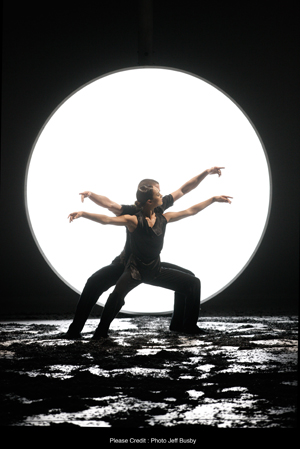
The set and lighting design was created by Jens Sethzman who has worked with Kvarnstrom on numerous occasions. The stage was a stark white with no real wings, only tiny entrances at far up and down stage, making it feel like the dancers were in a large room. From the ceiling hung a large circle that was lit in many different ways and the effects created a fantastic complete look overall. Against the stark white the dancers were dressed in all black. The lighting just set off the work and showed Sethzman’s great skill. At one stage extreme white light shone toward the audience making it feel like we were looking at the sun with the planet Mercury between us and its radiance.

Sydney Dance Company, Mercury. Photo by Jeff Busby

Sydney Dance Company, Mercury. Photo by Jeff Busby

There were many standout moments. The triple pas de deux was one of these. It was very contrasting in mood from the opening and was fun and flirtatious. With quick movements it displayed some interesting partner work and the female dancers used their expression well.  I particularly enjoyed the creativity that abounded from the simple movement of one dancer pushing another at the knees. This was a clever motif that kept reappearing, but was used in many different ways.

Another particularly memorable moment was in the last section were one dancer stood centre stage with a large metal pipe, and a mass of black feathers, appearing like black snow, fell from the ceiling. The dancer began to create a circle with the pipe and the sound was amplified, creating a hollow spinning noise.  Three male artists entered dancing in what seemed like feathered pants, looking slightly animalistic. The other dancers entered and moved through the black mess on the floor making a fabulous effect.

Throughout the piece there was an underlying sexual tension between the male and female dancers but in a mature and elegant manner, with often very playful moments as the dancers interacted. There were also times where the choreography made the dancers quite androgynous as the movement was not exclusive to the male or female dancer. The females were lifting the males and at times there was partner work happening and a single dancer also doing the exact same choreography, but on their own. This was quite unique and entertaining.

Mercury was an intriguing work. One could see the choreographer’s inspiration not in a loud way, but rather in a subtle manner. Kvarnstrom’s choreography had a maze of motifs and repetition with a definite but intricate formula, which I found pleasing to the eye. The dancers performed the choreography with ease and excellence. Mercury is yet another win for the talented Sydney Dance Company!

Posted in International ReviewsComments (1)

Kenneth Kvarnström’s Choreographic Process


By Dolce Fisher.

Acclaimed Finnish choreographer Kenneth Kvarnström was invited to commission a new work for Sydney Dance Company this year. The work titled Mercury premiered in November with rave reviews. Forging a choreographic career without any formal training in choreography, Kenneth was introduced to dance through amateur musical theatre, deciding to study dance in his gap year between high school and university. With a passion for dance ignited, Kenneth never looked back. One of Europe’s leading choreographers, Kenneth has directed the Helsinki City Theatre Dance Company and Dansens Hus in Stockholm, as well as his own K. Kvarnstrom & Co. Having also created works for Gothenburg Ballet, Helsinki Dance Company and Finnish National Ballet, Kenneth brought a unique creative energy to Sydney shores. During rehearsals Kenneth caught up with Dance Informa about the choreographic process behind his new work.

Do you use improvisation when forming your choreography?
“I like choreographing it all myself. With improv I am not good at giving tasks and getting the right thing out of the dancers. We will improvise for maybe five minutes and then I set the choreography. I still want to do all of the steps myself in order to find the tricks. I find where I want to fix things for the dancers. But it’s getting harder and harder as I am getting older. The dancers here are fantastic because I am showing them and they still understand what I want. There are some lifts I want to use from earlier productions but are too hard to explain, you just have to see them. So I have used video so the dancers can see.”

Kenneth Kvarnström with Sydney Dance Company dancers

Kenneth Kvarnström with Sydney Dance Company dancers

Not being formally educated as a choreographer, which areas of choreography have been more difficult?
“It’s good and bad. It would be good to have some kind of education but it’s good to have your own way of doing things. I feel I have a lack of musical knowledge, but I am not afraid because I can still communicate with composers/conductors. I can’t read music. I would like to be able to read a musical score, but knowing how to communicate helps.”

How did you come up with the title  ‘Mercury’?
“I actually had two other names, but ‘Mercury’ in a sense was easier as it didn’t say too much. The next thing was to give it a picture. That was what we did in the first week I was here. It all had to be prepared before I arrived. My idea was to make the dancers silver, but it didn’t really work. The final picture doesn’t say too much. I am not sure how it will work in the city landscape but people who know me have said it looks like my work.”

“We had finalised the name and then it was spring at home in Europe. I left the whole thing and didn’t think about it for a while. I just wondered about how I would make a dance for this. But for me it’s always important, according to the name, not to make it too obvious. You should leave something to fantasy and shouldn’t tell too much about the piece. So we have three different meanings with the piece divided in three different parts; Mercury is from Roman Mythology. Often the symbols he has are the wings on his hat. He is a messenger of the gods and he has a big stick with two snakes on it. That is the historical part, so we are using the big stick and feathers. Then we have quicksilver. That means constant movement. The last meaning is the planet Mercury. It is closest to the sun as you will see through the set design.”

You spent only a short time with the company on your first visit. Did you already have a few ideas?
“Yes, I had some ideas that I wanted to try. I was only here for ten days. The first week was OK because we were able to try a few things, but then I got tired of it (improvising) and decided to try to put it all together somehow. By the second week we were actually running a small section, and we kept most of it.”

How was this choreographic engagement different to others in the past?
“I accepted this work because it was such a good offer.  You get nine weeks of constant work with the same people without all the distractions of other choreography. So this is a very unique experience. And also to be able to experience a new culture was great. Without a job here it would be very difficult to come here, as it is on the other side of the world. It was a very good opportunity to meet some new dancers and also to work with the company. The dancers are really fantastic as well as the whole team. Everyone here is so eager.”

Mercury, Sydney Dance Company. Photo: Jeff Busby

Mercury, Sydney Dance Company. Photo: Jeff Busby

Has everything come together as you had planned?
“You have ideas and a structure when you go into the studio and meet the dancers. I think a lot is happening together with the dancers. Some ideas work, some don’t… you change and start from the beginning. I always work with different sections and then add them to each other. Doing so you can see what is missing. Maybe you have to add something or take something away. So more or less you are in a process that is changing. Half of the ideas I had when I started I never used, because they did not work. They were simply boring or did not fit in the new construction, etc. New dancers give new inspiration and the process itself gives new ideas. In the final week in the theatre and after the first preview we made some changes… actually we cut out five minutes of dance. I think it has been a good process.”

…And the audience agreed. Mercury is an outstanding new work, showcasing both Kvarnström’s brilliance and the dancers versatility and talent. To read Dance Informa’s review of Mercury click here.

Kvarnström has recently been appointed as Artistic Director of Helsinki Dance Company and will begin as director in 2010.

Posted in InterviewsComments (1)

Mercury Sneak Peak


Sydney Dance Company, Mercury

November 17th-28th
Sydney Theatre
Visit www.sydneydancecompany.com for further information.

Posted in VideoComments (0)

Sydney Dance Company – Mercury


Sydney Dance Company’s Premier Season 2:
Kenneth Kvarnstrom’s Mercury

15 performances only!

One of Europe’s most revered choreographers, Kenneth Kvarnstrom, will make his Australian debut, applying the sensibilities of this beyond-cutting-edge-choreographer to the creation of a world premiere full length work, Mercury for the Sydney Dance Company.

Finnish born Kenneth Kvarnstrom’s work is imbued with a bold and distinctive visual stamp as a result of his frequent collaborations with light and set designers of his choice; artists whose technical skills and personalities have combined to inspire the overall energy of his creations.

Defined by choreography which is at once powerful and dynamic, yet sensual and intimate, Kenneth Kvarnstrom’s work is both challenging and demanding.

“If the work of Kenneth Kvarnstrom comes to your town, see it!”
CriticalDance.com

Mercury – Sydney Dance Company
Date: November 17th- 28th
Venue: Sydney Theatre
Tickets: $20-$70
Contact: To make a booking by phone, contact Sydney Theatre on (02) 9250 1999

Internet Bookings www.sydneytheatre.org.au
www.sydneydancecompany.com

WIN A DOUBLE PASS! Click here

Dance Informa is a proud supporter of Sydney Dance Company.

Above photo: Mercury dancer Richard Cilli, photography Tim Richardson

Posted in Feature ArticlesComments (2)