New York City Center, New York, NY.
July 23, 2026.
Hugo Marchand, a danseur étoile (star dancer) at the Paris Opera Ballet, gathered a large cast of dancers from the Paris Opera Ballet and Béjart Ballet Lausanne to showcase works centered on the theme of love in Artists at the Center. In the program, Marchand notes that “love is deeper than language, deeper than thought, deeper than borders.”
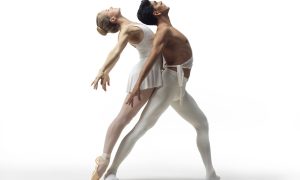
The evening opens with George Balanchine’s Sonatine (1975), set to music by Maurice Ravel. A light and airy piece, it is performed by Lénore Baulac and Germain Louvet, who are well-matched in height and frame. Technically, Baulac is a bit more solid than Louvet, but he dances like the wind and spins as gracefully as a top, all while maintaining a welcoming smile.
Maurice Béjart’s The Firebird (1970), set to Igor Stravinsky’s score, is based on a Russian fairy tale about a magical, glowing bird that helps a prince defeat an evil monster. The Firebird (Hideo Kishimoto, alternating with Konosuke Takeoka) performs in a red unitard featuring a peek-a-boo cut-out heart in the center. The piece is transplanted into a modern era: the camouflage jackets worn by the ensemble (designed by Roger Bernard and Joëlle Roustan) and Stravinsky’s pounding music lend it a militaristic air. The work, like most classical ballet pieces, was created to showcase technique. Kishimoto is a lithe dancer who demonstrates remarkable power in a series of hitch kicks and barrel turns. The choreography also features splashes of contemporary movement, including a section where the ensemble collapses to the floor, raises up on their shoulders, claps their feet, and returns to the ground.
The program had its highs and lows, with one of the lows being L’Abandon from Angelin Preljocaj’s Le Parc (1994), set to music by Wolfgang Amadeus Mozart. An intimate work performed by Dorothée Gilbert and Marchand, it could best be described as sex en plein air. Gilbert and Marchand kiss and roll over and under one another, drawn together like two inseparable magnets. This minimal movement and explicit narrative might have seemed radical on stage in 1994, but it feels dated in today’s “anything goes” world.
Trois Gnossiennes (1982), a duet by Hans van Manen set to Erik Satie’s moody piece of the same name, is performed by Baulac and Marchand, accompanied by Elena Bonnay on piano. Here, classical ballet is injected with modern elements; at one point, Baulac executes a piqué into an attitude with a flexed foot. Similar to Coppélia, Baulac appears completely immobile when Marchand lifts her as a single frame, twirling her around and guiding her through space.
Carolyn Carlson’s L’Esprit du Bleu (a pas de deux from 1997’s Signes set to music by René Aubry) is a duet of longing. Performed by Gilbert and Louvet, the choreography couples gestural and pedestrian movement with ballet in a quick-slow dynamic. It portrays two people trying — and failing — to recapture the love they once shared.
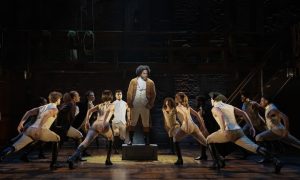
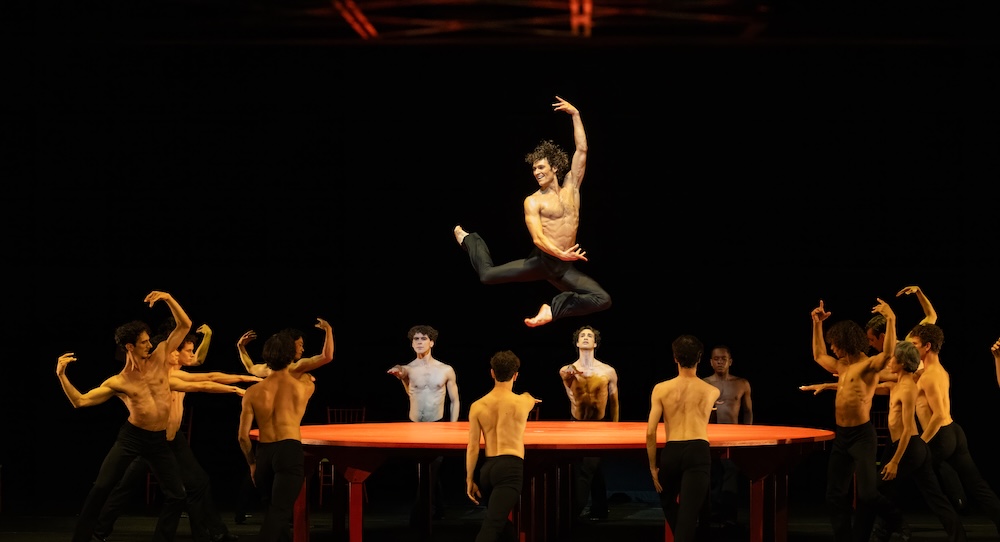
The pièce de résistance is Maurice Béjart’s Boléro (1961), set to Maurice Ravel’s iconic score. It is performed by a cast of 18 male dancers who encircle a raised, round platform on which Marchand performs a solo. All are dressed simply in tights and bare chests (Béjart is also credited with the costume design).
As the piece begins, Marchand slowly lifts one arm at a time, transforming a simple gesture into something deeply sensual. Marchand is notably tall (6’4”) with an unusual level of flexibility for a male dancer. In one section, he performs a series of grand battements to the front, bringing his knee almost — if not completely — to his nose. As the tempo accelerates, the precision of Marchand’s movements deepens, highlighting the sheer intensity of his performance.
Boléro was originally created by Béjart for Duška Sifnios, a Serbian dancer, and was famously performed by Maya Plisetskaya at her request when she was near the age of 50. Both Sifnios and Plisetskaya played the role with a light, playful air—perhaps enjoying the male gaze of the surrounding dancers while simultaneously ignoring it, remaining lost instead in the surging music and ritualistic movement.
Béjart altered the nature of the role when adapting it for a male dancer, subtly playing with the dynamics of a male-on-male gaze. Much of the movement retains a raw, sexual charge, particularly when the 18 men surrounding the platform thrust their pelvises back and forth (evoking a Fosse-like style) while rocking on their feet in fourth position.
In every generation, an exceptional dancer emerges, and Marchand is undoubtedly one of them. Like Rudolf Nureyev, who shared a similarly striking presence and high cheekbones, Marchand dances with formidable technical virtuosity and fierce athleticism. Confined to the narrow platform, he executes high kicks and swift jetés with immense control, channeling his power into a tight space without ever missing a beat. It is precisely this level of command that drives an audience into a frenzy — and earned the evening’s thunderous ovation.
By Nicole Colbert of Dance Informa.
Share this: