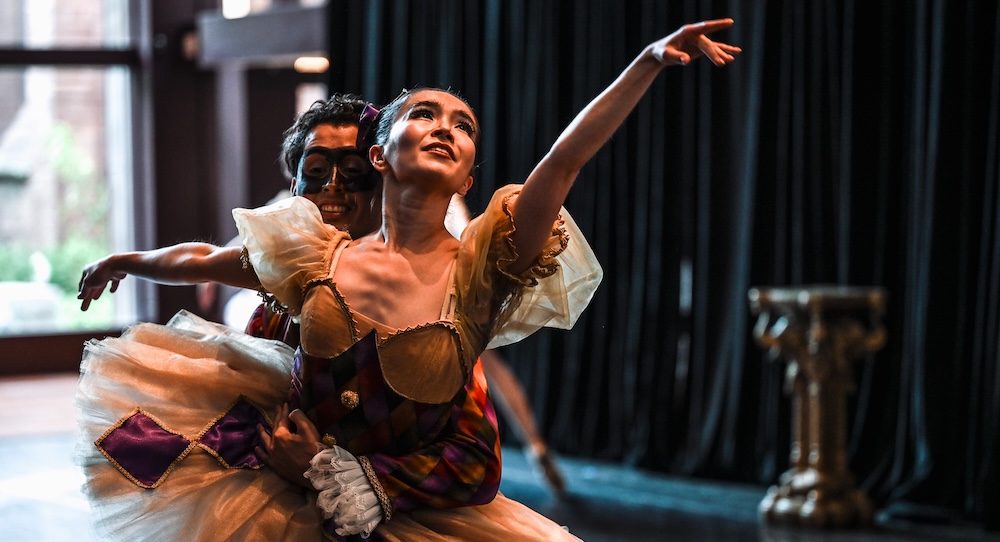
The Calderwood Pavilion, Providence, RI.
July 18, 2026.
“After Gelsey Kirkland Ballet shut down, I’d never thought I’d see these ballets performed again,” explained Nina Yoshida-Webster, Founder and Artistic Director of Renaissance Ballet Collective. Therefore, she continued, when she conceived of this new ballet project, they were the first works she knew she wanted the group to stage.
Such stagings would be toward the larger mission of “making the storytelling, connection, and shared human experience of ballet…engaging and accessible to people of all backgrounds, ages, and levels of familiarity with the art form,” as stated in program notes.
The works in the group’s inaugural performance Naissance were classical, in the strictest sense, but also challenged how many might envision classicism; the atmosphere was anything but stuffy, erudite, and “boring.” Rather, the works were highly theatrical, genuinely entertaining, and plain funny.
Certain nuances of how the group packaged and presented the works were also innovative, fresh, and arguably quite effective towards a better audience experience. The program was short, about an hour, but also included an intermission – allowing for (unfortunately shortened) modern attention spans and any other needs various audience members may have…not to mention fitting seeing some dance into busy schedules.
Being in a beautiful cathedral-ceilinged space, where audience members were but feet from the performers, we could hear the slides of their shoes and landings of their jumps, see tiny nuances of expression and gesture – and even the sheen of sweat reminding us just how physically demanding this art form can be. Such immersion made a more intimately sensory, immersive concert dance experience.
Pre-recorded voiceover before each work also ensured audience members had context and basic plot. The first steps of each work even came in towards the end of these short voiceover sections, creating more immersive immediacy.
Yoshida-Webster even brought audience members into the dancer experience a bit, noting that added musical interludes allowed time for costume changes. “You have no idea how long it can take to pull tights on over sweaty legs,” she joked. Perhaps the barrier of fourth wall artifice is a thing of the past, and that might just be a good thing.
All of that considered, the group is poised to help preserve such highly classical, perhaps otherwise neglected works – but also demonstrated an ability to do so in ways that acknowledge the world of 2026 as it is.
The ebullient Walpurgisnacht (1975), by George Balanchine (and from Charles Gounod’s opera Faust), kicked off the program. A mythical setting made the work classical in the most textbook sense. A trio of danseurs (AJ Maio, Garret McNally and Brian Gomez) offered high-flying fun in spades, with personality oozing from their presence.
A trio of ballerinas (Anjali Hern, Emma Halter, and Adele Walden) danced with easy grace, as light as their diaphanous chitons. Scarves of the same material added entrancing dimension to their shapes and formations. Simple turns and small turning leaps added just enough size to entice. In a dance world of ever-increasing athleticism, a spirit of such movement being enough (as it very much was) is refreshing, even.
Yoshida-Webster entered next, dancing with both precision and boldness – her presence matching the vibrant red and gold of her costume. She kept the satyrs and Bacchus spellbound through layered footwork and complex turns. The work ended with her having wrapped them around her little finger – feminine power and elegance in command.
The interlude to the next piece allowed for costume changes, as she described, yet also gave audience members an opportunity to enjoy the score – full of storytelling, as Yoshida-Webster had also described it. It even challenged audience members to do that, arguably, in this day and age of sensory overload and multitasking. We sort of had no choice but to enjoy the wonderful score for all it was, and only do that. That may even be a gift.
Marius Petipa’s Cavalry Halt (1896) followed, even more comedically theatrical while bringing a similar choreographic sophistication. Massiel Valderrama brought both strength and sweetness to Theresa, a lady three suitors fought over. Each of the three suitors (Brian Gomez, AJ Maio and David DuBois) created quite distinct – and delightful – characterization. Separate signature steps for each enhanced the distinctive quality for these characters.
There was a similarly straightforward quality to the vocabulary as in the first work, without athleticism for its own sake – yet there were high leaps and complex partnering steps that complemented narrative as well as atmosphere. A smooth waltz shifted into a lift with a leap that snapped open, like a rubber band, to a mid-air split. Valderrama and DuBois found timing synchronicity that created a compelling sense of call-and-response.
Various other characters populated the scene and stage space such that it felt more realistic and alive, as a whole community living before us. The narrative unfurled – through various hijinks, standoffs, and pleasantries – until the three suitors followed Theresa offstage.
Just like Yoshida’s character had the satyrs and Bacchus wrapped around her finger in the first piece, Theresa came out leading them all in the end. Older stories need not, and do not always, come with antiquated gender norms. Any of that wider context aside, what a treat of a work to experience.
After an intermission came the effervescent and memorable Harlequinade (1900), also from Petipa. The thoroughly entertaining and comedic theatricality continued. Dubois, a comedic standout in this work as well as throughout the program, dodged a high leap from AJ Maio – quite funny in a “you had to be there” sort of way.
Maio’s character, for his part, delivered much of the virtuosity in this work’s early part : complete with complex turn and leap sequences. Anjali Hern, as a female harlequin who offset him, was sweet and sprightly – but fierce at times, too. Gomez and Yoshida-Webster were a central couple, both elegant and whimsical, whose push-and-pull propelled much of the plot. A mystical figure (Nia Lessard) seemed to bless their union, enhancing the fairy tale feeling at hand.
A group of soloists (Hayley Donohue, Adele Walden, Massiel Valderrama and Emma Halter) added layers to the stage picture, and also struck the difficult balance of uniformity and individuality. Active props of musical instruments, pretend “played”, added yet more characterization as well as clarifying tangibility to the action. Subtle refinements – such as gestural flourishes with raising arms that met musical flourishes – continued the “less is more” quality, that which was a big part of making this program so satisfying.
Yet again, however, there was also athleticism. That was particularly present in the ending coda of Gomez and Yoshida-Webster’s characters: him passionate and smoothly vigorous, her strong as well as exuberant. An ending sequence exploded with joy and unity.
I remembered then what I overhead from a fellow audience member during intermission: “they look like they’re having so much fun!”. I couldn’t have agreed more. In her curtain speech, Yoshida-Webster also underscored the importance of supporting and partaking in “real, human-made art.” It’s the only kind through which we can share with other humans that sort of unbridled creative joy.
That can be through art that more than a hundred years old, while we also innovate in the ways we present it. Possibility abounds, and arbitrary boundaries are well…arbitrary. Artists like those of Renaissance Ballet Collective can lead the way in such thoughtful artmaking, and I eagerly await what this brand-new group of artists will continue to offer. Brava!
By Kathryn Boland of Dance Informa.
Share this: