Keats Theatre, Barrington, RI.
March 15, 2026.
As a school child, I detested math. It was the one subject I struggled with. Yet, geometry began to shift that attitude for me; it appealed to my visual sense, and I saw applications to dance. Physics also gave me a keener understanding of kinetics (and yes, there was math there too…unfortunately, I thought at the time). That dance-obsessed high schooler started to understand how different disciplines are intertwined and interdependent.
“Math is everywhere, and art is everywhere,” affirmed Newport Contemporary Ballet Executive Director Danielle Genest in her curtain speech for the company’s latest program Polygon. Both are everywhere, and they intersect – a truth that the program would call upon: through aesthetic approach as well as the overarching idea of opposites meeting.
“Exploring different angles and valuing different perspectives, we find meaning behind logic and logic behind meaning. Simplicity and complexity exist simultaneously in each moment of our lives,” Genest further asserted in her program letter. The program demonstrated that where different ideas meet can be the site of the most learning and the most poignant feeling.
Deanna Gerde’s evocative, emotive The Temple of You opened the program (premiering in this program). Lights gradually came up on two dancers in stillness (lighting design by Stephen Petrilli, as throughout the program). They began moving: slow, considered, even transcendent in the pure bliss of the moving body. The pair soon shared weight, softly leaning to evoke tender connection – shared without a word.
With two more dancers entering, the atmosphere electrified: the movement athletic and tenacious, hungry for space. Nuances such as hip rolls added something sensual, that transcendent bliss of the moving body. With thrashes and more muscular vocabulary – agitation arising – the soft and tender seemed far behind. Something more like yearning arose in the last moments, with dancers lying on the stage reaching for each other: as if grasping for grounding, for some sort of sustaining oxygen.
The work thus offered a feast of qualities and emotional states reflected in and through the body. I wondered: was the softer and slower necessary to come to that embodied strength, something more dynamic, and ultimately to deep emotional truth?
Whether or not, that’s a meaningful question, and these are undeniably all parts of human experience that the art of the moving body can illuminate. Also undeniable is how Gerde’s work investigated such grand questions, even at this relatively early stage of her choreographic career. I eagerly await seeing where it can grow from here.
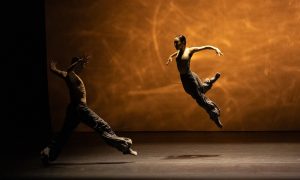
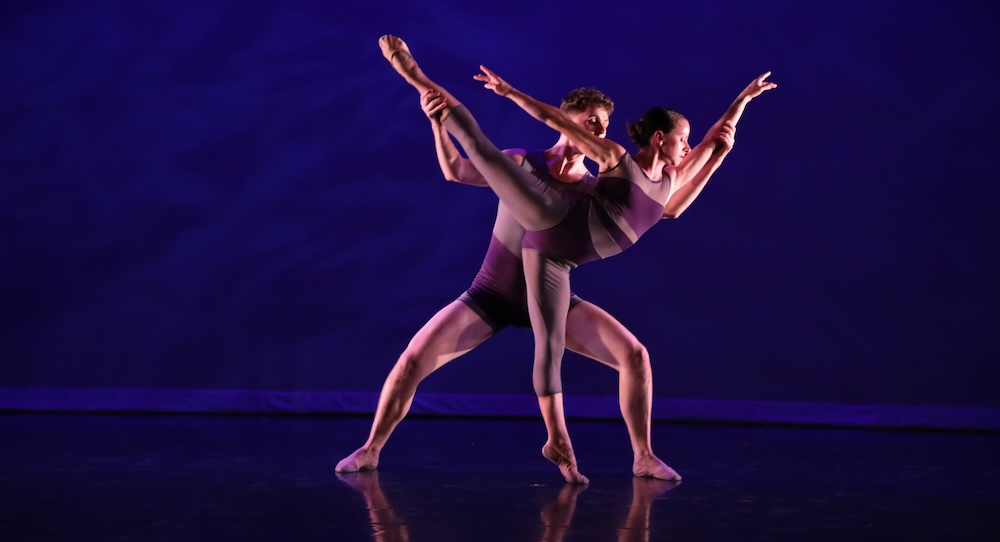
Danielle Genest’s Periphery (also a premiere) followed, serving up bold visceral exploration. Lights came up on the dancers in a line, moving with gradual, detailed gestures. Their keen intention, as well as the time to fully appreciate all of the nuances of their every movement, drew me in from the first count. Distinct meaning seemed abstract, yet I knew that such intention must be based in something weighty.
The speed and size of movement escalated, including partnering to wow the senses as well as ease the soul through a sense of steady support. Trainee Nadia Bradfield danced a solo with enticing gaze and calm power – making me eager to see her grow further with the company. Margot Aknin’s solo, grounded in fluid strength, bursted with captivating nuances.
The score pulsed with highly resonant layers, and the costumes (by Naomi Tanioka) reflected shapes both precise and unique – all of which the movement also presented. Genest’s vocabulary, and the way that the dancers executed it, was soothing in its lack of pretension or forcing anything. What it all seemed to seek was exploration rather than any defined outcome – and would thus dance to those edges, to those peripheries.
The work seemed intent on finding out what could be found in holding that shape just one more breath, in reaching farther than one could reach, in harmony with another moving body. What the dancers ultimately discovered? It stuck with me for some time.
3 (2019), also by Genest, followed intermission – and similarly piqued my curiosity as well as satisfied my senses. Grace Byars, Sarah Murphy and Jenna Torgeson danced the trio: working together with both attunement and generosity. That quality seemed to align with Genest’s seeming intention for the piece; “symbolic and divine, the triad represents harmony and wholeness. Beginning, middle, and end. Mind, body, and spirit. Past, present and future,” affirmed program notes.
Three spotlight fields on the backdrop underscored this theme. The dancers reflected cohesion SYN through shared movement vocabulary and harmony in how they shared space: formations and movement patterns fluid, seamless. Yet, they also created divergence through their individual performance qualities, the choices they applied to each moment. Unity and multiplicity danced in concert.
Another meeting of opposites lay in Genest’s singular movement vocabulary; linear shapes and diffuse pathways built both clarity and ambiguity. The intersection of opposing forces can of course be the locus of tension, of conflict. Yet the piece concluded with something quite different; dancers moved in unison, arms at shoulder height, softly rotating side-to-side through the spine. All had resolved to peace, to ease.
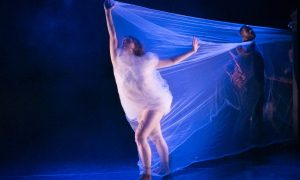
The premiere of DaYoung Jung’s imagistic The Shape We Become closed the program. Clear juxtaposition of the accented and muscular with the more supple and slower invested me from the start – just as earlier works in the program invested me, if for different reasons. Like Gerde’s piece, the work also offered a wide variety of tones and textures – which implied a wide emotional experience.
Movement vocabulary was largely classical, notably lifted and linear, yet reflected its own embodied discovery. The entire company of thirteen onstage – dancing in unison, canon, and in individual timing at different points – reminded me just how affecting such moments can be.
I saw a neoclassical quality of a sparse aesthetic (with effectively simple costumes by Eileen Stoops, in pure white), and that allowing the meeting of sound and form to shine brightest. With score by Alfonso Peduto, Jung’s musicality seemed both rigorous and entirely natural.
Within that neoclassical styling, I perceived that meeting of sound and form as work’s the main “message” or “meaning”, its aim more sensory than conceptual or philosophical. I chuckled to later check Yung’s program notes, for she did have a distinct meaning to convey: the idea of humans taking shape through life experience, with embodiment indispensable in that process.
I was quite pleased to have received her guiding concept for the work (even if I was delayed in doing so), but I clearly got something out of her work even without it. That is one kind of magic within concert dance, amongst others; the way that different minds and hearts can receive the same thing quite differently, and so long as all come to it with thoughtfulness, no one is “wrong.”
The same goes for different disciplines that contribute to the art form; diversity and multiplicity can truly be our strength. The tension of opposites can be both productive and satisfying – and ultimately resolve to something more peaceful. Newport Contemporary Ballet has demonstrated these understandings with this program and beyond, and I anticipate what the company can therefore create next: as always, anticipating with excitement, awe and gratitude.
By Kathryn Boland of Dance Informa.
Share this: