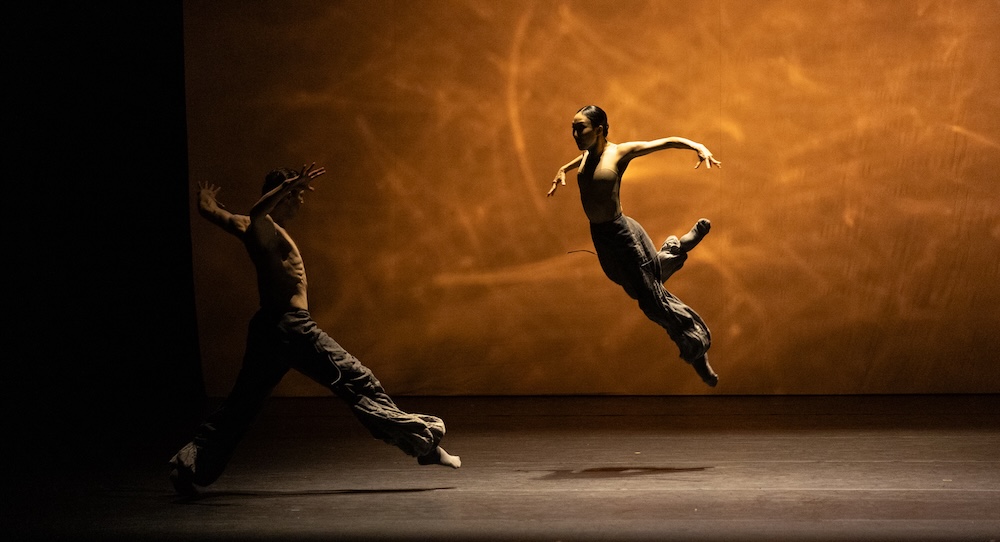
Citizens Bank Opera House, Boston, MA.
March 7, 2026.
Imagine this: you’re a well-to-do balletomane in 1913 Paris. You settle into your seat in the opera house, getting out your glasses and checking where you put your kerchief. You’re here for a new Vaslav Nijinsky work, and you’re quite curious about what sort of elegance and beauty it might offer…Le Sacre Du Printemps, a curious title.
Yet, the curtain rises, and the score builds, to reveal nothing of what you would have ever expected: pulsing accents, raw movement, and overall cacophony. You feel confusion, anxiety, and even a bit of anger (these tickets were expensive, and you’ve needed a night to relax!). You’re not sure what this is, but it is not ballet!
The crowd around you seems to share the sentiment; more and more of your fellow patrons are jeering, and it all gets louder and angrier. You join in the chants. You’re not sure what will happen, but this was certainly not the night at the ballet that you expected.
Flash-forward to Boston, MA, 2026: that was certainly not the atmosphere in the theater with Jorma Elo’s Le Sacre Du Printemps (The Rite of Spring) (2009), part of Boston Ballet’s 2026 Winter Experience. That, combined with my personal reception of the second act’s work (which I saw a second time and saw new things within), had me thinking along these lines: about how audiences align or misalign with an art form and its development, and how those flashpoints might ultimately be first steps in a new – and largely positive – direction.
Indeed, Elo’s memorable recrafting of the 1913 work (through Diaghilev’s Ballets Russes) didn’t cause a riot this time. On the contrary, the audience seemed engaged and pleased to the last note. As a dance history enthusiast who has heard about this work since I was a university dance major years ago, it was fascinating for me to experience it in a new form for the modern age.
Elo’s rendition calls upon classical movement vocabulary and aesthetic principles to make it a bit less jarring to the senses. It also comes at a time when audiences might be more open to receiving its darker and more chilling aspects.
Intriguing set pieces and backdrop lighting (by Brandon Stirling Baker) were the first things the work offered us in the audience, and set its tone: for something unique, mysterious, perhaps a bit dark at times yet still satisfying to experience.
The movable set pieces were like tall privacy screens, with a mesh-looking interior that brought to mind something of nature – something wild. Crimson reds and sharp lines in both costuming (by Charles Heightchew) and lighting subliminally spoke to the danger, the violence within the original’s narrative. It perhaps also offered something easier on the eye than Nijinsky’s collaborators contributed (the costumes had sparkles, after all!).
As Stravinsky’s score built (with arrangement by Alyssa Wang), dancers slowly accumulated on the stage and gestures quickened. Interestingly, however, Elo did not always bring in more dancers when the score peaked in intensity. This decoupling of aesthetic components could encourage each of them standing on their own merits, as well as enhanced the work’s unsettled undercurrent – of something just not quite aligning, not quite right.
Elo’s movement quality also subverted expectations and binaries; the dancers executed plenty of precise turns and sparkly-clean lines, yet also little signatures of Nijinsky’s original: occasional parallel rotation, two-dimensional facings.
Spinal undulations added curves and ripples to such picturesque shapes. Daring parterning – such as a dancer spinning right above Marley, her partner holding and propelling her by only one wrist – resonated in my mind long after they graced the stage. Wrists bent downwards from raised arms and quickly moving “v” shapes evoked something towards the work’s more ghastly themes; the indelible physicality of horror films flashed across my mind.
Elo blended all of this smoothly enough that it seemed a unified, integrated way of moving. More groundedness – deeper plies, a bit more softening towards the stage through the torso – might have enhanced the primal themes and feel of the overall work. Yet then, perhaps, the technical mastery and general strength of the movement as it was may not have translated as fully.
Indeed it did translate, and the dancers are certainly also ones to appreciate for that. They daringly delivered on such integration of varied qualities – as individuals and as a collective. They applied just the right level of wild abandon to their performance: just enough to support the chilling themes at hand, but not so much as to pull us away from the precision of the movement or how all aesthetic aspects at hand worked in concert.
I could see one arguing that the work could have accomplished the same thing at 70 percent of its length. To its credit, however, the choreography never felt stale – rather, I felt a quality of consistently innovating on itself. The work’s length (not unreasonably long, after all) seemed to also support another one of the work’s compelling qualities: on the whole, it felt like it had a constant ambience of danger and tension rather than a clear rising action towards a climax and then resolution. That built the sense of a life of peril, of watchfulness, of sincere uncertainty.
The work’s closing moments supported such uncertainty; one by one, dancers in a line fell by the will of the one who had been in danger all along…except for one in that line who remained standing tall. Would he fall too? Who would he rather be the ultimate victor? Such open questions might sit better with us in 2026 than they did with audiences in 1913 – as might the work’s aesthetic and sensory qualities.
Perhaps Nijinsky, or some other intrepid innovator, needed to take such risks in order for dance as we know it to have so developed; art is trial, error, and finally settling on something that feels right. With Elo’s Rite of Spring, that final “feels right” is both bold and intentional, enticing and satisfying, based in tradition and quite forward-looking. Brava!
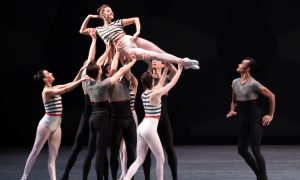
I also enjoyed Crystal Pite’s The Seasons’ Canon in this program, a second time – the first being when it premiered with Boston Ballet in 2024. I saw much of what I saw the first time: rather than discrete seasons, a sense of time moving cyclically. A fresh design concept (by Jay Gower Taylor and Tom Visser), kinetically insightful movement vocabulary, and 150% invested performances laid track for that theme to translate.
Re-experiencing works of art most often allows for seeing new things, and experiencing this one a second time didn’t break that trend for me. Certain images struck me more this time, for one. Gestures in canon, with a large group in a clump, created mesmerizingly smooth ripples reminiscent of a school of fish changing course. Blossoms falling across backdrop underscored themes of action and rest, turbulence and recovery, life and death.
On that note, I also saw more existentially weighty meaning in the work this time. Petals falling means the flower fades, yet its fruit lives on – and thus the plant from which it comes also does. The tension within certain gestures, and the final movements from one soloist, reinforced the difficulty of existence within those cycles and their extremes. Yet there is just as much beauty and light (which were both certainly abundant in this piece): therefore always hope, always new life.
The audience leapt to their feet and clapped for several bows. These people of 2026, at least, were receptive – beyond that, literally laudatory – of such deep themes that weren’t spelled out for them or handed to them on a silver platter. That gives me some hope for the future of this art form, that there are people out there who will enthusiastically engage with such ideas.
Elo’s The Rite of Spring highlighted the path we’ve traveled to that place. I’m delighted to stay right on that path, with tenacious companies like Boston Ballet to lead the way. I hope that you’ll keep walking with us, too!
By Kathryn Boland of Dance Informa.
Share this: