The Foundry, Cambridge, MA.
December 14, 2025.
Reviewing dance comes with a kind of ritual for me; I arrive, maybe snap a picture of the program, browse that a bit, and get out my note-taking materials. It is an all–too–rare space to have my phone powered down and exist in space with other humans, no faces in screens. It is a time to feel embodied by witnessing the kinetic experience – the dedication to and absorption in performance – of other bodies.
I got to thinking about this when Carmen S. Rizzo, via Akram Khan, described going to live performance as one of our remaining communal rituals. It involves a “contract” of shared understanding and etiquette. The mystery and depth of the program also had me pondering how live performance is also unique in that way; there aren’t many other things in 2025 that call for the same level of patient and engaged experiencing.
Everything is fast and “on-demand”. Messages urging us to create and present with greater and greater “efficiency” get ever louder. Live art, and perhaps live dance in particular, asks us to exercise different capacities and dig into something deeper.
That doesn’t mean lack of accessibility or welcoming spirit. In fact, for example, I felt a notably warm and inviting atmosphere as I entered this small, intimate space. I saw audience members who know each other embrace, others casually chat. Bar Bad sang with sensitive vocals and played meditative acoustic guitar.
I felt at ease, held and supported in this community of mostly people I do not know. Perhaps calling us back to our own humanity is the most welcoming act of all, no matter how much mystery or abstraction accompanies that invitation.
The compellingly abstruse Lá-Grimas began with Rizzo and Leah Misano grooving out to Lou Bega’s “Mambo #5”. Jazz dance vocabulary supported the score’s energy. It brought something joyful and free into the atmosphere. The pair moved at first independently, and then in unison.
Even in unison, for a good while, I felt a distance between the personas (literal within the stage space, yes, but also metaphorical). The groovy footwork of the beginning evolved into more technical and expansive movement, kicks and leaps reaching across the stage space.
Misano and Rizzo brought power to that, but also a pleasing ease. They clearly had no one to impress and nothing to prove. I loved that human quality of movement – integrated, assured, receptive – that resulted from such an apparent mindset.
After a score change – to something more somber – they bridged that distance to support each other’s weight in various ways. They piggybacked on each other, for example. After one fell from that height, I felt a certain weight into the floor – across the distance they had fallen. I wondered if this was a breaking of trust. The emotional dynamics at hand implied rather than described, so I had that space for questioning.
In order to do that, I – or any audience member – had to have patience and focus with the slowly unfolding dynamics at hand. Sadly, that’s becoming more and more of an ask for most people in this smartphone age.
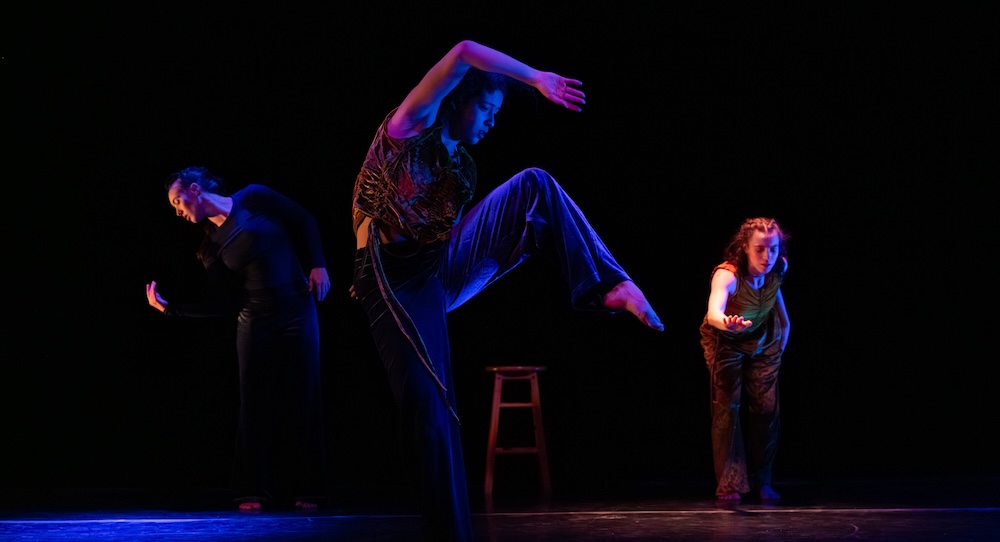
That was perhaps even more the case with Misano’s following solo: emotional, abstract, and technically impressive all at once. After Rizzo’s persona left the space, her weight into the floor felt like a ton of bricks; her visceral weightedness translated as a deeply poignant emotional weightedness. That could be deep grief, considering that this followed Rizzo’s exit, but also seemingly applicable to many other weighty, sticky emotions.
She rolled with a stool, bringing some inevitability awkward finagling of the object (as astoundingly smooth of a mover as she is). That was to the good here; it felt honest and real, because humans and their thoughts, emotions, et cetera can be awkward. Art that doesn’t shy away from that can do a lot for helping us understand such human experience better.
She didn’t stay down and struggling, however; she was flying high again soon, athletic acrobatics moving her upwards: in and across the space. Her exerted breathing demonstrated just how much physical investment she put into all of that. All of those aspects intertwining, I saw a certain meditation on grief humming through the ether. The piece also offered much to savor simply as movement, as kinetic energy at work.
Mel-e-Anina, both atmospheric and imagistic, came next. Warm-toned spotlights came up on Rizzo and Claire Lane (lighting design by Andrea Sala), one of them in each as they stood divided in space. Their costumes were similarly bright-hued (by Ryan Prinz). The score was bright, if soft – reflective in its cadence.
All of those elements created a mysterious atmosphere, but not one of darkness – as is often the case with contemporary dance. Light-filled mystery is also possible; anything that can go wrong can also go right. Remembering that can simply be a matter of perspective.
Intricate gestures blended the circular and angular, the continuous and accented. The dancers’ energy was also bright: expansive and full of vitality. Yet the distance between them, the darkness between their two spotlights, felt oceans wide. Something in me wanted them to bridge that palpable distance – and they did, after a time.
They gradually came together to share weight, and then the physical connection evolved into tender moments such as one resting a head on another, arms in parterned movement shifting and softening into an embrace. The athletic and pedestrian smoothly cohered.
Rizzo again exited, leading into a solo from Lane: full of soft strength, as explosive as it was sensitively attuned. Her quality offered a cornucopia of movement textures, all of which I treasured. It spoke to calm thoughtfulness – perhaps a different reaction than Misano’s character when she encountered a similar situation.
In this work, another difference was that Rizzo’s persona returned. That led into more moments of powerful tenderness, as well as some simply beautiful movement – again smoothly mixing strong athleticism and sensitive intricacy. None of it was obvious or fast. It required patience and open-mindedness to appreciate – and perhaps that’s a significant part of its value.
The hopeful, memorable Diz-Solução closed the program, featuring all three dancers from the two prior works. They gradually made their way to upstage center, their movement just as gradually evolving from inwardly– to more outwardly–directed. The work took its time to build momentum, and I was happy to come along for the build.
Certain movement motifs, such as arms moving in a circular motion behind the back, came full circle from the first work – but also took on new textures and dynamics. Those were the layers that could accumulate because the work took that time to scaffold and escalate energy.
Embodiments of tender care, such as more embraces and supporting of each other’s weight, were also possible within that richness. That then implied themes of community and genuine human connection. Whether they were connected or apart in space, together or apart in time, a sense of unity within the group remained.
The trio ended the work by together facing stage right, looking up, and raising one arm high. They stood in bright light. In that moment, I felt a keen rising of hope – hope at least in their unity, perhaps.
These were powerful themes, supported by much good movement material and presented by talented artists. I would love to see it all expanded. I believe that the themes that Rizzo cited in the program – of resistance and care, strength and softness, turbulence and calm, all of those rich dualities – can be further mined and structured into a more unified narrative. The thoughtful, rigorous movement material at hand, and perhaps more that could be similarly developed, could go a long way towards supporting that goal.
There are of course many factors at play in determining if such expansion could happen – from practical realities to artist bandwidth and interest. All I can say as one engaged and grateful viewer: I hope to see it happen.
Yet if not, these works already held welcoming space for audience members – space and time to put their phones away and be embodied. It also asked them to remain curious and patient. In an age of TikTok and “AI slop”, that can mean a whole lot. It can call us back to our very own genuine humanity, one step and gesture at a time.
By Kathryn Boland of Dance Informa.
Share this: