Tag Archive | "stretching"

Fitness Beyond the Studio


By Emily Yewell Volin.

Technique classes and rehearsals are a dancer’s job and a common misconception is that this training schedule provides enough exercise and conditioning to make a dancer performance ready. Not so. Dance Informa spoke with Nehemiah Kish (Principal Dancer, The Royal Ballet), Alice Hinde (Australia’s Dancenorth) and Glenn Allen Sims (Alvin Ailey American Dance Theater) to learn how they augment their workout regimes to achieve top fitness, stamina and sculpted physiques.

What type of fitness activities do you do in addition to your technique classes and why?

Nehemiah Kish – The Royal Ballet, UK
In addition to our daily ballet class, we are very fortunate at The Royal Ballet to have two sports scientists on staff as well as Pilates and Gyrotonics instructors. This season I have been working with our sports scientists. They test our strengths and weaknesses and give exercises accordingly. When I want to improve a certain area of my dancing or build a specific group of muscles they tailor the exercises to my needs. How much I do is based on my performance schedule, because some of the exercises leave me sore or fatigued. I like to take advantage of the days when I have fewer rehearsals and use those days to work on strengthening the areas I want to improve.

Alice Hinde, Dancenorth, Queensland Australia

Dancenorth Company Dancer Alice Hinde. Photo by Bottlebrush Studios.

Alice Hinde – Dancenorth, Australia
In addition to ballet and contemporary technique classes, I cycle, do yoga and skip. I have these activities on rotation so that my body is subject to different kinds of movement patterns. I enjoy doing all of these activities because they are also a rest for the mind. I aim to reduce the noise of a busy mind and just enjoy focusing on my breath in yoga or even the scenery while riding. Cross-training is great for the body, it helps improve stamina and strength and overall shape and performance.

Glenn Allen Sims – Alvin Ailey American Dance Theater, USA
I am always working out, especially at the gym, when I am not in my technique classes. While at the gym my main concern is free weights, basically sculpting my upper body and breaking down muscles groups into days of the week (ie. Monday- abs and shoulders, Tuesday- back, Wednesday- abs and cardio, Thursday- chest, and Friday- abs and arms). This schedule can be altered depending on what I am dancing that evening, if there is a performance or the free time I may have during a rehearsal period. I also take Pilates classes that are generally on a private basis with a Master Trainer. I feel that a man should look like a man from the stage, not to say that someone that is slighter than I doesn’t look like a man, but it is my prerogative. As an Ailey man, it is part of the history and legacy that the men always looked great, sexy and fit. I am just trying to live up to this standard as best as possible with all the knowledge that I know about fitness. Working out really plays a huge role on how good you feel about yourself, and when you are feeling great in your skin it really shows!

What is your strategy for staying fit and conditioned during your off-contract time?

Glenn Allen Sims
I try to make sure that I am at the gym on a daily basis. When I am on off-contract time I make sure to really focus on as much cardio as possible – it’s the only way I can come back to work with the same amount of stamina that I left with. I love taking a spin class or just simply running on the treadmill. The best cardio workout that I am head over heels for is aqua aerobics! You tone and work all the muscle groups without the impact on your joints, which is a huge plus for me as a dancer. In terms of my eating habits, I eat the same for the most part. I food combine what I’m going to eat, meaning that I don’t mix proteins and carbohydrates in a meal. This really aids the digestive system in processing the food I am taking in. I’m big on eating whole foods and loads of greens (especially green juices), and making sure that what I am eating is of quality – no junk foods. I try to stay away from desserts.

Alice Hinde
During the summer holiday, I try to allow ten days to two weeks for rest. In that time I might do some gentle stretching. Swimming and biking are two of my favorite ways to keeping my body moving while I’m on holiday.

The Royal Ballet's Nehemiah Kish and Zenaida Yanowsky

The Royal Ballet’s Nehemiah Kish and Zenaida Yanowsky in Raymonda Act III, photo by Tristram Kenton, courtesy ROH

Nehemiah Kish
Maintaining the same level of fitness and conditioning I have on contract is very difficult when I’m off contract. It basically comes down to time allocation – how can you give at least 5 hours a day to training as you would if you were working? So, I generally lead an active lifestyle which helps maintain some level of fitness, including regularly hiking, swimming and diving. As I am constantly on the move between cities and even countries, attending regular classes becomes difficult. To remedy this I always pack a skipping rope. It is lightweight and it’s easy enough to find a space large enough to skip in. Skipping also gets your heart rate up rapidly. I set my iPod to my favourite up-beat tracks and I can skip happily for 15-20 minutes.

How do you augment your exercise regimen while touring?

Alice Hinde
Touring doesn’t affect my routine that much. I don’t use a lot of machines or props when working out. Most of my exercises are based on using my own body weight.

Glenn Allen Sims and Linda Celeste Sims, Alvin Ailey American Dance Theater

Alvin Ailey American Dance Theater’s Glenn Allen Sims and Linda Celeste Sims in Jirí Kylián’s Petite Mort. Photo by Paul Kolnik.

Glenn Allen Sims
I carry a range of travel equipment with me. I have Spree resistance straps that help tone the body, the Perfect Push-Up and a Multi-toner, which is like the Pilates magic circle, but this was designed by DLFit and is a complete body workout. Of course, there’s only so much you can do in the hotel gym so most of my workout augmentation happens either in the hotel room or at the theater, unless there is a gym nearby.

Nehemiah Kish
I aim to tailor any fitness activities to things that can be done in a hotel room such as skipping and yoga. I find stretching extremely beneficial when on tour because of the increased workload when performing a show. Cardio and strength are usually taken care of by actually performing! A spa or bath also works wonders in decreasing lactic acid levels and keeping the body supple.

Top photo: Alvin Ailey American Dance Theater’s Glenn Allen Sims and Antonio Douthit in Alvin Ailey’s Opus McShann. Photo by Paul Kolnik.

Posted in Dancer HealthComments (0)

Stretching Truths


By Rain Francis.

Do you stretch extensively before class? Do you often sit in a stretch for a few minutes or more? Do you stretch every single day?
As dancers, most of us would probably answer “yes” to at least one of the above questions – which would mean that we might have been practicing unsafely, and could be doing our bodies more harm than good. It’s time to get wise about the correct, safe and effective way to stretch.

Flexibility is important for injury prevention, physical fitness and mental and physical relaxation. Since all bodies are different, there is little point in comparing your flexibility to another dancers; flexibility is determined by genetics. However, stretching, when practiced correctly, can increase your flexibility and improve your performance.

When to Stretch
The most crucial factor in regards to stretching is to always warm up first. As much as we may be used to it, this means not sitting in stretches before barre! A proper warm-up should start with some light aerobic activity (such as a gentle jog around the studio) to increase your core temperature. When you produce a light sweat, it’s time to engage in some dynamic stretches. Dynamic stretching should start slowly and gradually increase in the speed and power of the movement. (See below for an explanation on the different types of stretching). Many Pilates exercises incorporate dynamic stretching, so before class is a good time to do your Pilates routine.

At the end of your cool down after class – when the activity that requires you to be strong and stable has ceased – is a good time to do your static stretches. Believe it or not, stretching to your end-range before class actually reduces strength and stability, as well as increases your risk of injury, so it should be avoided at all costs.

What to Stretch
It may feel good to practice the stretches that are comfortable for you, but it’s important to stretch the muscles that need to be stretched, not just the ones that are already flexible. Stretch both sides of a joint, in order to not develop an imbalance that could lead to injury. Practice stretches that only target the muscles you are trying to lengthen. Isolating a muscle group gives you greater control and means you are able to vary the intensity of the stretch.

How to Increase Flexibility
In order to maintain your range of motion, a weekly stretch session is sufficient. However, if your goal is to increase your flexibility, you need to stretch three to five times per week, and you need to be consistent. It may take several months for certain stretches to become comfortable, but perseverance is key (just make sure you are not pushing yourself to the point of pain.)

As it takes time for your muscles to adapt and adjust, you must give them time to heal, rest and repair themselves. This means mixing up your stretching programme by alternating light days, heavy days and rest days. Any gym bunny knows the importance of working and resting different muscle groups on different days, and making gains in flexibility follows the same principles.

Though it may be tempting, over-stretching increases the risk of injury and can just push your goals even further away.

Stretches should be slow and gentle, and should never create a sharp or painful feeling. Use your breath to assist you, and do not bounce!

How Long to Hold Stretches
Hold your static stretch (but not your breath) for 30 seconds, then relax. After a brief rest, repeat the stretch two or three times. The changes in your flexibility from stretching in this way will only last less than an hour. However, when performed consistently, as explained above, flexibility gains can be maintained. If you are a child or young adult whose bones are still growing keep stretches to 10 seconds or less.

Contrary to what you may believe, prolonged stretching should only be used by medical professionals and is not appropriate for dancers. Rather than simply stretching muscles and their connective tissues, stretching for extended periods of time can elongate joints and ligaments, which are there to keep your joints stable. You may think that lying in second while watching TV is doing you good, but this can actually lead to loss of stability and serious injury, whether in the short-term or further down the track.

The Importance of Breath
There is a reason why yoga and Pilates place so much emphasis on the incorporation of the breath. Correct breath control is essential to getting the most out of your flexibility training. It helps relax the body, improve muscular elasticity, increase blood flow and remove lactic acid, which reduces muscle soreness and the risk of injury.

When stretching during your cool-down, keep your breath fluid, not forced. Use slow, relaxed breathing, with an emphasis on exhalation through the mouth or nose. Inhale through the nose, which will filter and warm the air you inhale and allow more oxygen into your lungs (just ask any yogi!)

Types of Stretching
There are several different techniques for stretching muscles, each with advantages and disadvantages. You should consult an experienced teacher or health care professional to find the best technique for your physique.

There are two main types of stretching: static and dynamic.

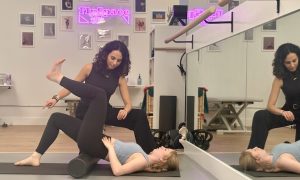
Static stretching is a stretch that is held in a particular position. For example, lying on your back with one leg raised in the air and gently easing the leg in toward the chest to stretch the hamstrings. Static stretching is more effective than dynamic stretching for producing long-term flexibility, but should only be practiced when the body is fully prepared.

Dynamic stretching is a stretch that is an active movement as a result of muscle contraction. For example, circling the ankle or shoulders, or controlled leg and arm swings. This type of stretching takes you to the limits of your range of motion, with no bouncing or jerking. A good dynamic stretch is one that reproduces the movement patterns required for the exercise you are about to undertake. For dance, an example is a controlled développé to the front or side, which dynamically stretches the hamstrings. Dynamic stretching should be performed only after a proper warm-up.

When researching for this article the author consulted the following resources:

Stretching – a vital part of dancers training and practice, by Tania Huddart for DANZ ©. www.danz.org.nz/Magazines/DQ/April2012/stretching.php

Stretching for dancers, by Brenda Critchfield, MS, ATC, under the auspices of the Education and Media Committees of the International Association for Dance Medicine and Science. www.iadms.org/displaycommon.cfm?an=1&subarticlenbr=353

Stretching rules for dancers
, by Ausdance. www.ausdance.org.au/articles/details/stretching-rules-for-dancers

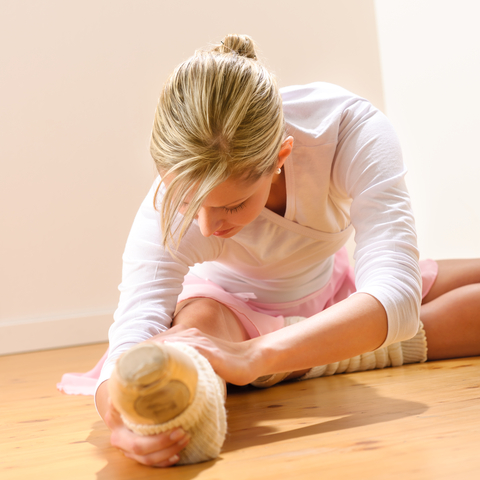
Photo: © Candybox Images | Dreamstime.com

Posted in Dancer Health, TipsComments (0)

Yoga for Dancers


By Jessica Innes.

De-stress and Stretch Out – two things dancers need a good dose of!

The inspiring choreographer Mia Michaels articulately pointed out that “when your spirit dances your body will follow.” This is sometimes easier said than done in an image conscious world of auditions, injuries and physical exertion. Yoga has been practiced since 3000BC and is based on the Sanskrit word meaning to “join, unite and attach” referring to the connection of body and mind. The result is an undisrupted ability to bare our souls as dancers with confidence, intuition and freedom of movement.

There are many different forms of Yoga and all offer unique benefits, however the results of Ashtanga Vinyasa Yoga in regards to a dancers flexibility, strength and balance are quite remarkable. Ashtanga yoga begins with a series of Sun Salutations as a warm up. This allows blood to flow through the body, clearing toxins and warming the core and extremities. Following this, a series of “Asanas” [poses] are performed both standing and seated. The standing poses focus on balance, concentration, alignment and stamina and when done correctly can result in working up quite a sweat! As dancers we always need to work on these core strengths. The seated poses allow for deep stretching in order to improve flexibility, as well as clarity of mind. Dance and Yoga have an evident relationship with one another as one of the standing Asanas is named “Natarajasana” meaning “Lord of the Dance.”

In addition to the physical aspects, deep breathing exercises called “Pranayama” allow dancers to look inwards and release tension. No matter what your spiritual beliefs, taking a moment to sit, breathe and relax can only be good for you. Breathing exercises don’t have to be a spiritual act, unless you intend them to be.

Here’s a simple breathing exercise you can try at home:

  • Sit comfortable with your legs crossed. Close your eyes and rest your hands on your knees, palms facing upwards.
  • Take a natural breath that allows your lungs to fill comfortably and then slowly exhale.
  • Continue to do this as you count down your breaths from 50 to 0. Each time envision more of your tensions and worries disappearing from your body with each exhalation.
  • If your mind wanders to sounds around you or other thoughts, calmly bring it back to your centre and focus on your breath. Notice how your breath feels on your top lip or how your diaphragm expands with each inhalation.
  • When you reach 0, enjoy the feeling of serenity that you have attained before slowly opening your eyes.

As with any form of physical exercise it’s important to remember to work at your own level and not to exceed your own physical limitations. Yoga is designed to gently stretch the body; therefore moving slowly in and out of poses is essential. It is also imperative to be honest with yourself and never push a stretch to the point of being painful. You should feel the tension of the stretch gradually dissipate as your body eases into it. The more regularly you take Yoga, the quicker you will see improvements in your strength and flexibility.

Relaxing to many of us means sitting in front of the T.V. or reading a book, however next time you want to wind down, take your mind and body on a holiday and try a Yoga class in your area.

Top photo: The “Lord of the Dance” pose

Posted in Dancer HealthComments (0)