Tag Archive | "dance company"

They’ve Got All The Right Moves


Dance Informa was invited to take a dance class with Travis Wall, Teddy Forrance, Nick Lazzarini, and Kyle Robinson of Shaping Sound to promote the July 31 release of their new weekly reality dance show All The Right Moves.

By Tara Sheena.

Travis Wall is a visual musician, and he will be the first to tell you so. “I feel I take music and I shape sound. My musicality…was always what I was best at. So, I ran with that,” he confidently tells me in a packed studio at Broadway Dance Center last Monday evening. Thus, his company Shaping Sound was born out of this desire to control music with nothing else but the human body. “I feel like I am a musician, but I don’t play an instrument, I play my body,” he says.

Other musicians in this symphony of movers are the three co-founders of Shaping Sound: Teddy Forrance, Nick Lazzarini, and Kyle Robinson. Their new show on Oxygen, All The Right Moves, which starting airing last week, profiles their journey of running their dance company from the inside out. Rehearsals, performances, and drama can and will happen.

“I’ve always said we should have our own T.V. show,” Wall quips, “I was like, ‘This is our opportunity.’” After shopping the idea around to a few networks, Oxygen jumped at the show. The deal subsequently closed on January 2, 2012. By February, camera crews were hard at work filming the newly birthed company in rehearsal, and continued filming until just last week. “Everything that we did is current for our audience,” Wall revealed. “It’s not like, ‘Oh, we filmed this six months ago…It’s current with what we’re doing as a dance company, so it’s good.’”

This dance company is already a force to be reckoned with, despite the fact that the company has only had a few official performances. With a roster of artists ranging from So You Think You Can Dance alums (including Season 8 winner, Melanie Moore) and the best and brightest of the commercial world (some of the dancers having worked with Adele and Lady Gaga), it’s no wonder when it came time to cast his company, Wall went straight to his group of talented friends.

“It’s why we started Shaping Sound. We wanted to give our friends jobs,” Wall said. “There’s not really an outlet for [commercial contemporary dancers] past things like So You Think You Can Dance, so we wanted to give dancers an afterlife.”

And, putting your friends together proved to be a perfect situation for Wall, adding it was a dream to work with them everyday in the studio, especially when he was used to choreographing by himself for so long. “The [choreographic] process with the dance company is very different and I learned a lot about it,” he stated.

It helped that most of the dancers had worked with him in other contexts before, whether it was a Dancing with the Stars gig or onstage at a convention, so they were already familiar with the type of movement style he wanted.  “They know what to do and where to go,” he says of his dancers, “It’s easier to clean and to get what I want.”

And, he wants a lot. Wall has large aspirations for Shaping Sound; make that, arena-sized. He sees the same popularity demanded by pop stars in a 20,000-seat concert venue for his dancers. “We could go on tour and have thousands and thousands of people scream our name because we are dancers. Not singers. Not actors. Dancers. And, that’s what I want for Shaping Sound,” he states with pure enthusiasm.

Well, if anyone can do it, it’s Travis Wall and this team of talented artists.

Catch All The Right Moves every Tuesday night on Oxygen.

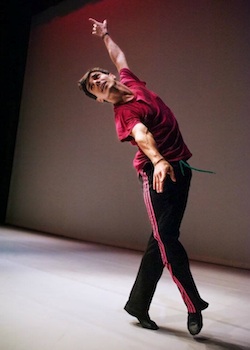
Photo: Travis Wall, Teddy Forrance, Nick Lazzarini and Kyle Robinson from All The Right Moves. Photo by Andrew Eccles, Oxygen Media

Posted in Feature Articles, InterviewsComments (0)

NYC’s Dances Patrelle: A Flair for Dramatic Ballet


By Stephanie Wolf.

Through the pinnacle of ballet’s neo-classism era and amidst the frenzy of contemporary dance, Francis Patrelle remained true to what he loves and does best … dramatic ballet. Over 20 years ago, he found a home for his vision in the Upper East Side neighborhood of Manhattan and formed Dances Patrelle (DP). Now, the company continues to establish its own niche in a competitive dance community by using classical steps and human emotions to create theatrical productions.

After training at the Julliard School, Patrelle began his career with the Albany Berkshire Ballet (ABB). Initially, he signed on as resident choreographer, but was persuaded to dance as well and ended up performing with the company for about 8 years. ABB exposed him to a lot of historical work – something he is very grateful for.

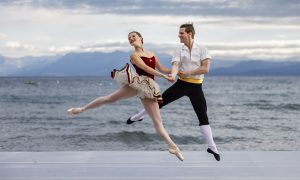
Dances Patrelle dancers John-Mark Owen and Julie Voshell. Photo by Eduardo Patino

During his time with ABB, Patrelle was invited by the Julliard School to create a ballet. He titled it Reeked with Class and it was a huge success with audiences and critics. Clive Barnes even said it should be entered into the repertoire of the Joffrey Ballet, which was still in NYC at the time. However, the Joffrey never called. And despite the hype, Patrelle had a hard time getting any big ballet companies to acknowledge his work. “They weren’t interested in what I was doing. My pedigree wasn’t what everybody else’s was. I [didn’t] come from a major company. It was a different curve from what normal choreographers take,” he explained.

This prompted the idea for a small company in Manhattan. Around 1988, Patrelle met with private donors and arts administrators to determine the financial possibilities of starting his own artistic entity. It took about a year to gain a non-profit status and turn the concept into an actualization, but New York was about to witness the birth of a different type of dance company. Since then, Patrelle has created over a 100 ballets, proclaiming some of his favorites to be Judy Garland: Come Rain Come Shine, Macbeth, and The Yorkville Nutcracker – which celebrated its 16th anniversary this past December.

From the classroom, to rehearsal, to performances, fun seems to be infused in everything Patrelle does. Administrative Director and Company Dancer Justin Allen calls Patrelle “a dancer’s choreographer,” which is why some of the world’s finest flock to work with him. He creates a work environment in which dancers feel safe to be themselves and make a joke or two. Alex Brady, who has been working with Patrelle for six years, agrees with Allen’s sentiments and says the dancers of DP “work very hard, but have a lot of fun too.” After dancing with the Joffrey, Miami City Ballet, and Twyla Tharp, Brady is drawn to DP’s sense of community and proclivity to keeping the work atmosphere light. Egos are left at the door and the focus is on making good art.

Dances Patrelle Presents Gilbert and Sullivan: The Ballet

The idea for Gilbert and Sullivan “gestated for years”, says Patrelle. Dr. Paul Horan, a former accompanist at Ballet Academy East, put the music on Patrelle’s radar. Then, serendipitously, Patrelle continued to run into various Gilbert and Sullivan tunes until he realized the potential for a ballet.

“The storylines are fairly complicated, to say the least, ridiculous, to say the least, and fabulous. And how the [heck] do you make the brilliant words into dance?” He went to Justin Allen, who is also an accomplished novelist, and asked him to write a ballet that would meld the duo’s most famous operettas: The Mikado, Pirates of the Penzance, and the H.M.S Pinafore.

Duke Mitchell as Arthur Sullivan and Dorothy O'Shea Overbey in the prologue of 'Pinafore'. Photo by Rosalie O'Connor

Previously, Allen wrote the script for Patrelle’s ballet Murder at the Masque: The Casebook of Edgar Allen Poe. But this concept presented new challenges. Allen thought Patrelle was “nuts” and worried the convoluted storylines would blend to make “a mishmash of indecipherable nonsense.”

After much analyzing of the stories and lyrics, Allen came up with a solution. Rather than telling the tale of the characters, why not portray the stories of the actors, managers, and Gilbert and Sullivan themselves as they attempt to put their beloved operas on the stage? Thus, Allen created “a series of spiraling stories that touch each other at many points.” With the script finished, it was time to bring in the music director, musicians, and the dancers.

These many components make for an evening of live music, live dance, and, of course, lots of fun. As the company prepares to embark on the production again this spring, Patrelle plans to do some tweaking, but promises the element of light-hearted entertainment will remain.

Down the Road: The Future of Dances Patrelle

When asked about a ‘wish list’, Patrelle replied, “I don’t even wish [for] things I know we can never afford.” In light of keeping his artistic goals realistic, he does have a few obtainable aspirations. In the not too distant future, he’d love to bring back his ballets Macbeth and Romeo and Juliet to create an all-dance Shakespeare Festival. Additionally, he’d like to see his ballet POP (a full-length ballet following 3 different couples on 3 different New Year’s Eves) run the week of Christmas to New Year with a special NYE champagne-induced event. However, Patrelle did confess that his “real dream is to have a summer residency in a non-distracting fashion … to create a ballet with dancers that I love, and have some time to play.”

Patrelle looks towards the future, but he’s also grateful for the company’s rich past, generous contributors, and Julie Dubno, Director of Ballet Academy East, who graciously provided studio space for DP since its inception. What exactly the future holds for DP is uncertain, but one can hope that this chamber ballet company will continue to provide New Yorkers with stunning and entertaining productions for a long time.

Catch Dances Patrelle in Gilbert and Sullivan the Ballet at the Dicapo Opera House, 184 East 76th St, New York, NY. May 3 – 6. There will also be an additional performance in Montauk Music Festival on May 12th

For more information visit www.dancespatrelle.org

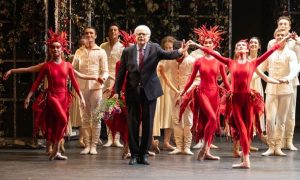
Top photo: The Dances Patrelle cast in Pinafore. Photo by Rosalie O’Connor.

Published by Dance Informa dance magazinedance news, dance auditions & dance events.

Posted in Feature ArticlesComments (1)

Dandelion Dancetheater Embraces Difference


By Leigh Schanfein.

San Francisco-based Dandelion Dancetheater is a dance company that is doing something different.  Founded in 1996 by Eric Kupers and Kimiko Guthrie, Dandelion takes dance-theater experimentation seriously.  Lots of companies strive to be innovative, cutting-edge, state-of-the-art, etc. but they still tend to fall within the parameters of traditional dance.  There is a form and thus a function.  Dandelion Dancetheater doesn’t seem to think that way.  Their most recent performance, Radical Inclusion: Conversations at the intersection of art, spiritual practice, and social activism, brought together theorists from the realms of art, activism, and spirituality to discuss interdisciplinary experimental art that draws from diverse inputs.  Dandelion is known for using dancers who are untrained, differently-abled, old, young, large, small, and from every culture and background, in addition to formally trained dancers.

I had the opportunity to experience the company (and I do mean ‘experience’ and not simply watch) during their NYC residency at Baryshnikov Arts Center.  I was struck by Don’t Suck, a series of vignettes spanning a great variety of movement that at times had the dancers expertly wielding wheelchairs, crutches, voice, violin, puppet heads, and even a slew of tennis balls.  The piece culminated in a voting session where the audience decided a winner and a loser of the performance.  The results were announced and discussed in front of and including everyone.  I asked Eric and Kimiko, as well as classically trained company dancer Julia Hollas, to give their insight into how Dandelion Dancetheater is changing how we consider dance.

When I watched/voted in Don’t Suck, I was blown away because I’d never seen anything quite like it.

Eric
That’s my hope, that our work will act as a waking up device and jolt people out of their everyday consciousness. Whether they like the work or not, we hope they at least pay attention to what is unfolding in the present moment.

When incorporating elements that are absent from our traditional construct of concert dance, do you hope that the audience questions your choices?

Eric
Questioning is fine, but it’s more important to me that audiences bring some kind of fresh attention to the work and don’t lump what they are seeing into categories based on what they’ve seen before.

Photo by Faye Chao

Kimiko
My hope is that all the elements used – be they traditional dance, song, words, non-trained dancers dancing, etc. – are not seen as separate, but rather experienced as integral aspects of the particular world of the piece.  That’s my hope for at least the actual viewing, which is ideally felt more wholly, like a wave washing over you.  Then later that evening or the next day, I think it’s great to question the work and why certain choices were made, because that always takes one closer to the core of a piece.  If those questions include ‘why are non-traditional aspects included?’, I would hope that person would eventually realize that they were included not to make a certain point separate from the heart of the piece, but because they were necessary to create the overall effect.  That’s why I don’t love that our company usually falls under the “dance” category; I think “performance art” is a better fit.

Do you hope that at some point a show with diverse dancers will not be something to discuss, but that these elements will be accepted just as well as the cookie cutter ballerina?

Eric
Actually I’m hoping that the kind of diversity we strive for will be even more accepted than the cookie cutter ballerina ideal. It’s not that I have anything against tall, thin, ballerina-type bodies. It’s rather that I want them to be appreciated as part of the wonderful diversity of human forms. There’s room for everyone.

Kimiko
Yes, I do.  One of the grandmothers of modern dance (maybe Duncan?) said something like “dance is always fifty years or so behind the other arts in sophistication because it has to do with the body and the body is the site of such baggage and oppression”.  One would never tell a visual artist her lines were just too fat.  We see dance as being “pretty” rather than expressive and interrogative. 

Julia
I think that we’re after the same end: through performance, to explore our deep inner natures and share those truths with the audience.  The challenging part is that we have completely different methods of getting there.  We’re not just diverse in the fact that one person plays the guitar and has had some dance classes as a college student; someone else plays the violin, does yoga, and has never had formal dance training; one person has extensive modern dance training; and another has done mostly ballet – we’re diverse in that we each have incredibly different approaches to what it means to have an artistic practice.  Get that in a room, and you’ve got two things: absolute chaos and a deeply rich community with infinite possibility for expression. 

If we get to the point where incredibly different performers occupying the stage together is no surprise, do you think there will still be a place for it? 

Eric
Yes, definitely. I don’t see our commitment to diversity as simply a reaction to the oppressive and limiting trends I see in the dance world, but instead it is a vision of how I hope things to be in the future. The great thing about diversity is that it is infinitely interesting. There’s always something new as long as there is another person in the universe.


Do you discuss with your dancers what it feels like to be part of a non-traditional company composed of individuals outwardly different from each other?

Eric
We do a lot of discussing of this and other issues, and a lot of emotional processing as well. So much gets stirred up in every project I direct and I view the discussing of what has arisen for everyone as an essential part of the rehearsal process. Some of the ensemble members like that, but some find it uncomfortable and would rather just get back to movement and/or music.

Julia
As someone who would really rather just dance than process, I have to say that I am constantly challenged by being a part of Dandelion.  I simultaneously dread our “emotional processing” and find it incredibly helpful.

Was “inclusion” something you’ve had in mind since the creation of the company, or have these ideas of unraveling the norm and exposing social issues emerged over time? 

Kimiko
I think we’ve always thought of dance as a tool to explore social issues, a means and not an end.  So in that way, we have always been committed to expressing ideas using whatever materials and mediums (sizes, shapes, colors, textures, etc.) are available and that best suit the work.  For me it’s more about not excluding what is needed for that particular piece of art than including it just for inclusion’s sake.

Where do you see the American dance scene heading in the next decade? 

Eric
I hope we’ll see more companies like Dandelion in the future. A big danger I see in the dance scene is artists and companies striving so hard for financial stability and popular acceptance that the work becomes watered down with commercial values. These values (that are fed incessantly by TV and other popular media) are exclusive, self-hating, disembodied, overly focused on outside criteria, narrow-minded, and boring.

The one thing that I see as a positive effect of the economic downturn is that financial success is even more difficult to obtain for dance artists, which is leading some to return to what I see as the roots of modern dance: rebellion, innovation, truth-telling, complexity, mystery, and a priority placed on the process of creation. The best of modern dance has always been at the edges that are pushing into the unknown. It means the form never really has commercial success, and I don’t think it should. This form exists to lead the way through challenging times, to help us think about things in new ways, and to remind us to return to our bodies, the present moment and the ultimate “unknown-ability” of the universe.

Julia, you grew up with a classical ballet and modern background, even training in ballet at the University of Utah.  You have very classical roots!  What drew you to Dandelion? 

Julia
I probably gravitated towards classical ballet and modern dance because I needed something that, through rigorous study, would allow me to unlock and observe myself.  I like the repetition of ballet, I like the purity, I like how exact it is, and for a long time all I wanted to do was join a ballet company.  One summer when I was home from college, I went to see a touring performance troupe.  This performance combined beautiful, fluid, movement, striking video, and theatrical elements which ripped at my heart.  It was the first “dance theater” performance I had ever seen, and the beginning of the end of me seeking ballet as an end unto itself.  I think it was a few months into working with Dandelion and Eric that I discovered that he had been in the dance theater performance I saw!  

Years later, I now see ballet as an extremely valuable tool that allows me to both open my body to a wide array of expression, and a way of challenging and thus learning more about myself internally. 

For more information about Dandelion Dancetheater, visit dandeliondancetheater.org

Top photo: Dandelion Dancetheater by Luiza Silva

Posted in InterviewsComments (0)

Dance Theatre of Harlem Reinstates Full Time Dance Company


By Stephanie Wolf.

Eight years after the unfortunate collapse of the Dance Theatre of Harlem, the world-renowned institution is ready to re-launch its full time dance company. Founded in 1969 by New York City Ballet alum Arthur Mitchell and former Ballet Russe de Monte Carlo member Karel Shook, DTH was pressed to temporarily dissipate due to difficult economic times. Now, after strategic rebuilding and reorganizing, the organization is scouring the nation, looking for a crop of energetic, talented dancers to kick off its return in the fall of 2012.

In December, DTH made the official announcement that it would be reinstating its full time dance company, providing some of the nation’s top dancers a stable artistic home in the heart of New York City. DTH Artistic Director Virginia Johnson stated, “I am grateful to be able to continue the work, artistry, and traditions established by our founders. The story that I hope [DTH] will tell again is the power of the arts to transform lives.”

Transform lives indeed. The company will employ dancers for a full season, giving them the opportunity to grow artistically and dance classical and Balanchine repertoire, as well as experience working with some of the best contemporary choreographers currently creating innovative dance. Interested dancers have two options for applying: submitting an online application or attending an in-person audition.

To apply online, dancers should visit the DTH website and have until February 20, 2012 to submit their reels, resumes, and a $20 application fee. Details on the required video content are also available on the website.

DTH’s audition tour kicks off January 14, 2012 in San Francisco. From California, the artistic staff will travel to Miami (January 28th), Chicago (February 5th), and New York City (February 25th), auditioning dancers for full time positions.

Executive Director Laveen Naidu is thrilled to see DTH back on track. “Returning the company on stable footing is a tremendous undertaking,” he said in a press release.  Thankfully, DTH didn’t have to go about their rebuilding alone. Chairman Kendrick Ashton Jr. led the reconstructing of DTH’s board of directors, while the organization engaged in proactive fundraising and worked diligently to strengthen educational programs. Organizations, such as the Upper Manhattan Empowerment Zone, The Rockefeller Foundation, The Andrew W. Mellon Foundation, Bloomberg, LLP, and The Ford Foundation provided additional funding and resources to aid DTH’s mission towards stability and growth. “We are grateful to our donors, large and small, who value this organization’s unique role in the community and around the world … we are set to have an exciting year.”

Having DTH back on solid ground is a huge achievement for the New York arts community. With a full performing season, educational programming, and more assertive fundraising tactics, the company has the potential to accomplish great feats for New York’s dancers, advance the art form, and reach new audiences.

Posted in Feature ArticlesComments (0)

New York Theatre Ballet: Adding Texture to the Art of Dance


By Emily Yewell Volin

The New York Theatre Ballet is on the map in a profound way.  For adults NYTB performs work by master choreographers including Frederick Ashton, Merce Cunningham, Agnes de Mille, José Limón, and Antony Tudor and the Ballet provides training that follows the Cecchetti syllabus.  In addition to its specialized adult season of producing chamber ballets by either famous or emerging choreographers, the NYTB produces full scale ballets created specifically for children ages 3-12.  “Ballet encompasses literature, music, design and dance” says NYTB Founder and Artist Director Diana Byer.  “We try to unplug today’s kids and open them up to how art can touch them.  We give young people the joy of entertainment and they become lifelong lovers of all art forms.  A lot of kids come back year after year and start to go to our grown up performances.  Parents go with their children and see how wonderful it is”.

Diana Byer. By Yoshi Ono

Diana Byer’s passion for quality dance and community is infectious. “Our mission is to be in the community.  When NYTB tours with our children’s shows, I go into the area’s ballet schools to teach and I bring kids into the theater where they can take company class with the NYTB dancers.  I speak with parents of the children and make myself available to discuss college and summer intensive programs”. Byer even offers a session playfully entitled ‘Help, My Child Wants to Be A Dancer’.

The NYTB has completely reinvented its Nutcracker for the 2011-2012 season.  This year the company is performing choreographer Keith Michael’s Art Nouveau rendition of the classic Nutcracker and calling it Nouveau Nutcracker .  NYTB had been performing Keith Michael’s original rendition of the famous ballet for 26 years and the impetus for recreation came from necessity.  Byers said, “I loved the original production, however, [last season] the set was 26 years old and held together with gaffer tape.  We knew we had to redo the costumes going into this season and we decided we might as well freshen up everything.” 

Choreographer Keith Michael shares Diana’s passion for community and the wellness of youth.  His Nouveau Nutcracker centers around a mantel clock that serves as a metaphor for ‘magic that can happen between everyday ticks of time’.  DI asked Byers what Michael’s intention was with this metaphor. Byers quoted Michael as eloquently stating, “time in the theater should be timeless, it should be an experience that can happen nowhere else, one that you can only get in that place and that time.  This, unfortunately, is an unfamiliar concept of experience.  Even a quaint one, in the current handheld device saturated era.  Our devices have the capability to photograph and video everything for later documentation and our thumbs can document and send what we think we are experiencing.  But, each one of these processes of documentation actually takes us away from having the experiences we are documenting.  Dance can only happen in real time and real space.  Photos and videos are only shadows of the real experience.  This Nutcracker ballet is a fantasy tale, a dream story outside the confines of time itself.  The ballet is Marie’s story.  She transforms the real people in her life to the creations of her fantasy life.  One hopes that a thrilling real life, real time experience in the theater can reconnect older audiences and introduce younger audiences to the joys of an unplugged, memorable now”. 

Photo by Richard Termine

Nouveau Nutcracker’s innovative reinterpretations of the classic tale include an exciting adaptation of the work’s divertissements.  Byers adds, “Keith is rather extraordinary in that he has knowledge of many different dance styles and a terrific imagination.  He’s gone beyond classical dancing and incorporated theatrical elements of surprise.  There are gigantic chopsticks and shadow puppets.  He’s added elements that create surprises and keep you on the edge of your seat”.  And, Marie is a more mature version of her original character.  According to Keith Michael, “My new Marie is a Juliet aged young woman and a debutante with romantic fantasies.  Everyone needs encouragement to activate their personal fantasy life, not only girls and boys, but most adults as well.  There is currently a debilitating social expectation to have the same experiences as one’s peers; to view the same entertainments, listen to the same music, eat the same foods, wear the same clothes and play with the same toys with the same packaged and marketed fantasies of how to play and who to imagine while playing.  The Nouveau Nutcracker’s Marie imagines a story all her own and is richer for it.”

NYTB delivers on its mission to serve community and youth.  LIFT, its community services program, provides tuition-free ballet classes and other vital help for at-risk and homeless children.  Byers explains, “It’s been proven that the arts change learning abilities in school”, and program alumni demonstrate that power.  Among many success stories two stand out to Byers.  One is a 7 year old boy who has since grown into a principal dancer with NYTB, has danced in child roles for Kirov productions and was honored as a finalist in the Rudolf Nureyev International Ballet Competition.  The second is a girl brought up in foster care who will soon graduate from SUNY after spending a semester working with orphans in Thailand. 

In this time of economic instability, how can the dance community help keep small companies doing big work from falling through the cracks?  Byers shared “NYTB does the kind of touring that large companies can not do.  It’s irresponsible to let companies with longevity disappear.  We add texture within the arts and we can bring these full scale first rate live ballets to communities without great facility or great funding”.  Byers invites people interested in helping NYTB to contact her.  “We’re not for profit so contributions are completely tax deductible.  And, right now we’re looking to broaden our base and build our board. If you’re a person who likes to be involved in the nitty-gritty details of a dance organization, we’re the company for you!”

To learn more, purchase concert tickets, and/or book the New York Theatre Ballet for your community visit www.nytb.org

Posted in Feature ArticlesComments (0)

Blossoming New Dance


By Laura Di Orio.

Exciting new dance companies are springing up across the country! As artists it’s important for us to be informed about these new companies and to support the creation of new initiatives. Here are a few to note:

Alight Dance Theater (circa 2010); Greenbelt, Maryland
Angella Foster, Artistic Director

The artists of Alight Dance Theater consider themselves, above all, storytellers. The company, led by Angella Foster, commits to creating emotive work that resonates with the audience. Along the way, Alight doesn’t stress about being purists of movement vocabularies. “If biting your index finger tells the story, we’ll do it,” Foster says, “but, if the moment needs a triple turn and some crazy backflip trick, we’re not shy about busting out the flashy stuff.”

Alight Dance Theater, photo by Enoch Chan

The company focuses heavily on its community and wishes to be part of a “dance local movement”.  Alight offers several free performances every year and tends to seek out locally-based choreographers. “In a world where most local papers are owned by international conglomerates, we believe that our commitment to serving in our community and making art in, for and sometimes about this place sets us apart,” Foster says.

Recent excitement? A new site-specific work in celebration of the 75th anniversary of Alight’s home of Greenbelt, Maryland, in 2012. Check out the company at www.alightdancetheater.org.

Billy Bell’s Lunge Dance Collective (circa March 2010), New York
Billy Bell, Creator/Choreographer

Lunge Dance Collective is a dance ensemble comprised of up-and-coming artists, in addition to already established performers. Billy Bell, former So You Think You Can Dance contestant and LDC’s founder and current sole choreographer, aims to create not just a dance performance, but instead wishes to be known for “experiential” or “logical” dance. The son of a general contractor, Bell is inspired by logic and history and often builds dances centered around the idea of architecture.

Since its formation, LDC has performed in NYC, Los Angeles, Boca Raton, FL, and Guelph, ON. 

LDC’s dancers are pulled together on a per project basis to suit the company’s needs and location. While many of the performers are Bell’s friends and colleagues, LDC also accepts online auditions and hopes to soon hold an open call. Bell says he wants to give exposure and experience to on-the-rise dancers and hopes that LDC will become “an established springboard for professional careers in dance.”

Recent excitement? A best-of performance on September 30, 2011, at NYC’s Symphony Space. For more on the company, check out www.lungedance.com.

CONTINUUM Contemporary/Ballet. Photo by Jaqi Medlock

CONTINUUM Contemporary/Ballet (circa 2010), New York
Donna Salgado, Creator/Choreographer

CONTINUUM Contemporary/Ballet is comprised of classically-trained dancers who respect ballet’s traditions but are interested in exploring their more contemporary artistic voice. “We know that ballet vocabulary has an undeniable movement potential,” says Donna Salgado, CONTINUUM’s founder, “but we seek beauty in the distortion and the improvisation.”

Salgado says she’s largely inspired by her fellow New York dancers, people who are talented, tremendous risk takers and are eager to create art. She finds most of her dancers through word of mouth. “We are looking for creative dancing artists who have emotional maturity, life experience and education,” Salgado says. “We are looking for people who can really work in the studio.”

Recent excitement? CONTINUUM just got back from Jacob’s Pillow Dance Festival, where they performed on the Inside/Out Stage. To learn more, go to www.continuumcontemporaryballet.org.

Indelible Dance (circa November 2009), New York
Robin Cantrell, Creator/Choreographer

The word ‘indelible’ means “not able to be forgotten or removed”, and Indelible Dance is a contemporary ballet company that focuses strongly on the Internet and technology. Indelible’s founder, Robin Cantrell, says the company aims to “create work with the awareness that the Internet exists and that it is an integral part of experiencing art.” Cantrell generally leads the choreographic process but remains open to collaborations with the dancers.

Indelible has performed in some untraditional settings – in the subway, in Cantrell’s bedroom, on rooftops, under the Brooklyn-Queens Expressway. “We aim to present one full-length live show per year,” Cantrell says. “We build the audience for our live shows by first building a fan base online. Videos are short, high-quality and creative. A clever meme will be viewed by tens of thousands of individuals.”

Recent excitement? Indelible performed its second evening-length program, featuring eight live musicians, eight dancers and 16 pieces, on September 2-3, 2011, at Triskelion Arts in Brooklyn. Find out more at indelibledance.com.

Sarah Konner and Austin Selden Dance Collaboration (circa 2010); Philadelphia, PA
Sarah Konner and Austin Selden, Creators/Choreographers

Sarah Konner and Austin Selden Dance Collaboration is a company best described by one of its founders, Austin Selden, as the “dark romantic comedy of dance theater”. Many of the duo’s choreographic collaborations include vocals and elements of humor and often tell stories of romantic relationships between man and woman.

Billy Bell's Lunge Dance Collective. Photo by Gary Curreri

“I’ve been drawn to narrative, dark, romantically tragic themes and images from my childhood,” Selden says. The choreographers, both graduates from the University of Michigan, tend to use dancers who are friends or colleagues in their work, as they usually have ideas of specific people for specific parts.

Recent excitement? A new evening of work to be shown at Triskelion Arts in Brooklyn, NY, in February 2012. For more, check them out at www.facebook.com/SarahandAustin.

Spark(edIt) Arts (circa 2010); Brooklyn, NY
Nadia Tykulsker, Creator/Choreographer

Spark(edIt) Arts is a company of artists of multiple mediums – dancers, musicians, poets, animators, visual artists, film-makers – who come together to generate dance-theater works that aim to question social constructs. “We are captivated by physical form – interested in what humans expose through movement,” says Nadia Tykulsker, Spark(edIt)’s founder. “We work with visual, auditory and sensory artists to offer the opportunity to experience the spectrum of human emotions.”

Since Tykulsker is influenced by a number of dance styles – hip-hop, house, breaking, West African and classical modern – she says the best way to describe the company is with the adjectives: “athletic, sassy, bold, unexpected, hip, provocative, urgent, dynamic and colorful.” With an expansive style and diverse pool of artists, Spark(edIt) hopes to question how and where dance can be viewed and, in turn, make dance more accessible to a wide range of audiences.

Recent excitement? An upcoming “unconventional” collaboration with photographer Deneka Peniston and colored smoke! To learn more, check out www.facebook.com/sparkedit.

WalkingTalking/Catherine Miller. Photo by Hope Davis

WalkingTalking/Catherine Miller (circa summer 2010); Brooklyn, NY
Catherine Miller, Creator/Choreographer

WalkingTalking/Catherine Miller is a project-to-project dance and performance company that explores and creates dance, theater and hybrid work. “Using any means available from complicated theatrics to the fundamentals of walking and talking,” says Miller, “I choose to make work because I believe in the power to transform lives, inspire change and spark revolution on emotional, social and global scales.”

Miller, who received her BFA from the North Carolina School of the Arts, is WalkingTalking’s sole choreographer, but she says she relies heavily on her dancers’ input during the process. “There is always an underlying physicality and reverence for motion in my work,” she says. “The partnering is physical and raw – very influenced by my studies in contact improvisation and puts equal emphasis on the women and the men.”

Recent excitement? A new evening-length piece in collaboration with the design firm, Harrison Atelier, is in the works.  
www.facebook.com/pages/WalkingTalkingCatherine-Miller/271481389529990

Zehnder Dance. Photo by Sarah Morrill

Zehnder Dance (circa 2010), New York
Sarah Zehnder, Creator/Choreographer

Zehnder Dance is an all-female modern dance company whose repertoire is based on hip-hop and modern aesthetics. The company’s founder, Sarah Zehnder, a self-taught hip-hop dancer, says the work of Zehnder Dance aims at “pushing the boundaries of traditional partnering and challenging what constitutes power onstage.”

Zehnder’s work is very physical and athletic. Her dancers lift each other, throw one another and push and pull one another – actions that Zehnder says are not often seen by women every day. “My work represents women in various aspects of life, the struggles we go through and the strength we have to endure all of life’s pain,” she says.

Recent excitement? Zehnder Dance will perform on September 24, 2011, as part of the Dumbo Dance Festival in Brooklyn, NY. Visit www.zehnderdance.com for more information about the company.

Top photo: Indelible Dance. Photo by  Jacob Pritchard

Posted in Dance News USAComments (1)

Peridance Breathes Life Back into Company


Peridance Contemporary Dance Company, formerly known as the Peridance Ensemble, was established in 1984 by Peridance Capezio Center’s Founder and Artistic Director Igal Perry. After hibernating for the last five years while the center transitioned into its current state-of-the-art new space, the company is stepping back onto the stage this year with new repertory and artistic collaborations.

Dance Informa was there to watch the auditions on July 31st as 75 eager artists danced up a storm for a chance to join the new company. In total eight dancers were hired, some from the open audition and some from private auditions.

The not-for-profit repertory company is housed within Peridance Capezio Center in New York and is a resident company at the center’s in-house Salvatore Capezio Theater. As part of its quest for originality and unique identity, the company seeks out choreographic and compositional collaboration. Over the years, company repertory came to include original work by world-renowned choreographers such as Ohad Naharin, John Butler, Danny Ezralow, and Benjamin Harkarvy, in addition to the work created by Artistic Director Igal Perry. The company has presented many works with original compositions by young composers including John Mackey, Quentine Chappetta, and Avner Dorman.  Mr. Dorman’s collaborations with Mr. Perry and his company have since been presented by companies in the USA, Israel, and Italy.

Dancers auditioning for the company

The identity of Peridance Contemporary Dance Company is shaped by original choreography, versatile dancers of diverse backgrounds, classical and contemporary accompaniment, and collaborations with live musicians. Artistic Director Igal Perry has structured the Company to experiment with new forms of classical expression while continuing to uphold the fundamental building blocks of dance.

During the 2011-12 season, the Company will be presenting contemporary ballet and modern work created by a diverse group of choreographers. Igal Perry has been commissioned to create the ballet El Amor Brujo with the company and the Post Classical Ensemble Orchestra in Washington DC, for a special evening of Stravinsky/De Falla, to be premiered at the Gonda Theater in DC on December 3rd and 4th. The company will also have a season in the early spring at the Salvatore Capezio Theater at Peridance. This season will present Igal’s work and a newly commissioned work by New York based choreographer Sidra Bell.

We look forward to seeing the new face of this company evolve.

Photos by Daniel Searle

Posted in Dance News USAComments (0)

Artistic Vision


What it Takes to Be a Dance Company’s Artistic Director.

By Laura Di Orio.

When an audience sees a performance, it notices the dancers, costumes, lighting, sets and music. But the driving force behind it all, is the artistic director. In a dance company, the artistic director’s role is to fuse all the business and artistic elements of the company and its productions to ensure they coalesce to portray the group’s vision. Dance Informa speaks with artistic directors from three established companies to find out what’s involved in being at the helm.

What qualities does it takes to be an artistic director of a dance company?

David McAllister, Artistic Director, Australian Ballet
I think that an artistic director needs to be a good communicator but an equally good listener. I believe that your motivation should be to facilitate the company to be the best it can be, rather than trying to big-note yourself. I love the fact that the company is the star and I am there to keep that flame burning as brightly as possible. You have to care about the people you work with and have a big ambition for the company you run. Both competing forces somehow need to be balanced.

Peter Boal, Artistic Director, Pacific Northwest Ballet, Seattle
Patience and perseverance. Clear vision helps, too.

Nan Giordano, Artistic Director, Giordano Jazz Dance Chicago
Your skills need to be very extensive and cover anything from finding the choreographers or being in rehearsal to working with the board – you have to wear a lot of hats. You have to be efficient and organized. You need to be an inspirational leader. That’s part of what I do – inspire. How I live is how I operate our company – good energy, high energy.

David McAllister & Karen Nanasca, The Australian Ballet. Photo by Jeff Busby

What do you look for in dancers for your company? Is it more than just dance ability? Is character a part of your decision?

Peter Boal
There are a few common denominators I look for in dancers, but what inspires me is the individuality of each dancer. Versatility and an ability to connect with the audience are also key.

Nan Giordano
Of course they have to be a wonderful dancer, but we look for a very specific type of person and the energy they exude during the audition process. We look at the whole picture.

How do you choose your season repertoire?

Nan Giordano
We want to be the trendsetters, to be ahead of the pulse. I like working with new cutting edge choreographers who are just being discovered. We try to do three new works a year. Then I look back at the rep we have and see how it’s all going to tie together. For the dancers, it’s important to keep them challenged and interested, and it’s important to me that they like the rep they’re doing. The more they like it, the more successful the piece will be.

Peter Boal
I look for a balance of respecting the traditions that PNB was built on and adding to the repertory by building collections of works by relevant choreographers – both world premieres and/or new works to PNB.

David McAllister
In an organisation where around 70 percent of our budget comes from box office, the audience needs to be front of mind, but I believe that context is always the way to take an audience on a journey. If you only mount works that are proven to be popular, then the audience never has an opportunity to be surprised and sometimes enlightened by something they may not have seen otherwise.

How do you keep inspired?

David McAllister
By surrounding yourself with wonderful people who challenge and motivate you to be better. The best piece of advice I got from someone when I became Artistic Director was to always employ people who are cleverer than you and could do your job. It is a great way in which to work as you can workshop solutions to problems that on your own seem insurmountable.

Peter Boal
I travel as often as possible to see new choreography and to see other ballet companies. Included in these travels is always a trip to the art museum of whatever city I’m in. It helps keep me inspired.

Giordano Jazz Dance Chicago. Photo by Cheryl Mann

How do you keep your dancers motivated?

David McAllister
That is the million-dollar question! I would say to try to provide a respectful, creative and supportive environment in which to work and a repertoire that inspires and is artistically diverse. It is integral to keep the flow of communication as open and transparent as possible and to be honest and timely with your feedback to the dancers individually and as a group.

Nan Giordano
We have a lot of fun together. They’re more than just employees. It’s a supportive environment. I feed them energy, they feed me energy.


Peter Boal
I think the repertory is a great motivator for the dancers. I also make a concerted effort to bring in coaches, stagers and choreographers who I know the dancers will benefit from working with.

What else should people know about being an artistic director?

Nan Giordano
You want to create a good arena so that you can create something great together. Our world really needs beauty, whether it’s on stage or in the classroom, so you need to focus on the positive.

David McAllister
Being an artistic director is the best job in the world. Each day is filled with unseen challenges and joys. To sit in an auditorium and see a dancer outperform their own expectations or to witness the premiere of a work that started with a conversation with the artists involved is a pleasure that has no price.

Top photo: Pacific Northwest Ballet Artistic Director Peter Boal with principal dancer Carla Körbes in a rehearsal for Boal’s new staging of Giselle. Photo by  Angela Sterling

Posted in Feature ArticlesComments (1)

Beyond the Stage – Part 2


Creative careers in dance related industries

By Emily Yewell Volin.

Most dancers aspire for professional performance work and many will achieve this goal but the fact remains that a dancer’s prime performance years are limited, if ever realized. However, if dance is a person’s passion, an evolving career within the field translates to immense job satisfaction for many transitioning artists. The analytical skills, perseverance and discipline learned through the study of dance are well known to help individuals recognize and commit to virtually any aspiration. With a little creativity and an open mind, a dance artist can produce and enjoy a lifetime of work in the field long after leaving the stage. 

I’ve contacted many dancers and collected their stories of dance life beyond the stage for this new series of articles. The resulting interviews are both informative and inspiring. Enjoy.

Founder of a Dance Company
Jon Lehrer, Founder/Artistic Director LehrerDance,
www.lehrerdance.org

Jon Lehrer holds a BFA in Dance from University at Buffalo and was a company member with Giordano Jazz Dance Chicago for ten years, including two years as Rehearsal Director and five years as Associate Director. Jon Lehrer also danced with Erick Hawkins Dance Company, John Passafiume Dancers, Merv Griffin’s “Funderful” in Atlantic City and with the Radio City Rockette Christmas Spectacular.

Jon Lehrer working Rachael Humphrey, Immanuel Naylor and Phil Wackerfuss of LehrerDance company. Photo Jim Bush

“When I was performing and teaching I treated my career as if I was an entrepreneur. I always knew I wanted my own concert dance company, so when I was teaching I was honing my communication as well as artistic skills and when I was performing I was always cognizant of what worked choreographically and what did not.

Because I had a very diverse career (going from the classic modern of Erick Hawkins to Giordano) I was able to pull positive experiences from both into starting my company. Being exposed to these two very different styles and approaches allowed me to become very diverse in my choreography and teaching.

Simply put – I would advise you to treat your dance career as if it were a business you owned. Be an entrepreneur where the product you sell is yourself. Every person you meet and every experience you have as a dancer can directly benefit your future beyond the stage. I have met many dancers who just go about their routine without maximizing their experiences. I tell all my company members to remember the ABC of career longevity – Always Be Cognizant. You must be aware of everything going on around you in order to properly utilize those experiences to your benefit.”

Director Performing Arts High School Dance Division
Denise Reeves, Director of the Dance Division at the Cobb County Center for Excellence in the Performing Arts, GA
www.cccepa.com/dance.htm

Denise Reeves has a Bachelor’s Degree in Dance Education from the University of North Carolina and a Master of Education specializing in dance from Frostburg State University. Her teaching is derived from being a certified Royal Academy of Dance  teacher with intense training in the Cecchetti and  Vaganova methods.. She is the former Pilates director and is presently the Dance Coordinator of the Cobb County Center for Excellence in the Performing Arts, Pebblebrook High School.

“Dancers have so many opportunities to network by using their talents beyond the stage. They may possibly need to make connections by volunteering their time and work to get established and to demonstrate their skills to others so that their talents can be integrated  within an organization.  It is good to get involved with several organizations so that you get a wide perspective of the dance scene in their area. Dancers can discover aspects of the performing arts that they love and can pursue them with the same passion that they had when they were dancing.

While I was dancing, I had no idea that I was learning so many useful skills for my future beyond performing. A strong work ethic and discipline come with being a dancer. Injury prevention, photography, costuming, and working with technology issues (including obtaining music, recording music, lighting), etc. help in so many ways beyond the stage.

Dancing encourages a lot of self motivation to accomplish your goals. The motivation that drives performers carries over into the life of the dancer beyond the stage and throughout the rest of their life if they pursue other aspects of what they love.”

Writing for Dance
Cynthia Bond Perry, Dance Critic at ArtsCriticATL.com
M.F.A. Dance, University of Oklahoma
Instructor of Dance Kennesaw State University and Brenau University, GA
www.artscriticatl.com

Cynthia Bond Perry writes for the Atlanta arts website ArtsCriticATL and teaches dance at Brenau University and Kennesaw State University. Her articles and reviews have appeared in Dance Magazine, The Atlanta Journal-Constitution and many other publications.

Perry previously served as a full-time Lecturer in Modern Dance and Dance History at University of Oklahoma under the direction of Mary Margaret Holt. Perry received early training in Oklahoma City under Yvonne Chouteau, Conrad Ludlow and Joy Feldman and later studied dance composition with Harriette Ann Gray and Doris Rudko. Perry earned a BFA in dance from New York University Tisch School of the Arts, studying with Lawrence Rhodes, Kay Cummings, Linda Tarnay and others while performing in works by Rosalind Newman, David Gordon and Lorn MacDougal. Perry holds certification in Laban Movement Analysis, Pilates Mat and Zena Rommett Floor-Barre Technique®.

When I write about dancers and choreographers, we have a special understanding because I’ve been there, too. I understand their intense joy and steely dedication. I know how much effort goes into a full-length production and what it’s like to tour. My ballet and modern dance training help me to understand technical standards, style and genre. My experience making dances and practicing Laban Movement Analysis help me determine how and why dances are constructed.

Academic credentials matter if you’re thinking of a career in dance history and criticism. See every dance performance you can, and write as much as you can. Seek mentors you respect. If asked to teach a dance related subject, such as history, music or anatomy – go ahead. Do the research and teach the course. Every ounce of knowledge you gain will serve you.”

Developing your passions within the field of dance is a lot about diversifying your potential and developing the practical application of your talents. May you find success and fulfillment beyond the stage.

Top photo: Jon Lehrer working with LehrerDance company members Kurt Adametz & Marideth Wanat. Photo Jim Bush

Posted in Tips & AdviceComments (0)