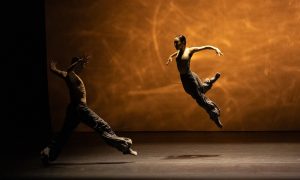
Dance is ephemeral. It is meant to be absorbed in the here and now. Transcendent moments linger and disappear like mists on the seas. Yet, there are ways to keep memories alive. Across the United States, dance archivists toil diligently to chronicle an art form that vanishes almost as soon as it is created. At the University of Denver’s Special Collections and Archives, The Dance Archive has made the preservation of dance history its central mission.
Founded in 1972, The Dance Archive originated when local arts philanthropists supported the creation of a dance library at Colorado Women’s College. In 1983, under the leadership of critic, curator and Denver Post arts writer Glen Giffin, the collection was transferred to the University of Denver, where it has continued to grow in scope and significance. Today, the archive describes itself as the largest dance repository west of the Mississippi and strives to serve as the most comprehensive dance resource center in the American West. Through documentation, preservation, access and educational outreach, it aims to advance engagement with dance history across genres and communities.
The collection now encompasses more than 100 individual archival collections, comprising thousands, and likely tens or even hundreds of thousands, of items. Some holdings are extensive, occupying hundreds of archival boxes. Preserved materials include photographs, performance programs, audiovisual recordings, posters, correspondence, publications and both two- and three-dimensional objects connected to performance and production. While the archive’s primary focus is dance activity in Colorado and the Rocky Mountain region, its collecting scope also extends across the broader American West.
Kate Crowe, Curator of Special Collections and Archives at the University of Denver, oversees The Dance Archive as part of her broader responsibilities for acquisition, curation, instruction and outreach. Her research interests include gaps and silences in the historical record, exhibitions as archival outreach and the use of primary sources in critical pedagogy. Crowe notes that determining what may surprise visitors to the archive is subjective, but emphasizes that the collections reflect a wide network of artists, educators, philanthropists and organizations whose work has shaped dance in the region.
Over the past five decades, the archive’s development reflects a steady expansion in both audience and programming. In addition to strengthening its research holdings, the organization has mounted interpretive exhibitions and documentary projects designed to bring archival material into dialogue with contemporary audiences. Public initiatives such as the Legends of Dance program, established in 2004, recognize individuals and organizations that have made lasting contributions to Colorado’s dance landscape. By honoring these figures, the archive seeks to acknowledge the artistic foundations on which younger generations continue to build.
Dance archiving is driven by the paradox of preserving an art form that is inherently transient. The Dance Archive characterizes its role as safeguarding the tangible record of an ephemeral practice – one capable of lifting the human spirit even as it resists permanent capture. As one Legends of Dance honoree, Duke Hartman, observed during a program event, archiving ensures that dance “doesn’t drift away from us” and that a record remains of both artists and their creative achievements.
For dancers, choreographers and scholars, archival collections can offer both practical and imaginative benefits. Documentation may assist in reconstructing repertoire, contextualizing stylistic developments or informing new creative work. Crowe points to choreographer Twyla Tharp’s long-standing habit of researching at the New York Public Library while maintaining her own personal archive of choreographic process. Such practices, she suggests, demonstrate how engagement with historical materials can serve as a catalyst for innovation as much as preservation.
The challenges of maintaining dance archives are considerable. Because live performance can never be fully captured, archivists must continually balance philosophical questions about authenticity with practical decisions about documentation. The Dance Archive follows a formal collections policy to guide acquisitions, prioritizing materials that illuminate dance and performing arts activity in the Rocky Mountain region while also reflecting wider artistic currents across the American West.
Technological change has both simplified and complicated this work. High-quality video recording is far more accessible than it was even two decades ago, allowing artists and companies to document performances more extensively. At the same time, the resulting digital files require significant storage capacity, specialized management and detailed cataloguing in order to remain accessible to researchers. Crowe notes that digitization itself is only one step in the process; the subject expertise required to describe and contextualize materials often demands far more time and resources. As a result, only a small proportion of the archive’s holdings (likely less than five percent) has been digitized to date.
The archival process can yield moments of discovery that underscore the importance of preservation. Crowe recalls the confirmation that the archive held a video recording of Southland, a work by Katherine Dunham that had been restaged by Cleo Parker Robinson Dance with support from a National Endowment for the Arts grant. The choreography had not been performed for more than half a century prior to that revival. Locating filmed documentation represented a significant contribution to dance scholarship and performance history.
The archive also emphasizes its collaborative relationship with the dance community. Staff members consult with artists and organizations on documentation strategies and assist researchers in navigating collections. This works to extend artistic legacies beyond individual careers. The archive positions itself not only as a repository of the past but also as an active participant in the contemporary dance network. Supporting the creation of new work today, Crowe suggests, is essential if there is to be meaningful history to preserve tomorrow.
Looking ahead, the organization continues to expand its educational outreach, including efforts to strengthen curriculum resources for K-12 students. Yet, its long-term ambitions depend heavily on community engagement. Contributions of archival materials, financial support and volunteer involvement all play a role in sustaining the archive’s goal of building the most significant dance resource in the American West.
Through careful stewardship of programs, photographs, films and objects, The Dance Archive keeps the stories of artists and communities accessible to those who will shape the future of the art form. Dance lives most powerfully in the here and now – archives such as this one ensure that its echoes continue to resonate.
For more information, visit thedancearchive.org.
By Mary Carpenter of Dance Informa.
Share this: