Tag Archive | "Nederlands Dans Theater"

Making the Leap: Dancer to Choreographer


By Laura Di Orio

When a dancer steps down from the stage and “hangs up his or her shoes”, it doesn’t always mean an end to a dance-centered career. Many go on to teach, open a studio, direct a company, design costumes, and several choose the route of choreographer. Those who make the shift from dancer to choreographer may find a most freeing, creative outlet to express themselves. And a former life as a dancer just may make that transition smoother and richer.

Dance Informa hears from two established choreographers, both former professional dancers, on how and why they made the jump and what their life as choreographer provides them artistically.

Did you always know you wanted to choreograph? When did those desires begin to surface?

Edwaard Liang, freelance choreographer, USA
www.edwaardliang.com
I never had the thought or desire to choreograph. I had a one-track mind in terms of what I thought I wanted in my career. When I was dancing with Nederlands Dans Theater, I was urged to try my hand creating in their annual choreographic workshops. I had such a great time with the process. I had no clue what I was doing, but loved it.

Stephen Baynes, resident choreographer, The Australian Ballet www.australianballet.com.au/about_us/artistic_staff/stephen_baynes
I always had an interest in it, but I wanted to have a career as a dancer first. It was only after several years as a professional dancer that I began to attempt choreography.

Where are you along this transition from dancer to choreographer? Have you completely shifted?

Edwaard Liang
I have completely shifted from dancer to choreographer. I don’t feel sad about not performing, I think because I’m still a part of this world. I get to take class and feel like a dancer and move when I want to, but don’t have the same pressures I used to before to be perfect. I get to enjoy movement for movement’s sake. Plus, I never got the ‘juice’ or ‘high’ from performing, so it was not hard to leave.

What does your life as a choreographer offer you that life as a dancer has not?

Stephen Baynes, resident choreographer for The Australian Ballet, rehearsing Baynes's "Beyond Bach". Photo by James Braund

Stephen Baynes
As a choreographer, I have relinquished the challenge and fulfillment of performing but have been challenged and fulfilled in a different way by creating my own dances and seeing them interpreted by wonderful artists.

Edwaard Liang
My life as a choreographer has given me more freedom and input into what I want to say. Making ballets are like making mini movies. You get to decide the music, costumes and sets. You feel like you’re able to mould the whole package.

For dancers who want to either delve into choreography or who want to transition completely, what suggestions do you have?

Stephen Baynes
Be very sure that you really feel you have something to say. Try to get as much experience in making dance as you can. It is a very practical endeavour and needs constant practice, but that can be difficult. More than anything else, search for your own voice, which doesn’t always mean that you can be completely original, but at least it is uniquely yours.

Edwaard Liang's "Age of Innocence" performed by Fabrice Calmels and Victoria Jaiani. Photo by Herbert Migdoll

Edwaard Liang
Keep working and creating, whether it’s a big or small project. The only way to get deeper, better and do richer pieces of dance is to get in there and create. Try not to edit. Find your own voice. Enjoy the process and time. This profession is one of the hardest, physically and mentally, so try to find joy in some of the little things that happen. Don’t always wait for the big promotions to celebrate yourself.

What’s next for you as a choreographer?

Edwaard Liang
I finished presenting my work at Fall for Dance at City Center in New York. I am now starting my first full-length ballet – a new production of Romeo and Juliet for Tulsa Ballet and also new works for San Francisco Ballet, Washington Ballet, Joffrey Ballet and a project with Yuan Yuan Tan and myself.

Stephen Baynes
I am busy with commissions until the end of 2012, including a full-length Swan Lake for The Australian Ballet’s 50th anniversary, and hopefully there will be more after that.


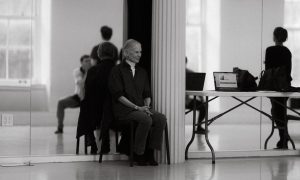
Top photo: Edwaard Liang rehearing with Victoria Jaiani. Photo courtesy of Edwaard Liang

Posted in InterviewsComments (1)

Paul Lightfoot Enlightens


By Rain Francis.

Born in Kingsley, England, Paul Lightfoot trained at the Royal Ballet School before joining Nederlands Dans Theater in 1985. He created his first ballet for NDT 2 in 1989 and went on to create over 40 works for Nederlands Dans Theater, in collaboration with his wife, Sol Leon. Since 2002, the couple – operating under the harmonious name Lightfoot Leon – have been  Resident Choreographers for NDT. Rain Francis caught up with the charismatic Paul Lightfoot, on NDT1′s recent tour.

Your work, Silent Screen was performed as part of NDT 1′s recent tour. Tell me about Silent Screen.

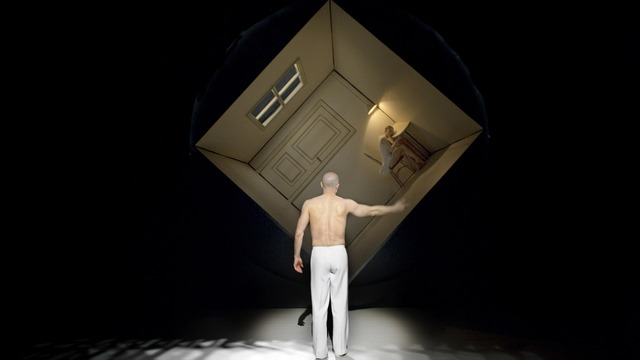
Every piece has a different catalyst; for this piece it was silent movies. It was Hitchcock who said that silent film is the purest form of cinema. I’m a big film fanatic, and I love the genre of silent movies. It’s basically choreography, because it’s people telling a story without words. I wanted to use a film without anybody in it to create a surreal situation, where you have real people moving with the camera, and they can go to different places that evoke different feelings. I thought it would be beautiful to create a tromp l’oeil, a Victorian parlour trick. Phillip Glass was also a huge inspiration, and his Glassworks is one of his most famous pieces. I was very lucky to come across it at the right time for this project.

Nederlands Dans Theater 1 present Silent Screen by Lightfoot & Leon

Are there themes or ideas that you find yourself returning to in your work?

Yes. Silent Screen is an incredibly important piece for us. It is the journey of a man and a woman, which of course is in relation to Sol and I, the way we work, and the way we are. It wasn’t to tell our story, but it was to tell the story of emotions that every couple can relate to, during the stages of a relationship. Sol and I have been together 25 years; we’ve had many ups and downs and those things inspire you.

Do you always create together with Sol?

Always. Ever since the first piece. For the first few years the works only had my name on them, and  Sol wasn’t really aware how much she was becoming a choreographer. She was helping me. We’d go home and chat, go into the studio and work something out, and slowly this partnership was growing. I like to share. Our partnership is highly irregular in the world of choreography. It’s like a dialogue; we combine our ideas, we respect each other, and move forward together.

Do you ever struggle for inspiration, or are you full of ideas?

It sounds very pretentious when I say I’ve got lots of ideas, but sometimes I think it’s a curse. Generally I’ve got too many. I have to chop them down, get to the essence. It can be very chaotic, but I work very instinctively. I’m a good planner but I immediately break all those plans, and follow my gut. With Sol there too it’s very important to remember that there’s somebody else there. You might be fixated on your idea but you have to be ready to let go of it, because the other person isn’t going to always be on the same wavelength.

Do you get to a point where you are satisfied with a piece of work, or could you go on tinkering with it?

No, there’ve been very few pieces that we’ve tinkered with. There are other choreographers I know and love very much, who get itchy. So they return to older works and make changes. It’s funny, even if it’s a lot better, I feel that they haven’t succeeded. I think when pieces have been made, they’ve been made – there’s a certain kind of destiny to it. Imperfections can be very beautiful, and what make things or people special, so I don’t look to make the perfect piece, and I think that’s part of what makes it magical sometimes. I haven’t touched a step of Silent Screen.

You say you are a film fanatic. What kind of things do you watch?

I love everything. I am a bit of a maverick really, I go to anything. Of course I watch the commercial things. I have a 13 year old daughter, so I’m quite often going to see those ones. I can have as much fun watching those as with a much more artistic film, but generally it’s more enriching to watch the work of great directors.

So, what did you think of Black Swan?

I think it’s a good film. It isn’t realistic, in terms of what a ballet company is – it’s a dark, negative fantasy, and frankly, I can imagine someone in that frame of mind going that far. We do deal with obsession, and we do stare at ourselves all day in a mirror and judge ourselves constantly, and those things can turn into a sickness if you’re not careful. I saw it as a lot less of a ballet film and more as being about the destruction of a human being, and ballet was just a tool to describe her story. The film paints a very dark tale. I love thriller and fear and they’re very important elements to all of us.

What advice can you give to budding choreographers?

I would give them a warning, with all the kindness in my heart – make sure you’ve got something to say. It’s not good to do anything in life if you don’t really believe it. Choreography is sort of an exaggerated version of that, it will show you up very fast.

Also, it’s very important to have your own language. Work a lot with your own body first, don’t just wait for others to do all the hard work for you, because it is hard work. It’s hours in the studio, and you have to be dedicated to doing that yourself.

Don’t be afraid to be influenced. I was highly influenced by many people, in many strange ways. Hans van Manen was a giant inspiration to me, and Jiri Kylian of course. People say, ‘I can see you are influenced by Kylian’ – well, absolutely – where else am I going to learn from? I don’t see that as being somehow negative. It’s very important to learn from people who are lots wiser and more experienced, like we do in all walks of life.

Posted in InterviewsComments (0)

Nederlands Dans Theater’s Invincible Vincent


By Rain Francis

Melbourne was honoured to host the iconic Nederlands Dans Theater 1 (NDT1) for an exclusive season at the Arts Centre. For over 50 years the company has been one of the most important forces in dance – and indeed the wider arts world – and it shows no signs of relinquishing its powerful influence.

Nederlands Dans Theater – which includes NDT1 and NDT2 – is now under the artistic direction of Jim Vincent, himself a former dancer with the company. In 2009, Vincent took up the coveted post once held by, amongst others, Hans van Manen and later, Jiri Kylian, who led the company during its heyday. Kylian’s name remains synonymous with NDT; he created a style and vocabulary for which the company became internationally respected and instantly distinguishable. The master choreographer also leaves in his wake a rich repertoire, one example of which Melbourne audiences witnessed, Double You, during the company’s recent visit.

Vincent seems a wise choice for the critical role of NDT’s Artistic Director. Having danced with the company for 12 years under Kylian, he has an intrinsic understanding of its core values and says of his appointment “it’s like coming home”. While keeping true to the original objectives – “to push the art-form and support and nurture our resident choreographers and artists” – he recognises the importance of moving the company forward.

The current structure comprises the core company, NDT 1, and the mentorship company, NDT2 – a ‘breeding ground’ of 16 immensely talented emerging dancers up to the age of 23. Vincent’s vision for NDT goes beyond these two companies, in his quest to impact the art-form on a more fundamental level. He has introduced a third aspect, named simply ‘The Project by Nederlands Dans Theater’. “It’s an opportunity for us to do a bit of what every other field and medium goes through, which is research and development,” says Vincent. “We’ve rarely given ourselves that luxury and I think it’s important for us to determine just as much about what we don’t want to do and where we don’t want to go, as it is the opportunity to create and to have clarity”.

The Project aims to “push dance out of its traditional equation” by blending with other fields, for example technology, science, medicine, fashion, architecture and music. It’s an opportunity not only to impact the art of dance, but to open dance up to a wider audience. Or, as Vincent articulates, “to break out of the microcosm of people already affiliated with dance and look to other fields to give relevance to movement as a form of designer expression, to people who don’t necessarily consider it as such”.

One could be forgiven for thinking that such an established, yet progressive, company would be at least partly immune to drastic reductions of state funding. The international dance community was shocked then, to learn of recent suggested funding cuts to NDT. The Dutch Council for Culture proposed a 40-50% reduction of funding, and that NDT be effectively demoted to a classification of ‘regional amenity’. This would have reduced touring primarily to towns in Holland, with occasional visits overseas. As Vincent says, NDT is “anything but” a regional amenity – it is the figurehead of Dutch modern dance and a cultural ambassador, revered the world over. That message needed to be sent to parliament, and quickly, and was done so, largely through a petition issued to the world just days after the Council’s proposition. Vincent believes the 10,000 signatures gathered worldwide were a huge influence on State Secretary for Culture Halbe Zijlstra, who did not adhere to the Council’s advice of drastic cuts and re-classification. NDT instead received generic 5% cuts, and maintains its top position, but Vincent says the wider dance landscape in Holland will be “completely turned on its head”, forced to look elsewhere for funding.

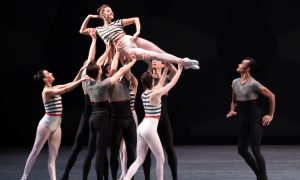
NDT 1 perform in Melbourne. Photo by David Wyatt.

That NDT was able to amass so much support so quickly is testament both to their great international standing, the spirit of community which unites them as a company, and with the greater world of dance. Of the 45 dancers in NDT1 and NDT2 today, there are in excess of 20 nationalities. As Vincent says, “that is some indication of the collective effort that is required, because it is one of tolerance. We are a family, and that’s a tradition that has continued on through the company’s history”.

NDT has had, from its inception in 1959, a rebellious nature. Born of a bunch of dancers breaking free from the Nederlands Ballet in pursuit of a new form of expression, it is its reputation as leader, not follower, which has made it the formidable voice it continues to be today. “You can’t take a company’s importance or acclaim away from it – it already has that,” says Vincent. “So if you decide to shift the gears for us and redirect us, that’s one thing, but you cannot take away what the company has accomplished in the last 51 years”.

Top photo: By David Wyatt.

Posted in Top StoriesComments (0)

Nederlands Dans Theater 1


State Theatre, Arts Centre Melbourne
July 13 2011

By Rain Francis

Fourteen years after their last visit, the incomparable Nederlands Dans Theater came back to Australia, for an exclusive season in Melbourne. With a diverse triple bill, this was easily the most fulfilling dance experience I’ve had, and am likely to have, in a long time.

The programme opened with Double You, performed with breath-taking precision by Bastien Zorzetto. Choreorgraphed by Jiri Kylian, it embodies the style which the Czech master made synonymous with Nederlands Dans Theater, and with his own name. It explores themes of self-doubt, both psychological and physical, and of dealing with the passage of time. Upstage, two giant pendulums swing quietly, their size suggesting domination, their gradually waning energy reflecting the cycle of life. 

The second work was The Second Person by Associate Choreographer, Canadian Crystal Pite. An ensemble piece for 22 dancers, it provides a wonderful contrast to Kylian’s opening solo. Pite has created a highly theatrical yet powerfully human world using a voiceover, a stormy backdrop, an eclectic soundscape, rat-race costumes and – in the words of Artistic Director Jim Vincent –  ‘miniature humans’. Immediately we are drawn in, and immediately we know that this is a piece about us; that although we are unique, we are part of collective. While various solos and duets bubble out of the mass of grey suits, the mass itself develops and envelops like a storm cloud. The closing imagery, where the individuals finally unite and harness a collective intuition, flowing in harmony, is one what will stay with me.

Closing the evening was Lightfoot Leon’s Silent Screen, inspired by silent movies. I can comfortably describe this one as an epic saga – a thoroughly engaging one at that. It is a journey through a lifetime, through the course of a relationship, and through time itself. It is bookended by a beautifully made, primarily black and white film, in which the dancers seem to be characters. Paul Lightfoot’s and Sol Leon’s daughter features both in the film and, by representation, in the choreography. Lightfoot said, ‘Saura was six then and we both felt like her state of innocence was changing, her consciousness, and that’s what we wanted to explore in the piece – changes of states of being, growing older with someone’.

Silent Screen is set mostly to Phillip Glass’, Glassworks; a perfect choice, with its constantly forward-driving rhythms and a hypnotic melody which seems to embed itself in the listener’s consciousness. In a particularly memorable moment, a man and a woman emerge from the orchestra pit and move upstage. As they travel, the woman’s dress trails behind her, covering the entire stage, until suddenly, the featherweight silk is billowing, brought to life by some hidden wind.

The three works in this programme were linked by anthropological themes, giving the evening a sense of cohesiveness. As Vincent said, ‘This is a pretty clear and somewhat perfect cross-section of the company today. It maintains the history, respects the tradition but it also looks to the future of the company’. Performances from all dancers were, not surprisingly, flawless – these truly are some of the best dancers in the world. Let’s hope this magnificent company return to Australia soon. 

Photo by David Wyatt

Posted in Australian ReviewsComments (0)

Nederlands Dans Theatre in Aus


Photo Feast!

The Arts Centre, Melbourne is enjoying an exclusive Australian season of contemporary dance featuring the legendary Nederlands Dans Theater I this week. Dance Informa’s David Wyatt was there to capture the action. 

Photos Copyright David Wyatt david.wyatt@capturingimages.com.au www.capturingimages.com.au

Posted in GalleryComments (0)

Nederlands Dans Theater I Returns to Melbourne


Melbourne audiences are in for a treat! The Arts Centre has scored an exclusive Australian season of contemporary dance featuring the legendary Nederlands Dans Theater I. After a 14 year absence, the doyennes of contemporary dance will showcase their distinctive style at the Arts Centre’s State Theatre with five performances from 13 – 17 July 2011.

Since its inception half a century ago, Nederlands Dans Theater has gone on to define dance and attract admiration the world over, and is now recognised as arguably the most innovative dance company in existence. The company has created a rich repertoire with works from master choreographers Jiří Kilián and Hans van Manen, as well as from resident choreographers Sol León & Paul Lightfoot and associate choreographers Crystal Pite and Johan Inger.

“It’s a real coup for us to be able to attract this great international company and dance lovers from around Australia will be eager to come to Melbourne for this exciting season”, said Judith Isherwood, Chief Executive of the Arts Centre. “The company has inspired many first-time visits to the theatre for a great display of modern dance and I have no doubt this 2011 season will provide a similar opportunity.”

“It’s an honour to be back in Australia. We look forward to sharing with the Melbourne audiences a programme which reflects the essence of who we are: fortunate to have a rich and creative dance history which provides us with brilliant signature works like Double You by choreographer Jiri Kylián, while at the same time presenting recent creations by an emerging generation of contemporary dance makers such as Sol León and Paul Lighfoot, and Crystal Pite”, said Nederlands Dans Theater Artistic Director Jim Vincent.

“These three uniquely dynamic productions, created by four diverse choreographic voices and performed by our ensemble of extraordinary dancers will make this programme a truly unforgettable experience” he added.

The Melbourne performances by Nederlands Dans Theater I will feature three works. Created by Jirí Kylián, Double You is an intimate solo which offers a window into a man’s soul as he grapples with life’s experiences.

In The Second Person, Canadian choreographer Crystal Pite creates a powerful atmosphere which draws the audience into a different world. Featuring 24 dancers on stage, they represent the exchange between the collective and the individual, searching for their own identities.

Inspired by the art of silent movies, Paul Lightfoot and Sol León explore the beauty of expression without words in Silent Screen. The highly acclaimed performance will feature large screens projecting luscious and fluid scenery for dancers to move through and beyond.

About Nederlands Dans Theater
Nederlands Dans Theater originated in 1959 when 22 people broke free from the Nederlands Ballet. These rebels were impassioned by dance and the desire to give it a style all their own. Under the direction of Carel Birnie and Benjamin Harkarvy, they steadily built a different repertoire to dance companies of modern dance. Fifty years later, Nederlands Dans Theater has become one of the leading dance companies in the world.

A rich repertoire has been built up with works from master choreographers Jiří Kilián and Hans van Manen, as well as from resident choreographers Sol León and Paul Lightfoot, associate choreographers Crystal Pite and Johan Inter and many other guest choreographers such as Ohad Naharin, Nacho Duato and William Forsythe.

Through the years, but particularly in its heyday under former artistic director Jiří Kilián, Nederland Dans Theater has created pioneering works in contemporary dance. Ballets originally made for Nederlands Dans Theater are still performed all over the world. Numerous dancers and choreographers that once started with the company have set up their own dance companies world-wide, spreading Nederlands Dans Theater’s influence far and wide. A number of Australian dancers have worked with Nederlands Dans Theater, including Graeme Murphy, Gideon Obarzanek and Kirsty Martin (The Australian Ballet).

Nederlands Dans Theater has two companies, with two generations of dancers – Nederlands Dans Theater I and Nederlands Dans Theater II. Nederlands Dans Theater I is the first company, founded in 1959 and consists of thirty dancers. They vary in age from 23 to 42 and each one of them excels in their solo qualities. Nederlands Dans Theater II was founded in 1978 for young, upcoming talent with astonishing technique and endless energy. NDT II currently consists of sixteen dancers up to the age of 23. The second company is a revolutionary breeding ground for talented dancers and established choreographers who together create new work.

Get your tickets here!

Posted in Features, Top StoriesComments (0)

Term 1, Dancing at Codarts


By Madeline Harms.

Dear Readers,
The weeks are flying by and the first half of the semester at the Rotterdam Dance Academy is over! When I left you last I was just settling in, and looking back now I realise I have come a long way since then.

The beginning wasn’t easy; everything was exciting and new, yet so foreign. Getting to know my classmates, the city, and the school was all a slow but steady process. Rotterdam is a city flourishing with students, as there are many big universities in the city and surrounding areas, so the student vibe is comforting.

University Life
At Codarts University there are eight different academies, including numerous genres of music, musical theatre, circus and dance. Imagine the cafeteria at lunchtime – a great mix of artists and people from over 60 different nationalities. More than 60% of students come from abroad. This is what I love about the place; so many cultures and languages mixed together. I am lucky as English is the common language within the school, however I am very aware of my Aussie slang and distinct accent!

Our third year timetable includes ballet every day.  Two classes are with our set teacher, and three classes are with a guest. We also have two classes of Cunningham Technique a week and three modern classes with a guest teacher. The guest teachers change every 2-3 weeks giving us the opportunity to experience different skills and teaching methods.  Other subjects include a conditioning program called Gyrokenisis, Modern Jazz, and Drama and our academic subjects include Dance History, the study of Art and Dance, and the Sustainable Performance program, addressing Nutrition, Biomechanics, Anatomy, and Performance Psychology. Our remaining time is dedicated to rehearsals for repertoire and up-coming performances. The timetable is always changing, as there is an abundance of activities going on. I am one of 20 new people in the third year level, joining the original 20, so there are quite a few of us!

Sabine Kupferburg, Jiri Kylian, Brigitte Martin. Photo: Joke Schot

Working with Jiri Kylian!
Last term it was announced that Jiri Kylian, one of the most renowned choreographers of today, will lead the professorship ‘One of a Kind’ for four years at Codarts, starting this year. He will be collaborating with associate researchers Dr. Friederike Lampert and Dr. Désirée Staverman, to explore the wider concept of the dancer and choreographer. With numerous themes related to dance and choreography, they will discuss subjects such as expressivity of the human body in various age-related phases of life, the voice and spoken word, video, photography and lighting. Over the next few years various lectures and workshops will be held at Codarts to address these topics. I am so privileged to be here at this time!

There was a performance to launch the project and at that the new third year students had the chance to participate. We were auditioned for a Jiri Kylian piece, titled ‘A Way Alone’. It is a trio for two male dancers and one female dancer, originally created on Nederlands Dans Theater III in 1991.

I was one of six girls lucky enough to be chosen to learn and work with this piece, along with six boys. For four weeks we worked intensely with our rehearsal director Brigitte Martin, an ex-dancer of NDT, and Sabine Kupferburg, who is the original female dancer on which the piece was created. Sabine spoke to us about the real meaning behind the work and how Kylian choreographed every single movement for a reason. The piece is about the thoughts and memories of loved-ones lost; the sadness, grief, anger, frustration, and the feeling of missing someone or something. The last section of the piece is made up of three poems in sign language, each written by the original dancers themselves about an individual experience.

To understand what the movement was saying, and to put my own personal experiences and understanding into the choreography, was a different experience for me; so sensitive, so touching. I walked away from these rehearsals with a new perspective on how to view and understand dance. This piece was no longer just a nice piece of choreography, it was a conversation, a meaning, a story.

In the last week of rehearsals, Jiri Kylian came and worked with us on his piece, which was unbelievable. This time last year I was sitting in a classroom learning about this genius, and a year later here I am shaking his hand! I absorbed his words like a sponge.

I was not chosen to perform the main part in the trio this time, however those who were not in the trio were still able to be part of the performance. We joined in with the sign language towards the end of the piece. The performance was a big success and it was very thrilling to be a part of – an experience I will never forget.

My first visit to NDT!

Shows
I have been lucky enough to see a number of performances and exhibitions whilst being here. I saw the incredible performance of Retouch by Nederlands Dans Theater I; a triple bill including the world premiere of Tone Bone Kone by Johan Inger, Of And If And by William Forsythe, and Bella Figura by Jiri Kylian.  All three pieces were compelling in their own way, however the pas de deux of Of And If And, moved me to a place I had never been taken before. The honesty, passion and sensitivity of the dancers, Karyn Benquet and Roger van de Poel, were beautifully empowering. When the lights smoothly dimmed up and down, capturing glimpses of the young relationship blooming, like a film capturing moments in time, I began to weep. I was shocked, for I have never cried in a dance performance before; they were overwhelming tears of joy.

I recently enjoyed a performance called Trust written by Falk Richter and choreographed by Anouk van Dijk. It included dialogue in German, with translation in Dutch on the screen above, so I couldn’t understand it at all. However, this enabled me to approach the piece from a different perspective, relying solely on the body language, tone of voice, and expressions of the performers. I was amazed how much I understood just by their energy and the atmosphere.

Brussels Markets

Travel
We had a week off at the end of September, so I went to Paris to visit my cousin, and meet up with some friends from home. Seeing familiar faces and being able to talk about home was refreshing and warming. I had a wonderful time exploring one of the most beautiful cities in the world. I have also managed to do quite a bit of traveling on weekends, going to other Dutch cities such as Amsterdam, Den Haag, and Utrecht. I have also just recently spent a weekend in Brussels, Belgium. Each city has something unique and different to offer, with its own special vibe.

I do not want to pretend that I haven’t felt homesickness yet, because I have. I am learning how to deal with it. I allow myself to feel it, then take a deep breath and move on, looking at it as part of the whole adventure and experience…

I am always discovering something new here and feel I have already learnt so much! I am very excited about what this term will bring and what experiences I will be able to share with you!

So until next time…
Maddy

Posted in FeaturesComments (0)

Nederlands Dans Theater to Return


The Arts Centre, Melbourne has scored an exclusive Australian season of contemporary dance featuring the legendary Nederlands Dans Theater. After a 14 year absence, the doyennes of contemporary dance will showcase their distinctive style at the Arts Centre’s State Theatre with five performances in July 2011.

Since its inception half a century ago, Nederlands Dans Theater has gone on to define dance and attract admiration the world over, and is now recognised as arguably the most innovative dance company in existence. The company has created a rich repertoire with works from master choreographers Jiří Kilián and Hans van Manen, as well as from resident choreographers Sol León & Paul Lightfoot and associate choreographers Crystal Pite and Johan Inger.

“It’s a real coup for us to be able to attract this great international company and dance lovers from around Australia will be eager to come to Melbourne for this exciting season, “ said Judith Isherwood, Chief Executive of the Arts Centre. “The company has inspired many first-time visits to the theatre for a great display of modern dance and I have no doubt this 2011 season will provide a similar opportunity.”

“It’s an honour to be back in Australia. We look forward to sharing with the Melbourne audiences a programme which reflects the essence of who we are: fortunate to have a rich and creative dance history which provides us with brilliant signature works like Double You by choreographer Jiri Kylián, while at the same time presenting recent creations by an emerging generation of contemporary dance makers such as Sol León & Paul Lighfoot and Crystal Pite,” said Nederlands Dans Theater Artistic Director Jim Vincent.

Nederlands Dans Theater 1
13 – 17 July 2011
the Arts Centre, State Theatre
www.artscentre.com.au

Tickets on sale Monday 8 November at 9am. Phone 1300 182 183.

Photo: Joris-Jan Bos

Article published by http://www.danceinforma.com

Posted in Dance News AustraliaComments (0)

Nils Christe Creates


By Deborah Searle

Enjoying an exciting year, the Queensland Ballet have commissioned Dutch choreographer Nils Christe to create a piece for the company’s 50th Anniversary Gala in August.  Christe, who has successfully worked with the company twice before, brings a wealth of knowledge, experience and creativity to Australia, having choreographed for Europe and America’s leading ballet companies in a career spanning over 35 years.

Tell us about your work for the Queensland Ballet International Gala. What can audiences expect?

I am remounting my work Fearful Symmetries on Queensland Ballet for their 50th Anniversary International Gala in August. It’s the third piece I have done with the Company and this work is the youngest, being only a few years old. It is actually the first time it has been remounted since I created it on Ballet Mainz (Germany).

Rachael Walsh and Keian Langdon of QLD Ballet perform 'SYNC' (from …with attitude 2009)

Rachael Walsh and Keian Langdon of QLD Ballet perform 'SYNC' (from …with attitude 2009)

Fearful Symmetries is choreographed to fabulous music of the same name by John Adams, my favourite composer at the moment. It has incredible drive and is high voltage, and has an element of “travelling”, or going somewhere.

Audiences can expect a piece which is “now” – current and contemporary. There are some surprising elements, which I don’t want to reveal now. I don’t want to ruin it for them! In this ballet, I play with primary colours – a reflection of the famous Dutch painter, Piet Mondriaan’s traditional way of painting with black, white and primary colours. Fearful Symmetries is nice in that it goes to an incredibly high climax and then ends peacefully.

How does your choreography challenge the Queensland Ballet dancers?

This piece is probably more challenging than Purcell Pieces and SYNC (the previous two works with QB) as it uses everything – pointe work, classical virtuosity, and contemporary elements. It is a great piece for them to get their teeth into. The dancers are absorbing it well, and I have been able to teach it to them very quickly. Indeed, the QB dancers who have danced in my other two works are picking it up very quickly.

Do you enjoy working with Australian dancers? Why?

I am often asked this question for whatever country I am working in. I find that working with dancers is really the same wherever it is in the world – all dancers are hungry to learn new material, they are like sponges.

Christe with his wife Annegian Sneep

Christe with his wife Annegian Sneep

Tell us about your years at Nederlands Dans Theater. How did they shape your choreographic voice?

NDT certainly influenced me as a young choreographer, but that was 30 years ago and many things have influenced me since then. Many of the people that influenced me at 20 years of age are no longer alive. It was definitely a special time, but so much has happened since in my career, and I have really found my way as a choreographer.

You have created so many ballets on the world’s most prestigious companies. How do you keep so inspired and creative?

Firstly, I am inspired every day by my wife and partner Annegian Sneep. Wonderful dancers also inspire me. People with their own Company, like Queensland Ballet’s Artistic Director and Chief Choreographer François Klaus, have an advantage as they are always tuned in with their dancers. However, as a freelance choreographer, there is the advantage of being challenged and inspired by dancers who you haven’t worked with before. I usually work with a Company prior to actually creating a ballet on them, which is different to creating on dancers who are used to being created on by me. Music is really the most important inspiration for me. I would now dare to choreograph to music I wouldn’t have choreographed to earlier in my career.

What are your career highlights?

There are so many highlights – I was so lucky to be at NDT with that fantastic opportunity to choreograph at such a young age. Before Nightfall with the Paris Opera Ballet was another highlight, working with dancers such as Sylvie Guillem – one of twelve of the most fantastic POB dancers ever. That whole cast became the POB étoile – at just 19/20 years old, an indication of how good they were.

Where will we see you next?

Paris Opera Ballet will be performing one of my pas de deux at the Varna Competition in Bulgaria, and then we will be working with the Swedish Ballet later in the year. We will be returning to Australia at the end of July to complete Fearful Symmetries in readiness for Queensland Ballet’s 50th Anniversary International Gala.

What advice would you give to young choreographers?

Don’t try and re-invent the wheel.
Start with a smaller cast.
Don’t start with complicated music.
Don’t choreograph steps on yourself and then onto the dancers, go straight to the dancers.

To see Nils’ work with the Queensland Ballet make sure you get your tickets to the 50th Anniversary International Gala. Click here for more information www.queenslandballet.com.au

Posted in InterviewsComments (0)