Tag Archive | "Chunky Move"

NZ Dance Co – Not just living, but thriving


By Rain Francis.

In 2012, a new dance company was born over in Kiwi-land. Led by Artistic Director Shona McCullagh, The New Zealand Dance Company (NZDC) hit the road rolling with its launch season Language of Living. Met with positive responses from both Auckland audiences and critics, the production is now being rebooted for a North Island tour.

Language of Living comprises a diverse programme performed by some of New Zealand’s top dancers, including Ursula Robb, Craig Bary, Justin Haiu, Hannah Tasker-Poland, Tupua Tigafua and Lucy Lynch. The works come from both extraordinary emerging voices, such as Sarah Foster-Sproull, and New Zealand’s choreographic royalty, such as Arts Laureate Michael Parmenter.

Parmenter’s work Tenerezza, a duet for Craig Bary and Justin Haiu, explores the idea that no movement occurs without initiation by the other. “The piece began very much with the two dancers, both of whom I have worked with on a number of occasions,” says Parmenter. “I had a sense of the particular quality of relationship that I wanted to explore and so that led me to the particular piece of music [by Carl Philipp Emanuel Bach], with which too I had had a previous choreographic relationship.”

Tenerezza was developed via two partner-improvisation forms – Piloting and T.A.C.T.I.C.S. – that Parmenter has been developing over recent years, and with which both the dancers had a certain degree of familiarity. “Initially the idea was to have a certain component of improvisation remain in the finished piece, but as it turned out the only remnant of this is in the choreographic relationship to the music, which since both the dance and the music are performed live, is not fixed but varies from performance to performance,” explains Parmenter.

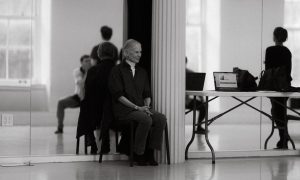
Choreographer Michael Parmenter

Michael Parmenter. Photo courtesy of New Zealand Dance Co.

Craig Bary is a dancer who is much loved in both New Zealand and here in Australia, having performed with companies such as Australian Dance Theatre, Tasdance, KAGE and Chunky Move. He speaks fondly of Parmenter’s duet. “It’s challenging and exciting to perform every time,” he says. “Because it was created through improvisation techniques created by Michael, it’s really about us, the dancers, and that feels really special.”

NZDC audiences in Auckland and Wellington will be treated to performances of Faune by international choreographers Anne Teresa De Keersmaeker and Mark Lorimer. Set to Claude Debussy’s famous score L’après-midi d’un faune (The Afternoon of a Faun), the solo will be performed by Ursula Robb, who has worked with De Keersmaeker’s Rosas company in Belgium and the Paris Opera. On the Warkworth, Orewa and Whangarei legs of the tour, a new work has been added to the programme. Without Eve is a humorous take on the art of male conversation by UNITEC choreographer Ashleigh Coward.

Language of Living is an eclectic programme, and audiences can expect to see “world class dancers and choreographies,” as Bary says.

New Zealand Dance Company, Language of Living

New Zealand Dance Company in ‘Language of Living’. Photo by John McDermott.

Parmenter agrees, even despite having yet to see the production in its entirety. The busy choreographer notes, “What strikes me about the glimpses I have seen of the pieces is a devotion to the ‘art’ of dance itself. This may seem somewhat quaint in light of the current theory-impregnated dance aesthetic, but I can’t help but see it as an act of respect for and maintenance of a rich tradition of aesthetic understanding.”

Aside from its professional performance seasons, NZDC has also been building a Youth Engagement Programme (YEP!). As part of the Language of Living tour, the company will be performing shows just for schools in a variety of centres. They will also be selecting talented local dancers to perform alongside the professional – a wonderful opportunity for dance students.

“The New Zealand Dance Company has a leadership youth engagement role, creating access and mentoring for young people to get hooked into dance,” says Artistic Director Shona McCullagh. “The art form and society are fortified by inspiring the values of courage, enthusiasm, independence and contribution.”

Like Australia – and let’s face it, most places on Earth – New Zealand has no shortage of dance and choreographic talent. With internationally respected training institutions such as UNITEC and New Zealand School of Dance turning out world-class graduates year after year (including a large proportion of Australians), the need for jobs is greater than ever.

“There has been a call for this kind of inclusive and mainstream company for quite some time,” says Bary. “Any company that allows for the development and practice of art forms is a great thing for the cultural diversity and language of its nation. Allowing a voice to our incredible artists and collaborators to share with an interested and excited growing audience is a great way to explore our identity nationally and internationally.”

Language of Living North Island Tour runs from May 25 to June 12. For full venue and ticketing information, visit www.nzdc.org.nz.

Photo (top): Craig Bary and Justin Haiu in Michael Parmenter’s Tenerezza. Photo by John McDermott.

Posted in FeaturesComments (0)

Chunky Move’s 247 Days


Merlyn Theatre, Malthouse, Melbourne
March 16 2013
As part of Dance Massive

By Grace Edwards.

Chunky Move’s 247 Days is described as an “exploration of human dynamics within the context of a shifting Australian landscape.” The name 247 Days refers to the number of days the work took to gestate, and approximately the number of days choreographer Anouk van Dijk has spent in Australia. In this work, she explores the familiar theme of self and its significance within a wider world. In a sense, she is taking us on her latest journey, the well-worn migrant experience of trying to work out one’s new identity in a land of unfamiliar cultural norms.

Many aspects of this production are well conceived. The backdrop, a wall of mirrors, proves an effective device to explore ideas such as the interplay between the group and the individual, and self-image versus the true self. The dancers literally observe themselves, not recognising the reflection staring back or simply finding no reflection at all. The use of colour in the costume designs is also self-consciously harnessed to elucidate the personal transformations of the performers.

The dancers are clearly committed to the work and their vulnerability on stage provides strong testimony to their trust in van Dijk’s vision. Lauren Langlois and James Pham offer particularly notable performances, transforming the frequently off-centre balances, falls, tumbles, spins and inward foot flexions of van Dijk’s movement vocabulary into a physical metaphor for the negotiation of social forces and expectations beyond our control.

The same ideas are returned to again and again in different scenes, lending the work interest. Some passages, however, are consequently overly wrought, as though van Dijk did not quite trust that the audience would take away her message, whilst other, more fleeting, moments lack context. At one point in the work, Pham takes to the open microphone at the front of the stage to speak openly of love. Meanwhile, his colleague contorts his face in the background. Apart from distracting from the meaning of Pham’s words, the intent behind this act was decidedly unclear and the overall effect was rather random, if not a little comical. A minor criticism perhaps, but unnecessary moments like this peppered the work and made it seem somewhat indulgent.

Perhaps van Dijk’s major obstacles, if 247 Days is anything to go by, stem from the very issue which inspired this work; her tendency to crowd out the more conceptually interesting passages whilst overextending some of the lesser sequences is perhaps a sign that van Dijk’s is still finding her voice. Nonetheless, van Dijk’s choreography style is exciting and distinctive on the Australian landscape, and it will be very interesting to watch how her choreography evolves over the course of her promising career with Chunky Move.

Posted in Australian Dance ReviewsComments (0)

Anouk van Dijk’s 247 Days in Aus


By Rain Francis.

“It’s just like Holland!” Anouk van Dijk exclaims cheerfully as she arrives at the Chunky Move studios. It’s 10:30am in late February and Melbourne is doing that thing where – after a prolonged streak of stifling weather – it’s really, really raining.

Van Dijk and I are meeting up today to talk about her new work for Chunky Move, 247 Days, which will premiere at the Merlyn Theatre on March 15. The new creation will be her second work as Artistic Director, having taken over from Gideon Obarzanek last year. Her 2012 work An Act of Now was a huge success, or in her words, “a total blast. Very outgoing, very site-specific and with lots of people involved. It was really an event.”

Presented as part of the Melbourne Festival, An Act of Now won best new Australian work in The Age Critic Awards. From van Dijk’s perspective, it was an excellent way to begin work with a new group of collaborators, to break her into her new role in a new country – and now the time has come to go deeper.

Anouk van Dijk's 247 Days, Chunky Move, Australia

Chunky Move in ’247 Days’

“I have to start looking at things from different perspectives, inevitably,” she explains. “Moving to the other side of the world, moving to another culture, how do you communicate with people? In Europe, we all speak English with each other because that’s the only language we can all share. You develop a particular kind of language together, which people call ‘eurenglish’. For the last couple of months, I’ve been trying to understand how to speak English here.”

This question of communication and human interaction forms the basis of 247 Days. Van Dijk is interested in how we view the world, and how the world views us. “Do we behave as expected, or accept who we truly are?” asks the press release for 247 Days. “If we could observe ourselves in an unguarded moment, what would we see?”

To begin finding answers to these questions, van Dijk and her dancers made “a few thousand beautiful pictures” with celebrated dance photographer Jeff Busby, who also collaborated on An Act of Now. These images, amongst other devices, became the inspiration which has informed the choreography.

“I wanted to literally capture a moment in time, so we started to make photographs of people in movement; the dancers, their families, their friends, the staff, their families,” says van Dijk. “I wanted to capture these moments when people are taken off guard, or about to recover from something or surrendering into something. For me, this also stands for this moment in time, the discovery process we’re in.”

The cast of 247 Days includes five dancers from An Act of Now and one new addition, Tara Soh, formerly of Australian Dance Theatre. All in their early or mid-twenties, they are at a point of discovering new ways of moving and new ways of thinking about dance, van Dijk explains. “They are all discovering certain things for the first time and becoming aware of certain patterns and mechanisms, in themselves and in society. It’s a really exciting departure point for a dialogue, for all of us,” she says.

Part of the dancers’ discoveries can be attributed to learning Countertechnique, a method of thinking and a practice that van Dijk has developed over the past 20 years. The basic principle is that, rather than working with a ‘centre’, one works with energy directions. Every direction has an opposite and the two of them together create the balance. This application of this idea results in more freedom in the joints, freedom of mobility, ease of directional changes, and the ability to retain speed, momentum and balance. “That’s the mechanics we work with, and I’ve developed a toolbox full of practical knowledge the dancers can use in order to achieve this,” says van Dijk. “It enables them to be more proactive in their training, to deal with injuries better… and it makes movement less exhausting.”

247 Days is being presented as part of Dance Massive, a bi-annual festival of contemporary choreography. It’s an intoxicating time for Melbourne dance fans, with works being presented by Stephanie Lake, Larissa McGowan, Lucy Guerin, Antony Hamilton, Jo Lloyd and many others. “I would like to see everything,” van Dijk says emphatically. “That’s very frustrating, because in the first week I can’t see anything. It’s a really exciting way for me to get to know, in a short amount of time, many Australian artists that I don’t know yet.”

The spirit of curiosity, exploration and discovery is all around her, it seems. She left her European homeland last year to take up the coveted post of Artistic Director, the first person to take the helm of a much-loved company after the founders. So, while it also means “what’s going on in people’s consciousness 24/7”, the title of her new work also stands for the amount of time she has been in Australia.

As we head into Spring, these stifling days will become a memory, documented in part by a dance work created to capture the moment. And, with the next 247 days of van Dijk’s journey sure to bring more of our famous weather, I’m sure she will feel right at home in Melbourne.

247 Days by Chunky Move
Friday March 15 – Saturday March 23
Merlyn Theatre, The Malthouse
www.dancemassive.com.au

Top photo: Anouk van Dijk by Silvia Sztankovits

Posted in FeaturesComments (0)

NZ News January


By Rain Francis.

The New Zealand School of Dance class of 2012 has been successful in securing the following contracts for 2013: Brydie Colquhoun – Black Grace; Chloe Einicke – West Australian Ballet; Samantha Hines – Australian Dance Theatre; Laura Jones – Royal New Zealand Ballet; Simone Lapka – Douglas Wright; Jia Xi Lee – Singapore Dance Theatre; Gareth Okan – New Zealand Dance Company; James Pham – Chunky Move; Luis Piva Junior – Singapore Dance Theatre; Matte Roffe – Australian Dance Theatre; Andrew Searle – Dancenorth.

Congratulations to all graduates and all the very best as you embark on your performance careers!

The New Zealand Dance Company is hosting an international exchange with Chicago based dance theatre company Lucky Plush Productions. This Professional Devising Workshop comprises of a morning technique class followed by two devising sessions, where participants will work with the Lucky Plush company members in their devising process. The workshop is suitable for actors, dancers and physical theatre artists at tertiary and professional level.

New Zealand School of Dance

Luis Piva Junior in Loughlan Prior’s ‘Verse’ for New Zealand School of Dance Graduation Season 2012. Photo by Stephen A’Court.

Lucky Plush Productions will bring its distinctive devising process to Auckland’s dance and theatre communities as they begin creative research for the company’s second collaboration between Artistic Director Julia Rhoads and theatre director Leslie Danzig. This research populates classic physical comedy routines with different bodies and invites workshop participants to experience a contemporary reworking of this material. Through exploration of various research questions, the work considers how bodies generate and defy comedy, and how this classic physical comedy form can be opened up to a complex and lush choreographic language that speaks both viscerally and intellectually to audiences.

To find out more, email classes@nzdc.org.nz or visit www.nzdc.org.nz

Atamira Dance Workshop is a new contemporary dance and choreography workshop offered at Corban Estate Arts Centre’s Summer School 2013.  The workshop will be taught by the professional Maori Dance Company Atamira, who will share dance exercises inspired in their Kaha show and introduce some techniques for creative dancing. Whether you are interested in finding inspiration to innovate in your dance repertoire or just learning new steps, this workshop is for you!

Atamira will ignite new ideas by leading dance exercises and setting choreographic tasks that use dance to stimulate creativity. Dancers will practise some of Atamira’s repertoire and choreographic skills based on the arts of moko (body tattoo), kowhaiwhai (painting) and raranga (weaving) designs, and explore how contemporary art can be used to create new  choreography.

Location: Corban Estate Arts Centre. 2 Mt Lebanon Lane, Henderson
Dates: Mon 14 – Wed 16 January, 10am – 12.30pm
Fee: $65

Find more information at www.ceac.org.nz. Dance teachers, tutors and lecturers will receive a 10% discount on the course fee!

Top photo: Julia Rhodes from Lucky Plush Productions in Punk Yankees.

Posted in FeaturesComments (0)

Kristina Chan – Dancing Free


By Linda Badger.

With an enviable career, Kristina Chan is one of Australia’s foremost independent dance artists. Having worked with so many of Australia’s most influential contemporary and classical companies and choreographers, Kristina won the Australian Dance Award for  Outstanding Female Dancer in 2009 for her work in Tanja Liedtke’s Construct. She has taught in many dance companies, universities, dance institutions and the like and is an artist to watch, and be inspired by.  Even after many years of a full career, Kristina is still at her peak as a dancer and collaborator, seemingly going from strength to strength with each project.

Dance Informa’s Linda Badger had the opportunity to ask her a few questions about her work and career.

You began serious dance study with full-time classical ballet. Was that the path you thought you wanted to take?

I started ballet at the age of three and then did a full-time classical ballet course in 1994 and 1995. I thought that I wanted to pursue classical ballet, but halfway into the course I discovered contemporary dance and found that it was more suited to me. I found it much more inspiring and engaging.

What have been the formative moments in your career?

Getting my first professional job with Australian Dance Theatre in 1999 probably kicked me into gear and was a big learning curve for me at the age of 19.

Working with Tanja Liedtke – her dedication and vigour was admirable and inspiring. I learnt a lot from working with her. (Kristina was one of the key dancers in Liedtke’s creative team, working closely with her as a dancer and a collaborator on both of Liedtke’s full length productions, Twelfth Floor and Construct.)

There have been many formative moments and hopefully more to come.

Where are you currently based and what are you working on?

I’m based in Sydney, however work takes me all over the place. I am currently in Singapore Airport waiting to board my flight to Budapest where I will be touring with Chunky Move.

Independent Australian dancer Kristina Chan

Kristina Chan performs in ‘In Glass’ at Spring Dance 2010. Photo by Ian Bird.

What is the most interesting work you have been involved in?

Because I freelance, my work is constantly shifting with each project I am involved in – that is the most interesting part.

What has been the biggest challenge in your career?

Performing at Tanja Liedtke’s funeral tribute. That was difficult, strange and surreal.

How do you prepare for a role?

With each role comes different preparation. I may work on a piece for several months, researching and creating material for a role. Other times I have to jump into an existing work with only a week to learn and hopefully develop my own feel for it.  It’s a completely different process, but I try my best to give as much as I can to the process so that I can perform it well and not just dance the steps.

What are your influences?

Visual art, movies, music, nature, peers – everything in your life influences you in some way or another.

You have such a captivating stage presence, how have you developed this?
I really am interested in exploring how movement is executed, with less emphasis on what the moves are.  Dance as an experience for both myself as the performer and hopefully, you as the audience.

How do you overcome disappointment in your career?

Put the past behind you… And what could be that disappointing when you have a career in what you love to do?

What is your favourite and least favourite type of choreographic process?
Least favourite would have to be a process in which the choreographer would give me all the choreographic material, it’s quite an old school method of making dance work. I much prefer to be in a collaborative process where the performers are included in the making of the work and get to contribute their own creative ideas. In saying that, I have worked with directors that ask you to create basically everything and don’t seem to contribute much themselves. A balance is ideal.

You created a piece for the IO Myers Studio which was shown at Spring Dance festival this year. Are you moving into choreography as a next step in your career, or was that just something you decided to do for that particular show?

Choreography is definitely a progression in my career but I am by no means labeling myself as a choreographer, not for now anyway. I am still very interested in performing in other peoples’ work. I am looking to find a mix of the two.

Would you ever create a full-length work? What would it be about?

I recently made my first full length work, Kingdom Mourning, on the third year students at Adelaide College of the Arts. In the work I looked at the relationship between an abstract world and it’s inhabitants, the community within it, both as a group/pack and the individuality within the group.

If you could dance with any company, which would it be?

I am very happy freelancing.

Posted in Features, InterviewsComments (0)

Asanti Dance Theatre: Going back to move forward


With its roots in Africa and its home in Melbourne, Asanti Dance Theatre is striving to make sense of tribal tradition in a fast paced multi-culture of accelerated change.

By Paul Ransom.

“Most of our traditional dances are very boring,” says Ghanaian born, Melbourne resident choreographer Appiah Annan. “Not just the Ghanaian ones, but across most of Africa,” he adds. “But it’s up to us to change them and make them interesting.”

This might seem like an astonishing admission for someone reared in the multi- coloured cultural melting pot of West Africa, with its vibrant and very musical fusion of tribal tradition, reggae, hip-hop and Western pop and dance. However, for the man behind Sankofa, a new ‘Afro-contemporary’ dance work premiering this month at Melbourne’s Malthouse Theatre, it is the launch pad for an investigation of both tradition and the desire for change.

As Appiah Annan explains, “People say it’s not possible to change those dances but I think the basis is there and if you have the artistic direction to think of things in a different way, it is possible to make those old dances new again.”

Asanti Dance Theatre Melbourne Australia

Asanti Dance Theatre. Photo by Sebastian Avila

Indeed, the prime motif of Sankofa is precisely that; going back to move forward. In Ghanaian iconography, Sankofa is a bird reaching its neck back towards its tail; the symbolism of which Annan is trying to embody in a work that fuses contemporary discipline, African energy, live music and multi-ethnic performance.

Before settling in Australia in 2007, Annan was already exploring modern forms of dance. “I didn’t really study traditional dancing at first. I was into what we in Africa call ‘freestyle’, which is danced to house music and hip hop. From the freestyle I went back to the traditional dance,” he recalls.

From there he set up Asanti Dance Theatre which, from small beginnings, garnered an international reputation, not only for its creative works but its community outreach. Transplanting the company to Australia, Annan delved deeper in to his love of contemporary, inspired by such luminaries as Pina Bausch, Jiří Kylián and, locally, by Chunky Move founder Gideon Obarzanek.

“Traditional dance is very different to contemporary dance,” Annan states bluntly. “What I’m trying to do is to change some of the traditional moves to become contemporary. In Africa everything sticks to the traditional. We don’t change as much as you do here in the West.”

Working within the self-consciously mutable milieu of the Western contemporary style, Sankofa clearly seeks to examine the role of tradition, not just in dance but in culture generally. To what extent, in a rapid fire world of constant change and faddish ‘innovation’, can solid tradition play a stabilising role? “It does talk about the value of tradition,” Annan confirms, “but also it talks about how we don’t have to stick with those things. We have the opportunity and the capacity to change things, to make things new or to change the way they are going.”

From a purely performance perspective, Annan seeks to evoke this by utilising a lot of “going back and forward” movements. “We’ve also tried to show what Sankofa means to different people from different cultures.” To this end, the show features dancers from Africa, Asia and Australia, as well as a live soundscape of African drumming and modern electronica.

Asanti Dance Theatre Australia

Asanti Dance Theatre. Photo by Sebastian Avila

However, the obviously multicultural nature of the work is not necessarily a cry for tolerance and understanding, nor is it a nod to political niceties. As Appiah Annan insists, “This is not a ‘cultural’ thing, it’s just an artistic work that people from many countries have come together to create.”

Having said that, Annan is clearly able to evaluate both the differences and the similarities between the cultures of Ghana and Australia. The two are quite obviously distinct, not simply in terms of economy, technology and cultural proclivity, but with regards to the way that the arts are practised. “Here, they think about lighting and staging, story and connection, whereas in Africa we don’t think about all these things, we just do it,” he says.

Now that he finds himself ensconced in the world of Western performance, Annan believes that he has fundamentally changed the way he creates work. “Doing this show has been a very amazing journey for me because I have come from that background of just letting things go and just doing it,” he explains. “Coming here to Australia I realise, no, you need to know why, how this is connected with that, and have some kind of story so that audiences, even if they don’t see the story, can see that things are connected.”

Helping him make all the inter-cultural connections are an ensemble of eight dancers and a live ‘band’ under the direction of Melbourne sound artist Dale Gorefinkel. With its West African roots and Australian influenced contemporary aesthetic, Sankofa seeks to do more than simply create a colourful fusion, unifying the often competing impulses of evolution and tradition.

As Appiah Annan prefers to say it, “It’s like, if you have a car and you haven’t washed it for two years, on the first day that you do wash it it will look new. It’s like fixing things, or fitting things that are old into the contemporary world.”

For tickets to see Asanti Dance Theatre present Sankofa at the Malthouse on December 14 and 15 visit www.malthousetheatre.com.au

Top photo: Asanti Dance Theatre by Sebastian Avila

Posted in FeaturesComments (0)

NZ Dance News September


By Rain Francis.

Pre-eminent choreographer and award-winning writer Douglas Wright’s work rapt is set to be performed in The Hague at the prestigious Lucent Danstheater next April. Douglas Wright Dance is initiating a fundraising drive to raise $35k NZD to realise the project.

The invitation has come from one of the world’s largest dance festivals, Holland Dance in conjunction with Lucent Danstheater, home to the world famous Nederlands Dans Theater. It is unique for a New Zealand company to achieve the chance to perform on this prominent dance stage.

New Zealand Dance Company's Language of Living at the ASB Theatre, Aotea Centre, Auckland. Photo to John McDermott

The New Zealand Dance Company's 'Language of Living' at the ASB Theatre, Aotea Centre, Auckland. Photo to John McDermott

The project has received major funding support from Creative New Zealand, however the challenging economic environment and significant size and scale of rapt means that the total cost of the rehearsal period and tour cannot be covered by performance fees and Creative New Zealand funding alone.

People can donate from as little as $10 by visiting www.pozible.com/rapt.  A number of donation tiers with acknowledgement benefits have been created as a means to say thank you to supporters. These include personally signed Douglas Wright books as well as an opportunity to attend a rehearsal of rapt in Auckland before the company departs for Holland.

The world premiere performances of the recently established Auckland based contemporary company, The New Zealand Dance Company met with rave reviews from five different publications.

The programme featured works by Justin Haiu, Michael Parmenter, Sarah Foster Sproull and Executive Artistic Director Shona McCullagh. The company doubled their audience targets at their launch in the ASB Theatre, Aotea Centre.

Rise by Java Dance Company

After 25 years at the helm of Footnote Dance Company, Deirdre Tarrant announced earlier this year that she was retiring from the post. It has recently been announced that Malia Johnston will assume directorship in 2013. An award-winning choreographer, Malia is also currently Artistic Director of the Brancott Estate World of Wearable Arts Awards Show (WOW). She also runs Rifleman Productions and is a regular guest tutor of choreography and technique at both New Zealand School of Dance and Unitec.

Java Dance Company is continuing to have a great year. Out of 923 shows at the Adelaide Fringe Festival, Java’s Back of the Bus was ranked 5th best. They’ll be back in Australia next month when they bring the show to Perth, for the Awesome International Arts Festival for Bright Young Things.

Java has also recently been commissioned to make a new show for 3-14 year olds for the Capital E International Arts Festival in Wellington.

New Zealand School of Dance third year students, due to graduate in November, are already receiving company contracts and offers for next year.

New Zealand School of Dance students Cauê Frias and Christopher Gerty. Photo by Stephen A’Court

Contemporary students Samantha Hines and Matt Roffe will join Australian Dance Theatre on full-time contracts, dancing alongside 2011 NZSD graduate Zoe Dunwoodie, who is already with the company. Their classmate James Pham has taken up a position with Chunky Move. He will perform in the company’s upcoming season at the Melbourne International Arts Festival.

Classical student Cauê Frias has been offered a place with Houston Ballet II and Christopher Gerty with San Francisco Ballet School’s Trainee Program. Cauê is performing in Stanton Welch’s September production of Madame Butterfly for Houston Ballet.

Top photo: New Zealand School of Dance students Matte Roffe, Samantha Hines and Simone Lapka, photographed by Stephen A’Court

Posted in FeaturesComments (0)

Melbourne Festival Dance Program 2012


In 2012, Brett Sheehy directs his fourth and final Melbourne Festival. Exploring the threads of ‘identity’ and ‘place’, this year’s dance program features works from some of the finest Australian and international artists, many of whom Brett has worked with over the past decade.

An exciting and diverse dance program commences with the Australian Premiere of The Forsythe Company’s I don’t believe in outer space, a work by the legendary father of modern ballet, William Forsythe, that investigates life itself, in all its physicality, fragility and inevitable mortality. Renowned for his rigorous and calculated choreography, Forsythe returns to Melbourne Festival for the first time since 2001 with an un-missable event for anyone with an interest in the past, present or future of contemporary dance.

After taking the 2010 Melbourne Festival by storm with his visceral Vertical Road, dance phenomenon Akram Khan returns with a new mesmerising full-length contemporary solo show about the indelible ties of family, culture, and the elusive nature of the place we call home. Playful and imaginative, intimate and deeply affecting, DESH is a masterwork from a performer at the peak of his powers.

Chunky Move presents the world premiere of An Act of Now, the highly anticipated debut work from new Artistic Director Anouk van Dijk. Casting a fresh eye over her new hometown, van Dijk will stage the production in the iconic Sydney Myer Music Bowl, a tantalising taste of what’s to come for one of Australia’s most beloved contemporary dance companies.

One of Australia’s most renowned choreographic talents, Lucy Guerin, stages Weather, a homage to the breathtaking power of the elements. An arresting new work born from a co-production between Lucy Guerin’s Melbourne-based company and Montreal’s Festival de Danse, Weather draws on the inventive design skills of Robert Cousins to create a show of climactic proportions – integrating forceful winds, floating fog and an ethereal light show into a choreographed maelstrom of movement.

Part of a world premiere season from award-winning choreographer Kate Champion and Force Majeure, Never Did Me Any Harm is a collision of dance and theatre inspired by the themes of Christos Tsiolka’s novel, The Slap. A riveting dissection of what it means to be a parent in today’s Australia, Never Did Me Any Harm is a captivating work from one of our nation’s most compelling and innovative choreographers.

Fault Lines, Leshan Song & Dance Troupe

A world premiere Melbourne Festival commission, Fault Lines represents a unique collaboration between China’s renowned Leshan Song & Dance Troupe, who hail from Sichuan province, and Christchurch-born choreographer Sara Brodie. Together they have crafted an intimate, personal response to an overwhelming catastrophe – a recount of what it is to survive and live in the wake of an unimaginable tragedy.

An intimate exchange between cultures and cities based at the vibrant Foxtel Festival Hub, grobak Padi brings together multimedia art installations, contemporary dance and authentic Javanese street food in a free outdoor event featuring accomplished dancers Agung Gunawan and Tony Yap, with video-art by Michael Hornblow.

In the first season of a biennial event – Dance Territories, Dancehouse premieres an intercontinental journey to the frontiers of modern movement with Sense and Sensibility that brings together two internationally renowned Swiss Choreographers, Perrine Valli and Cindy Van Acker, along with two of Australian dance’s brightest stars, Sandra Parker and Matthew Day.

And the Festival’s inaugural program of international film, Art Matters…on Film curated by Richard Moore, contains documentaries that examine the world of dance including Charles Atlas’ Ocean, which captures one of the final productions of Merce Cunningham. Hail The New Puritan tracks a day in the life of legendary choreographer Michael Clark and A Good Man from directors Bob Hercules and Gordon Quinn tracks Bill T Jones through the exhilaration and frustration of developing his Fondly Do We Hope…Fervently Do We Pray.

Posted in Top StoriesComments (0)

Infinity – The Australian Ballet


By Rain Francis.

Arts Centre, Melbourne
February 2012

The Australian Ballet’s 50th Anniversary celebrations have begun with a big, beautiful bang. Infinity is a triple bill of new works created by three of Australia’s most important choreographers, to three commissioned scores.

The evening opens with The Narrative of Nothing, from Australia’s beloved Graeme Murphy. After creating a string of lavish story ballets, including 2011′s Romeo and Juliet, Murphy opted out of the constraints of expressing a narrative, returning to a more neoclassical, purely abstract form. During the creative process, however, he found it impossible to NOT find meaning in the steps being constructed, eventually coming to the conclusion that as humans we need – have always needed – stories. The resulting ballet is a 30 minute exhibition of formidable technique, not necessarily always virtuosic in the sense of being grand and showy, but intricate, flawlessly executed and at times lightning-quick. As Murphy noted, in the various groupings of dancers, the audience is free to find its fictions and fantasies.

The Narrative of Nothing is set to Brett Dean’s Fire Music, dedicated to the victims of the 2009 ‘Black Saturday’ bushfires. Powerful in scope and elaborately detailed, the score is expertly rendered by the choreography. The dancers are dressed in unitards which are covered in minute mirrors – an innovative design of Murphy’s long-time collaborator, Jennifer Irwin.

Unexpectedly, the most traditional classical ballet choreography and costumes of the evening are to be found within a piece by one of our most eminent contemporary choreographers. There’s Definitely a Prince Involved is Gideon Obarzanek’s first major work since departing Chunky Move. It asks questions such as ‘what is ballet?’ and ‘what is love?’, drawing on answers collected by Obarzanek when conducting interviews as part of his research. Swan Lake, as the quintessential ballet, is deconstructed and given a realist’s revamp, shot through with candid, sometimes amusing, often nerve-touching narration. Created alongside the choreography, Stefan Gregory’s score manipulates Tchaikovsky’s famous original, thankfully retaining its faultless essence.

The show-stealer of the second work is easily the contemporary Grand Pas de Deux, narrated by Madeleine Eastoe and danced by guest artists Sara Black and James O’Hara. The two bodies writhe and tumble with invertebrate fluidity, reminiscent of the fabulous dressmaker’s dummy in Dame Peggy van Praagh and George Ogilvie’s production of Coppelia.

For me, the piece de resistance of the evening is Stephen Page’s mesmerising Warumuk – In the Dark Night. Inspired by Yolngu families’ creation stories of the night sky, the work explores the ‘spiritual relationship between people, land and nature’. Various myths are interpreted, including those of the Milky Way, the lunar eclipse and the morning star. Dancers from Bangarra Dance Theatre and The Australian Ballet blend seamlessly, the latter embracing a more weighted movement vocabulary. Throughout, the combination of the dance, David Page’s score and Padraig O Suilleabhain’s lighting is nothing short of hypnotic, but it is Jennifer Irwin’s breathtaking costumes which blow my mind, particularly in the dance of the Seven Sisters.

Infinity is a well-balanced cross-section of the Australian dance palette. It incorporates various traditions and our unique Indigenous culture, whilst nodding to the new directions of our choreographers. Here’s to the next 50 years.

Photo: Graeme Murphy, Lana Jones, Gideon Obarzanek, Stephen Page. Photo Georges Antoni

Published by Dance Informa dance magazine – everything dance in Australiadance news, dance auditions & dance events.

Posted in Australian Dance ReviewsComments (1)

Assembly


City Recital Hall, Angel Place
January 2012
As part of Sydney Festival

By Elizabeth Ashley. 

Chunky Move with Artistic Director Gideon Obarzanek participated in the Sydney Festival 2012 with Assembly – a work exploring the dynamics of crowds in everyday life. Obarzanek’s fascination with ‘spatial and moving patterns’ is creatively worked through on a set of steep stairs, mirroring the sloped seating of the watching audience so that we come face to face with the facets and behaviour of various crowds.

While crowds in their various shapes and forms may be an unavoidable part of modern life, Obarzanek reminds us of their intricacies, uniqueness and creative force. Assembly, as the name of the work, reflects the vision to assemble something en masse that transcends our individuality. Obarzanek’s assembly of various dancers and choristers, integrating voices and movement into a harmonious whole is the highlight of this work.

Dancers from Chunky Move collaborate with singers from the Sydney Philharmonia choirs to explore the way a crowd affects individuals as well as creating a life of its own.

Unexpectedly and refreshingly, Obarzanek does not delineate the dancers from the singers – the variety of ages, body types and ways of moving endears the audience to this ‘crowd’ and somehow includes us in the process.

As 60 performers climb the stairway, set to take their opening position, a question is nagging – “But where will the dancers dance?” Then they all start talking loudly, gesticulating as if they were all telling you their life story. It’s not until the mass separates and walks purposely in intricate and highly structured patterns up and down and across the structure that we realise the dancers are lost in the anonymity of the crowd.

Seamless integration of voice and body allows Assembly to explore the many types of crowds in modern life, from raucous football games to audience participation, to queuing, trend-following and the alienation of cityscape bustling. In this work the standout performance is no particular individual but the group entity itself.

The space is well-used and has the ability to show the depth and shape of crowds. We see the ebb and flow, creating an almost 3D effect. We no longer see the crowd as a chaotic mess but rather as one mass, constantly forming and reforming patterns as the individuals interact and disperse – an embodiment of a creative entity that is greater than the sum of its parts.

The choir must be applauded for their absolute commitment to their roles not as singers but as performers, executing phase-shifting sequences as well as rolling and slithering head-first down the stairs. Equally, the Chunky Move dancers handle the challenges of shoulder rolls and pas de deux sequences on a stairway with skilled control as well as performing percussive and resonating falls due to the pushing and shoving nature of crowds.

The combination of mass bodies in motion with voices singing in unison is a masterstroke of creative envisioning, allowing the work to capture the contradictory experience of the crowd or assembly.  The anonymity and earthbound nature of the dancing bodies is contrasted with the ethereal quality of the voices that suggest a juxtaposition of mind/matter and subjection/transcendence, as well as the themes of fragmentation and wholeness.

Assembly is an uplifting and refreshing collaboration that engages the audience, elicits laughter, spontaneous applause and recognition. Echoing a review from The Age, Assembly is “meditative, mesmerising and existential”, and extremely rewarding.

Photo by Jeff Busby.

Posted in Australian Dance ReviewsComments (0)