Tag Archive | "Australian Ballet"

Classical Diva of Dance – Audrey Nicholls


By Brian Nolan.

If there is one person who exemplifies a true Classical Diva of Dance then Audrey Nicholls is it. She hails from Townsville in north Queensland, but after training in Sydney and then furthering her training in London, our second diva made her home in Victoria.  (If you didn’t catch my interview with our first diva, Carole Oliver, click here)

In the world of RAD (Royal Academy of Dance) and in the performing arena Audrey Nicholls stands pointe shoes and tutus over the rest. She is renowned throughout Australasia and internationally for her contribution to the RAD and in 2010 was honoured by the board of trustees at the Academy headquarters in England with a Fellowship in recognition of her contribution and remarkable, dedicated service to the Academy.

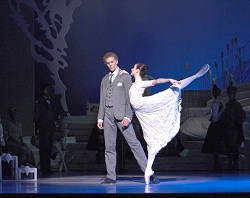
Audrey Nicholls dances with Robert Pomie in the Pas de Deux from Don Quixote

With a career spanning 61 years, Audrey, along with Colin Peasley,  is one of the longest serving and dare I say one of the more ‘’mature’’ dancers still performing in Australia. As a valued guest artist of the Australian Ballet Company (where she has been guesting since 1992), Audrey is not only constantly performing character roles with them but still has roles created on her!

Audrey has had a very illustrious career and in her day she graced some of the world’s best stages. A soubrette, with a sensitive lyrical and artistic quality, coupled with assiduous attention to detail and a resounding technique, enabled Audrey to perform and portray a huge variety of roles.

Audrey commenced her career in 1950 where at the very young age of 16 she joined the Borovansky Ballet (now the Australian Ballet) as a member of the corps de ballet. In 1951, she won the inaugural Frances Scully Memorial Scholarship and travelled to London to further her studies. In 1952, she joined the Rambert Ballet as a soloist and in 1953 was promoted to a principal dancer. In 1955, she returned to Australia and rejoined the Borovansky Ballet as a senior soloist.  In 1958, the Ballet Guild of Victoria (Ballet Victoria) was her next stepping-stone with some outstanding principal roles especially in Giselle and Coppelia.

Audrey Nicholls performs 'Waltz' in Le Sylphides with the Ballet Rambert in London, 1954

A career in television from 1958 – 68 saw her immortalized on the small screen with both Channel 7 and Channel 2 (ABC). During this time Audrey commenced teaching the RAD Syllabus.

In 1973, Audrey Nicholls was appointed as a Graded Examiner of the Royal Academy of Dance. From 1982 to today, she has taught RAD teaching courses and classes throughout Australia. Audrey instigated the Victorian Grade Awards and was honoured when the awards were named after her this year.

Audrey is a truly remarkable lady, who is forever smiling. Her warmth and passion for the people around her and the art she loves is evident. When taking workshops or courses, teachers specifically ask for Audrey as they know that the students all come out of class beaming.

Audrey Nicholls FRAD ARAD

What influenced you to become a teacher?

I had been a professional dancer since the age of sixteen and continued until I was about 36. During this time at around 23, I was passionate about teaching ballet and wanted to give back to aspiring young students my love and experience in dance. Along with professional dancer Eve King, I began what was to become a long and rewarding journey of teaching ballet.

When you first started teaching what were your aims and ambitions?

To give the students a pure classical technique and to inspire their love of music. When I hear music, I immediately have a physical reaction to move and express myself and to bring out the artistry of the dance step. I also wanted to offer knowledge of other influential teachers and use the expertise of Martin Rubinstein (Maestro), Lynn Golding, Jack Manual and Christine Howard. We were very privileged to be a part of their education.

Have you achieved these goals?

I do feel a sense of achievement and feel rewarded to have trained many students who have gone on to wonderful professional careers not only as classical dancers but also qualified examiners, teachers, actors and stage managers. I have also trained Genee gold medallist Holly Smart and bronze medallist Pamela Smith, as well as several soloists in the Australian Ballet and Royal Ballet Companies including Delia Harrington and James Newman. One former student of note is Christine Howard who is the Character teacher at the Australian Ballet School (30 years).

What is your proudest moment in all your years of teaching?

Being recognized by my peers and having the honour to be awarded the Fellowship of the Royal Academy of Dance (2011). Also the achievement of 40 years of collaboration with Eve King and our teaching together in our ballet school.

Where do you think ballet is headed in the next 10 years?

Supply & demand – we have the supply of many talented dancers, choreographers, designers, composers and of course teachers! Dancers today have the opportunity to receive excellent training with technical ability being pushed beyond their boundaries. Contemporary and classical demands the utmost from the dancer- today there is no limit to where and what will happen in the next 10 years.

What do you think is the most important thing that has happened or influenced dance in the last 10 years?

Televised live broadcasts of performances reach thousands of people who might not normally have the opportunity to see a ballet. In addition, one of the biggest of all: YouTube

What is your favourite ballet?

I am a bit of a traditionalist, so I will say Giselle. I love the first act, the communicative story telling in the demi character style, told with drama and heartfelt emotion especially with Giselle’s acting in the ‘mad scene’.  Then the pure classicalism of Act 11, the choreography raises so many sentiments and reactions that enable the dancers to put their hearts on the line. It is a wonderful vehicle for the dancer.I grew up on Giselle, starting in the corps de ballet, then Pas de Six, Peasant Pas de Deux, Queen of the Willis and eventually the title role of Giselle.

Who is your favourite dancer?

There are three exquisite women and it is impossible for me to choose between them, they are: Natalia Makarova, Darcy Bussell and Natalia Osipova – for me they are the epitome of dance.

You are an RAD examiner. Why did you choose RAD and do you still examine?

My original teachers were Gwen Hardie and Ann Roberts FRAD, ARAD who both taught the RAD syllabi.  I found the syllabi structure and exam preparation beneficial and certainly challenging. Therefore, when I commenced teaching, the transition to RAD was a natural progression. Becoming an RAD examiner seemed to follow automatically.

I will always be grateful to Martin Rubinstein for his mentoring and guidance when I was becoming an examiner in those early days and to this day. I loved examining, meeting the different teachers and exchanging ideas. I enjoyed helping to sort out problems and addressing the needs of the country teachers where little access to examiners or experienced teachers was available. I have travelled internationally and throughout Australasia for 33 years as an examiner. As an examiner, we all were continually updated with education in dance, psychology, syllabus and new methods. It has been a very rewarding career and I continue as an RAD tutor on different faculties for courses, workshops for teachers and students, and as a Juror for RAD events.

How would you like to be remembered?

Fondly – I hope!  But also for my lifelong love of dance and my devotion to my husband David and my family.

Top photo: Audrey Nicholls in the Pas de Trios from Swan Lake – Ballet Rambert 1954.

Published by Dance Informa dance magazine – everything dance in Australiadance auditions, dance news, dance events and resources for dance teachers.

Posted in Features, Teacher Tips & ResourcesComments (1)

The Australian Ballet 50th Anniversary Ballet Project


Here’s your chance to create a concept for the Australian Ballet to stage in 2015!

The Australian Ballet’s 50th Anniversary Ballet Project encourages an artistic team with a unique artistic vision, be they professionals or novices, to submit ideas for a brand-new ballet work. The competition is to create a totally original work–narrative or abstract – comprising synopsis, choreography, music and design concepts.

The winning entry will receive A$30,000 and will have their work considered for staging by The Australian Ballet in 2015. The Australian Ballet Society (Victoria) has generously donated the substantial prize.

Entries will be judged by a panel of leaders in the arts community with special areas of expertise:
Hugh Colman, designer
Nicolette Fraillon, Music Director and Chief Conductor, The Australian Ballet
David McAllister, Artistic Director, The Australian Ballet
Patrick McIntyre, General Manager, Sydney Theatre Company
Richard Mills, composer
Graeme Murphy, choreographer

The Australian Ballet celebrates and honours classical ballet in all its forms, and recognises that it is through continual exploration and development that the art form will survive into the future. The 50th Anniversary Ballet Project honours this commitment.

Since its inception in 1962, The Australian Ballet has commissioned over 140 new works. These commissions embrace not only choreographers, but include visual artists, designers, composers and allied artists. Each creative project carries some degree of artistic and financial risk. However, the company’s commitment to dynamic and innovative programming remains a key goal.

Entries close 5pm (AEST) 31 August 2012.
For complete details download the Terms and Conditions (PDF)
and email enquiries to 50thproject@australianballet.com.au
The winning entry will be announced after 9pm (AEST) on 2 November 2012.

Note: Judging panel subject to change due to any unavoidable cause.

Photo: Laura Tong in Night Path, The Australian Ballet(2008)
Choreography Stephen Baynes, Music Richard Mills, Set and costume design Michael Pearce, Lighting design Jon Buswell

Published by Dance Informa dance magazine – everything dance in Australiadance news, dance auditions & dance events.

Posted in FeaturesComments (0)

Graeme Murphy Choreographic Workshop


By Rain Francis.

February 26 2012.

Last month, Melbourne dance students were treated to a very special experience. The Australian Institute of Classical Dance held a workshop, led by master choreographer Graeme Murphy, and his wife and Creative Associate Janet Vernon. Held at the beautiful Australian Ballet Centre studios, this was a rare chance for the next generation of dancers to learn from one of the country’s most treasured creative teams.

The workshop began with a talk by Mr. Murphy. He discussed questions such as ‘what is choreography?’, inviting answers from the dancers as well as sharing his own ideas with us. He also talked about his most recent work, The Narrative of Nothing, which is part of The Australian Ballet’s Infinity season. Having seen the show only the night before, this was for me a fantastic insight into a brilliant work. Personally, I would have been happy to sit on the Tarkett for hours and just listen to Mr. Murphy talk. He was so personable, engaging and articulate, with a sense of humour everyone warmed to.

When we did stand up, we tried a few simple group exercises, under the direction of Mr. Murphy. He instructed us to find a horizontal shape, then to turn it to face the back, moving as a group. We experimented with different levels and speeds, and with the spatial arrangement of the group. Next, we learned a very short movement sequence, which we then had to decipher in retrograde. Spread out in a line across the room, we moved through the sequence in a canon, then reversed it, and again played around with tempo. These simple exercises illustrated the effectiveness of playing with the elements of movement, and the endless possibilities available to the choreographer.

After a brief lunch break Mr. Murphy talked about the importance of linking steps; about the pathway between one movement and the next. We were asked to come up with three separate movements in only five minutes. The next instruction was to find ways to link them together to form a phrase. After some time working on this idea, we were asked to present our phrases one at a time. This was quite a daunting task for many of the younger dancers in the room. I found that a good approach was not to think about the fact that I was about to perform solo in front of Graeme Murphy and Janet Vernon. Both of them made observations on everyone’s phrases, giving feedback and asking for repetitions and variations. They were encouraging and sincere in their reactions, which was inspiring.

Although fleeting, this workshop was an unforgettable way to spend a Sunday. To meet Graeme Murphy and Janet Vernon was in itself a treat, and to gain even a fragment of insight into their working methods was of great value.

Formed by Marilyn Jones OBE, the A.I.C.D. is a non profit organisation to assist teachers and students of classical dance in Australia. It is run by a devoted band of volunteers headed by Dame Margaret Scott, the founding Director of The Australian Ballet School. The programs the A.I.C.D. produce are designed for the particular needs of dancers in Victoria. Their next program is a series of adult ballet classes given in the studios of The Australian Ballet and taken by principal dancers of The Australian Ballet. All monies raised go toward funding a Choreographic Showcase to help promote new choreography.

Photo of Graeme Murphy by Lynette Wills.

Published by Dance Informa dance magazine – everything dance in Australiadance news, dance auditions & dance events.

Posted in Australian ReviewsComments (0)

The master of movement invention – Graeme Murphy


By Kristy Johnson.

Infinity sees choreographers Graeme Murphy, Gideon Obarzanek and Stephen Page, collaborate in a powerhouse triple bill, for The Australian Ballet’s 50th Year Anniversary.

Murphy takes a turn from his established narrative style with an abstract piece aptly titled The Narrative of Nothing. This piece allows audience members to appreciate a pared back ballet from which they are able to draw their own stories.

Having known the company intimately as a dancer and choreographer, Graeme returns to The Australian Ballet to open its milestone 50th year.

Prior to the Melbourne premiere, Dance Informa journalist Kristy Johnson sat down with the iconic Australian choreographer.

Firstly, congratulations on your last work choreographed for The Australian Ballet, Romeo and Juliet.

Oh, thank you. I have to tell you, I really enjoyed that work. I’m so happy to hear, because I thought it was going to be hard for some of the diehard fans. They’ve had that one for a long time. I had to shake cobwebs off, you know? It’s a beautiful ballet, but this was not going to be a replica of that. There’s no point. I think it paid off because it brought in a really different audience. I think there were a lot of people who weren’t necessarily ballet people in the audience, because it was visually sort of everywhere.

Trained dancers are the best audience; they actually know how hard it is. A lot of people love ballet, without sort of knowing. And it’s not just about knowing how hard it is, it’s about knowing how much brainpower goes into making those things work. It’s about making hard things look easy. I often tell my dancers, ‘make it look harder’ (laughs).

Graeme Murphy. Photos by Lynette Wills

With your next choreographic work The Narrative of Nothing falling more on the abstract side, were you keen to break away from a pure storytelling piece?

I used to always alternate doing a storytelling work and doing a pure dance piece at Sydney Dance Company, because if you do one storytelling piece after another, you just get into this sort of really difficult deep world of ‘how do I tell this in dance?’ It’s so hard because you let the music put you in free fall. The dancers are a huge motivation in this one, because they’re all beautiful.

There will be 1500 people in that auditorium and there will be 1500 different narratives applied to my non-narrative work. That’s how it should be. Human beings are not capable of accepting abstraction. That’s human nature to tell stories.

You must be excited to be choreographing this piece as part of The Australian Ballet’s 50 Year Anniversary.

It’s like being part of a family of dancers, because I’ve been working pretty solidly here for the past thirty years. This is one of the greatest companies in the world and it’s not necessarily about standards and techniques. It’s about the fact that it lets people grow. It’s a beautiful network of individual dancers. There’s such a variety of people I like to work with and in some companies you don’t get that. You get that fabulous uniformity but you’re just hanging out for a rebel (laughs). I do love this company.

How can you tell when a dancer has that X-factor?

I think you don’t always tell when someone walks into the room. I think it’s something you learn and sometimes someone who you just saw dimly in the background pulls your eye and you store him or her in your memory for a work like this. This is a great work. To work with some of the more established people and the more unknown. I keep pushing because if I see the spark, I’m going to break your comfort zone. I’m going to push you out of your warm fluffy slippers (laughs).

Why do you think your partnership with your wife and Creative Associate Janet Vernon works so well?

We know each other so well and she was my muse for so many years. She’ll see me demonstrate the step and the dancer perform the step, but she sees beyond those things and she sees how that step should be. She was the person who would be the icing on the cake or put that level of perfection up a notch. She’s fabulous and the dancers love her because when she gives direction, they know it has the potential to push the level. The dancers want it. You’re not in this profession if you’re lazy, are you?

How does it feel to be working alongside Gideon Obarzanek and Stephen Page?

That’s extraordinary. I’ve got to keep up with the young guns (laughs). Both those choreographers have found their signature and found their stride. You see their hunger to create, and that’s what choreography needs. That’s the mark of choreography.

You have had such an amazing career to date. How do you ensure your creative ability is always flowing?

I’m very lucky. I’ve always had a good variety. I’m so blessed my job has led me and hasn’t stuck me into one mould. But at the end of the day my greatest joy is creating one one-on-one dance in the studio. That’s more thrilling than the opening night. That process as opposed to the finished product is what keeps you interested; hoping that I can sometimes break out of what comes naturally and what comes easily, and find another direction to extend my vocabulary and find some new words. It’s the same in life. You can sit comfortably in one level but occasionally you have to break the mould, find some new friends and do something that scares you. This has afforded me all of that. That’s why I’m still interested.

Infinity closes on March 6 in Melbourne. Sydney shows will commence from April 5-25. For bookings visit australianballet.com.au or call 1300 369 741.

Published by Dance Informa dance magazine – everything dance in Australiadance news, dance auditions & dance events.

Posted in Top StoriesComments (0)

Mao’s Last Dancer – QLD Ballet’s New Director


Queensland Ballet has announced that Li Cunxin has been appointed the new Artistic Director of the Company.

Already an internationally acclaimed ballet dancer, author and motivational public speaker, this will be Li Cunxin’s (pronounced shwin-sing) debut as an Artistic Director.

Queensland Ballet Chair, Adjunct Professor Joan Sheldon AM, said, “We are absolutely delighted to welcome Li on behalf of the Company, its friends and supporters. This is an exciting new direction for our Company, our audiences, and Queensland.

“Li’s passion for dance and devotion to artistic excellence and quality complements our vision as a leading classical ballet company with a distinctive spirit and vitality that is proudly reflective of Queensland and Australia. Li’s extraordinary career, international reputation, networks and commercial experience will provide the Company with invaluable opportunities to build upon the achievements of our 52 year history. The Company can only benefit with Li leading us into the next chapter of our journey of renewal, growth and pursuit of creative excellence.”

The six month global search attracted applications from over 40 candidates around the world. “Our culture of creativity, collaboration and intimacy attracts leading artists, performers and arts professionals from around the world. The field was extremely competitive and demonstrates Queensland Ballet’s strong position in the international dance community, our financial robustness and a firm belief in the Company’s potential to build on our success.” commented Mrs Sheldon.

At the age of eleven, Li was selected by Madame Mao’s cultural advisors to attend the Beijing Dance Academy. In 1979 he joined Ben Stevenson’s Houston Ballet company as an exchange student and later went on to achieve the top rank of Principal in 1982. He moved to Melbourne in 1995 to join the Australian Ballet as a principal artist. Li retired from ballet in 1999 at the age of 38 to pursue a career in the financial sector. He currently works in Melbourne as a senior manager at Bell Potter, one of the largest stockbroking firms in Australia and is on the board of The Australian Ballet and the Bionics Institute.

In 2003 Li published his international best-selling autobiography Mao’s Last Dancer, which has received numerous awards. The book was adapted as a feature film in 2009.

Commenting on his appointment Li said “I’m very excited. I have been following Queensland Ballet with great interest and feel privileged to help lead the Company into the next era. The Board and CEO Anna Marsden’s commitment to a strategic future for the Company is very powerful. I have always been immensely impressed with the quality of the dancers, and look forward to working with them. I’ve never lost my passion for dance, and I’m excited to start a new journey with such an ambitious and inspiring Company.

“It’s also a homecoming of sorts – my wife Mary McKendry is from Queensland and we’re looking forward to making it our home. Queensland’s cultural industries have experienced phenomenal growth over the last five years and I’m honoured to be joining the Company at this time. I have so many ideas – I can’t wait to get started.”

Li will begin programming the 2013 season when he joins the Company in July. He will be the fifth Artistic Director in the Company’s 52 year history and the first curatorial Artistic Director. Current Artistic Director Francois Klaus has international artistic opportunities he would like to pursue and the Board agreed Francois would leave his role as Chief Choreographer and Artistic Director at the end of 2012.

Top photo: Li Cunxin by Robert Bontscheck.
Published by Dance Informa dance magazine – everything dance in Australiadance news, dance auditions & dance events.


Posted in FeaturesComments (0)

Ivan Cavallari to farewell WA Ballet


By Grace Edwards

2012 will be a busy year for Ivan Cavallari, Artistic Director of the West Australian Ballet, who recently announced that he will leave the company at the end of this year to take up a position as Artistic Director with Ballet du Rhin in Alsace, France. Until then, he will have to juggle responsibilities as the effective head of both companies.

Fortunately, Cavallari is no stranger to hard work. A principal dancer and choreographer with the Stuttgart Ballet before his move to Australia, he has seen the company grow from an ensemble of 19 dancers to one of 36 over the course of his six years with the West Australian Ballet. The company is currently celebrating its 60th Anniversary year and will soon boast a new set of studios.

Cavallari will take fond memories of his time in Australia back to Europe. “My very first impressions [of Western Australia] have nothing to do with the company,” he says. “Meeting the dancers and all of that seemed very normal. But I think it was the isolation…I remember on my first day, I left the hotel at 10pm to go for dinner and couldn’t find a place so I said ‘Okay, let’s go for a beer’. I could not find a place for that either,” he laughs.

“That was actually quite a shock at the beginning, but once I got into a routine I began to appreciate a lot of things that somewhere like Western Australia can offer, and how fruitful that quietness can be for creative people, so I began to appreciate the good side.”

The flip side, however, has been the distance from his family and friends.  In October 2010, Cavallari flew back to Europe to be with his partner who received a bone marrow transplant in Germany the following month. “I suppose that’s the reason I started to look around and see if there was an opportunity in Europe. I just could not deal any longer with travelling four times a year and not having a real presence here or there. You come to realise there is not much you can do psychologically or morally about such situations.”

Despite the challenges, working with the West Australian Ballet has been an enriching experience, says Cavallari. “I’ve had many opportunities to develop myself as a person and as an Artistic Director. You have to be able to multi-task, it’s not just about choreographing or teaching but also working parallel with the management and keeping everyone’s motivation up. When I first came to Western Australia I had to learn the new systems, the political system – there’s politics even in the artistic system. You become aware of such things as the company’s relationship with the orchestra and how you can use money in the best way, so one becomes very conscious of everything.”

Cavallari is grateful for what he’s learnt. “I just have to say a big ‘Thank you’ to Western Australia. Now I know what it means to be an Artistic Director. I will not start my new job so completely naked. If similar problems arise I’ll know that I can afford to approach them in a more positive way.”

With the extraordinary task of running two ballet companies on opposite ends of the world ahead of him, Cavallari confesses he will need a lot of focus, planning and inner reserve to get through this year. “I will try to have a joyful year,” he resolves.

When I ask what drives him, he pauses for a moment to reflect. “Look, I’ll be very sincere. I always put my faith in God’s will and I try to follow his advice. Whenever I feel desperate about a situation I pray to him that something will happen. He’s never left me.”

Celebrate the West Australian Ballet’s 60th Anniversary season with, Ballet at the Quarry at The Quarry Amphitheatre, City Beach, 10 February – 3 March 2012. For more information, visit www.waballet.com.au

Posted in Top StoriesComments (0)

Making the Leap: Dancer to Choreographer


By Laura Di Orio

When a dancer steps down from the stage and “hangs up his or her shoes”, it doesn’t always mean an end to a dance-centered career. Many go on to teach, open a studio, direct a company, design costumes, and several choose the route of choreographer. Those who make the shift from dancer to choreographer may find a most freeing, creative outlet to express themselves. And a former life as a dancer just may make that transition smoother and richer.

Dance Informa hears from two established choreographers, both former professional dancers, on how and why they made the jump and what their life as choreographer provides them artistically.

Did you always know you wanted to choreograph? When did those desires begin to surface?

Edwaard Liang, freelance choreographer, USA
www.edwaardliang.com
I never had the thought or desire to choreograph. I had a one-track mind in terms of what I thought I wanted in my career. When I was dancing with Nederlands Dans Theater, I was urged to try my hand creating in their annual choreographic workshops. I had such a great time with the process. I had no clue what I was doing, but loved it.

Stephen Baynes, resident choreographer, The Australian Ballet www.australianballet.com.au/about_us/artistic_staff/stephen_baynes
I always had an interest in it, but I wanted to have a career as a dancer first. It was only after several years as a professional dancer that I began to attempt choreography.

Where are you along this transition from dancer to choreographer? Have you completely shifted?

Edwaard Liang
I have completely shifted from dancer to choreographer. I don’t feel sad about not performing, I think because I’m still a part of this world. I get to take class and feel like a dancer and move when I want to, but don’t have the same pressures I used to before to be perfect. I get to enjoy movement for movement’s sake. Plus, I never got the ‘juice’ or ‘high’ from performing, so it was not hard to leave.

What does your life as a choreographer offer you that life as a dancer has not?

Stephen Baynes, resident choreographer for The Australian Ballet, rehearsing Baynes's "Beyond Bach". Photo by James Braund

Stephen Baynes
As a choreographer, I have relinquished the challenge and fulfillment of performing but have been challenged and fulfilled in a different way by creating my own dances and seeing them interpreted by wonderful artists.

Edwaard Liang
My life as a choreographer has given me more freedom and input into what I want to say. Making ballets are like making mini movies. You get to decide the music, costumes and sets. You feel like you’re able to mould the whole package.

For dancers who want to either delve into choreography or who want to transition completely, what suggestions do you have?

Stephen Baynes
Be very sure that you really feel you have something to say. Try to get as much experience in making dance as you can. It is a very practical endeavour and needs constant practice, but that can be difficult. More than anything else, search for your own voice, which doesn’t always mean that you can be completely original, but at least it is uniquely yours.

Edwaard Liang's "Age of Innocence" performed by Fabrice Calmels and Victoria Jaiani. Photo by Herbert Migdoll

Edwaard Liang
Keep working and creating, whether it’s a big or small project. The only way to get deeper, better and do richer pieces of dance is to get in there and create. Try not to edit. Find your own voice. Enjoy the process and time. This profession is one of the hardest, physically and mentally, so try to find joy in some of the little things that happen. Don’t always wait for the big promotions to celebrate yourself.

What’s next for you as a choreographer?

Edwaard Liang
I finished presenting my work at Fall for Dance at City Center in New York. I am now starting my first full-length ballet – a new production of Romeo and Juliet for Tulsa Ballet and also new works for San Francisco Ballet, Washington Ballet, Joffrey Ballet and a project with Yuan Yuan Tan and myself.

Stephen Baynes
I am busy with commissions until the end of 2012, including a full-length Swan Lake for The Australian Ballet’s 50th anniversary, and hopefully there will be more after that.


Top photo: Edwaard Liang rehearing with Victoria Jaiani. Photo courtesy of Edwaard Liang

Posted in InterviewsComments (1)

Telstra Opening Act!


Open for The Australian Ballet
Your amateur dance troupe could be the warm-up act for The Australian Ballet in Brisbane on Nov. 5. All styles welcome to audition.
Click here for more information

Posted in VideoComments (1)

Jack Productions’ Chamber Ballet


Jack Productions burst onto the scene with their acclaimed first production, Human Abstract in 2010.  The brainchild of Lucas Jervies, Robert Curran, Andrew Killian, and Laura Tong, Jack Productions promised to inspire audiences and produce a fusion of classical and contemporary dance that was innovative while exploring classical ballet technique.  With performers from The Australian Ballet as well as international stars, Jack Productions has revolutionized the dance landscape in Australia and is set to further impress audiences with the upcoming collaboration A Chamber Ballet with Ensemble Liaison. 

Ensemble Liaison was formed in 2006 and was recently named Ensemble in Residence at Monash University.  Comprised of three internationally acclaimed musicians: David Griffiths (clarinet), Svetlana Bogosavljevic (cello), and Timothy Young (piano), they performed their debut concert for ABC Classic FM the same year.  They have collaborated with sopranos, violinists, performed interstate and overseas, released a CD, and been broadcast nationwide on various radio stations. 

A Chamber Ballet, the collaboration between Jack Productions and Ensemble Liaison will feature Joseph Simons, Marc Cassidy, and The Australian Ballet’s Rachel Rawlins and Andrew Killian, with choreography by Lucas Jervies.  The chamber ballet will present the passionate songs of Manuel de Falla – The Six Songs interwoven with Love the Magician arranged by Ensemble Liaison.  The essence of the collaboration is about building on the instinct to get up and dance to music. This exciting union of creative forces is for only one night at Melbourne Recital Centre, and promises to bring a unique opportunity for lovers of ballet and chamber music to come and experience these two art forms united.

Dance Informa asked dancer Rachel Rawlins and pianist Timothy Young about the experience of putting the production together.

Rachel, you have worked closely with musicians and composers previously. How does the experience of working with Ensemble Liaison compare?

The process of working with Ensemble Liaison has really just begun. I have met the company and heard them play. It is such an inspiring atmosphere to be involved with talented, enthusiastic, passionate musicians.  Reacting to live music is one of the best thrills of being a dancer.

Timothy, what were your impressions of dancers prior to working with them, and has that impression changed now?

My understanding of what it takes to be a dancer has only been reinforced through this experience. The discipline and grueling practice regime required to be in top form is not dissimilar to being a musician. To observe the focus and commitment of the dancers was no surprise. I think the rehearsal space with wall to wall mirrors and the constant visual scrutiny of their every move left more of an impression – we rely mostly on ours ear to make these judgments!

How does working with dancers and choreographers compare to working with musicians and composers?

Rachel
Being a professional dancer for twenty years, working with other dancers and choreographers is like second nature to me. I think having musicians and composers involved in the creative process and the end result completes the artistic experience.

Timothy
The comparison between the two art forms is unbelievably close. It would seem that the dancers’ and choreographer’s creative work and decision making is simply an extension of what we do musically all the time. As musicians we technically divide space in time to achieve the sounds to realise the composer’s intentions. The dancers too divide space in time to realise the movements to achieve those same intentions. Rhythm forms the foundation for us both to work from.

How much of a collaborative effort is this production? 

Rachel
So far I have been mostly working with Lucas on developing and expanding movement phrases. He is completely open to suggestions and personal interpretations. There is a lot of freedom within his ideas and themes for collaboration.

Timothy
From the outset the production has been a close collaboration. This started with the selection of the music to perform. It then progressed to ordering the succession of musical numbers corresponding to connections made between the individual musicians and dancers. We are also combining other works of De Falla within the body of the ballet, so we needed to maintain the dramatic build up in the original musical form. Then there are logistical issues on how to position the players and dancers on stage without losing the intimacy required to perform chamber-music and still interact integrally with the dancers. Further questions then arise; Do we reflect this collaboration in what the musicians wear? Should the musicians move and dance around the stage too, should the dancers play?, etc.

What are some of the challenges of a production like this?

Rachel
The challenge is finding time. 

Timothy
Some of the challenges from the purely musical perspective are to arrange a score that has a large orchestral palette to begin with and transcribe it for only four instruments. We are striving to maintain the dramatic implications of the score’s original wealth of colour and contrast.  At the same time we must adhere to the natural qualities that our instruments have both in their individual and combined voices. Integrity regulates the creative balance between what we can realistically achieve without changing the composer’s intention.

What have been some highlights of the experience?

Rachel
Seeing how Lucas creates movement and turns it into dance, being created on and dancing with Andrew Killian. Also I’m really looking forward to next week when the musicians are being woven into the piece. 

Timothy
Some of the highlights have been watching Lucas spontaneously create and improvise some of the moves for the dancers to try, and then observe their almost immediate assimilation of those ideas. To see how the same interpretative process that a professional musician takes is applied to ballet is inspiring. It has also been exciting and satisfying to see how the musical arrangement and interpretation has taken shape as ballet and reciprocally how the dancers’ movements have influenced our interpretation and spontaneity.

What can the audience expect on August 18th?

Rachel
The audience can expect  an energetic, uplifting collaboration between fantastic musicians, an inspired and refreshing choreographer and dancers who just love to have the opportunity to be involved and contribute in creating new art.

Timothy
Lovers of chamber music and ballet can come together and experience these two art forms united .The audience will have a rare experience to hear and see Manuel De Falla’s masterpiece in a very intimate and unique arrangement in a stunning venue. It is a beautiful way to witness this magical dialogue and strong bond between music and dance.

A CHAMBER BALLET – Ensemble Liaison with JACK Productions
Date: August 18, 7pm
Venue: Elisabeth Murdoch Hall, Melbourne Recital Centre
Book at www.melbournerecital.com.au or call the Box Office on 03 9699 3333.

Posted in FeaturesComments (0)

NAB Dance the Dream


NAB and The Australian Ballet are pleased to launch NAB Dance the Dream for 2011, a program designed to help young Australian dancers realise their potential through access to a unique training and learning opportunity.

Steven Heathcote and Lynette Wills, former principal artists with The Australian Ballet, will host five NAB Dance the Dream workshops for 250 dance students across the country.

In 2011, NAB Dance the Dream will visit Adelaide, Perth, Bendigo, Western Sydney and the Gold Coast and feature a series of master classes hosted by Steven and Lynette followed by a Question & Answer session for students to gain an insight into the life of a professional dancer.

NAB will also provide workshop participants the opportunity to win an exclusive dance experience weekend in Sydney to go behind the scenes and meet dancers from The Australian Ballet following a performance of Romeo & Juliet in December.

As an added incentive, dance schools with the highest number of NAB Dance the Dream entries in each State will win a $500 NAB Community Grant.

Lynette Wills, who has been involved in the program since 2008, said NAB Dance the Dream offered a great opportunity for Australia’s dance community.

“Over the last four years, NAB Dance the Dream has taken ballet off the stage and into many local communities. I am looking forward to working with my former dance partner Steven Heathcote and building on the program’s success in 2011,” said Lynette.

NAB has been a partner of The Australian Ballet for seven years and during this time has invested in various programs to develop local dance communities around Australia. Kevin Ramsdale, NAB’s General Manager Brand & Sponsorship, is delighted with the program’s achievements to date.

“We are extremely proud of our longstanding partnership with The Australian Ballet and our joint commitment to assisting young dancers to reach their potential through NAB Dance the Dream,” said Kevin. “The response to the competition is always overwhelmingly positive and we are pleased to make these types of opportunities a reality for Australia’s dance community,” he said.

Dance students aged between 9 to 16 years are eligible to enter. To enter, visit www.nab.com.au/ballet and in 50 words or less, describe what ‘NAB Dance the Dream’ means to you. Entries open on 18 July 2011 and close on 22 August 2011.

Posted in Dance News AustraliaComments (0)