Tag Archive | "Steps on Broadway"

Nicole Winhoffer – Working with Madonna


By Kristy Johnson.

As Madonna’s personal trainer and the creative director of the ‘Addicted to Sweat’ program at Hardy Candy gyms, Nicole Winhoffer knows what it takes to keep Hollywood’s elite in tip-top shape. Yet, from speaking with the fitness guru, it becomes clear that it’s her passion for dance that has led her down such a successful path. Securing her first Broadway show at only 17 gave her a taste of what the future could hold with hard work and dedication.

Here we chat with Nicole about her dance background, working on Broadway and what it’s like to choreograph alongside the Queen of Pop.

Can you tell us about your dance background?

I began dancing at 7 years old. At 12, I began to seriously train in the Balanchine method of ballet and all other forms of modern, jazz, musical theatre and hip-hop. I was exposed to the best teachers who not only offered the best training, but were also working in the industry. I would have my parents take me to Manhattan to take adult classes at Broadway Dance Center and Steps on Broadway. Training with adults and professionals pushed me to the next level.

At 17, I booked my first Broadway show! This was the first national tour of 42nd Street. I didn’t get to go to my senior prom, but it was worth it! The best school in life is pure life experience.

Madonna's personal trainer

Nicole Winhoffer. Photo courtesy of Xthestudio.com.

How was the experience of working on Broadway?

I was a swing and assistant dance captain for Andrew Lloyd Webber’s Bombay Dreams on Broadway. I was also attending Fordham University simultaneously; living in the dorms, going to class full-time, and by night, doing eight shows a week. My schedule was jam-packed as we began the show in New York with lots of rehearsals. But the experience was amazing! I was 19 and matured quickly. I had a lot of responsibility by covering eight girls and understudying four.

What did you learn from this experience?  

Broadway is such a great gig. You live in New York, have a call time 30 minutes prior to the show, work with talented artists and perform on stage. Your theatre is your ‘home’. After the show is over New York is your oyster!

As a dancer, I learned the importance of warming up and taking care of your body. Once you become a working dancer, it’s up to you to continue your training, including warming up, and body conditioning. With eight shows a week, heavy costumes, heavy wigs, heels and choreography repetition, taking care of your body is essential.

Was becoming a personal trainer a natural progression for you?

I come from an athletic family. With mum, dad and three soccer-playing younger brothers – fitness was in the blood! I would wake-up every morning before school to do my personal workouts: stretching, running, dancing and improving my craft. By dancing every afternoon after school, my curiosity toward the human body grew. I saw the amount of power and control that one had to change and improve their body.

This curiosity carried through up until now. During my work as a Broadway dancer, I developed my own body conditioning routine that allowed me to perform eight shows a week. I take class and have been a member at many different gyms. Being a student allows me to continue to learn. So, to answer your question – No I never thought I would be doing what I am doing today! It kind of just chose me!

Broadway dancer, personal trainer and commercial choreographer

Nicole Winhoffer. Photo courtesy of Xthestudio.com.

How did you become Madonna’s personal trainer?

I was on the European leg of her Sticky and Sweet Tour in 2009. I worked and assisted her and her dancers on their dance-conditioning regime. Watching her creative process inspired me. I watched her shows and danced with her and her dancers. I developed new solutions to fitness, combining performance, dance, anatomy, physiology and kinetic energy, and in the process, became her primary trainer.

How would you describe your working relationship with Madonna?

I love working with Madonna. We’ve seen each other six days a week for the past four years. It’s hard work, discipline, focus, perfection and high energy. Every day is a new day. We are machines, pushing our body to its potential. I have notebooks filled with all her programs and choreography. If she doesn’t like something, she will suggest a change to fix it. I like working like this. When we workout it’s a collaborative exchange and process. We stay creative even while working out!  

What’s next for you?  

I want to be the best in my industry – hone my craft, develop more innovative programming, collaborate with musicians and DJs, collaborate with fitness apparel brands, travel the world, shoot more DVDs, finish updating my website, collaborate with artists, take care of my clients and continue to stay grateful and in love with the world!

Photo (top): Nicole Winhoffer. Photo by Adam Rindy.

Posted in Feature ArticlesComments (0)

Why Do I Have to Take Ballet?


By Laura Di Orio.

Becoming a professional dancer is like building a house from the ground up. You can’t start by adding the roof and interior decorations; rather, you must start by creating a solid foundation to support the structure and make it last. Similarly, a dancer must establish that foundation in technique before adding all the “tricks” and performance quality. And that foundation, according to many dance teachers and professionals in the field, is ballet.

“Because ballet has been constantly evolving for over 400 years, it has arrived at a very solid method of developing human movement potential for the stage,” says Stephen Pier, director of the Dance Division at The Hartt School of the University of Hartford, located in Connecticut.

“It’s still the most relevant technical training all around and can serve as a very effective way of organizing and developing the facility of the dancer. Most other techniques or styles have not been around that long. They are too limited to be the sole basis of training, and they haven’t worked out the science and art of dancing to the depth that ballet has.”

All of Pier’s students are required to take daily ballet class during their four years at Hartt. Ballet has proven to inform their dancing, and students have gone on to work in a vast range of professional companies – from Paul Taylor and Joffrey Ballet, to downtown contemporary and Las Vegas.

Like Pier, Dawn Hillen, master ballet teacher who currently teaches in NYC at Steps on Broadway, Broadway Dance Center and Ballet Arts, stresses the importance of ballet as a foundation of training. She says even her non-ballet-focused students have benefited. Some of her students who first started in hip-hop and found ballet later, for instance, said they felt definite improvement in their ability to change weight quickly, hit clean lines faster, focus and stay in the moment, and they became physically and mentally stronger.

Dawn Hillen leads a ballet class at Broadway Dance Center

Dawn Hillen leads a ballet class at Broadway Dance Center. Photo by Fiamma Piacentini Huff.

“You can use ballet to refine yourself,” Hillen says. “It creates a dancer or performer who is centered, balanced, lengthened and physically graceful. Just standing up is an art form, and it is a big part of your first impression. There have been a number of pre-professionals who were not getting work, and once they added ballet training to their daily or weekly routines, they began getting callbacks and jobs.”

Ballet contributes more to a dancer than just refined technique, too. Pier says ballet also imparts skills like “attention to detail, mastery, form, harmony, precision, discipline, social grace and awareness of the group – all skills that help young people succeed in the adult world.”

In addition, Yuka Kawazu, who has been teaching ballet in NYC for 15 years at various studios, including Ballet Arts and Broadway Dance Center, says, “We learn so many things, like patience, discipline, a different language, how to breathe, and we share joyful moments with other dancers.”

For these reasons, it is probably best to introduce ballet early on in a dancer’s training, to establish these skills in his/her dance and life. “If you really have the dancer’s best interest at heart, you must offer a proper ‘diet’ of training, and ballet is a big part of that good ‘diet,’” says Pier. “Not everyone is going to like broccoli if they’re used to eating candy all the time, but you might find some great recipes for serving it more tastefully.”

Still, some students may complain that ballet is “boring” or that learning the basics of technique is “slow.” In actuality, however, ballet is rigorous and demanding and a practice that requires great physical and mental control. To change a dancer’s approach from ballet as “boring” to ballet as “interesting” or “enjoyable,” Pier suggests taking a look at that dancer’s passion. Perhaps he/she is more focused on jazz. Then how can ballet support that passion, and what does ballet have in common with that passion?

Yuka Kawazu corrects a young dancer in her ballet class

Yuka Kawazu corrects a young dancer in her ballet class. Photo courtesy of Yuka Kawazu.

“Sometimes it’s good to show them how many successful artists in that field have studied ballet,” Pier says. “I like to point out in ballet class how different steps or phrases or movements relate to other dance techniques that I know a student is really turned on by.”

Similarly, as a teacher, Hillen says that when students come to her with the “ballet is boring” attitude, she tries to discover what they want, what they value and what drives them, and then she connects ballet to that. 

“The dancer can use this same approach on themselves to link up what they love with what they may need to do that, at first, seems ‘boring’,” Hillen adds. “Ask yourself what you want and what you like and how ballet is actually a means to creating those things.”

Many of Kawazu’s students are young Broadway professionals, and she says they have all come to realize the importance of ballet training to their career. Her teenage students have performed on Broadway in Finian’s Rainbow, Mary Poppins, Billy Elliot, Beauty and the Beast, Evita, Once, The Little Mermaid and more. 

Kawazu says she has had students who didn’t want to take ballet but should of in order to better their performing career. “I tell them that it’s okay to make a lot of mistakes and then they’ll learn,” she continues. “I mix between trying to make ballet fun and teaching more seriously. I would like them to feel that they can get better when they repeat the same exercises a few times. And when they hold their balance or can do the step, I see their face glow. I love that moment!”

In today’s dance world, where dancers are expected to be versatile, it probably doesn’t hurt every dancer, regardless of his/her concentration, to explore other dance forms. But it is the old tradition of ballet that seems to make the difference between dancer and professional. 

“Ballet is the ‘grandmother’ of them all in the Western world,” Pier says. “This system has evolved over centuries and has survived and absorbed every fad imaginable. It has great wisdom and logic imbedded in it, which every dancer should learn about. It’s not important whether or not you think you will become a ballet dancer. It is very important, however, that you become educated about your art and respect all of its various practices and practitioners.”

Posted in Feature Articles, Tips & AdviceComments (4)

DoubleTake Dance focuses on choreographic diversity


By Laura Di Orio.

Ashley Carter probably chose the name DoubleTake for a reason. At first glance, it’s another dance company. Looking deeper into it, though, DoubleTake (DT) Dance Company is a rare fusion of different dancers and genres of dance, with each work being completely different from the next and each with a strong message. The company’s repertory includes works that are tango, theater, jazz, contemporary, tap and neoclassical, a range that may be standard for large companies but less prevalent among smaller dance companies.

Co-directors Carter and Vanessa Martinez de Baños built New York City-based DT from scratch when Martinez de Baños saw something in Carter and encouraged her to start teaching and choreographing. From there, other companies began to ask Carter to choreograph on them, and after a while she just started submitting work under her own name and came to find she was getting a good response.

DT as a company and name was born in 2010 and since then has continued to grow. The company performed at NYC’s SummerStage last year and continuously performs throughout NYC festivals and venues, and has even performed in Madrid. Carter and Martinez de Baños only hope that their joint hard work can take them further.

“I never really planned to have my own company,” Carter says. “It’s something I sort of fell into. And I’m really glad I didn’t try to do it alone. It’s hard enough with two of us!”

Carter and Martinez de Baños come from entirely different dance backgrounds. Carter, primarily New York-trained, has performed with companies and artists ranging from Pilobolus to Nicki Minaj. She enjoys doing artistic company work but has also had the chance to dance in music videos, commercials and industrials for brands such as Nike, Lush, Microsoft and Nokia. Carter has also taught at such renowned dance studios as Broadway Dance Center, Steps, Ballet Arts and Lines, and for the past few years has successfully maintained her own contemporary jazz class at Peridance. As a choreographer, Carter has created work for a FuseTV commercial incorporating pop and breakdance and also for a sci-fi movie that required modern and contemporary.

DoubleTake Dance

DoubleTake Dance Company dancers, including co-directors Vanessa Martinez de Baños (center) and Ashley Carter (right), in performance. Photo by Stephanie Crousillat.

“It’s the huge range of work that prevents me from ever getting bored and it challenges me every day,” Carter says. “The variety is something that I also try to bring to DoubleTake Dance.”

Martinez de Baños, on the other hand, was born in Madrid, Spain, and began her career as an actress, which led into musical theatre and then a love for dance. She moved to NYC after receiving a scholarship from the Spanish Ministry of Culture. Martinez de Baños has danced for many choreographers, including Guillem Alonso, Lynn Schwab and Ryan Beck, and has choreographed for musical theatre and contemporary companies. She has also taught master classes both nationally and internationally.

Like Carter, Martinez de Baños strives to continue to learn and push herself further. “I’m passionate about my job and nourish every opportunity that comes my way,” she says. “I try to do as much as I can, which makes me versatile and stops me from ever getting bored.”

The variety of Carter and Martinez de Baños’ background has clearly fueled the direction of DT. The repertory has a wide range, and the company’s dancers, although all athletic, technical and musical, tend to be very different in terms of their strengths, body type and dance background.

“One of our main goals as a company is to create each new piece of work to be as different as possible from the rest of our rep,” Carter says. “We also try to use different ideas for props or costumes or influences to make the pieces meaningful.”

Last summer at SummerStage, DT premiered a piece that Carter calls an “experiment,” where they fused sign language with contemporary dance and used those movements to tell the story of how it feels to be an outsider. The company’s latest piece, Shirt Off My Back, is a work that utilizes the company’s technical strength and floor work to express homelessness and how the community of relatively “privileged” people responds and reacts to it. Carter and Martinez de Baños even gave their dancers a “homework assignment” – food to hand out to people in need as they came across them on their daily commutes. Carter says this was to “both help out and help our dancers understand the emotional connection to the story.”

DoubleTake Dance Company

DoubleTake Dance co-director Vanessa Martinez de Baños. Photo by Olivia Alvarez.

This broad spectrum of repertory not only makes DT unique as a small company, but it also helps set them apart in a place like NYC, where there is a sea of dance companies.

Remaining afloat in NYC remains to be difficult for almost any small dance company, but Carter and Martinez de Baños keep their standards high and the dancers’ priorities up front.

“Being able to always pay our dancers is challenging,” Martinez de Baños explains. “In a business where the new trend is to pay to perform instead of the opposite, it’s hard to stay afloat and do the right thing. We believe in the art, we believe in our dancers and respect their time and talent, therefore we always compensate them. We never pay to perform, unless renting a theater, and we don’t perform or rehearse in places that are not appropriate for dance.”

Carter adds to that list of challenges: the scheduling, and the technical, administrative, financial and logistical details.

Still, however, amidst these stresses there are rewards. “Watching our finished products is always rewarding,” Martinez de Baños says. “And seeing how our audience is moved, especially when they aren’t dancers. SummerStage is an example. When you see that hundreds of people decide to stay and watch despite a violent thunderstorm approaching, you know you must be doing something right.”

Next up for DT is a split-bill showing on April 19 at NYC’s Secret Theatre, where the company will present 40 minutes of rep. Further down the road, Carter says she hopes DT will continue doing what they’re doing, but bigger and better.

Martinez de Baños agrees. “We hope to get more people to know and fund us,” she says. “We have some projects in mind that can’t be accomplished without funds, so hopefully one day… And maybe have a place and not have to pay rental space. We would love to offer free classes to our dancers.”

For more information on DoubleTake Dance or to show support to their next venture, head to www.doubletakedanceco.com.

Photo (top): DoubleTake Dance in performance. Photo by Maverick Sean Photography.

Posted in Feature ArticlesComments (0)

Ensemble on Ensemble


September 28-29, 2012
Steps On Broadway

By Laura Di Orio.

For the first time, Steps Repertory Ensemble, the resident contemporary dance company of Steps on Broadway in New York City, presented an evening of 11 new works created by members of the Ensemble themselves. What came to life was an evening of these talented young dancers dancing with each other, for each other and performing work by each other.

Each dancer had a moment to speak before his/her choreography. Some took this time to explain the piece or his/her intention, and some said little and chose to let the work speak for itself. There seemed to be shared themes of love and quirkiness; motifs probably prevalent in these young people’s lives. All in all, the evening showcased some definite up-and-coming dance talent and also introduced some new, interesting choreographic voices.

The Ensemble dancers are undoubtedly lovely performers and excellent technicians, but this performance became more about their skills as dance makers, which, for some may have been a first.

Emily Schoen, a dancer who draws you in with her presence and smile, presented the evening’s first work, Banjo Suite, a playful, quirky, all-female “mini ballet” set to folky bluegrass music. The dancers, all in country frocks, moved with ease as they seemed to have a dialogue with each other and with the music. Here, Schoen and her dancers seemed to portray the layered woman – graceful and “girly”, humorous and smart, and, by incorporating moments of partnering between the women, strong and capable. With this first glimpse of Schoen as a choreographer, and through watching her dance over the course of the evening, she is surely someone to follow.

Steps Repertory Ensemble

Photos by Grace Courvoisier

It May Not Be Here, Gabriel Malo’s story about love told through dance and the Brazilian prose over which it was performed, was a highlight. Marielis Garcia and Ricky Kuperman were luscious together as the couple in subject. The dancers were well-suited for one another. Individually they had freedom and ease, and together they were unified in movement and partnering. Malo’s work continued to build, encasing a story of heightened love and passion, until Kuperman was left onstage alone, left to ponder and the audience left to wonder.

Another memorable piece on the program was Kuperman’s own, Tit for Tat. It was a work for four men with music by Mark Korven. Kuperman described his piece as one about trusting relationships and surveillance. The men began to move over background street noise, then progressed to more dynamic movement and very impressive partnering sequences. They all captured a type of “breathy” strength, and it was very rewarding to see this group of men dance with such fearlessness and commitment. The partnering that Kuperman developed was especially hypnotic. The men were able to use their natural physical strength to create interesting, statuesque snapshots and hold them for a long moment. Overall, Tit for Tat was a very enjoyable and well-structured piece.

Lane Halperin also embraced solid partnering interactions in her Romp, set to electronic music, interlaced with wind chime-like sounds. Both dancers, Halperin and partner Clinton Edward, were dressed in summer attire and socks. Romp was playful. The dancers high-fived with their elbows, and toes and hands became an important choreographic tool. Edward has such a striking look, that it was hard to not watch him.

Another playful piece was Victor Larue’s La Vie en Rose, set to the famous song by Edith Piaf and danced beautifully by Ensemble rehearsal director Mindy Upin. Larue introduced his piece as one’s “own story” and encouraged the audience to interpret it as they wanted. Upin resembled a curious young girl in the piece. She’s a petite woman and she wore girly lace socks. Her character danced as though she was always on the verge of falling; trying to be cool and calm but always aware of people watching. Upin is a likeable, theatrical performer and undoubtedly was a natural choice for this role

The closing piece of the evening, Modnar is Random, was Upin’s own creation on the Ensemble. She prefaced the work by saying she was motivated by the oddities she saw during the summer in NYC. This was the first time we saw the entire Ensemble onstage together, and it was refreshing to see so many talented bodies, all unique in personality and movement quality, complement each other so well. The dancers started as a collective walking mass traveling through space, all dressed in some variation of cut-off jeans. One by one they left and changed into shiny, colorful leggings.

Modnar is Random was a well-crafted, enjoyable piece. As New Yorkers, the work brought out familiar gestures and made us recognize what Upin observed during the summer months. The dancers traveled through random pathways and came together for dynamic unison phrases. They finished in a slow motion clump downstage, where Halperin acted as though she was rocking out to her headphones, and the audience was left with a smile.

It was exciting to see so much dance, so much movement, in one evening. It was apparent that the dancers had all spent a considerable amount of time on their creation, and while some may have been more successful than others, it was inspiring to see so many ideas and voices in such a young crowd.

Posted in Reviews - USAComments (0)

The Creative Process Unraveled


Steps Beyond: The Creative Process Unraveled with Donald Byrd, Heidi Latsky, and Jennifer Muller

By Leigh Schanfein.

Steps Beyond regularly holds a lecture series in which distinguished artists discuss their work, influences, process, history, and everything in between in the hope that dance professionals and aspiring artists take this information in to enhance their own work and find inspiration.  The series, which takes place at Steps on Broadway in New York City, provides the opportunity for connections within the ever broadening sphere of the dance community.

I attended Step’s most recent Artists Talk entitled “Choreography From Studio to Stage” where three very successful artistic directors were invited to discuss their work with an engaged audience.  Jennifer Muller is artistic director of Jennifer Muller/ The Works, which she founded in 1974; Heidi Latsky is artistic director of Heidy Latsky Dance, which she founded in 2001; and Donald Byrd is artistic director of Spectrum Dance Theater.  The talk attracted an audience of dancers, former dancers, teachers, choreographers, festival directors, and aspirants to all of the above.

Steps Beyond Creative Process UnraveledWhat I heard was fascinating and could have gone for twice as long if we’d had the time.  I couldn’t recommend more highly that if you have the opportunity to attend a lecture or discussion that you definitely take advantage of it and garner the valuable information that the people who have created the world of dance as we know it today are ready to give to those who ask.

Here is just a taste of what the talented choreographers presented and discussed:

Jennifer Muller gave us insight into the development of her work Bench, which was a commission inspired by the film An Inconvenient Truth.  For this work, as with any work, she began with a concept, a “pin prick”, from which to develop, because without it she finds the process too vague.  Muller comes from a background of movement with reason that requires a deliberate process that might even take on a narrative arc.

For Bench, Muller considered how we interact with our environment and what influence we hold over it.  She used video as well as an actual bench on stage, neither of which as an acute focus but either of which can take on multiple roles and which remain central to the relationships that play out on stage amongst the dancers.  Her video was a meticulously constructed orchestration of images to depict themes relevant to each sub-portion of the piece, projected as a strip rather than a full backdrop to aid its serving as an element rather than the focus.  Video doesn’t have to be its own thing; it can be there to create an environment.

Muller emphasized that she always tries to find a new vocabulary or structure unique to every piece she does.  This might come about because of certain rules she decides to enforce for herself regarding how she will approach the piece, what she will allow herself to do, and sometimes it is her self-imposed choreographic restrictions that can make the process very difficult.  For example, she decided that for Bench, the dancers would stay on stage the entire time, and for a 33 minutes piece this was quite a challenge.

Mulller is often criticized for having multiple things going on simultaneously that pull the viewer’s attention in two or three directions at once, but this is something she does deliberately, practicing how she can create a double focus effectively.  In fact, thinking about and re-thinking about the choreographic structure is something she does a lot; she re-choreographed one section of Bench five times and completely changed the music four times!  Muller loves collaborations with composers and designers and fully understands the impact her artistic partners can have on the final work.

Heidy Latsky discussed and introduced us to her continually evolving work Gimp, or as she calls it, The Gimp Project.  It began in 2006, took three years to make, and after six years it was re-done with new choreography, staging, and lighting. The work is born out of the commission of an amputee artist who wanted to use choreography in her artwork.

Latsky had never worked with disabled non-dancers and dancers before and this was a starkly different experience for her.  She would start with one idea and have to completely change it because she realized that she couldn’t go about things the way she usually did, which was to work from her own body and create from what she felt.  She had to take the work out of her body, “I didn’t want them to do what I could do”, she explained. Latsky had to find out what they could do well, be it intricate upper body articulations, fluid movement across the floor, or falling.

The artist who first came to Latsky normally wore prosthetics, and had started with them in the rehearsal process, but found that she was using them for safety, and that she had to at some point discard them to reveal a beauty in her movement that was real, fierce, and vulnerable.

Latsky had difficulty reconciling her wish to make a sociopolitical piece and her desire to keep it about and within the art.  For the dancers, more so than for herself, the piece had very strong political statements, and it was important for the dancers that this not be diminished.

This piece has been performed and developed over many years, and was even performed just this July at Lincoln Center in New York City.  It has had many casts, which is startling considering how specific the movement must be to each performer.  Each dancer has different abilities.

Donald Byrd brought us one of his renditions of the classic ballet Petroushka.  He has already created the Harlem Nutcracker and his own versions of several romantic ballets.

Byrd started out with a post-punk/grunge version of Petroushka that took place in a club, with a mosh pit.  He came away from his own work disappointed; he was disillusioned with the proscenium stage and how it gave the viewer a false power of perspective.  He decided some time later to return to the ballet, turn it into immersive theater, and develop it into a real fair for a “carnie” Petroushka.  Was it a tale of tragically misplaced love, or was it simply sad and pathetic?  For this version he had the audience move through an actual small fair and several rooms in a fun house, including a room where the dancers appeared via surveillance cameras looking in on characters in their rooms.  The arrangement was extremely voyeuristic.

Byrd finds that he is now more into stage directing his already-choreographed works, trying to find the best way to tell his story.  The movement is the text of the story and Byrd is trying to clarify what the author states, to elucidate his meaning.  He will leave it to other companies to stage his works as they were originally done!

These three unique artists continue to push the envelope and foster the evolution of their work and our art form. It was a pleasure to hear about their choreographic process, concepts and challenges.

Photo: Heidy Latsky Dance, The Gimp Project. Source www.thegimpproject.com/gimp/gallery

Posted in Feature ArticlesComments (0)

Steps on Broadway’s Annual Faculty in Performance Concert


Steps Studio Theater, NYC
May 2012

By Tara Sheena.

Every year the springtime comes bustling through Steps on Broadway in a big way. The studios see sunshine streaming through their oversized windows; the impending summer months attract a slew of new students, from recent college grads to seasoned vets, ready to emerge from hibernation; and, this well-respected NYC dance studio has its annual Faculty in Performance concert. This year’s sold-out concert took place on May 18 and 19 and showcased a wide array of some of the dance center’s most talented instructors. Everything from contemporary ballet to flamenco to hip hop was shown in a whirlwind production. It was a lot to take in in the two-hour period of time, but it was a definite testament to the variety and talent imbedded into Steps on Broadway. The curriculum is all-encompassing and it was a joy to see this cohesive attitude put to work in the performance.

The standout works of the night were undoubtedly the two pieces performed by the Steps Repertory Ensemble. The ensemble is a tightknit group of professional dancers, ranging from age 18 to 25, who represent Steps on Broadway by performing repertoire from emerging and established international choreographers at various venues throughout the year. One of their main performances is the Faculty in Performance concert, and they delivered two striking works on their home turf.
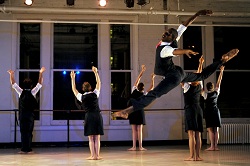
Steps On Broadway

'Air Suite, Part IV' choreography by Larry Keigwin. Photo Eduardo Patino

The first work was Knead choreographed by Benoit-Swan Pouffer, current Artistic Director of Cedar Lake Dance Company. Donning black biker shorts, translucent tops of navy and burgundy hues, and black socks, this fluid and dynamic work showcased the dancers’ ability to navigate music and movement in a highly generous fashion. Set to the music of American chamber group, Rachel’s, a constant push and pull of bodies was at play.

An opening duet by Marielis Garcia and the incredibly astute Victor Larue was eye catching. Garcia was able to waver effortlessly from off-kilter arabesques to sky-high passes, allowing the quiet push behind from Larue to mold her body into what it was supposed to be. Their partnership pointed to Larue as a guiding tool to Garcia’s fluidity, never forcing or intentionally shaping, but allowing us to see how his calm force manifested on her form. I also saw a distinct gentleness from dancer Lane Halperin, whose ease and simplicity came through as a sign of maturity. The way she mixed the richness of the music with the discreet strength of her movement was a pure joy to witness.

The second standout work by the ensemble was by the inimitable Larry Keigwin (how can you go wrong?). It’s no secret that Keigwin’s choreography is developed and complex, yet accessible and entertaining, all in one easily digestible work of dancing excitement. It was no surprise the ensemble dancers took on excerpts from Air Suite with ease. It was one of the only pieces of the night that I felt used the entire scope of Steps’ studio theater.

A cheeky, gestural introduction saw the dancers mimicking the obligatory flight attendant instructions (aptly, they were all wearing flight attendance uniforms). The dancers had fun with this kitschy humor, which fed seamlessly into an equally hilarious duet between the lean and lanky Landes Dixon and the muscle-bound, compact Kyle Mullins. A gestural battle of wits, Dixon and Mullins showcased a cat-and-mouse game of flirtation. Quick jolts of movement were punctuated by pauses that found the men in compromising positions—at one point, Mullins’ hands cupping Landes’ bottom. You could not help but let a giggle loose.

The final section, set to the music of the ubiquitous Phillip Glass, was a lesson in free falling. I was taken on an airless journey as the dancers sliced and slashed through the air with such an effortless quality that I forgot a floor was under them to break their falls. Again, eating up space with a vengeance, the female solo moments stood out the most. Each dancer delicately tripped through the space and never gave any warning as to what was going to happen next. Standout moments came from the mesmerizing turning ability of Jesse Dunham and the delicious grounded quality of Emily Schoen (also currently a member of Keigwin’s main company, Keigwin + Co.). At the end of the two hour stretch, though I had seen a lot, I left wanting more of Keigwin’s full-bodied parade of smooth movers.

The ensemble represented the wide-ranging contemporary work happening at Steps on Broadway, but there were also notable pieces across other disciplines. Richard Pierlon’s jazz piece opened the show with a sultry, pulsing parade of ladies (and a few gentlemen) clad in short skirts, bra tops, and, of course, signature black LaDucas. And, I won’t soon forget the Flamenco stylings of Arielle Rosales—excitingly rhythmic and undoubtedly seductive. The night saw many standout performances ushered in by the talented faculty of Steps on Broadway. It is easy to see why they are considered one of the best dance centers in New York City.

Top photo: Shadows choreography by Richard Pierlon. Photo by Eduardo Patino

Posted in Reviews - USAComments (0)

Charming Chet Walker


By Deborah Searle

After launching a successful Broadway career at the young age of sixteen in the first revival of On The Town, multi-award winning Director/Choreographer/Writer/Teacher and Mentor Chet Walker has garnered acclaim onstage across the globe, in television, film, music video and all commercial media. His Broadway credits include Lorelei, The Ambassadors, and four Bob Fosse musicals: The Pajama Game, Pippin, Dancin’ and Sweet Charity.

Perhaps best known as Creator and Co-Choreographer of the Tony and multi-international-award-winning FOSSE, Chet has directed and choreographed original new musicals, as well as having mounted extraordinary recreations of classic musical productions in close collaboration with shows’ original creators. His original works range from Cirque du Soleil, to dance works created for Compania Internacional De Teatro Musical, the international Jazz/Musical Theater Dance Company which he co-artistic directs in Buenos Aires, and Jacob’s Pillow where he serves as Director of the Jazz Program.

What makes you proud to be Chet Walker?
That I still am alive with new projects and energy to create and inspire others to live life to the fullest.

What are your passions?
My passions are travel, meeting and teaching students in jazz, American jazz – Jack Cole jazz, and musical theater techniques for dance, acting and singing. It is my desire to help make jazz and musical theater recognized as art forms. I do that in every country I travel to, with my work at Jacob’s Pillow and with the classes that I teach at Steps, NYC. Check out their website (stepsnyc.com) for information on the Jack Cole Jazz Classes and also
(jacobspillow.org) for my work there.

What is your career highlight?
I hope it hasn’t come yet. I really mean that. On my last day on this earth I guess I can answer that one.

You have directed and choreographed so many famous musicals. Do you have a favorite?
I know this sounds crazy, but it is the work that I am working on at that moment. I love what I do. I can’t imagine doing anything else

What are your current projects?
My current project is THE JACK COLE PROJECT, that I’m teaching at Steps with my friends. We had a residency at Jacob’s Pillow this year regarding the work and technique of Mr. Cole. We receive an NEA Grant to do that. I’m also working on a new show for Las Vegas with the working title Jazz on Jazz. 

I am working with Queens Theater and my company WALKERDANCE on some projects relating to the greats in the jazz music world. I am going to London to work on a new show. I directed and choreographed Cabaret in Belgrade, Serbia and that is still playing currently. I direct the Jazz/Musical Theatre Dance Program at Jacob’s Pillow each summer and for the past five years I’ve directed The Jazz Happening where I bring people from Broadway to come and perform with the students.

What makes a great musical theater performer? What do you look for in an artist?
What makes a great musical theater performer is a person who is a triple threat and who knows and studies his/her craft. What I look for is personality, intelligence and someone who has a hunger for work and the process. 

What is the future of musical theater?
I think the future of the Musical Theater is bright. New people, new ideas and new exploration of the human condition, and the joy that the theater has always given people, will continue.

How can we as dancers help Musical Theater thrive and keep audiences strong?
I think dancers need to hone their craft. Know the history of the art forms and read, read, read about the people who have come before. Know our history because knowledge is power. 

Posted in Top StoriesComments (2)

I am Korhan, This Is My Dance


By Deborah Searle.

Born in Bursa, Turkey, dancer Korhan Basaran now calls New York home – a city that inspires him to teach and create dance.  In June Korhan and company presented two world premieres at the Ailey Citigroup Theater in a show boldly titled “I am Korhan, this is my dance”.  So who is Korhan, and what is his dance?

What is your dance background?
I was an actor. I started to dance to help my acting in my college years. I started with some modern and ballet. I was then directed into dance more seriously by many inspiring dance artists, such as Binnaz Dorkip of the Ankara State Ballet Company. I had a couple years there, then when I first arrived in New York I received a scholarship from the Cunningham Studio and had the honor of meeting Merce and working with Mr. Robert Swinston. Cunningham Technique helped me to clarify and bring all the information I’d received over the years into a more personal place. I started realizing the knowledge within me so now all the classes I teach are almost like a research laboratory for creating new movement, testing new experiments and playing with the energy.

Why do you dance?
Less is more -  all the complexity can be defined with simplicity. It is a privilege to be able to express yourself without having to choose the correct words; to express with just whatever your body says. Movement is honest, simple and less, which helps you explain more, express more and understand more. I’m so much enjoying the universal language of movement and dance, and being able to be understood by all the people of the world without worrying about the words.

Why do you choreograph?
There’s not really an explanation to that.  I have an issue with the world, life, existence and with where the world is at. I believe that the only way to turn the world into a better place is through art. I simply know that my choreography will make the world a better place amongst all the other artists’ works.  The people who I have the chance to share my work with become better beings and I become a better being because I receive their response. What is shared between us in a performance is so alive, so real and so honest.

Tell us about your world premiere – I am Korhan, this is my dance.
The performance had 3 themes – On Love, On Land and On Life. On Love featured six love driven solos to Jean Marie Leclair for each dancer. I performed a solo to Johann Sebastian Bach. For On Land I chose some traditional Turkish music that has almost ritualistic importance. I made one sextet for the dancers and a solo to an elegy.

Then the second part of the evening was On Life, a composition created on a Philip Glass violin concerto. This piece was inspired by the life in New York. I wanted to look at something so simple and connected to life such as running – as in NY you just keep on running every day, all day. This was a theme of the piece and how it connects into more complex and designed movements. You keep running – you fall down, stand up, go on and fall again, yet you keep on going.

The beautiful dancers were Alexander Dones, Nikki Hock, Lindsay Richter, Jenna Otter, Kei Tsuruharatani and Chad Van Ramshorst. We had a very nice installation-set piece designed by Sila Karakaya for the On Life, NY piece, our lighting designer was Joyce Liao and our stage manager was Gwyndolyn Kay.

How long was the creative process?
I started working on some phrases, sentences and material at the end of April and we attended some performances together. I was working with the whole cast from the 25th of May. So we had a short period of time to create the whole evening long work. I’m so glad that we’ve managed to develop a nice language of movement in such a short time.

How did the audience receive the work?
I think they weren’t really sure how to react or what to expect, as this was my first official show in a big theater like Ailey for the New York audience. But as they started to know who we were as human beings and then dancers, I felt like they started to be more open and welcoming, especially in the second half. By the end of the second act, danced to the Philip Glass violin concerto, I felt energy flow from the audience towards us. We were accepted. The dancers and I have received amazing feedback, e-mails and messages from the audience and from some big names in the New York dance scene.

What are your future plans for the work?
That’s a very long road that one has to walk. Every minute you are subject to change, evolve, and feed yourself with what you experience in life.  I still have a lot to do to find out my inner voice. I’m taking brave steps and trying not to lose my courage and my honesty. I’ve just got to go on making more works, share with people and allow the dance to find its way through my body, mind and soul.

Are you working on any other dance related projects?
All through the Summer I’ll be teaching at Steps, DNA and Peridance across New York. I will be choreographing for the Intensive Course at the Peridance Summer Program. I’m also starting a laboratory work on a weekly basis (on Saturdays), where I invite artists from other disciplines to join with my dancers, and dancers interested, to keep the connection, research and exploration developing. It is a two hour open jam installation of music, movement, theater, visual arts and other contributions. I am very excited about it.

www.korhanbasaran.com

Photo:  Ali Sarikaya

Posted in InterviewsComments (0)