Tag Archive | "dance review"

Falling Forward: The Dance Gallery Festival Celebrates Five Years


Ailey Citigroup Theater, NYC
October 15 2011

By Tara Sheena.

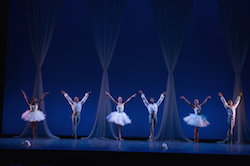
In its fifth year, the Dance Gallery Festival has presented the works of seasoned choreographers such as Patrick Corbin, Camille A. Brown, and Pascal Rekoert, in addition to having a Texas contingent as well. Presented by the choreographic sister team of Astrid and Mojca von Ussar, the festival aims to address the scarcity of affordable venues available for presentation of modern dance and showcase the work of emerging and established choreographers from around the United States.

Taking place at the Ailey Citigroup Theater, the final night of the festival included works from eleven choreographers, who came together to create an authentic smorgasbord of works. Festivals such as Dance Gallery happen frequently in NYC, especially during the fall season, and it is always a pleasant to experience such a collage of viewpoints and artistic voices in a single program. It would be near impossible for me to reflect on each piece with the detail it deserves, so I will focus on three stand out works from the evening.

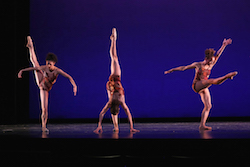
Mojca Ussar, dancer Andreja Sraj. Photo by Yi-Chun Wu

After a slightly distracting smoke machine filled the stage with a pseudo-fog, Spencer Gavin Hering’s 4Ward & 4Gotten showcased a quartet of fearless, virtuosic movers. The ambiguously clichéd title and fake smoke effect can be easily forgiven, in this case, because of Hering’s sophisticated and highly developed movement vocabulary. The port de bras moved with effortless grace while sturdy legs twisted, extended and turned to full potential. His bold use of dynamic fluidity and constant juxtaposition of body parts make his work consistently exciting.

Set to music by Wendy Sutter, the movement and music took turns overpowering each other. In a piece that allowed the physical qualities of the movement speak for itself,  the music sometimes overshadowed the idiosyncratic flicks of the wrist or subtle head ticks that were so wonderfully executed by each performer. Conversely, the movement was so rich and kinetic, that the music, at times, did not live up to this constant motion. This undying movement paired with a distinct classicism (turned out legs, striking releves, high extensions) drew connections to the work of Jiri Kylian or William Forsythe, where the lower body serves as this virtuosic playground for the upper body to float on top of. Hering stretched the limits of all of his dancers, with standout performances from Lindsey McGill and Andrea Dawn. Most of all, the work gave me a sense of Hering’s creative process and his singular aesthetic—a hard feat to accomplish in a piece that was less than ten minutes in length.

After a short intermission came Roundabout, an ensemble piece by Andy Noble and Dionne Sparkman Noble of NobleMotion Dance. I was especially taken by this piece because of the choreographic effort that was immediately evident. Witnessing the work, I could not help but think about how their creative process was conducted. Did they set the movement on the dancers? Were the dancers allowed some creative liberty? Was that step first a mistake? How long did it take them to get it to this level of performance? I had an enjoyable time exploring these questions as the piece unfolded. Nobles’ work had so many intricacies and illusions that were very pleasing to watch, that I could not help but muse over how it all came together.  

The ensemble partnered well together. Lifts ascended with ease, transitions were smooth and not overwrought, and there was a joyous lift supporting every movement. Soaring through the air, both assisted and not, the dancers created a space that extended beyond the confines of the stage. At the same time, as one structure was created in this mass of moving bodies, it was destroyed just as quickly, producing a constant cycling and recycling effect. A wonderfully expansive and intelligently constructed piece, it was certainly one of the most impressive of the program.

The final work of the night came from Sarah Stanley and her company, Sarah Stanley Dance. Set to a version of Philip Glass’ ‘Metamorphosis Four’, the piece, titled Inscriptions, capped off the evening on a calm and cool note. The program had no specific music credits, a very disappointing oversight, but the familiar languid quality of Glass’ work echoed as great as ever in the Citigroup Theater. The dancers responded in a flurry of windswept movement that nicely mimicked the gentle swells of the music. I was pleasantly surprised at numerous points throughout the piece, thinking the dancers were going to overshoot a distinct cue in the music, and startled to find that they were keeping up with the score in unexpected ways.  I welcomed this with the gentle bouncing motif, or a small gesture that hit just the right note—literally and figuratively. Light as air, a breath of fresh air, brisk as the night air—yes, it covered all of those bases.

Top photo: CorbinDances, Photo by Yi-Chun Wu © 2011

Posted in Reviews - USAComments (0)

A Melding of Minds


Lessons in art appreciation at this year’s BAM Next Wave Festival

Symphony for the Dance Floor
BAM Harvey Theater, New York
October 13 2011

By Tara Sheena

As a self-proclaimed dance geek, I regularly make a point to attend the myriad of performances and events that circulate around New York City. In my humble experience of seeing dance at every given moment I can, I rarely come across a performance like the one headed by Daniel Bernard Roumain in his world premiere of Symphony for the Dance Floor.

Roumain, also known as DBR, is a Haitian-American renegade violinist and composer who has shared the stage with everyone from Phillip Glass to Bill T. Jones and Lady Gaga. In his third commission by the BAM Next Wave Festival, DBR showcased his zeal for collaborative efforts, combining music, dance, video, and design in a fast-paced, high-tech showcase of talents. Video featuring photography by famed photographer Jonathon Mannion, known for his portraits of hip hop artists like Jay-Z and Eminem, and choreography by Millicent Johnnie of Urban Bush Women, made the show a whirlwind of urban energy. Nods to the landscape of New York City, hip-hop music, African dance, and Haitian culture came together in an exciting array of theatricality.

DBR has no formal training in dance, nor is he an aspiring choreographer or performer. In all fairness though, it should be mentioned that he is the former Music Director of the Bill T. Jones/Arnie Zane Dance Company and, I was told from sources close to the artist, that he once had a stint as the accompanist at the Martha Graham Company. However, it is evident that he has a deep appreciation for the form. He made a point to include Johnnie’s dynamic and kinetic movement in a show that would’ve been just as compelling without any dancers. DBR even included ‘dance’ in the title of his show, a telling quip for the emphasis he wanted to make.

In my humble, modern-dance-loving mind, it gave me hope that other artists are brave enough to branch out of their conventional performance equations and find something new to bring to the table. All artists can benefit from this approach, especially at a time when funding and venues are an increasing impossibility. Most importantly, I left the performance with a deeper appreciation of not only the art I am so obsessed with, but the other forms that were showcased as well. The music, the video, the fashion, the lighting were all in cooperation and, what’s more, in appreciation of one another. A recent New York Times article (found here: www.nytimes.com/2011/11/05/arts/dance) questioned this melding of live music and dance. I immediately thought of DBR’s Symphony after coming across this article. He is able to offer a completely different perspective on this conversation and I only hope it’s one the dance world continues to have.

What do you think? Is live music in dance necessary? When is it too much? Sound off! Leave your comments below or shoot me an email at tarasheena@gmail.com.

Posted in Reviews - USAComments (0)

New York Theatre Ballet – Dance on a Shoestring


The Dance Gallery, New York Theatre Ballet
September 30 and October  1, 2011

By Katherine Moore

Last Friday night audience members packed into The Dance Gallery, New York Theatre Ballet’s in-house performance space, for this fall’s informal performance series, Dance on a Shoestring.  With parents seated cozily together on chairs, and children resting on plump purple pillows, the tone was set for an evening of cheerful amusement. The audience awaited the first unveiling of choreographer Keith Michael’s all-new Nutcracker, as well as other works performed by New York Theatre Ballet’s children division, company members, and David Parker and The Bang Group.

The program began with Parker’s  excerpts from ‘Misters & Sisters’,  an amusing, lighthearted,  cabaret of sorts.  Dancers Nic Petry and Amber Sloan began by performing an elegant waltz, which was shortly followed by a rendition of In My Own Little Corner, performed by Parker and Jeffrey Kazin.  Dressed in jeans and sweatshirts, they comically sang lyrics of love and fantasy while stripping off their clothes to reveal sparking gowns and, in Kazin’s case, pointe shoes.  The piece morphed into a hilarious interpretation of Sisters, complete with giant feather fans.

The program then altered course with Antony Tudor’s Tirolese from ‘Soiree Musicale’, a lovely duet performed by dancers Elena Zahlman and Mitchell Kilby.

Next, and my personal favorite of the evening, was The Ribbon Dance from ‘La Fille Mal Gardee,’ an ensemble piece performed by the NYTB children’s division.  These young ballet dancers performed with both abundant delight and determined precision, which exemplified NYTB’s commitment to honoring ballet classics while encouraging the talents of young, eager students.  The dancers performed enthusiastically and graciously, their love of dancing evident to all in the room.

Following this joyful piece was the sneak preview of Keith Michael’s new production of The Nutcracker. After performing Michael’s old version of this much-loved ballet for 26 years, NYTB felt it was time to revamp their production with new choreography, new sets, and new costumes.  Time will tell the success of this Nouveau Nutcracker, as NYTB is calling it, but from the excerpts seen last Friday, audiences can expect a delightful, whimsical, and romantic journey into the magical world that audiences have learned to love and expect from any production of The Nutcracker. 

Petease, choreographed and performed by Yukiko Kashiki with dancer Joshua Andino-Nieto, was the most cryptic and melancholy work of the evening, but certainly an intriguing and physically beautiful duet set to music by George Gershwin.  Then, young dancer Benjamin Levine showed off both his performing and choreographic talent with The Stick, a playful, mischievous work developed during the 2011 Summer Camp organized by the NYTB’s LIFT Community Service Program.

Ending the program was A Rugged Flourish, choreographed by Richard Alston and performed by NYTB dancers.  The lead male hero was portrayed by Steven Mendelez, who danced with exceptional strength and precision while retaining the rawness of spirit that the role demanded. This moody, mature work demonstrated the dynamic range of NYTB’s repertoire and finished off the evening with a determined sense of accomplishment.

Photo by Richard Termine

Posted in Reviews - USAComments (0)

Enter the Stage and Choose Your Own Adventure: Punchdrunk’s Sleep No More


McKittrick Hotel, NYC
September 6 2011

By Leigh Schanfein 

Already heralded as a show completely unique to Broadway theater goers, Sleep No More is a bold Off-Broadway production that does everything but follow the trends of the popular theater scene.  Bright lights, starlets, bustling crowds: what do you expect from your Broadway experience?  Don’t expect that here.  Walk away from the electrical illumination of Times Square down ever more shadowed streets.  Leave the throngs of enthusiastic bright-eyed pleasure seekers, and seek something unknown nearer the dark waters of the Hudson.  Once you’ve arrived at the formerly grand, now transformed, McKittrick Hotel, proceed to experience a show as you never have before.  Experience Sleep No More.

Sleep No More is an immersive theatrical experience developed by the British theater company Punchdrunk, housed in what was several warehouses and then nightclubs in New York City’s Chelsea district.  The entire building, renamed the McKittrick Hotel, is outfitted for the production, each room decorated with painstaking detail to create a true environment for the actors and audience in this modernization of Shakespeare’s Macbeth.  Theatergoers quickly lose their tenuous audience classification when they are shipped to one of the hotel’s floors and thrust into the set of this production that takes over the entire building and all of your senses.  It’s difficult to remember once inside that this is not merely an immersion in a parallel world, it is also a show and you are going to have to seek out the scenes yourself. 

The production feels like a choose-your-own-ending novel in the real, where one must, in real time, walk through and observe an enacted scene and then choose which path to take next at the scene’s end.  You make your decision and continue.  Of course, you want to know how the other choices would have panned out, so you must physically go back and begin following another path, in real time, to its next point of bifurcation.  Then you make a choice again.  It is an amazing concept – the pages are already written, the scenes play out whether you see them or not, and you have to make the right choices to reveal them.  Of course, I did not realize this at first. How ignorant I was! Stepping off the elevator to see a slew of audience members race in pursuit of an actress who looked like she might be a nurse, I promptly headed in the other direction to “explore.”  Well, after an hour or so of exploring the hotel’s various desks, drawers, books, nooks, crannies, closets, ballrooms, bathrooms, living rooms, storerooms, doodads, things, trinkets, and halls, strange smells and all, I realized I was doing it wrong.  I had forgotten it was a show, a low-volume high-intensity show, and I had to create it myself with (only) up to three hours in which to do it.

I began working through the scenes as best I could, trying to catch actors and stay with them along with a handful to a throng on other observers.  In real time, we were trying to follow one of 12 characters (as far as I could tell there were 12, but maybe I never found some..) through his or her own tale, going in and out of other characters’ sequences, sometimes breaking off to follow the newly introduced until his or her sequence similarly became enmeshed with another.  It became clear after some time that the show essentially repeats every 30 minutes and that I likely would not have time in one evening to catch it all. 

By now you are probably a little confused, thinking “actors…but what about the dancing?!”  Well, all of the actors are dancers.  And, they are all superb.  There was not a single moment that was not fully embodied in every way.  Not a moment when I didn’t know them to be their characters, nor a moment that I didn’t feel I should stay half hidden behind a column or doorway because I was an intruder eavesdropping on their lives.  Through it all, I caught five dance sequences: a lusty duet in a storeroom, a frantic duet at hotel registration, a fraught and ultimately destructive trio in the barroom, a fantastical waltz consuming most of the cast in the ballroom, and a powerful duet wrought with brutish beauty and fueled with anguish.  The latter duet was the final act of my experience at the hotel that evening.  It was a gorgeous, ugly fight, a final scene in a strange production that bewitched me.  Two other scenes of note were an exquisitely staged slow-motion climax at a banquet that I watched, exhilarated, three times by chance, and, what was oddly my favorite element other than the final duet of my night, an entrancing, brilliantly acted lip-synch of Peggy Lee’s “Is That All There Is?” by one of the male actors.  I can’t tell you why, but I was mesmerized.

And that’s one of the great things about Sleep No More, I can’t tell you why.  In fact, I really can’t tell you much when it comes down to it.  And, to be frank, I had just about no idea what was going on the entire time. I read and enjoyed Macbeth about 10 years ago, and remember nothing.  I chose not to read any reviews of the show or brush up on my Macbeth prior to viewing it because I did not want to taint my experience.  This too, I believe I did wrong.  I recommend that you go ahead and familiarize yourself at least minimally with the plot so that you feel the magic of realization when elements come together, and so that you don’t feel like you are perpetually missing something.  Of course, no matter how you are when you enter the hotel, it will still be a spectacular show and exquisite undertaking!

Notes:
Don’t worry, I haven’t revealed a thing!  It will all be new to you.
Allow a minimum of two hours, though you’ll probably want to go for 2.5 or 3.
You might be doing a lot of standing and walking (or running) and there are only stairs between floors, so don’t dress for the club.
You must check your bag at the entry point ($3) no matter how small.
You will lose track of time so wear a watch if you need to meet a hot date after the show.
You may view nudity if you are in the right (or wrong) place at the right (or wrong) time.
You may have mild to heavy interaction with a performer.  Let it happen. 

For Information and Tickets visit sleepnomorenyc.com

Posted in Reviews - USAComments (0)

The Latin Choreographers Festival


Baruch Performing Arts Center, New York City
August 2011

By Laura Di Orio

In its fourth year, The Latin Choreographers Festival is evidently evolving. This year’s program, curated by its founder and director, Ursula Verduzco (who also choreographed, danced and created costumes for pieces on the program), was expansive in its dance genre, musical choices and feel. It reaffirmed that every artist has a voice, has something to say, and should be given the opportunity to do so.

Works by 12 choreographers of Latin descent, and one by Aszure Barton, this year’s chosen non-Latin choreographer, were featured at New York City’s Baruch Performing Arts Center, a new home for the festival. Some of these names were new to me, while others I was familiar with, but in all I was greatly in awe of the choreographers’ dedication to their work and of the dancers’ commitment to it as well.

Steven Gray and Jennifer Pray in Eloy Barragan's 'Some Day'. Photo by Rachel Neville

A favorite, ‘Some Day’, choreographed by Eloy Barragan, and danced beautifully by Steven Gray and Jennifer Pray, blew me away. The pull between ‘Some Day’s’ softness and passion made you feel for the couple, clad in neutral, muted tones, during their times of loneliness and of harmony.

‘Maria’, Antonia Urzua’s work, featured passionate partnering between dancers and also between music (it’s set to a fusion of Tracy Chapman and Arvo Part, which worked unexpectedly well). At one point, one dancer lifted and swung another via a back brace with handles. The characters became, in more ways than one, less attached, and it was relationship full of reaction.

Another highlight was David Fernandez’s ‘La Danza del Fernando’, a dance with a strong undercurrent of narrative story and, at times, elements of humor, intrigue and surprise. Roberto Lara made for a stunning hero, and it was nice to see Fernandez on the stage as well.

Verduzco and Fredrick Davis were technically strong and funny in gestural dialogue in Benjamin Briones’ ‘Lights On’. And Alejandro Chavez’s ‘Triangulo’, with three nearly identical men in appearance and dance style, told the story of an intense love triangle. Music by Fazil Say accompanied it well, telling the story alongside the movement, and the moments of stillness were just as powerful as the most energetic ones.

Rounding out the program was Barton’s ‘Blue Soup’, with a diverse crop of dancers from The Steps Repertory Ensemble, all dressed in business suits. The piece was smart, funny, and certainly polished.

Aside from a few awkward lighting transitions (a couple of pieces were also unfortunately too dimly lit), and a somewhat lengthy program (although I’m sure it was tough to narrow it down), Verduzco showcased a batch of insightful artists. I’m excited to see what’s in store for next year’s Festival.

Top photo: Ursula Verduzco and Fredrick Davis in Benjamin Briones’ ‘Lights On’. Photo by Rachel Neville

Posted in Reviews - USAComments (0)

The Nvitational Inspires


18 Shows over 3 weeks by LA’s most incredible artists.

By Alex Little.

It was this past Spring when Dee Caspary posted an event called “The Nvitational” on his Facebook wall. I knew an event created by Dee Caspary would be something worth looking into, because if I know one thing about this man, it’s that he doesn’t post much.

OK, truth be told, what I know about Dee is that he is an incredible artist, visionary, risk-taker and of course, choreographer. When I spoke with him a few months back, he was fired up about the Nvitational, to say the least. The opportunity to bring together various great choreographers, dancers and musicians into a festival of performances in North Hollywood was the first of its kind in Los Angeles, and there was to be three weeks of shows! As Dee said, “there is no place for choreographers to present their work, outside of Carnival, unless they produce their own show”. Instead, the El Portal Theatre, the city of North Hollywood and Dee Caspary produced the shows for them.

Here are some reviews of the festival’s highlights:

Who We Are – Jennifer Hamilton

By Alex Little

I was thrilled to have the opportunity to see Jennifer Hamilton’s showing of “Who We Are”. The audience was humming with excitement, and as I glanced around I met eyes with many big names in the industry. We were all there for what we knew would be sensational. “Who We Are” did not disappoint, in fact sensational doesn’t even cut it. If you know Jennifer, or are familiar with any of her work, you know that she is the real deal. She is one of the most grounded, authentic and talented artists in our community, and her work always reflects these attributes.

Beginning with a projection of birds flying across the morning sky, the stage slowly filled up with her full cast, dressed colorfully, walking and moving in various patterns, slowly meeting one another, couple by couple. The vibe was upbeat for the first two pieces and there was a feeling of pure joy and happiness on stage. The all-male piece was funky and almost “Movin’ Out” in feel, featuring strong masculine movement. The camaraderie felt on stage permeated into the audience, as we found ourselves grooving with the dancers. The seamless transitions from one piece to the next kept the show’s thought line clear, all told through Hamilton’s distinct movement. Hamilton’s repertoire is quite accessible to all audiences and I could see her work being successful on all stages, Broadway, television or movies. She has range.

The show continued with more projections of the sky, like a day was passing by. It felt like Hamilton was paralleling the cycle of a day with the cycle of relationships. My favorite dance was the third piece called “Cold Water”. It was the story of two couples in distress and a third, in a love triangle. Hamilton’s direction in this piece was more astounding than the choreography, which I believe is the mark of a brilliant creator. Between Hamilton and the dancers’ characterization, I was mesmerized.  It felt like we were watching a movie, not sure how it would end. The story felt relatable. I can’t imagine that we all haven’t been one of the seven characters at some point in our life. Colleen Craig and KC Monnie stood out in this piece, and throughout the entire show. Kelly Allen was also a notable performer.

The show ended with an all-girls piece, where Hamilton showed her jazz roots, asking for strength, sensuality and strong technique. Boy, did these ladies give it to you! The finale was a beautiful, loving duet performed by the incredible Genise Rudiaz and KC Monnie, then joined by the entire cast to “Crash” by Dave Matthews. It was such a fitting piece of music, choreographic phrase and performance to conclude the tale of “Who We Are”, as the projection on the cyc was a glorious sunset. Thank you, Jennifer Hamilton. Your vision came to life and moved me in a profound way. I think it is safe to say Hamilton’s craft is unparalleled and her work will be seen on larger stages soon.

Amor

By Alex Little

Kersten Todey, Jessica Lee Keller and Ben Susak were the creative team behind “Amor”, a performance combining live music, spoken word, and dance. In addition to this, lighting was also a major element in this love story, as the dancers spot-lit each other with 4 box shaped lights, manipulated by the dancers, setting the mood of each piece and directing the audience’s eye. This was one of my favorite elements of the work.

The show began with dancers Natalie Reid and Ben Susak, each performing solos to the spoken words of Jessica Lee Keller and Robert Earl Sinclair. The intimate Forum Theater was the perfect setting for such artistic choices, and one could hear a pin drop in the audience as the dancers moved with each word and breath, in and out of the spotlights. During his recitations, Sinclair was on stage with the dancers. This was such a lovely directorial choice, as it made it feel as though Ben Susak, and later Chaz Buzan, literally were his voice. More dancers eventually joined the stage in “Lullaby”, sung by the beautiful Debra G, musically accompanied by Joe Gilette and Cameron Dean.

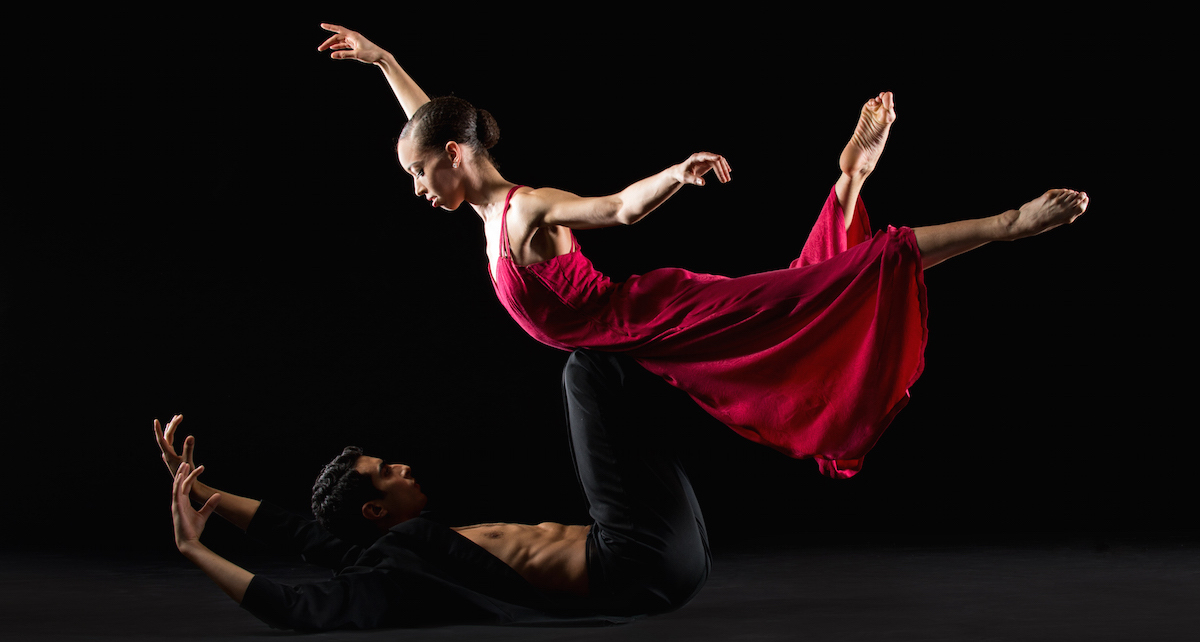
The lighting of the show kept the continuity extremely engaging, as did the ever-changing pacing between music, words, silence, solos, duets and group pieces. I take my hat off to the choreographers for their arrangement of the elements in “Amor”. Kersten Todey’s choreography shined in “9 Crimes” as she arranged her movement ‘in the round’, just as the theater was constructed. Not only did Kersten’s intricate choreography define her vision clearly, but it highlighted the gut-wrenching story between the principal couple, performed by the aforementioned Keller in a brilliant red dress, and Mason Cutler.

Keller’s choreography in “Burnin Up”, a quartet of four women; Katherine Wolanske, Mandy Korpinen, Ashley Glavan and  Elizabeth Petrin,  was one of my favorites of the night. The blend of Keller’s intention and her work with the singer Debra G, came through with her elegant movement and staging. Sometimes it feels nice to breathe with a piece, and this was just that for me. Susak’s choreographic highlight was the upbeat and energetic ”Live Forever” featuring the entire cast. This piece looked like an incredibly challenging work to execute, but the dancers performed it with a sense of ease, power and their hearts on fire! I loved his use of running circularly, and the adventurous ways he utilized the spotlights.

I commend Todey, Keller and Susak on their execution of their vision “Amor”. With a cast of incredible dancers, musicians, singers and speakers, art came to life, all at once.

Choreographer Mandy Moore

A Night at the Piano

By Alex Little

I am so happy that I was in attendance for this particular show! It ran about 40 minutes in length, and here was the premise: ask Dana Wilson,  Mandy Moore,  Amanda Leise, Tony Testa, Matt Cady, and Dee Caspary to each choreograph a piece to a song that would be played live by pianist, Kevin Su Fukagawa. That’s it – a taste of some of Los Angeles’ best choreographers in one sitting. The intimate setting of the Forum Theater was perfect for this show. It began with Dana Wilson, who danced a brilliant solo, dressed in black and white with a painted mime-like face and white satin gloves. Wilson’s choreography was a fusion of gestural contemporary meets pantomime, to tell a sad story of what seemed to be a lady asking for love or acceptance. It was one of my favorites. Wilson was impeccable.

Wilson was followed by Dana Fukigawa and Will Loftis dancing to Adele’s “Rolling in the Deep”. Mandy Moore’s clear vision was executed by her authentically strong, grounded technical style that when performed by her dancers, especially, will blow you away. Her work always does that to me. And those creative lifts! WOW!

Matt Cady came next with a wonderfully clever trio between himself and two ladies all dressed in gowns. This character piece was hysterical and brought the audience to laughter on numerous occasions. The threesome were great actors too. The piece found them mocking the high-life, each other, and even dance.

Amanda Leise’s tap piece was up next and this performance truly garnered the most applause of the night. She was joined by two men and a lady, and this quartet performed brilliantly. The difficulty and intricacies of Leise’s work were met with ease and confidence between the performers. They were having one big party and we were all invited!

Tony Testa followed with a moving piece that spoke about growing up, but keeping your youthful nature alive, no matter the age. This piece was danced by a young child, Tony himself and an elderly gentleman, all portraying the same person through the years. Testa told a beautifully theatrical story utilizing an army theme. The older gentleman was incredibly inspiring.

Lastly, Dee Caspary presented a trio danced by Chaz Buzan, Channing Cooke and Ashley Galvan. Caspary’s work mesmerizes me. The way his unique movement flows seamlessly with his staging is quite brilliant and never ceases to amaze. This piece had a lovely breath of simplicity to it and brought the piano to life.

Peter Chu presents The ChuThis Group – Nothing Sticks

By Alex Little

Where do I start? What words can describe the experience accurately? I will do my best to recap the evening I spent taking in the phenomenal “Nothing Sticks”. Peter Chu is one brilliant man, dancer, visionary, director, choreographer, artist and teacher. But many of you already know that. He designed a show that brought together every element of the theater onto one stage.

In 90 minutes we were taken through a story of resistance and change. Chu designed a show with a company of seven dancers on what looked like an old movie style set, utilizing live projections of various stick figures throughout the evening, and at one point a projection of himself dancing (that he accompanied dancing live, creating a duet). He incorporated two huge movie-set lights on the stage, manipulated by the dancers, as well as a chalkboard used at one point to play hang-man with the audience. Chu, the narrator of the story, wore a top hat and carried his umbrella, like a cane, which was later seen in giant form, as the dancers used it to create a hook effect to pull one another off stage. Such great visuals!

The plethora of movement styles brought into “Nothing Sticks” was remarkable. Gorgeously constructed contemporary pieces with signature Chu movement were woven into the story by way of solos, duets, trios and harmonious group work of intricate and technical movements, gestures, expression, imaginative partnering, innovative floor work and sublime pantomiming. The dancers were elegant athletes as they contoured the space with refined grace, technique and performance.  Chu’s choreography is aesthetically pleasing, yet undeniably difficult in nature.

Chu blended his contemporary style with vaudevillian and Broadway- inspired pieces, transitions and even acting and speaking parts, where the 4th wall was broken to include comedic breaks in the show, such as the aforementioned hangman game played with the audience! Such fun and laughter ensued. This led into a gorgeous duet against the chalkboard performed by Rebecca Niziol and Matthew Peacock, where lines kept being erased by Niziol and redrawn by Peacock.

Other notable performances were Steven Hernandez’s solo to “Dream a Little Dream” and Chu and Hernandez’s duet, which was probably my favorite piece of the evening. Matthew Peacock was incredible as he opened the show with a solo that brought us right into Chu’s world. Jillian Chu’s interactions with Peter Chu in explaining that it is “OK to erase and start again” melted my heart. For as the story told, change, is inevitable. I can only hope this show continues to run so everyone can have a chance to be in the audience.

Terry Beeham presents Mental Head Circus

By Deborah Searle

We walked into the dark Forum Theatre where we were immediately greeted by artists hanging from the ceiling moving eerily, yet beautifully in the air. Within seconds it was clear that Mental Head Circus are a talented aerial troupe, who are as much athletes as artists.

We enjoyed just a snippet of what the company can really do, and I was left wanting to see more. A beautiful aerial rope piece had one dancer creating exquisite lines at the back of the stage with death defying drops from the ceiling. The movement created by the dancer and her bright red dress memorized the audience.

The dancers showed both grace and enviable flexibility throughout the display. They are truly gifted, and incredibly strong! Their character portrayal and performance technique drews us in and keep us on edge.

Terry Beeman stunned us with a theatrical dance around and inside a cube. His contortions and balances were mind-numbing. I was shocked to discover after the performance that he is in fact in his 40s, as on stage he shows the agility and athleticism of a teenager. He truly defies nature!

Beats Per Minute

By Deborah Searle

What a fun performance! Beats Per Minute had us all toe tapping in our seats. Created by Glyn Gray and Nathan Sheens, Beats Per Minute is a tap and music performance, where the tappers set the beat and become instruments, jamming with a live band.

Three talented tappers; Glyn Gray, Brin Hamblin and Chris Rutledge, created a light hearted and entertaining show, accompanied by a guitarist, bass player, drummer and vocalist. Gray is a consummate performer and a definite crowd pleaser. His concept for Beats Per Minute, was simple, yet brilliant – create music with the feet as well as the band.

Vocalist Lindsay Hough had a strong, jazz flavored voice that was appreciated by all. She sang a theme song to ‘Beats Per Minute’ that could have come across corny, but was actually quite catchy and fun. She is a talented artist.

Chris Rutledge was a very capable tapper and I enjoyed watching him ‘bust his moves’ and play off the other two performers and musicians.

Beats Per Minute could entertain even a non-dance audience. The performance was laid back and created a casual atmosphere in the theater. I can see this show being a hit on stage, as well as on the streets. It would draw a huge, excited crowd of both lovers of dance and music.

Posted in Reviews - USAComments (0)

Mystère – Cirque du Soleil


Treasure Island, Las Vegas
August 8 2011

By Deborah Searle.

Mystère is an all engaging Cirque du Soleil classic. The first creation in Cirque’s Vegas Strip empire, Mystère has all the elements that made Cirque du Soleil a hit, combining powerful athleticism, high-energy acrobatics and inspiring imagery to take the audience on a dream-like journey.

Deemed a theatrical “flower in the desert”, Mystère thrills audiences with its exhilarating blend of magic, drama and the unimaginable. The story line is one of new life a celebration of life, and can be interpreted differently by each viewer. Mystère explains that life itself is a mystery, full of beauty, wonder and surprises.

The acrobatic Spermatites

With strong men, aerialists, dancers, trapeze artists and gymnasts all sharing the same stage, Mystère is thrilling and memorizing. The music, sound and lighting are perfectly connected, whilst the stage changes and moves throughout the show, creating different levels and new exciting landscapes for the artists to explore.

The dancers and acrobats are incredibly talented. They take us on a journey with them and make us feel as if we too can fly. The character of ‘Red Bird’ is a standout. His beautiful lines and dance movement, followed by quick, fluid acrobatics draw the eye. And Les Bébés, a comical baby character, is entertaining and light-hearted. Les Bébés provides a laugh and some relief from the intensity of the other performances.

With a perfect mix of humor and awe, this show is a must see for all ages. Presented exclusively at Treasure Island in Las Vegas, Mystère is one of those theater experiences that can’t be missed. You’ll never look at life the same again…

Photos by Al Seib, costumes by Dominique Lemieux

Posted in Reviews - USAComments (0)

Traces – 7 Fingers


Union Square Theatre
New York
July Previews

By Deborah Searle

Traces, by Montreal-based troupe 7 Fingers, is astonishing! If there’s one show that will make you gasp this season, it’s Traces. Nail-biting, awe-inspiring, freaky and fun, the artists of 7 Fingers are an eclectic mix of talent and tenacity. From varied countries, backgrounds and artistic pursuits, all seven acrobats can seemingly defy gravity.

Traces is a delightfully entertaining show, where we get a glimpse into the lives of the seven artists and even see a few baby photographs, adding to the personal feel of the program. The artists perform daring moves upon rollerblades, skateboards, chairs, poles and even a teeter-totter. Many times they come flying at the audience, stopping just short of landing in our laps. These acrobats seem to have no limits! At times I wanted to close my eyes, worried that with just one slip the performers would sustain severe injuries or land on top of me. How these artists perform without safety strings or nets amazes me.

A contemporary dance pas de deux by Mason Ames and Valérie Benoît-Charbonneau is beautiful and daring, as they not only dance together and perform lifts, but include acrobatic tumbles and tricks upon each other’s bodies. They are so precise and seemingly fearless as they perform the most elaborate of tricks.

A dance number beginning in a row of chairs across the stage was a highlight, and showed that the artists aren’t only acrobats, but consummate contemporary dancers also. A thrilling number by Bradley Henderson with a large ring is astounding, a chair piece by Florian Zumkehr shows his remarkable strength and balance and a Chinese yoyo dance by Xia Zhengqi is lighthearted, displaying mind-boggling accuracy and concentration.

Every scene brings a little humor, dare and delight. Traces is an explosive display of physicality, with the magic of circus and the grit of the street.

Traces will also be touring to Philadelphia and Hartford, CT. Make sure you get your tickets!
Tracesusa.com

Photo: Michael Meseke

Posted in Reviews - USAComments (0)

Ignition – Atlanta Ballet


Alliance Theatre, Atlanta
May 2011

By Deborah Searle.

Atlanta Ballet’s Ignition program allows the company to shine; not only the dancers, but the artistic team, and the new choreographers that it commissions. The program gives up-and-coming choreographers a chance to create work on a hungry and enthusiastic team of dancers with the strong support of Artistic Director John McFall and his talented team. As 2011 Ignition choreographer Gina Patterson revealed, “I really felt completely supported artistically by the Director, John McFall, and the staff. The dancers were really open. I felt like I could go into the piece really deeply and openly and the dancers went there with me wholeheartedly, physically, artistically and emotionally”. When a choreographer’s vision is supported and nurtured, magic can be created, and that is what we witnessed at Ignition 2011.

Flux. Dancers J. Welker and T. Lee. Photo by Charlie McCull

The evening of performances, danced in the intimate setting of Woodruff Art Centre’s Alliance Theatre, started with Flux, a work developed by young Bennyroyce Royon, a talented graduate from Julliard, New York. The movement was like liquid as the dancers body-rolled, slid across the floor and explored each other’s space. The performers, in pedestrian clothing and dancing in socks looked like average people at first glance until they started to hypnotize us with their intoxicating movement.  Royon has a unique choreographic voice and the dancers seemed to revel in his creation.  As partners they played with negative space and as groups they danced with strength and power. The men of Atlanta Ballet showed their prowess in compelling group numbers. The music was interesting and took us on the journey with the dancers. At times the music and the movement it inspired got a little repetitive, but that is my only criticism. I enjoyed the unique choreography and the challenge it presented to the Atlanta Ballet dancers, who I had only ever previously seen perform traditional ballets.

Quietly Walking, by Gina Patterson was a polished balletic masterpiece. Unlike the other works of the night, which seemed to need a little more time to reach their full potential, Quietly Walking had indeed arrived. It was a complete work, refined from start to finish and showed Atlanta Ballet’s dancers as brilliant technicians and engaging and expressive artists. There were so many special moments. Patterson explored layers of costuming and beautiful fluid choreography that caught our attention and kept it. The work discussed themes of urbanization and deforestation, but it wasn’t all doom and gloom. We experienced the circle of life, death and rebirth and were taken on a breathtaking, yet thought provoking journey. The partner work was exquisite as the dancers showed their vulnerability and seemed to wholeheartedly enjoy the journey. I was taken to another place. Patterson has a gift! Her choreography, and the dancers’ execution of it, together with a beautiful yet simple backdrop of a stark tree branch within a frame, was evocative.

Quietly Walking. Dancers C. Clark and C. Winkler. Photo by Charlie McCullers

Lastly we were treated to Home in 7, the most unique work of the night. Choreographer Amy Seiwert made a bold creation, where she blended live poetry, live music and dance. The company danced to the words of talented poet Marc Bamuthi Joseph as he passionately and rhythmically told tales of Georgia and Atlanta. The poems on their own were engaging, but coupled with dance to express the words spoken, the stories came to life.  Violinist Daniel Bernard Roumain accompanied the choreography and his music was an intimate and beautiful response to both Marc and the dancers. Home in 7 was powerful and thoroughly entertaining. Amy Seiwert seemed to be able to find the essence of the words spoken without mimicking them and took us on a journey with the poet. She had such a bold idea, but it was a gamble that paid off. The dancers once again showed us why they are Georgia’s best and Atlanta Ballet as a company impressed us with their courage to try something new. The piece has immense potential and should be toured across Georgia and shown again and again, as a tribute to this great state. Dancers and local US ‘Georgians’ alike couldn’t help but enjoy it. The work was so engaging that I wasn’t ready for it to finish when it did. It seemed to end suddenly to me, and that is my only criticism. Maybe that’s only because I was so engrossed in it?

Ignition ignited my personal passion for dance and the arts and was an evening exhibiting artistic collaboration at its best. Congratulations to Atlanta Ballet and the talented choreographers.

Top photo: Home in 7 by Atlanta Ballet. Dancers P. Gamino, T. Lee and D. Hansel. Photo by Charlie McCullers.

Posted in Reviews - USAComments (0)

Rebecca Stenn’s Fantasy, Lies, Hubris and Voyeurism


The Animals Come Out at Night

West End Theatre, NYC
May 20

By Laura Di Ori.

Sitting in New York’s dome-shaped West End Theatre before Rebecca Stenn’s Fantasy, Lies, Hubris and Voyeurism, you can’t help but take in the space and wonder how all its elements will come together – the bare stage and exposed back wall, the nearly camouflaged piano and the laptops and music equipment in the balcony box above. What appears at first glance to be simple, is still hidden but planned, and representative of the still of the night and the mysteries that darkness seems to hold.

The piece opens with Stenn’s stillness as though we’re looking on in some far-off pasture at dusk. Benton Bainbridge’s video projections of clouds move across the back wall. Stenn is joined by three other characters – Eric Jackson Bradley, Trebien Pollard and John Mario Sevilla – who, all clad in pedestrian clothes, circle her. Stenn breaks the pedestrian feel in what comes as almost a relief. Stenn, a former member of Momix for several years, moves with incredible softness in her upper body that rests so well against Alice Hwang’s live piano accompaniment of Chopin’s Nocturnes. Her movement with Charlie Chaplin footwork and bird-like wafting arms is animalistic, as Stenn as the first creature of the night plays alone in the quiet.

Two characters leave the stage, and as darkness prepares to fall overhead, only Pollard remains, left unaffected by Stenn’s curiosity of him. Then we begin to wonder, who are these figures? As we begin to wonder who they are, we begin to care for them. Are they happy? Are they lonely?

Throughout the entirety of Stenn’s Fantasy, her most recent work, we try to understand these characters. Although we may not find out who they are or where they’re going we are made to feel close to the characters. This is through the space’s intimate setting, the relatable quality of their movement (the choreography is infused by things we all know like running, yoga, stretching, walking and movement that resembles the animal impersonations we do as kids), and their interaction with one another. Whoever or whatever they are, we’re concerned for them.

The relation between all the characters is a common thread throughout the whole piece. The partnering sequences are particularly memorable, well-produced and executed. I wanted a ball-of-the-foot swivel partnered turn between Stenn and Pollard to go on forever.

The next several scenes all incorporate more environmental projections as the backdrop – the evening sky, a brick wall, snowy field, even a car on the freeway (the only sign of modern civilization we see), accompanied sometimes with Hwang’s Chopin music, sometimes silence, and sometimes the sound of the piano meshed with Jay Weissman’s modern electronic sounds. We see different combinations of the four characters move and frolic together. We can’t help but see them as animals and as creatures of the night with Stenn’s bird-like arms, Bradley’s moments of nonstop hopping and Sevilla falling over sideways as though he’s fallen asleep on his perch.

There is primitive nature in us all. There is a fascination with another being, but also a selfish desire to survive and succeed. These characters all interact with one another at some point, but in the end, one by one, they leave until only Stenn is left onstage. The work discusses the balance of relying on others but needing to be one’s own rock, of making your way through all of life’s distractions and all of the things and people in your path. We can long and hope, but we can’t always depend. Sometimes in the end we only have ourselves.

Posted in Reviews - USAComments (0)