Tag Archive | "American Ballet Theatre"

An Evening with Some Dance Company


Choreographer David Fernandez bids adieu to New York with ‘Some Dance’

By Laura Di Orio

One rehearsal with choreographer David Fernandez is like a party – his energy is contagious, his humor non-stop, and his work makes his dancers want to dance. So imagining a string of rehearsals and 60 professional dancers culminating in one evening of Fernandez’s work seems unreal – like some giant dance party.

On February 27, 2012, at New York City’s El Teatro at El Museo del Barrio, Fernandez will present a collection of his work as he bids adieu to New York before relocating to London to be with his children. The performance will feature friends and dancers with whom he has worked from New York City Ballet, American Ballet Theatre and NYC’s freelance dance community.

Altogether, Fernandez calls his project ‘Some Dance Company’ – a group that will simply gather together for the sake of the joy of dance. “We are here to dance,” Fernandez says. “Just press play and we will dance…a lot!”

In the early fall of 2011, freelance dancer Kimberly Gianelli and a friend first conceived the idea to celebrate Fernandez and his work in New York before his move. What began as an event that involved 18 dancers in a 180-seat theater has since blossomed into a performance of nearly 100 dancers – about 60 professionals and 40 of Fernandez’s students – and will now be housed in the 600-seat venue of El Teatro. Gianelli, a first-time producer of such an event, did the bulk of the fundraising on Kickstarter.com and used facebook as a means to spread the word.

“I want David to embrace this opportunity and present his work with the integrity it deserves,” Gianelli says. “I want the audience to walk away having seen a performance that made them feel entertained and happy, and to have introduced them to a collection of incredible dancers and a kind and talented creator.”

Fernandez was born in Mexico City and trained at the Centro de Arte y Ballet and later Giordano Jazz Dance in Chicago. He has choreographed works for Dance Theatre of Harlem Ensemble, New Jersey Ballet, Opera North, Staten Island Ballet, and Westchester Ballet Company, amongst others. He has also been commissioned to create works for such ballet stars as Ask La Cour and Joaquin De Luz, both of whom will perform in the Some Dance Company performance.

Fernandez describes his choreography as “a very simple dance vocabulary that can range from classical pieces to modern works, with a focus on musicality. I don’t like to make heavy statements, have a super philosophy, try to change the dance world or fall victim to the pressure of having to say something very smart,” he adds. “They are quite simply pieces focused on just dance.”

ABT's Luciana Paris and Argentine tango dancer Claudio Asprea, who will perform a tango number at the February 27 performance. Photo by Renata Pavam

ABT’s Luciana Paris says she looks forward to dancing at this event. “David has always been about having fun,” she says. “Some Dance Company is a group of dancers who were touched in some way by his potential, his drive, his inspiration, and his artistry, who want to dance in celebration of that.”

The current roster – including La Cour, De Luz, NYCB’s Gonzalo Garcia, Amar Ramasar, Chase Finlay and Savannah Lowery, and ABT’s Luciana Paris, Maria Riccetto and Nicole Graniero – is proof that dancers enjoy working with Fernandez. On a Monday night, which is, for many professional dancers, a day off, they will instead be donating their time and talent in his honor.

“David breaks through the limitation of choreographer and learns everything he can about his dancers – inside and out,” says Lowery, who will dance in Fernandez’s White Shirt, Black Tie, Black Pants. “He is a friend in the most loyal sense and inspires his dancers through his friendship and love of the art.”

Garcia, a NYCB principal, agrees. “He is a great guy, who I would hang out with and talk about life and ballet for hours,” Garcia says. “I love to be able to support a new talent who is so excited about his work and dance in general.”

“Professionals recognize his artistry,” Gianelli says. “David is so musical and provides a dancer an opportunity to explore so many different types of movements. His work has a sense of humor and a light-hearted nature that brings out a sense of joy. It is also quite challenging and demands a lot of stamina from the dancer. It’s like a puzzle piece that always fits together so seamlessly.”

“I have no words to describe the overwhelming feeling that I have from this event,” Fernandez says. “To know that all my dancers, friends and students have collaborated to make this possible and that they like to dance my pieces is the biggest honor that I can ever have. Because it comes from the dancers it is so special. Without them I’m nothing. I could have many ideas, but no dancer, no choreography and no fun.”

As a way to give thanks to the dancers for their time and energy, Fernandez has decided to donate all net proceeds from the February 27 performance to Career Transition for Dancers, an organization dedicated to providing a variety of resources to dancers.

To purchase tickets to “Some Dance Company: A David Fernandez Celebration”, featuring about 14 of Fernandez’s works, some old and a couple new, visit his website at www.davidferndance.com/tickets.htm.

Top photo: NYCB Principal Joaquin De Luz in rehearsal with David Fernandez

Posted in Feature ArticlesComments (0)

American Ballet Theatre Soloist Misty Copeland


Shaping Her Own Career and Future

By Stephanie Wolf

When considering the future of dance, conversation often focuses on new dance companies and how the art form is progressing choreographically. These topics are appropriate, but one significant factor is sometimes overlooked … the evolution of the dancer’s position within the profession. More than ever, dancers are branching out and going to lengths to represent themselves as individuals rather than just a member of their affiliated company; thus, strengthening their voices and public presence. American Ballet Theatre soloist Misty Copeland is one of several American dancers acknowledging the potential in embracing her own individuality and the ‘business’ side of dance to further not only her own career, but the art form as well.

Misty began dancing at 13, an unconventionally late age for a female to start ballet, but she took to the physical demands quickly. It wasn’t long before teachers noted her raw talent and work ethic and encouraged her to pursue ballet professionally. After she attended the American Ballet Theatre summer intensive and had a stint in the Studio Company, Kevin McKenzie invited Misty to join the corps de ballet in 2001. Six years later, he promoted her to the rank of Soloist  – making her ABT’s third African American Soloist ever, and the first in over two decades.

Misty Copelan. Photo Copyright Jade Young

As her career progressed, Misty felt compelled to share her unique story with others and recruited a manager to help in this pursuit. She did not make the decision lightly, but felt she had the ability to connect with individuals outside of the dance world and bring more public awareness to ballet, specifically African Americans in ballet. Currently, Misty works diligently on both improving her pirouettes and furthering her mission. She admits, “being a brand or a spokesperson of dance is a lot of work and takes diving into the unknown, unfamiliar world of the public as a voice rather than an image.” The determined ballerina, though, does not shy away from this extra ‘work,’ and is interested in more than just self-promotion.

Misty uses new media tools, such as her website, Twitter, and Facebook, to “connect our rare art form to the rest of the world.” Her ultimate goal is to inspire people to attend live dance and hopes the ease and accessibility of new media will help accomplish this. She encourages others in the dance community to tab into these digital trends.

While Misty is an advocate of ‘branding’ in the professional dance world, she also understands how intimidating this business outlook can be for dancers, particularly those in ballet. Dancers “are taught from a very young age to blend with others to prepare … to be part of the corps.” Individuality is not part of a young dancer’s curriculum. Additionally, there is an inherent “fear of being reprimanded … or feeling like [having a voice] is disrespecting the art and company.” Personally, Misty believes the pros of standing on her own two feet and placing herself in a position of public scrutiny outweigh the cons.

Another hot topic Misty speaks candidly on is the meshing of pop culture and dance. With the popularity of television shows such as Dancing with the Stars and So You Think You Can Dance rising and ballet’s recent Hollywood spotlight in Black Swan, ballet is gaining more mainstream interest. Not all dancers see the integration positively, but there are many advantages to this exposure. “Just putting the image of dance in the average person’s head … is wonderful,” says Misty.

Photo Copyright Erin Baiano

Misty contributed to this amalgamation when she danced with pop icon Prince. “The opportunity for a classical dancer to appear in a music video and at Madison Square Garden is extremely rare,” she said. Initially, she had concerns about mixing classical ballet and rock music, but her heart told her to accept it, and now Misty is grateful for the opportunity. “My experience collaborating with Prince has been an eye opener, a growth period as an artist.”

While she continues to develop her artistry, Misty also focuses on her entrepreneurial side. About 10 years ago, while dealing with her body changing and “becoming an adult,” Misty noticed that most dancewear lines did not cater to the aesthetics of a “curvy figure.” Realizing there was a demand for this type of dancewear, Misty began conversations with a long-time friend and a designer about creating a line of leotards designed with “support for movement” to suit all physiques. Currently, Misty and her team are still fleshing out the details and a launch date for M By Misty. But she thinks it’s perfect timing to reinvent the leotard, as the dance world begins to “open and broaden” the specifics of what constitutes an ideal body type for dance.

Eloquent in speech and poised in manner, Misty is so much more than another ballerina. Her business wits and intuition are going to take her career to unimaginable heights, making her a role model for any individual with dreams and ambitions. “My message has always been that it’s ok to be different, an individual, healthy, and confident.”

Top photo by Erin Baiano. Subject to Copyright.

Posted in Top StoriesComments (0)

Making the Best of Breaks


How dancers cope, physically and mentally, during breaks between seasons and gigs

By Laura Di Orio

A dancer’s job is one that is physically, mentally and artistically demanding. Whether a dancer is engaged in a full-on performance season or contracted for a gig, he/she is most likely kept busy with classes, rehearsals and performances. So when a sudden break between projects arises, how do dancers cope – physically, mentally, and even financially?

Here, Dance Informa speaks with a couple of dancers – one a company member and the other a freelance artist – on how they treat their breaks and keep their body up to par.

Tell us about your yearly performance schedule.

Anna Liceica in Don Quixote pas de deux. Photo by Karen Bosch Petrov

Anna Liceica, former NYCB and American Ballet Theatre dancer, principal guest artist
I will start with the Nutcracker season, which is the busiest for me. My first shows start mid-November and go straight through Christmas. I perform with different companies every weekend, which only leaves a day off and the rest are travel and rehearsal. After Nutcracker season, I have a week off between Christmas and New Year’s Eve, and then we start the Youth America Grand Prix regionals, for which I am a judge and teacher. After YAGP, I usually fly out and guest with Deutsche Oper in Berlin for some performances of their spring season. Then I come back to New York for Staten Island Ballet’s spring performances and Petrov Ballet’s shows. During the summer I have guested with Angel Corella’s company, and there are always different opportunities and offers that vary from year to year. I usually take about a week off during the summer and one week off during the winter.

Kathryn Morgan, soloist, New York City Ballet
We start in September with about three weeks of rehearsal, then have a four-week performance season. Then we either have a month off or some sort of tour. Around the first of November, we have another three weeks of rehearsal, followed by Nutcracker performances for six weeks, then about two weeks of rehearsal and a six- or seven-week winter season. Next is around three weeks off or a tour. Then we have three more weeks of rehearsals and a four- to six-week spring season. Then we get a few weeks off, a week of rehearsal and then two weeks of performances in Saratoga Springs. Then we have off until September when the year repeats.

After a long, strenuous dancing season, do you think that a break of some sort seems necessary? How do you cope body-wise during a break?

Kathryn Morgan, NYCB soloist. Photo by Paul Kolnik

Kathryn Morgan
After a long season, a break is necessary, but not for too long. I end up being much better off with some sort of break, but I never go too long without dancing. You don’t want to lose your strength or technique. If it’s a short break, I start back in class a week before, a long break, two to three weeks before. I just do barre for a few days to make sure I don’t injure myself and then gradually work back up to a full class.

Anna Liceica
The breaks are usually not very long between projects; therefore, I always take class and take on some teaching jobs during the off weeks. I try to stay in shape at all times because I feel at my best that way. Besides, there are always unexpected calls for dancing different projects without much advance notice, and it’s always easier to learn and tackle difficult choreography when one is in shape.

If you’re constantly rehearsing and performing during a season, it can be a shock to the psyche when the season’s suddenly over. How do you cope mentally?

Anna Liceica
I love performing, and I enjoy being onstage and in season, but it is always a welcome relief when I have successfully finished a series of performances and I have a bit of downtime. I usually take a couple of days off and then take class generally five days a week, thinking a bit about the projects ahead and slowly rehearsing for what’s coming.

Kathryn Morgan
As much as I love dancing, the last few days of a hard season are difficult to get through. I welcome the break because then I can start back with a clean slate. Mentally, it is also good to get away from the stresses of ballet. But then, after a week at most, I’m antsy to start dancing again. I try and keep active but do make an effort to think about other things on a break.

With your current dance schedule, does it allow you to seek out other dance gigs during an off-season?

Anna Liceica and Marcelo Gomes in Black Swan pas de deux. Photo by Rosalie O'Connor

Kathryn Morgan
I do take gigs that come along, if I can. I do have to think about injuries and such, but I love an opportunity to dance when I can. Plus, the more I am onstage the happier I am. However, my rule is that if I’m not fully dancing at NYCB (such as having an injury or slight illness), then I don’t take the gig. I have to be doing my job first before an extra comes around.

Monetarily, do breaks between seasons affect you?

Kathryn Morgan
We are given generous vacation pay, which we receive toward the end of a season. Gigs also tend to pay well.

Anna Liceica
I have been on salary since I was 16, and for many years I had a fixed income besides the extra gigs I always like to do. Right now, I get paid from project to project, and so far between performing, staging and teaching, it has been a pretty constant flow.

Do you supplement yourself in other ways or keep yourself busy with other hobbies during breaks?

Anna Liceica
I like spending time with my husband, my family and friends. My parents live in the city, and I often visit them. I read a lot and spend a lot of time doing research on news and videos of things of interest related to the arts. I like to know what is going on in the dance world and the art world in general. I love going to see different shows- Broadway, plays, dance – and good movies as well.

Top photo: Kathryn Morgan, NYCB soloist. Photo by Paul Kolnik

Posted in Tips & AdviceComments (0)

Alexei Ratmansky Choreographs New Firebird for ABT


By Stephanie Wolf 

These days, former Bolshoi Ballet Artistic Director Alexei Ratmansky is in high demand for his choreographic skills in the ballet world. Since being named American Ballet Theater’s Artist in Residence in 2009, he has traveled the world, choreographing for some of the industry’s best dance companies. His next big undertaking brings him back to New York City, where he will create his fifth ballet for ABT – his own adaptation of Igor Stravinsky’s The Firebird.

This is not Ratmansky’s first time mounting the one-act story ballet. Previously, he choreographed a production of The Firebird for the Royal Swedish Ballet in 2002. His version for ABT will showcase the work of two other Russian artists: Simon Pastukh’s scenery and costumes by Galina Solovyeva. The trio also worked together on Ratmansky’s 2009 ballet On the Dnieper.

The new production will receive its world premiere from March 29 – April 1, 2012 at the Segerstrom Center for the Arts in Costa Mesa, CA, coinciding with the center’s 25th anniversary. Shortly after the five performances in Costa Mesa, the ballet will stage its Manhattan premiere at the Metropolitan Opera House during ABT’s spring season.

ABT’s Artistic Director Kevin McKenzie feels Ratmansky and his Russian design team possess the heritage and talent to recreate a ballet of such historic significance. “Alexei’s background in Russian music, culture and symbolism combined with his incredible facility for story-telling, will surely have an important impact on how he brings this enchanting tale to life,” he says.

The Firebird depicts the Russian fairytale of Prince Ivan and his quest to conquer evil and win the love of his princess. Ivan becomes lost in the forest of the evil Kostchei. As he struggles to gain his bearings, he encounters an enchanted Firebird. The Firebird’s likeness to both woman and bird hypnotizes the prince. He captures her, and she offers one of her magical feathers in return for her release. After his encounter with the Firebird, he finds himself at Kostchei’s castle, where twelve maidens greet him. He meets Tsarevna and falls in love. Kostchei appears and casts a spell to turn Prince Ivan into stone. In defense, Ivan waves the magical feather, bringing forth the Firebird herself. Together, the prince and Firebird defeat the evil Kostchei, allowing Ivan and Tsarevna to wed; thus, receiving their happy ending.

Michael Fokine choreographed the first production of The Firebird on Sergei Diaghilev’s Ballets Russes at Paris’s Theatre National de l’Opera on June 25, 1910. Over a century later, ABT plans to present Ratmansky’s interpretation, which is the fourth time for Ballet Theater to revive the ballet. The first time ABT premiered Stravinsky’s The Firebird was in 1945 at the Metropolitan Opera House, with choreography by Adolph Bolm and sets and costumes by Marc Chagall. Christopher Newton restaged Fokine’s choreography for the second ABT production of The Firebird in 1977 at the Dorothy Chandler Pavilion in Los Angeles, CA. And, they revived Fokine’s choreography again in 1992. Nicholas Beriozoff produced this third rendition for ABT, which premiered in Mexico City at the Palacio de Bellas Artes.

Ratmansky’s version will star three of ABT’s remarkable ballerinas as the illusive creature: Misty Copeland, Isabella Boylston, and Natalia Osipova. Both Boylston and Copeland are soloists with ABT, and Osipova is a principal dancer with the Bolshoi Ballet and a guest artist with ABT.

Ratmansky’s previous ballets for ABT, including The Nutcracker, The Bright Stream, and Dumbarton, received great responses form both critics and patrons. With a team of skilled collaborators and ABT’s roster of excellent dancers, Ratmansky’s new The Firebird possesses the potential to make its own mark in ballet history.

Sources: ABT Broadway World, The Ballet Dancers’ Guide

Posted in Feature ArticlesComments (0)

It’s Electric: Creating Chemistry On Stage


 By Laura Di Orio.

Art reflects life, and in dance we see stories of relationships, of people during times of love, loss and other relatable human emotions. To make those portrayals most believable to the audience, the performers have to obtain that human quality of connection with each other in a most realistic way. So how do dance partners make those chemicals zing across the stage and create that special “something” when steps alone are not enough?

Dance Informa spoke with professional dancers about how they create chemistry on stage. For some, like real-life married couple Ana Luizi and Júnio Teixeira, it comes naturally. And for others, like Jared Matthews who often dances with fellow American Ballet Theatre soloist Yuriko Kajiya, that chemistry stems from years of dancing together. Here, these dancers share what it means to work together toward a common dance goal of establishing a magnetic connection for the audience to see.

To you, what makes a great dance partnership?

Ana Luizi, Dancer, New Jersey Ballet Company
First of all, it needs professionalism. With respect, the partnership will work, and passion and chemistry will make it great. I’m not saying that you need to love your partner, but you need to love what the both of you are creating together.

American Ballet Theatre soloists (and frequent dance partners) Yuriko Kajiya and Jared Matthews

Jared Matthews, Soloist, American Ballet Theatre
A great partnership is when you have two separate individuals who are excellent by themselves but when they dance together they bring something out in each other to get to another level.

How do you create chemistry with your dance partner? How do you make it real and genuine?

Ana Luizi
I have to be open, and I have to trust my partner in all circumstances. The chemistry comes with time. The more you dance together with someone, the better it gets. It’s hard to create chemistry if you have many different partners. Once you have it, it just gets better, and the dance becomes more natural, more real. You don’t have to push it too much when the chemistry is true!

Jared Matthews
Whether it’s an acting role,  a real character or simply a pas de deux, I think it’s your responsibility to make that connection as a dancer and as an individual. Sometimes if the other dancer is not connected to you, you have to be individually responsible to help create that connection.

Tell me about your recurring dance partner – whether it’s someone with whom you often get paired, someone with whom you enjoy dancing or a real-life partner with whom you also dance.

Júnio Teixeira, Dancer, New Jersey Ballet Company
Ana and I met almost 13 years ago in Brazil. Since we are together, we are comfortable with each other and have lots of time to talk about our partnership. The best thing is that after all of our performances I have a chance to go home with the woman I love!

Ana Luizi
It’s awesome to have my husband as my partner in life and dance. The greatest feeling is when we’re together on stage, giving and taking the best of each other. It’s magical!

Jared Matthews
[Yuriko and I] do a lot of outside work together. Oftentimes, when there’s not a lot of rehearsal time, people want to do what’s most comfortable. She constantly wants to push the bar, to challenge, to make it more difficult, to bring it to a new place. I’m like that as well, so together we’re able to transform the dance and continue to grow.

How do you build chemistry with a dance partner, even if you’ve just met or have never partnered together before?

Jared Matthews
If a person is self-involved, then they’re not interested in establishing a connection. For me, I enjoy creating the art with someone else. It’s bigger than myself. Being aware of establishing a connection is a personality trait as well. Be open to it. Maybe during the first rehearsal, instead of worrying about the execution of it, think more about the reaction of it. Focus on the other person instead of yourself. There’s nothing worse than seeing people dance together who have no connection.

Ana Luizi
I don’t believe you can build chemistry. If you have chemistry with a partner, that’s natural. It doesn’t matter if you’ve just met. With time you can work on it and make it better. It’s like a regular relationship: if you have the chemistry, then later on it can be love, but you can’t build the chemistry if it’s not there.

What if you’re young and haven’t experienced love or heartbreak before? How do you create those emotions so it’s believable to the audience?

Ana Luizi
In that case, you should think about things that have happened to you – sad things, happy things, surprising things. You have to feel something, anything. You don’t need to live a love story to be able to perform one. Act the way you think the story should be told, put a little of yourself in it and open your mind.

Jared Matthews
You have to go about it a different way. One of my acting teachers said, ‘by the age of six you have all the impulses you need to play Hamlet.’ Maybe you haven’t experienced love for another person, but maybe you have a dog that you really love. Look at those feelings you have for that dog. You’ve experienced that feeling of love, that emotional reaction. Once you establish and realize you have those feelings you can generate it in a performance with another person.

What if you’re in a relationship? How do you separate your character and real life so as not to upset your boyfriend/girlfriend/spouse?

Júnio Teixeira
It’s an understanding of what our job is about. We are not only athletes but also actors.

Jared Matthews
I don’t think you should worry about that. When I’m onstage, I’m not Jared. I’m the character. That’s the whole point of the art – going into and creating a role and doing a role. I hope if you’re in a relationship they wouldn’t judge you by that. It’s not reality. What I do on stage is not reality. Me coming back to my hotel room after the show is reality.

Is there any other advice you’d like to offer about creating believable, genuine chemistry with a dance partner?

Júnio Teixeira
We have to leave our ego outside the dance studio. When both dancers are trying to reach the same proposal, the partnership will reach a great level.

Jared Matthews
You also have to create a connection with your audience. You need to bring them into your world. They’re part of the performance as well because you feed off of their energy.

Ana Luizi
When I dance a pas de deux, I think that’s a dialogue. Both are on the same page, questioning and answering, sending and receiving, giving and taking. You’re not alone; the two become one. Enjoy the moment, let it go!

Top photo: New Jersey Ballet dancers (and real-life husband and wife) Ana Luizi and Júnio Teixeira in performance. Photo by Shirley Penaforte

Posted in Feature Articles, Tips & AdviceComments (2)

Ethan Stiefel – AD for New Zealand Ballet!


One of the world’s most acclaimed dancers has been appointed Artistic Director of the Royal New Zealand Ballet.

Ethan Stiefel – currently a Principal Dancer with American Ballet Theatre (ABT) and Dean of The School of Dance at the University of North Carolina School of Arts – will take up the position next year.

‘This is a huge coup for the RNZB,” said RNZB General Manager Amanda Skoog. “Ethan is one of the most talented dancers currently performing in the world, but on top of that, he’s a fantastic teacher and I have no doubt he will not only be an inspiring mentor but he will lead the RNZB to a new level of recognition and excellence.”

Stiefel, who is currently based in New York City and Winston-Salem, North Carolina, said he is looking forward to building on the RNZB’s excellent reputation while at the same time “seeking to be a fresh, innovative and inspiring leader for the RNZB“. 
 
Born in Pennsylvania, Stiefel has a close affinity with New Zealand – his grandmother was born and raised in Christchurch and he has relatives in Invercargill and Manapouri.

Stiefel, whose dance repertoire features an extensive list of lead roles in both classical and contemporary ballet, began his dance training at the age of eight in Madison, Wisconsin. His early teachers included Paul Sutherland and Ted Kivitt. He continued his studies at Marcia Dale Weary’s Central Pennsylvania Youth Ballet. He was awarded a full scholarship at the School of American Ballet, where he studied under Stanley Williams and then studied with Mikhail Baryshnikov at his School of Classical Ballet. Stiefel began his performing career at age 16 with the New York City Ballet where he quickly rose to the rank of Principal Dancer. He was also a Principal Dancer with the Zürich Ballet and joined American Ballet Theatre as a Principal Dancer in 1997.

During his career, Stiefel has performed as guest dancer for some of the most renowned companies in the world including The Kirov Ballet, The Royal Ballet, The Australian Ballet and the New York City Ballet.

The 37 year old – who starred in the hit movies Center Stage (directed by Nicholas Hytner) and Center Stage 2, Turn it Up, will begin his role with the RNZB on 1 September after taking care of his existing commitments with ABT and the School he directs.

Stiefel said he and partner in life Gillian Murphy, also a Principal Dancer with American Ballet Theatre, were looking forward to the new adventures his appointment would bring.

Stiefel was appointed after an extensive international recruitment process. “The calibre of applicants from both New Zealand and overseas was extremely high,” said RNZB Board Chair, Anne Blackburn. “Ethan shone through in all areas, impressing the interview panel with his vision for the RNZB and his commitment to the art of ballet.”

Both his background as a dancer and his experience as Dean of Dance at the University of North Carolina School of Arts made him the ideal choice, Blackburn said.

“This is a very exciting time for the RNZB. Ethan has an outstanding reputation internationally and we are ecstatic he has accepted the position of Artistic Director.”

Watch Ethan Stiefel in one of his famous scenes from Center Stage!


Article direct from
www.nzballet.org.nz
Top photo: Ethan Stiefel at ABT Studios, New York. Photo Rosalie O’Connor

Posted in Dance News USA, International Dance News, NewsComments (0)

ABT’s Jose Manuel Carreño To Retire


 New York Farewell Scheduled for Thursday, June 30, 2011 at Metropolitan Opera House

Jose Manuel Carreño, a Principal Dancer with American Ballet Theatre since 1995, will retire from the Company in August 2011 following performances on the Company’s tour to Asia. A New York farewell is scheduled for Thursday evening, June 30, 2011 at the Metropolitan Opera House. The evening will be highlighted by a special performance of Swan Lake featuring Carreño in the role of Prince Siegfried dancing opposite Julie Kent as Odette and Gillian Murphy as Odile.

Jose Manuel Carreño was born in Cuba, where he received his training at the Provincial School of Ballet and the National Ballet School. He won the Gold Medal at the New York International Ballet Competition in 1987 and the Grand Prix at the International Ballet Competition in Jackson, Mississippi in 1990.

Carreño joined English National Ballet in 1990, where his repertoire included Solor in “The Kingdom of the Shades” from La Bayadère, the Prince in Cinderella, Franz in Coppélia, Albrecht in Giselle, the Prince in The Nutcracker, Romeo in Romeo and Juliet, Petruchio in The Taming of the Shrew and leading roles in A Stranger I Came, Études, Graduation Ball and Prince Igor. In 1993, he joined The Royal Ballet as a principal dancer where his repertoire included the Bluebird in The Sleeping Beauty, Basilio in Don Quixote, Oberon and Puck in The Dream and a leading role in Herman Schmerman.

Carreño joined American Ballet Theatre as a Principal Dancer in June 1995. His repertoire with the Company includes the title role in Apollo, the leading role in Ballet Imperial, Solor in La Bayadère, Franz in Coppélia, Conrad, Ali, the Slave, and Lankendem in Le Corsaire, Basilio in Don Quixote, the third sailor in Fancy Free, Albrecht in Giselle, Des Grieux in Manon, the Cavalier in The Nutcracker, the pas de deux Diana and Acteon, Grand Pas Classique, Other Dances, Sinatra Suite and Tchaikovsky Pas de Deux, Sergei in On the Dnieper, the Man From the House Opposite in Pillar of Fire, the Warrior Chieftain in Polovtsian Dances, the Son in Prodigal Son, Jean de Brienne in Raymonda, Romeo in Romeo and Juliet, Prince Désiré in The Sleeping Beauty, Prince Siegfried in Swan Lake, the second movement in Symphony in C, the first and second variations in Variations for Four and leading roles in Push Comes to Shove, Theme and Variations, Without Words, Clear, Études, Overgrown Path, Petite Mort and Rabbit and Rogue. He created a leading role in Within You Without You: A Tribute to George Harrison.

Carreño has appeared as a guest artist with companies throughout the world. Following his retirement from American Ballet Theatre, he plans to continue performing as a guest artist.    

Photo: Courtesy of www.abt.org 
Jose Manuel Carreño with Natalia Osipova in Don Quixote during the 2010 season at the Metropolitan Opera House. Photo: Gene Schiavone. Copyright 
2003-2008 Ballet Theatre Foundation, Inc.
All rights reserved.

Posted in Dance News USAComments (0)

Life at ABT II with Aaron Smyth


By Deborah Searle. 

Aaron Smyth is a young success story. Raised in Australia and now living out his dance dreams in New York City, Aaron was accepted into American Ballet Theatre II in April. ABT II is a small classical company of twelve young dancers of outstanding potential. ABT II prepares these dancers to enter American Ballet Theatre and provides performance opportunities across the US and the world.

A well rounded performer, Aaron has trained in gymnastics and many styles of dance and was awarded the RAD Solo Seal Award. He was a top 4 finalist in Australia’s Got Talent in 2008 and has won awards in many dance competitions worldwide.  His most coveted award was the Gold Medal and the Bravo Audience Choice Award at the Genee International Ballet Competition in Toronto, Canada in August 2008, where his talent, charisma and stage presence awed both the crowd and judges.

Now Aaron is conquering the dance world and enjoying world class training and experiences with ABT II.

Tell us about life at American Ballet Theatre II.
Basically my day starts with company class at 10:15 am to 12:00pm. Then we start rehearsing repertoire for upcoming tours and finish around 5:00pm, Monday to Friday. We are set to be traveling to Columbia, Costa Rica, Spain, Italy, London and all through USA when I resume in September. 

In my spare time I often walk through Central Park, take classes at Steps on Broadway, or meet up with friends and just relax. I feel very fortunate to live here! 

What is your greatest challenge at ABT II?  
My greatest challenge would probably be the fact that we travel so much and I basically live out of a suitcase. But we get to dance a lot and see amazing new places, which you don’t get to do in a lot of other companies. I am just thrilled and happy to be a part of this company. 

What do you enjoy the most about dancing at ABT?
I have been a part of the company, by being with the school as well, for the past 2 years, and I feel like it’s one big family here. And the fact that I get to take class everyday with my idols like Roberto Bolle, Marcelo Gomes and Angel Corella, just to name a few, is so inspiring. 

Tell us about the ballet competitions you have competed in this Summer.
I got the opportunity to do these competitions through a girl from ABT II and we represented the company. First was Jackson International Ballet Competition which is held every 4 years. It’s considered the Olympics of Ballet. My dance partner Alys Shee and I won the Silver Medal there. We then went onto Cape Town South Africa and won the Silver Medal there too. Our final destination was Varna Bulgaria where I was a non-competing partner because of confusion with the age deadline. The whole experience was pretty tough, but rewarding. We only had a short time to prepare and we were plane hopping from New York to Toronto where we trained at the National Ballet of Canada studios with Alys’s coach Evelyn Hart. Then we flew to Jackson, and then back to Toronto to train, before going onto Cape Town. We then flew straight out after the Gala Performance to Varna, Bulgaria. I am now departing for New York to finalise paper work for my Visa and organise accommodation, which is always a drama. I will be back in my home turf, Australia, early August for a three week break before returning to New York early September.

What are your future goals? Where will we see you in five years?
I am not sure where I will be in five years, but I am working towards becoming a Principal Dancer with ABT as soon as possible.

And we have no doubt that Aaron will taste success! Good Luck Aaron!

Watch Aaron in action!

Posted in InterviewsComments (0)

American Ballet Theatre – Romeo and Juliet


Metropolitan Opera House
NYC July 5th 2010

By Rebecca Martin.

It was the 5th of July when I ventured to the Metropolitan Opera House in New York, the day after the city had celebrated Independence Day and the collective hangover was compounded by the 100 degree heat (38 Celsius). The Met provided the perfect relief through its supply of air conditioning, gorgeous architecture, a little hair of the dog, and of course, American Ballet Theatre’s production of Romeo and Juliet.

Kenneth MacMillan’s Romeo and Juliet is undoubtedly a masterpiece, with elaborate set designs, smooth scene changes, and colourful costumes that remain relatively true to the era of the Shakespearean tragedy. However, there are a few clunky moments that aren’t seen in John Cranko’s version. The most obvious of these is the awkward choreography in the opening market scene, namely from the gypsy girls clomping uncomfortably in character shoes. Fortunately, the dancers transcended the clumsy steps and musicality with suitably dramatic flair and energy. Soon after, Julie Kent as Juliet burst onto the stage with a display of great exuberance and youth as though it was the first time she had performed the role.

Marcelo Gomes (Romeo), Herman Cornejo (Mercutio), Gennadi Saveliev (Tybalt), Carlos Lopez (Benvolio), and Sascha Radetsky (Paris) were all flawless technically. MacMillan’s Romeo and Juliet allows the men to be the stars, while the women – even Juliet to some extent – have secondary roles. Gomes was a flawless technician and a convincing Romeo who had me entranced with his portrayal of the young lover and there was chemistry galore between him and Kent. The male solos and group dances were greeted with rapturous applause from the audience who were in agreement that the show was about the men.

Having said that, Kent was a stunning Juliet, with crisp footwork and clean, strong technique that allowed her to perform the role despite her maturing years. What sets Kent apart, particularly in the role of Juliet, is her incredible artistry and assured performances. During the balcony pas de deux in the first act, she was flung by Gomes like a rag doll and you couldn’t help but be swept up in the passion and excitement of the young lovers. The famous scene was fluid, beautiful, and breathtaking. The two dancers moved as one, and although they may have been acting, I believed them.

The adoration of the men by the American audience was reinforced in Act 2 and their appreciation was not misplaced. Act 3 was filled with all the drama, tragedy and redemption that the story is renowned for, without any contrived over-acting. It was truly heart-wrenching to witness Romeo and Juliet be torn apart and see them resort to death to be together. I had goose bumps, my hair stood on end, and there were definitely tears in my eyes. The spellbound audience leapt to its feet for a standing ovation and multiple curtain calls. As we poured out of the theatre and onto the street, the stifling heat no longer bothered anyone and we went our separate ways reminded that American Ballet Theatre is a polished company that delivers memorable performances.

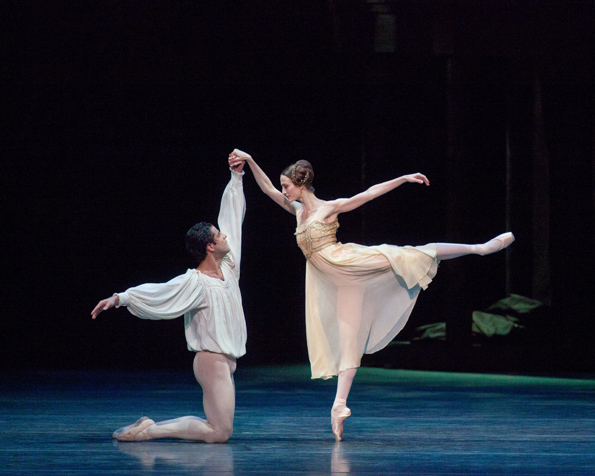
Photos: Julie Kent and Marcelo Gomes in Romeo and Juliet.  Photos by Rosalie O’Connor

Posted in Reviews - USAComments (0)