Tag Archive | "Ailey II"

Ailey II – Returning Favorites


Ailey Citigroup Theater, NYC
March 16 2013

By Laura Di Orio.

Ailey II, the second company of Alvin Ailey American Dance Theater, and one made up of some of The Ailey School’s most promising scholarship students and soon-to-be professionals, presented its annual New York season at its home theater, The Ailey Citigroup Theater. This two-week run, from March 13-24, was the first with newly appointed Artistic Director Troy Powell, a former Ailey dancer and only the second person to lead Ailey II since its inception in 1974.

The company performed two programs – one of all new works by rising choreographers and one of “Returning Favorites”, with works by Powell, former Ailey Artistic Director Judith Jamison and by Ailey himself. This performance of “Returning Favorites” proved that Ailey II has the talent to shine as a company of its own and provides another outlet for some of the Ailey company’s great works to resonate.

The first piece, The External Knot, choreographed by Powell with music by Philip Glass and Robert Schumann, seems to tell the journey of one man, danced powerfully by David Adrian Freeland, Jr., as he juggles between assimilating with the community or standing strong with his independence. The dancers are dressed in crushed blue velvet dresses for the women and jazz pants for the men. The work opens with Freeland’s back to us, as he stands against the crowd.

The dancers all look as though they’re searching for something, and recurring wave-like gestures with their arms and hands crossing back and forth reverberate through all the sections of the work, bringing the story together. At times, Freeland walks through the rest of the company as they dance. He is clearly separate from them.

The External Knot is laced with varying couples and also beautiful sections of a duet and a trio, with echoes of partnering from the first group section. We’re not entirely sure of the group’s relationship to each other, and no one seems entirely happy, until the final section, marked by a sudden change in music – from subtle, melancholic compositions to more exciting drum beats. There are again echoes of Powell’s choreography from previous sections, but now there is an entirely different feel. The group is now smiling, their movements as a whole are much more dynamic, and they are almost playful, like in a game of tag. Freeland dances opposite of the group at times, but there is something different now – he is more a part of the community but is still different, still independent, and it seems everyone is okay with that.

Ailey II performs Alvin Ailey's Quintet

Ailey II in Alvin Ailey’s ‘Quintet’. Photo by Eduardo Patino.

At the start of Ailey’s Quintet, we are introduced to five luscious ladies in slinky red gowns, red heels and various “bombshell” wigs. We see them first as back-up singers, as they lip synch to the soulful lyrics of Laura Nyro, but their “bootylicious” moments (pretty clever of Ailey, who created the piece in 1968) are quickly interrupted by one dancer who breaks away from the crowd, in a complete moment of internal seriousness. She then snaps out of it and rejoins. These moments trickle through the group. One by one, they break apart from the idealized beauty that exists as though they’re showgirls on display.

Quintet showcases the lovely talent of the women of Ailey II. Each has a chance to break free individually, both as characters and also as dancers. As the piece carries on, the women shed more and more – figuratively, as their movements contrast those of the original “doo-wop” group, and literally, as they toss off their shoes and wigs and dance in neutral clothing.

Quintet is refreshing and interesting in its satirical approach and as a commentary on women. It shows women and their complexities. What’s underneath the glamour and sparkly gowns are real, deep beings. The piece concludes with the five dancers back in their original costumes, but this time with the depth and layers they have just showed us.

The program ended with Jamison’s Divining, a work from 1984 that uses African beats and displays the dancers well in very grounded, modern movement. They appear tribal, almost animalistic, and Andy Kay’s costumes and Timothy Hunter’s lighting create a vibrant final touch.

Divining is a very strong, very musical work, and it allows the dancers to show their strengths both individually and as a group. At times, they even seem to pulse as one breath.

The “Returning Favorites” program was a diverse one, and Ailey II was an energetic, dynamic group who danced a lot and did it well. I can only say it’s a shame that part of my experience was interrupted by an audience member two seats down from me who apparently couldn’t wait through 30 minutes of dancing until the first intermission before digging into her snack with crinkly paper. These dancers are up there working hard, and they deserve the audience’s attention and respect.

Photo (top): Dancers of Ailey II in Troy Powell’s The External Knot. Photo by Eduardo Patinio.

Posted in Reviews - USAComments (0)

Ailey II – Contemporary Choices


Ailey Citigroup Theater, The Joan Weill Center for Dance NYC
April 2012

By Deborah Searle

This April, Ailey II presented a mixed bill of modern and contemporary dance works for 11 nights at the Ailey Citigroup Theater. Audiences could choose from two programs, either Modern Moves or Contemporary Choices.  On the evening on April 19 we were treated to the contemporary program which featured three distinct works; The Corner (2010) by Kyle Abraham, The Legacy of Inheritance (2011) by Stefanie Batten Bland  and Shards (1988) by Donald Byrd. Each work was very different and showed the varying strengths of the company’s young dancers who are all students in Ailey’s professional dance courses.

The Corner surprised me as it had a strong street dance and hip hop flavor, as opposed to the modern dance usually displayed by Ailey dancers. It included spoken word, characterization and much fun and frivolity as the dancers became friends hanging out on what I envisioned as a street corner. It involved moments of humor, games and comradery as the dancers grooved in colorful, casual costumes. The soundtrack was a mixture of popular music and classical with funky, jazzy choreography and some slower, softer more lyrical moments.  An upbeat group number at the end was entertaining. The stand out dancer for this work was Elizabeth Washington who seemed to embody her own personal groove and really suited the choreography. The other dancers, although they all executed the steps well, didn’t always embody the theme and style as Washington did.

The Legacy of Inheritance which followed was starkly different from the first work. It was much more raw and contemporary. In the intermission we could see fog being dispersed across the stage as well as a huge piece of white, light material. This intrigued me, as I wondered how the dancers were going to work with such a huge prop. To begin, the cast of dancers picked up the white material and wrapped themselves up in it as they slowly swayed. It was eerie but intoxicating. Although the movements were simple, the manipulation of the cloth, the way the light hit it, and the dancers’ commitment to creating interesting shapes were rapturing.  A swimming-like scene where the dancers in lines seemed to swim on the ground in different directions was mesmerizing and unique partnering scenes involved inventive lifts and lines.  Stefanie Batten Bland’s work was very interesting and it showed the dancers’ technical strengths as well as their ability to work with what could have been an overpowering prop. I thoroughly enjoyed this work. Thomas Varvaro in his first season with Ailey II was delightful to watch. He finished every movement and danced with clarity and ease.

Lastly, Shards by Donald Byrd was different again. We were hooked from the first second as the company started in a group center stage, in the spotlight. With the dancers all in royal blue, the bright costumes coupled the bright choreography perfectly. At times the music was very dramatic and the dancing matched. The dancers were able to perform simple port de bra with such dynamics to fill out the strong music and keep us entertained.  The choreography was quite balletic and demanding. It involved much batterie, battements to second, penchée on relevé and some flinging but controlled movement.  A pas de deux by dancers Fana Tesfagiorgis and Colin Heyward showed Fana’s flexibility and strength. A solo by her later in the program cemented her as a stunning dancer.  Anne O’Donnell, in her first year with Ailey II, was stunning in this work. She has lovely lines and strong ballet training.

Contemporary Choices by Ailey II was a dynamic program that showed the young dancers’ versatility. It is wonderful to see these budding young stars have the opportunity to present such works to a large and appreciative audience.

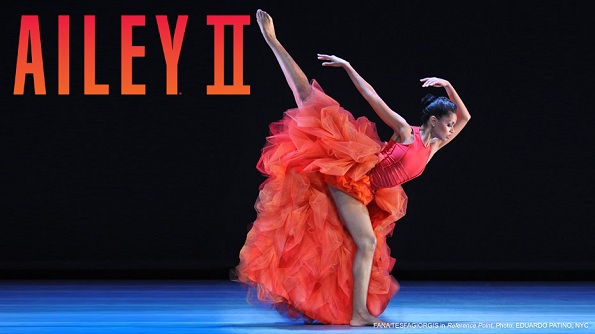
Top photo: Fana Tesfagiorgis in Troy Powell’s Reference Point. Photo by Eduardo Patino, NYC.

Published by Dance Informa digital dance magazinedance news, dance auditions & dance events for the professional dancer, dance teacher and dance students.

Posted in Reviews - USAComments (0)