Archive | November, 2011

Hofesh Shechter – Dancing or Politics?

Hofesh Shechter – Dancing or Politics?

By Rain Francis.

Hofesh Shechter, Artistic Director of Hofesh Shechter Company, is recognized as both a choreographer and a composer. Born in Israel, he studied at the Jerusalem Academy for Dance and Music before joining Batsheva Dance Company. In 2002 he moved to London to dance with Jasmin Vardimon Dance. Forming his own company six years later, Hofesh Shechter is currently one of the UK’s most exciting artists.

On a world tour, Shechter recently brought his bold contemporary work Political Mother to Los Angeles, and spent a few moments talking with Dance Informa about it.

Political Mother is a physical and gritty work danced to Shechter’s own score, featuring a band of live drummers and guitarists.

Describe the experience that is Political Mother.

It is likely to be quite an intense experience. There are nine musicians onstage and there are twelve dancers. It’s a piece that sort of explodes on you and shouts at you. It has also some tender moments, but it’s rhythmic, like a demonstration that goes on and flickers through worlds – from one world into another. It’s a pretty intense experience. The idea is to create a sort of emotional build up and tension. It’s loud at times, it’s angry, and it’s fun, if you’re in the right mood.

What are the themes you’re trying to explore with that intensity?

I’m a little bit scared of the word ‘themes’, but I do deal with human emotions and human experience below and underneath the pressures of modern life. But it’s not about these pressures, it’s not about politics, it’s not about politicians. It’s about the people that live underneath, it’s about the emotional experience, it’s about the way that we deal with it. There is a lot going on, but it’s definitely dealing with human emotions.

What sort of emotions in particular do you deal with in this work?

Anger and I think there is a lot of despair, and a feeling of hopelessness. But through that, sometimes at the bottom we find hope, we find a sense of perspective, a sense of brotherhood, a sense that we share this experience with other people. So it’s a lot about hope and the loss of hope.

What was the catalyst for the creation of Political Mother?

The work always starts with things that I deal with in my life. I did deal with collision of different worlds. I’ve seen and experienced in my own life, how you can see something that is happening just next to you, or very far away from you (something that is very powerful, very disturbing) and you can forget about it in five minutes. It can really disturb you, and then you just move on. I find our ability to have parallel worlds that are conflicting in a way, but actually exist sometimes very closely, kind of disturbing and worrying. But it’s also just the way it is. That’s the way we respond to the world. It started from this curiosity about our ability to care and then to not care.

In this work you use both traditional Jewish folk dance and live, hard rock music. What is the relationship between these two?

There are parallels between the social structures that allow people to feel connected to each other, and to feel connected to certain emotions that they need to express and want to experience. Rock can give you that angry experience, but it’s like a bubble in a way – you’re not doing anything, you’re just venting, you’re not changing the world at all, or yourself. Folk dance can give you this sense of belonging, a sense of identity. It helps direct people towards a certain way of thinking. I find this interesting – the social systems that help direct people to where you want to direct them. That’s the parallel that I’m looking at.

Hofesh Shechter Company is currently performing Political Mother and other works across Europe, and will be touring across the world well into the New Year.

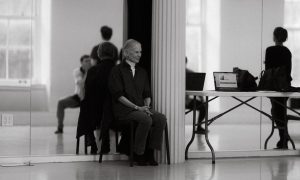
Top photo: Israeli Choreographer Hofesh Shechter, photo by Carl Fox

Posted in Top Stories0 Comments

Playtime with Loni Landon and Gregory Dolbashian

Playtime with Loni Landon and Gregory Dolbashian

By Tara Sheena

Loni Landon and Gregory Dolbashian are two undeniably emergent forces in the NYC dance scene. Between the two of them, they have a strong roster of credits, ranging from Juilliard to the Ailey School, to professional companies and to Met Opera productions. Most importantly, they run their own respective companies: Loni Landon Projects and the DASH Ensemble. Last fall, like so many professional dancers in New York City, they were fed up with expensive classes and lack of opportunities to explore more creative outlets in an open environment. With a little determination and a lot of creative desire, The Playground was born.  

What was the original motivation for starting the Playground?

Loni Landon: When I returned from dancing in Europe I felt like I had nowhere to go in terms of a dance class. I did not have the money to go to a $ 25 workshop, where the class would be filled with more than 50 people. I knew many other dancers felt the same way as I did and had similar complaints. In the dance scene in NY, sometimes it can feel very closed, and impossible to make a connection with a choreographer. When I met Greg Dolbashian I started talking with him about the idea of a collective. I spoke about my experience and wanted to  have an environment that was like a company setting with no company attached. He was speaking about how pricey it can get to rehearse and we thought that it [would] work out if the dancer and choreographer could benefit from each other.

Money and budget are always a big issue for dancers and choreographers. Since the recession hit, trends of donation-based and discounted classes have been popping up all over the city. What is unique about the Playground?

Loni Landon & Gregory Dolbashian:  The people we bring in as choreographers are encouraged to play, whether that be sharing their methods of choreography, working on ideas for upcoming commissions, or trying out new techniques for movement invention. It gives dancers a chance to genuinely work with a choreographer for a day without spending $30 to do it. Dancers need a place not only to build their technique, but to apply it to something beyond. They need a place to be pushed to elevate their dancing in a creative, energized environment. We also make it a point to reach out to choreographers that are in-demand and generating a following both in NYC and abroad. For instance, in our last session we were able to have Alex Ekman from Nederlands Dance Theater and also Danielle Agami, former rehearsal director of the Batsheva Company.

If I’ve never experienced a class with the Playground, what can I expect?

Loni Landon & Gregory Dolbashian:  You can experience an atmosphere of drive and enthusiasm. You will feel pushed and challenged, yet completely supported. You will be around high-levels of talent both from the dancers and from the choreographers. The best thing is that every day at The Playground is different. We are always so excited to see what the choreographer will bring in for that day. There is also a great feeling of appreciation. We get so many reactions from people saying, “Thank you for doing this. Dance really needs this. Keep it going”. For us, that is the best because we believed that we had something really big on our hands when we started, and we are so glad that people feel that same energy.

What do you hope the teachers of the Playground get out of the experience?

Loni Landon & Gregory Dolbashian:  So much. What we are mostly giving the choreographers is space for experimentation. Since The Playground is not a technique class, the teachers are given a 2-hour time frame to venture new ideas and test their creativity on trained professionals.  How the choreographer uses the space and time is up to his or her individual discretion.  It’s literally as though we are giving a painter a huge blank canvas with excellent paint! We hope they get the chance to discover more about the ideas and languages that they have. We hope they get stimulated and inspired from the work they are playing with. We hope that they give a dancer in a session a job. We hope that they feel productive and excited. We hope the Playground generates more exposure and insight into their work and their respective companies/projects. We are trying to build the ultimate exchange where both dancer and choreographer grow and benefit from their time with us.

Your Vision Statement speaks to the importance of an open forum for not only students and teachers, but also presenters who may observe these classes. Why is it important that presenters see this development occur?

Loni Landon & Gregory Dolbashian: Many times the audiences’ experience of a work is a lot different than the choreographers and the dancers experience of the work.  Both are extremely important. We want to expose the process of making choreography and the dancers effort in learning it. In the process and rehearsal of creating dance, there is a beautiful roughness—there is laughter, frustration, community, camaraderie, exploration, and play.  The truth is, in dance we spend most of our time in the ‘process’ stage rather than the ‘product’ stage. If presenters understand our process, they’ll only then be able to better understand our product.

Where do you hope to see the Playground in the future?

Loni Landon & Gregory Dolbashian: We want The Playground to have a permanent home where we would love to have residencies, performances, and have a consistent presence in NY [and, eventually] nationally and internationally. The Playground (New York), The Playground (Seattle), The Playground (Detroit), The Playground (Rome), The Playground (Barcelona). We want The Playground to be a community where artists feel like they can go whenever they want.

This November, playtime starts up again at the Manhattan Movement and Arts Center, 248 West 60th Street, NYC. Come out and play 10:30am-12:00pm every weekday, November 28- December 16.
Also, check out “The Playground NYC” on Facebook and Kickstarter.

Photo by Jennifer Jones

Posted in Feature Articles0 Comments

For the Health of the Dancer: IADMS Conference 2011

For the Health of the Dancer: IADMS Conference 2011

By Leigh Schanfein

The weekend of October 14th, 2011 held a lot of excitement for me and others devoted to dancer health, as it was time for the annual conference of the International Association for Dance Medicine and Science (IADMS). Delegates from all over the globe converged on Washington DC to present, learn, observe, network, and draw inspiration from colleagues involved in every aspect of dance.

IADMS formed in 1990 to address the rapidly growing awareness that dancers have very specific needs when it comes to overall wellness. Sports medicine and science has been developing for decades. The dance world has finally reached a point where art can meet science in a respectful and successful way. The mission of IADMS is to enhance the health, well-being, training, and performance of dancers by cultivating educational, medical, and scientific excellence. The culmination of activities directed towards this goal is the annual IADMS conference, which draws several hundred attendees every year from more than 35 countries. The three-day conference is directed at those involved with improving the health of dancers. Guess what? That includes you! As a dancer or dance instructor, it is part of your job to create, maintain, and improve the body as an instrument.

Opening Remarks 2011 IADMS Conference. Copyright Jake Pett 2011 cobophoto.com

Each year, the IADMS conference consists of three primary components: lectures, movement sessions, and social/networking events. The lectures include brief presentations as well as longer symposia, and are always followed by question and answer sessions. Lecture topics cover a wide range of scientific, medical, and educational subjects. Just to give you an idea of their scope, a few lecture titles included: “Bone health for dancers,” “Balance training and its implications for risk of dance injury,” and “Teaching tomorrow’s stars: common problems associated with exceptional talent.”

The movement sessions are one-hour blocks dedicated to hands-on learning. Much like the lectures, a wide range of ideas that could fall under exploratory concepts or clinical concepts are shared. Some examples from this year’s conference included: “Sacroiliac motion in dancers: hands-on appreciation,” “Recovery and prevention in motion: performance psychology in action,” and “Evidence-based dynamic warm-up for dancers of all ages.” The lecturers and movement session leaders truly wish to disseminate the most useful information to as many people as possible who can then pass on what they’ve learned to their colleagues and students.

The third networking component may have the least amount of conference time dedicated to it, but it is just as important as the others. When you can get face to face with someone you are creating a canvas for the exchange of ideas, the birth of inspiration, and the spread of knowledge. The key to the conference is the people. You listen, inquire, and share. Derrick Brown, a former dancer and dance instructor with a Master of Science degree who now teaches dance science in The Netherlands, has attended the IADMS conferences since 2005. As a scientist, he attends to present and hear the latest research as well as to network with colleagues and discuss the future direction research should take. Derrick points out, “Our little science world is still very young,” and, as an educator, some of his interest lies in not only encouraging the pursuit of knowledge and expanding our world of dance science, but also in effectively getting that knowledge to the dancers.

Dr. Matthew Wyon is a Professor of Performance Science at the University of Wolverhampton in the UK, and has been attending the IADMS conferences since 1998. As with everyone I’ve asked, Dr. Wyon attends the conferences to find out about the newest research, present his own work, and to meet up with friends and colleagues. In fact, not only was he able to meet up with three potential graduate students who might join his lab at Wolverhampton, he also figured out a multi-institution research study with colleagues in both the USA and the UK. Dr. Wyon emphasizes that the conference is not just for lab rats, “There is something for everyone involved in dance whether a teacher, practitioner, dancer, therapist, PT, doctor, or scientist. Also, it is the friendliest conference I go to where we mix good research with having a good time.”

William G. Hamilton, MD, accompanied by his wife Linda (left), receiving the Lifetime Service Award from IADMS board member Marika Molnar (right). Copyright Jake Pett 2011. cobophoto.com

The IADMS conference truly is designed for anyone who is interested in, or thinks they might be interested in dance-related science. Don’t be turned away by the term; ‘science’ is anything but a dirty word! Dance-related science applies to clinicians, teachers, dancers, and other practitioners in the related arts and sciences. The people who attend the conference range from dance students, to former dancers who now teach/research/treat and to non-dancers who find themselves servicing the dance industry, such as physical therapists and doctors.

IADMS recognizes what every dancer knows – it is critical that clinicians understand the specific needs of dancers. IADMS also knows how important it is that dancers and dance instructors educate themselves and are receptive to information garnered though scientific research. Science does not ignore or impune tradition. Science supplements it. If the information we are getting from scientific research can help you prevent injury, jump higher, positively direct your emotional energy, and have a longer healthy career, wouldn’t you like to find out about it?

Kumiyo Kai, a dance student from Japan who is pursuing a Master of Fine Arts at the University of California Irvine, USA, has attended three IADMS conferences. She has found that the conferences provide great inspiration and have introduced her to many different aspects of the field, as well as some great friends. With regards to this year’s conference she notes, “We had many students and young researchers; it was nice for me to feel that I am not alone!” We both left the conference with the excitement of new ideas to explore.

The IADMS conference 2011 was a success. From the first hour, we could tell it would be a special event with the opening address delivered by the inimitable Suzanne Farrell, who shared with us that even George Balanchine engaged in dance science when he helped develop a new stage floor design – for a sprung stage. We saw her company perform an evening of Balanchine work two days later.

The Lifetime Service Award honored Dr. William Hamilton, MD, who is truly another one of “Balanchine’s Legacies”, as the orthopedist for dancers from companies such as New York City Ballet and American Ballet Theater for over 30 years. In his address, Dr. Hamilton said that those who help cultivate art, such as a doctor treating his dancer patient, are as much artists themselves. And I think we can all agree that to extend the life of the art, we must first consider the health of the dancer.

I strongly encourage you to attend the IADMS conference if it is ever in a city near you. Even if you can’t attend, you can find lots of information online at www.iadms.org including a slew of downloadable and print-ready resource papers on a range of topics.

Top photo: Moira McCormack from the UK, a speaker for Teacher’s Day, discussing the content of her talk on hyper-mobility.
Copyright Jake Pett 2011. cobophoto.com

Posted in Feature Articles0 Comments

NUTCRACKER Makeup Tips

NUTCRACKER Makeup Tips

By Christine Dion of Mode Dion

Tis the season for Christmas Holiday shows. Of course the most popular of all, the Nutcracker, will be presented by studios across the country. In many cases the ballet will be performed on a large stage and may require a little more facial enhancement than a typical small stage performance.

The Nutcracker features many characters. Here are some makeup tips and ideas for the varied roles. A simple eye makeup change is all that’s needed to add drama and help enhance the look.

Sugar Plum Fairies and the Land Of Snow

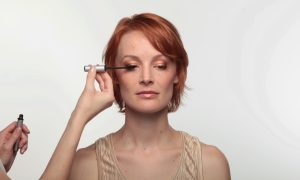
Where traditional ballet makeup is required keep in mind that the brows need a little more enhancement and extending.  Eyeliner will need to be extended a bit further at the ends. Don’t meet the lower and upper lines at the sides. I like to use a brown cake/shadow liner below lower lashes and a black cake/shadow liner at the end of upper lashes to create a softer look. A Mode Dion Pro Pallet eye shadow compact has all the colors you need. Keep eyes wide with white pencil in between.  Add a little white shimmer like Mode Dion’s Shimmer Pot to the center of lid, brow arch and inner eye corner to open eyes even more. False lashes will be a must to create big elegant eyes (see photo)Adding a bit of magical glimmer to the cheekbones and eyes can really create more enchantment.  Use glitter in opal/white like Mode Dion’s Crystalina and secure it with spirit gum like Mode Dion’s Diva Glue. 

Arabian Dancer

Arabian dancers can quickly get the look just by extending the black cake/shadow liner towards the inner eye corner, creating a cat eye appearance. White pencil will help define the look by applying a little at the inner eye corner and between the two lines out at the end of the eye corners. Extend the liner a little there too as this will lengthen eyes creating a more exotic effect. Rhinestones placed along the upper brow line can create more drama.  Place little dots with your eyeliner to get the design and spacing right, then adhere them with eyelash glue.  If the costume is sparkly enhance that with matching glitter secured with Mode Dion’s Diva Glue.

Chinese Dancer

A Chinese Dancer only requires a very red lipstick applied just at the middle of the upper and lower lip to create a tiny rosebud mouth and lengthened eyeliner extended out at the sides of the eyes upwards. Meet the upper and lower eyeliners at the sides to close and angle eyes for an Asian look. If lids are naturally full they can easily be reduced to a more Asian almond eyed look by using black shadow across the lid. Very red cheeks just on the apples will make the face look rounder.

Dolls and Toys

The Doll/Toy look is an easy twist from a standard stage makeup look. Add more red cheek color to the rounds of the cheek.  Remove lip color from the sides of the mouth and create a more rounded lip look for a baby doll lip. Highlight the center of the upper and lower lip so the lips look even more pulled forward. Draw lines below lower lashes to look like painted on lashes and in between use white pencil to help them look more pronounced from a distance. Apply shimmer highlighter, like Mode Dion Shimmer Pot (opaque shimmer), to cheekbones, chin, forehead and down the center of nose to make skin look light and reflective like plastic. 

Clara and Children 

Clara and other children in the party scene should have a softer more natural looking makeup.  Skin should appear flawless by applying a matte oil-free foundation and powder.  Brows should be well defined and shaped along with lips and cheeks slightly flushed. Mode Dion’s Stage Red cheek color and  Rhubarb lipstick add just enough color to look natural and show up on stage. 

Men and Boys

Men and boys should be sure to wear foundation, concealer to cover dark circles under eyes and powder to set.  A cheek contour shade under cheekbones and along sides of nose will help further define features.  Shade sides of mouth with a natural lip pencil and apply a lipstick close to the same shade as lips.  Define brows, line eyes with brown liner lightly and apply black mascara.


For more step by step instructions and all the stage makeup needed to get these looks see modedion.com. For podcast tips see Christine Dion’s youTube channel “Mode Dion Makeup University”.

Mode Dion is a Cosmetic and Training Company deeply devoted to providing affordable, top quality cosmetics and education for the special needs of performers. From Dance, Show Choir, Cheer, Drill, Twirl, Ice Skating, Pageantry, Modeling and Acting, these talented performers need the right look, the right make-up and the skill to pull it all together for the most polished professional presentation.

Top photo: The Atlanta Ballet presents Nutcracker. Photo by C. McCullers, Courtesy of Atlanta Ballet

Posted in Feature Articles, Teacher Tips & Resources, Tips & Advice1 Comment

Dance in the Digital Age

Dance in the Digital Age

TenduTV and Dance Films Association Join Forces

By Stephanie Wolf.

In our digital world how can dance stay relevant and expand its audience? Luckily, there are dance innovators in New York City, who are doing more than breaking choreographic barriers in the dance studio. These individuals are technology-savvy and possess a knowledge and appreciation of dance. Combining technology and dance performance, TenduTV and Dance Films Association (DFA) are collaborating to bring more awareness to the New York City dance scene.

The two organizations have announced plans to create three high-definition, three-dimensional feature dance films; with a goal to make these films available all over the world for both public and in home viewing. Additionally, they will launch a new collaborative project titled NYC Dance Export. Backed financially by the Rockefeller Foundation’s Cultural Innovation Fund, the initiative will highlight selected New York City dance companies as they undertake the process of producing a dance film.

TenduTV is an online network dedicated to providing digital dance-centric content to people all over the world. The company has been working with Dance Films Association “slowly and steadily since TenduTV was created,” explains Founder and General Manager Marc Kirschner. After a 3D collaboration with the New York City Downtown performance troupe 3-Legged Dog (3LD), Kirschner wanted to expand on this experimentation of performance and technology. Because TenduTV is a for profit organization, Kirschner needed to seek out a nonprofit partner to help spearhead his idea. He approached Dance Films Association, an easy choice for him due to the history between the two organizations. European dance companies are already tapping into advanced media and incorporating it into their work, but this type of dance/technological undertaking has yet to exist anywhere in America.

Based on a similar advocacy for dance and digital media, Susan Braun founded Dance Films Association in 1959. She brought together some of dance’s biggest contributors to form the first Board of Directors, including Jose Limon, Ted Shawn, and Alicia Markova. Today, DFA Executive Director Christy Park carries on Braun’s mission through the preservation of dance films and creation of new, innovative content by collaborating with some of dance’s finest artists and companies on both a national and international level. Park believes the partnership with TenduTV has enormous potential. She deems it, “a catalyst for future innovation and preservation of dance on camera.”

Both Park and Kirschner are particularly excited to present the beauty of dance in 3D. “Dance in 3D if it’s done right is gorgeous, it’s an organic fit,” said Kirschner. However, shooting dance in this format presents many challenges. Elements such as fast movement, stage lighting, set design, and raked stages can be problematic for filming in 3D. Kirschner also pointed out that the standard film frame rate of 24 frames per second is too slow to capture dance adequately. They hope to shoot at a much faster rate, in the range of 48 to 72 frames per second.

In terms of an overall distribution plan, DFA and TenduTV intend to follow a ‘Hollywood model’, broadcasting the films in theaters, on television, in festivals, and, eventually, making them available in both 3D and 2D on Bluray, DVD, and digital download. They are in conversation with potential partners in all of these ventures.

Each of the two organizations plays a distinct role in the projects. While Dance Films Association supervises and guides companies through the process of creating and producing the films, TenduTV chooses the company or artist to highlight and distributes the final product. Everything will be easily accessible through popular media distributors, such as iTunes. The media can be found by a search for TenduTV in the iTunes store.

With a constant shortage of finances and resources, TenduTV and Dance Films Association demonstrate how much stronger the arts can be when united. International organizations are taking note of this concept and transitioning into similar alliances. Kirschner thinks it’s an essential move in order for American dance “to survive and thrive in this new paradigm.”

The organizations already have an outline of the first production in mind. If the proper funding can come together in the near future, then filming will begin at the end of November. Additionally, funding efforts are already underway to nationalize and expand the programs. “This is not just about great New York City dance companies. There are great companies throughout the country. We want to make sure American dance can be competitive throughout [an international] marketplace,” expressed Kirschner.

The response from the local dance community is optimistic. Dancers, directors, choreographers, and companies will keep a hopeful eye on the partnership, tracking its evolution and reception. This could be a huge leap into a new direction for the dance profession.

Posted in Dance News USA0 Comments